
Executive Summary
Organizational culture in finance is the set of beliefs, norms, and incentives that shapes how a company handles financial truth. Many leaders treat it as a soft HR topic, yet it behaves like a control system. It decides whether a finance transformation takes root or fades away.
This article explains why finance transformations fail when culture goes unexamined and how CFOs can redesign it. It covers five levers: the invisible balance sheet, financially fluent teams, the ethics of profit, temporal intelligence, and financial identity. Each section offers practical frameworks for leaders of recurring revenue businesses.
What Is Organizational Culture in Finance?
Beneath every balance sheet runs a second ledger that records assumptions instead of transactions. It tracks what a company believes, tolerates, ignores, and reveres. That ledger is organizational culture, and it has long been parked with off-sites and motivational slogans. Culture is the deepest control system a company owns, yet nobody has learned to audit it.
Reimagining culture for financial transformation means treating culture as a causal mechanism built from expectations, feedback loops, risk postures, and ethical stances. These elements either accelerate or slow financial performance. A lasting transformation must rewrite how truth surfaces, how decisions get made, and which trade-offs the company permits.
Organizational Culture in Finance as a Feedback System
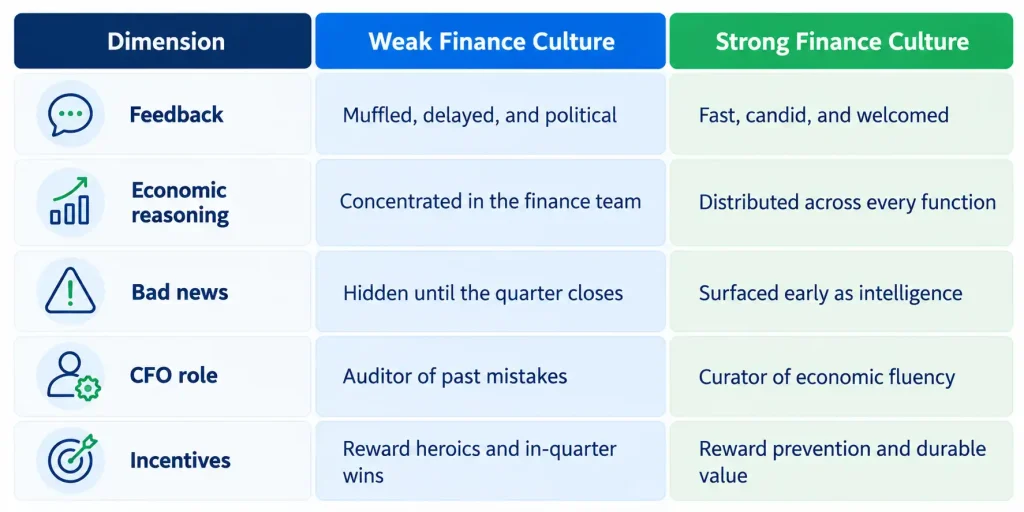
Above all, culture decides whether feedback flows or stalls inside the business. Adaptive systems survive by sensing error and correcting course. In a poorly designed finance culture, that signal arrives muffled, politicized, or late:
- Teams learn to avoid surfacing bad news until the quarter closes.
- Executives cling to forecasts long past their expiration date.
- Costs drift away from the purpose they were meant to serve.
No transformation survives that kind of denial for long. Strong cultures also spread economic reasoning beyond the CFO’s office. Product managers think in marginal utility, marketers grasp LTV/CAC dynamics, and engineers weigh support cost trade-offs.
Comparing Weak and Strong Finance Cultures
Why Do Finance Transformations Fail?
Finance transformations rarely fail for lack of insight; far more often, they fail for lack of alignment. One team optimizes for growth while another protects margin. One assumes infinite runway, and another clings to austerity. The outcome is incoherence, and several failure patterns appear again and again in these situations:
- Strategy and processes change, while beliefs about truth stay frozen.
- Incentives reward in-quarter wins that cannibalize next year’s margin.
- Junior staff see problems but lack the permission or vocabulary to raise them.
- Legacy stories about past wins override what the spreadsheet says.
A healthy organizational culture in finance acts as a translator, offering a shared grammar for what matters and why.
Consider a cybersecurity and identity access management company with roughly $30M in ARR. Reframing support from a cost center into a margin engine changes daily behavior across functions. Engineers reduce support loads upstream, and sales stops overselling unstable features. Paired with pricing discipline and a better workforce mix, that reframe can lift gross margin by twelve percent.
The CFO as Philosopher-in-Chief
The CFO must define what the company values when values conflict. Should accuracy outrank speed when a board deadline looms? When hierarchy and data disagree, which one wins the argument? Those answers must be lived through incentives, not laminated on office walls.
Building Financially Fluent Teams Through Organizational Culture
A quiet myth holds that financial acumen belongs to the finance department alone. In a recurring revenue transformation, that division is dangerous. Financial fluency must become a universal design language instead of a functional dialect. True fluency is not knowing what gross margin means; it is knowing how the next design choice affects it.
The Financial Fluency Progression
| Stage | What Changes | Signal That It Is Working |
| 1. Visibility | Teams see the economics behind their work | Designers connect bounce rates to LTV erosion |
| 2. Shared language | Finance turns numbers into narrative | Sales discusses CAC recovery on poor-fit deals |
| 3. Permission | People feel safe naming trade-offs | A junior engineer flags an overbuilt codebase |
| 4. Trust | Leaders welcome inconvenient truth | Churn risk gets raised well before renewal |
| 5. Self-regulation | Teams absorb margin discipline unprompted | Product asks whether a feature adds cost in perpetuity |
Turning Visibility into Shared Interpretation
Visibility is a narrative problem as much as a data problem. Most dashboards overwhelm, so the CFO must think like a storyteller. When product managers see the fully burdened cost of service calls, UX changes become cost-saving interventions. Margin then turns into a practical design constraint.
In a venture-backed performance marketing business scaling from $9M to $180M in 24 months, CAC and LTV discipline sustains growth. That discipline works only when it extends beyond the finance team.
Fluency also needs permission, because in brittle cultures fear silences people and those silences calcify into cost. The CFO must step out from behind the model and translate economic logic into daily reasoning. Culture has shifted when someone outside finance warns that a promising idea adds cost in perpetuity.
Trust, Risk, and the Ethics of Profit
Beneath every question about growth sits a harder one about which profit the company will refuse. Money carries the fingerprints of how it was earned. In recurring revenue models, profit is the cumulative result of trust extended over time. Customers who doubt the fairness of pricing do not complain; they leave.
Ethics is a matter of decision design, not risk avoidance. Pushing a poor-fit customer through the funnel breaks the moral contract recurring revenue depends on. Delaying a critical fix creates relational debt, paid later in cancellations.
In a professional services firm growing from $12M to $63M in eight months, engagement-level profitability analytics reveal where margin leaks. Some engagements look like growth but extract more than they contribute. Ethical coherence, by contrast, leaves a recognizable financial signature:
- Customer lifetime value that holds steady instead of eroding
- Expansion revenue that flows from genuine utility, not inertia
- Support costs that reflect thoughtful design, not apologetic labor
- Employee retention that mirrors belief in the mission
Emmanuel Levinas placed the beginning of ethics in “the face of the Other,” and in recurring revenue that Other is the renewing customer. A healthy finance culture also makes it safe for an analyst to name a contradiction.
Temporal Intelligence: Teaching Finance Teams to Think in Time
Even mature companies treat time as neutral, yet it tilts behavior and warps judgment. Some cultures live breathlessly in the present, while others plan for a future they never execute. Enduring cultures deliver today, learn from the past, and adjust toward a chosen future.
Common Time Misalignments in Financial Decisions
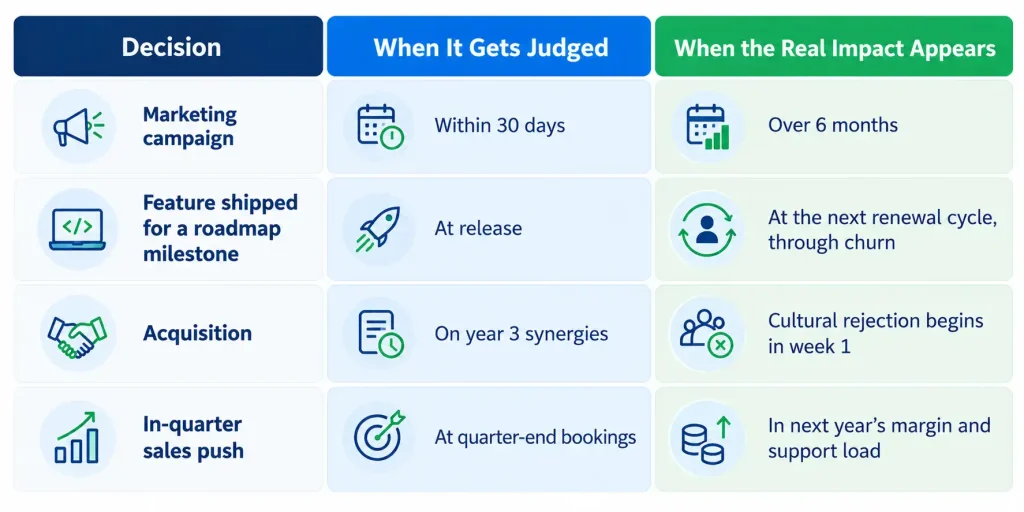
Temporal blindness usually traces back to poorly designed incentives. The CFO becomes a temporal coach, asking “when is the ROI?” alongside “what is the ROI?”
Mission-driven education and research institutions need this discipline when modeling multi-year scenarios under variable funding. That clarity builds temporal integrity, with no promises the organization cannot keep.
Memory, Myth, and the Renewal of Financial Identity
To transform a company is to trespass against its memory. Every organization carries myths about its first big client or the crisis it survived. Those stories shape its financial identity and its beliefs about which trade-offs are noble. Sometimes the spreadsheet declares one answer while the room silently chooses another.
The CFO must become an archaeologist of meaning and an editor of the company’s financial narrative. Stories resist deletion, so they must be renewed instead of erased. A scrappy company may cling to being “nimble” long after improvisation has become volatility. Reframing nimbleness as adaptive design keeps the story intact while changing its tempo.
Publicly listed gaming companies operating across several countries face a similar identity problem. Each subsidiary tends to tell its own story about revenue until a firmwide systems rollout creates one unified definition. That shared definition then becomes a shared narrative across the group.
Transformation is never complete, because memory keeps forming and identity keeps moving. When the math, the people, and the myth converge, profit begins to feel earned. The defining question for organizational culture in finance remains: what does this company believe it deserves?
Three Key Takeaways
- Organizational culture in finance works as a control system, so CFOs should design it with deliberate rigor.
- Finance transformations fail when alignment, fluency, and permission are missing, not insight. Building shared financial language across every function is the most durable fix.
- Lasting change depends on ethical coherence, an honest relationship with time, and a renewed company story. When those align, transformation becomes how the organization behaves.
Disclaimer: This article is intended for informational purposes only and does not constitute legal, tax, or accounting advice. You should consult your own tax advisor or counsel for advice tailored to your specific situation.
Hindol Datta is a four-time CFO and senior finance executive with over 25 years of leadership experience across cybersecurity, SaaS, gaming, logistics, digital marketing, medical devices, consumer products, and nonprofit organizations. He has led more than $120M in fundraising and over $150M in M&A transactions while building the financial and operational systems that let complex businesses scale with confidence. He is the author of seven books in the Systems CFO Series and holds active CPA, CMA, and CIA credentials.
AI-assisted insights, supplemented by 25 years of finance leadership experience.



