
Executive Summary
Options valuation is not a static number set once and forgotten. Every funding round, 409A refresh, or market recalibration resets option pricing for every outstanding and future grant. That reset changes what new hires can expect, what existing employees can afford to exercise, and what compliance and tax exposure the company carries.
This guide walks through what happens to options valuation when a company’s worth rises, what happens when it falls, and the strategic responses that keep option pricing fair and retention-focused through either direction of change.
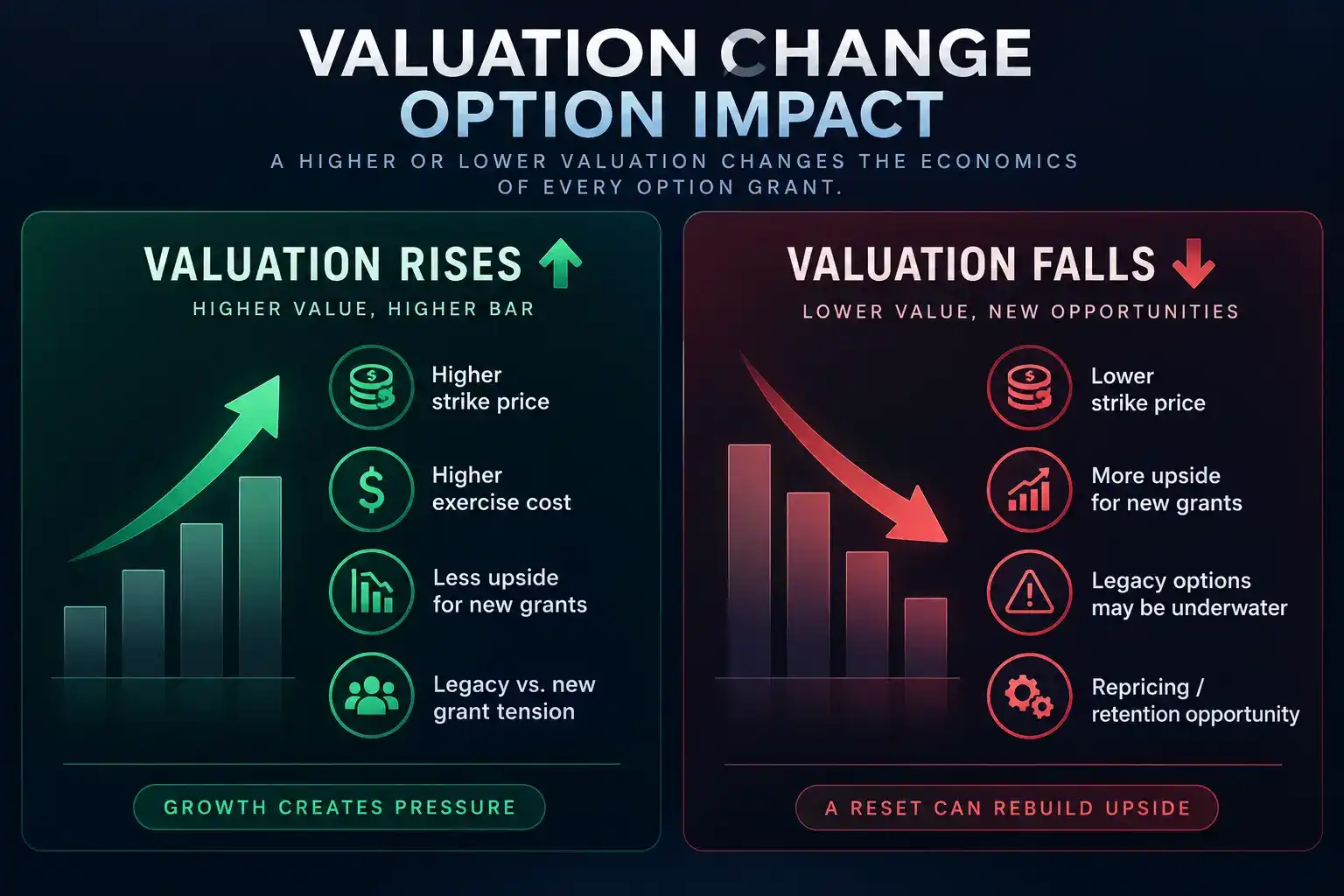
Valuation as a Structural Force, Not a Vanity Metric
Valuation signals credibility to founders and sets expectations for investors. For a CFO, it functions as something more foundational: the basis on which every equity instrument gets priced, granted, and interpreted.
Nowhere does that show up more clearly than in employee stock options. A valuation change, whether triggered by a new funding round, a 409A refresh, or a broader market recalibration, reshapes the economics of every option on the books. It changes the pitch to new hires, shifts the liquidity math for current employees, and carries real compliance and tax consequences. Treating the option pool as a retention tool, not just a ledger entry, means tracking these shifts closely rather than reacting to them after the fact.
When Valuation Rises: Why Growth Can Undermine Option Value
A rising valuation brings good news on the surface: term sheets arrive faster, media attention grows, and morale often improves. Underneath that, rising options valuation creates specific pressure on option grants.
- Higher strike prices: new option grants must price at or above the current fair market value, so employees pay more for the same share
- Reduced notional upside: the gap between strike price and expected exit value narrows for new hires, unless the company keeps scaling
- More expensive exercise: higher strike prices raise the cash cost and AMT exposure of early exercise, pushing many employees to delay it
- Retention erosion: legacy grants sitting deep in the money next to new high-strike grants can create real internal tension
Timing new grants carefully, refreshing the pool ahead of valuation spikes, and educating employees on the intrinsic value of options even at a high fair market value all help manage this pressure.
When Valuation Falls: Challenges and Opportunities
A declining valuation, whether from a down round or a 409A adjustment, creates its own set of pressures, but it also opens room for a genuine reset.
- Lower strike prices: new hires get more favorable economics, since the same grant now offers greater upside
- Underwater options: older, high-strike grants may sit worthless on paper, which calls for repricing, retention grants, or a new compensation approach
- Morale management: a lower valuation can dent perception, but positioned well, it becomes an opportunity to give employees renewed upside
- 409A reset timing: periods following a down round or layoff often trigger a 409A review, which is a natural moment to realign option strategy
The strongest operators use a falling valuation as a prompt to revisit pool strategy, tighten refresh modeling, and clarify what the options are actually worth across a range of future exit outcomes.
Rising vs Falling Valuation: A Quick Comparison
| Effect on Option Pricing | Rising Valuation | Falling Valuation |
| Strike price for new grants | Rises with fair market value | Falls, improving economics for new hires |
| Upside for new hires | Shrinks unless growth continues | Expands, since the gap to a future exit widens |
| Cost of early exercise | Rises, along with AMT exposure | Falls, making exercise more accessible |
| Main retention risk | Perceived inequity between legacy and new grants | Underwater legacy options with little paper value |
Strategic Responses to Options Valuation Volatility
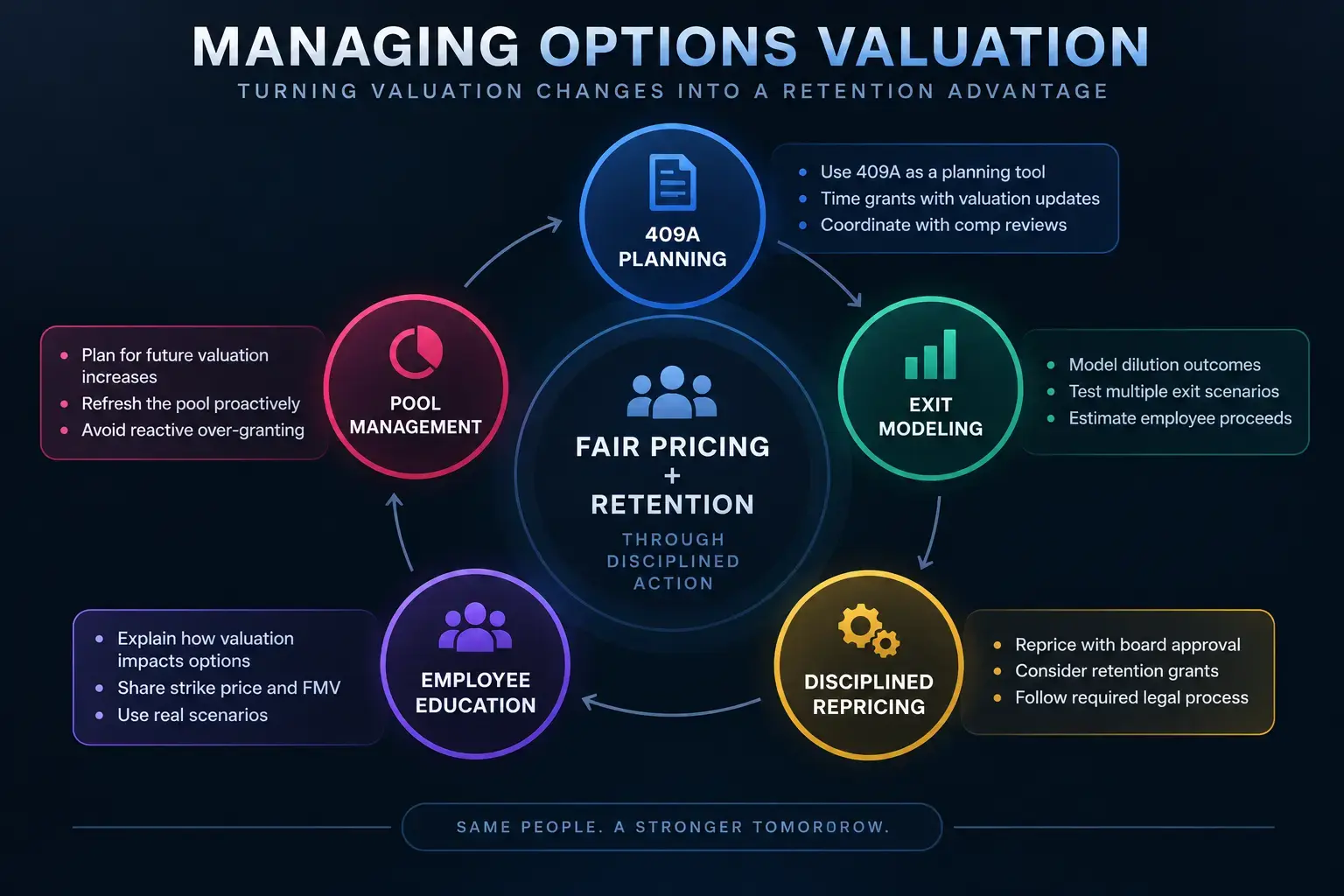
Use 409A as a Planning Tool
A 409A valuation, typically refreshed annually or after a material event, sets the fair market value that governs strike prices. Aligning equity grants immediately after a 409A update, delaying non-urgent grants during a pending valuation increase, and coordinating refreshes and executive comp reviews with 409A windows all turn this cadence into a planning advantage rather than a compliance chore.
Model Exit Scenarios
Every valuation change deserves a fresh look at dilution outcomes at key future valuations, option value across exit points such as $100 million, $500 million, and $1 billion, and post-tax proceeds for employees and executives alike.
Reprice With Discipline
Underwater options can be repriced, but the process requires board approval, legal documentation, and sometimes shareholder consent, with SEC rules applying at public or late-stage companies. Where repricing is not feasible, retention grants can offset underwater value without the added legal complexity.
Educate Employees Continuously
Most employees do not intuitively grasp how a valuation shift changes their options. Regular equity education sessions, strike price and fair market value spelled out in grant letters, and scenarios that illustrate both potential value and risk all close that gap.
Preserve Pool Integrity
Every valuation shift affects the size and perceived competitiveness of the option pool. Building an equity budget that accounts for potential fair market value inflation, refreshing the pool proactively, and avoiding reactive over-granting during high-valuation cycles all protect the pool’s long-term integrity.
Three Key Takeaways
- Options valuation moves every time company valuation moves, and each shift changes option pricing for every outstanding and future grant, not just new hires.
- Rising valuations raise strike prices and shrink upside for new grants, while falling valuations can leave legacy grants underwater. Each direction needs a different retention response, not the same playbook applied twice.
- A disciplined 409A cadence, continuous employee education, and proactive pool management turn valuation volatility into a retention advantage instead of a source of morale risk.
Disclaimer: This article is intended for informational purposes only and does not constitute legal, financial, or tax advice. Please consult your professional advisors before making decisions related to valuation, 409A, or stock option management.
Hindol Datta is a four-time CFO and senior finance executive with over 25 years of leadership experience across cybersecurity, SaaS, gaming, logistics, digital marketing, medical devices, consumer products, and nonprofit organizations. He has led more than $120M in fundraising and over $150M in M&A transactions while building the financial and operational systems that let complex businesses scale with confidence. He is the author of seven books in the Systems CFO Series and holds active CPA, CMA, and CIA credentials.
AI-assisted insights, supplemented by 25 years of finance leadership experience.