Executive Summary
Operational excellence seldom comes from hitting the forecast number; it comes from knowing what the number means and what to do when it moves. Most finance teams still build forecasts as scorecards to defend, and those forecasts go stale within weeks of release.
This article reframes data-driven forecasting as a rehearsal for decisions instead of a report on accuracy. It explains why traditional models fail, how a living forecast works across functions, and the mindset a CFO needs to lead.
Why Traditional Forecasts Undermine Operational Excellence
A typical forecast cycle ends when the latest version reaches the executive team. Finance checks the assumptions, debates the adjustments, and aligns the final numbers, which look neither thrilling nor dismal. Three weeks later, reality has drifted and the forecast has turned decorative. Teams now open it out of obligation, which points to a failure of relevance, not of Excel.
Built for a Stable World That No Longer Exists
Finance teams designed the traditional forecast for an era when demand trended and capital was scarce but predictable. Modern businesses behave stochastically, with nonlinear demand, monthly market shifts, and fast feedback loops between product, revenue, and cost. Competitors now launch features before finance finishes the board deck, yet many teams still treat the old format as sacred and repeat familiar habits:
- Forecasts refreshed quarterly on a calendar instead of on business movement
- Lead-to-close ratios that ignore the dynamics of product-led growth
- Revenue ramps that assume linear and predictable customer onboarding
- Unit economics that never adjust for new packaging or bundling
What a Failed Forecast Is Trying to Say
Every forecast is a collection of bets, and each bet shows where leadership placed conviction and where it settled for hope. A CAC trend works as an x-ray of go-to-market maturity. Gross margin assumptions carry a silent wager about pricing power, cost control, and operational elasticity. When a forecast fails, the arithmetic is often fine, but the questions behind it were wrong.
One logistics business modeled fulfillment center expansion as linear, using 12 months of clean trailing data. The market had already begun shifting toward regional micro-distribution, so the model was consistent but blind. Its CFO did not miss the number; the CFO missed the shift. The purpose of the modern forecast is not to prove leadership right but to make the organization ready.
Building a Living Forecast for Operational Excellence
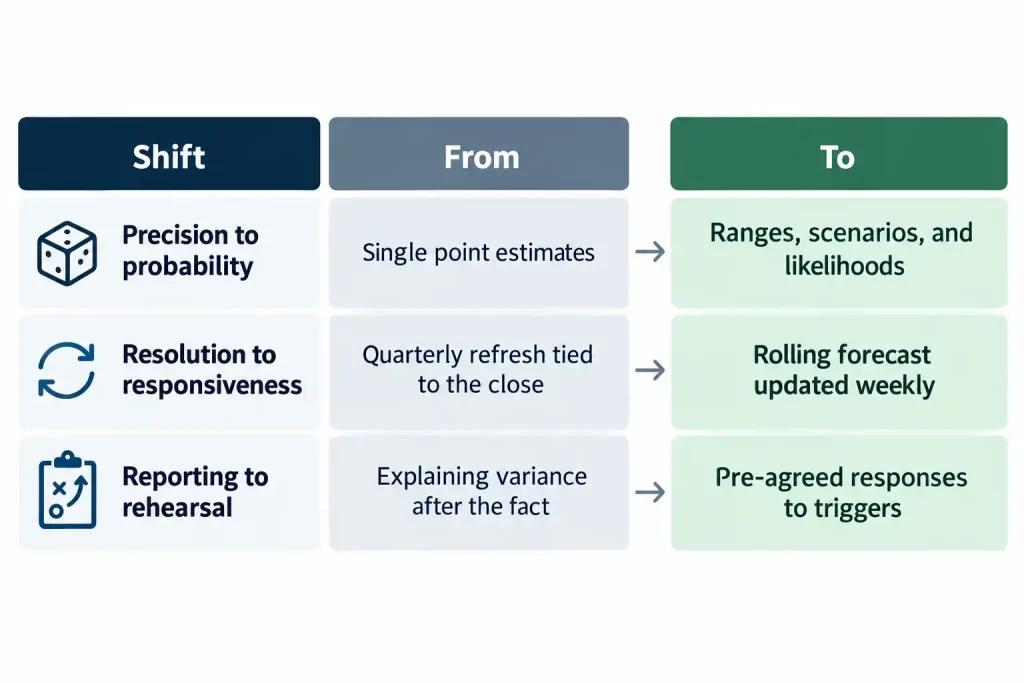
If the traditional forecast is a photograph, clean and instantly outdated, the living forecast is an ongoing conversation between data, people, and time. The future is unknowable, but finance can narrate it through structured, conditional stories. Getting there is a design challenge, and operational excellence depends on three shifts.
Three Shifts That Turn Forecasts into Strategic Instruments
From Precision to Probability
Letting go of point estimates takes courage, not timidity. Saying revenue will land between $148M and $162M, based on three early indicators, communicates with integrity instead of anxiety. Strong operators do not demand certainty; they demand contextual confidence, and scenario planning provides it.
From Resolution to Responsiveness
Operational decisions pulse weekly, so a forecast tied to the quarterly close always arrives late. A rolling forecast should draw on usage metrics, customer behavior, hiring velocity, and funnel dynamics. One cybersecurity and identity access management company with $30M in ARR built a driver-based forecasting engine for this purpose. It held actuals within plus or minus 5% of forecast for 8 consecutive quarters, a level of operational excellence that made rapid growth predictable.
From Reporting to Rehearsal
A forecast should train teams to respond when assumptions evolve. The useful questions sound like rehearsal scripts: what happens if CAC spikes, or if churn plateaus? Which levers stay elastic at 80% revenue confidence? Here the CFO acts as co-pilot instead of judge, asking sales to think in probabilities and marketing to speak in payback periods.
How Forecasts Drive Operational Excellence Across the Business
Inside a company that moves in rhythm with its forecast, the result feels like clarity, trust, and momentum. The forecast becomes a coordination mechanism, the quiet spine of operating discipline. For that to happen, the CFO must translate one model into terms each operator finds credible and useful.
Function-by-Function Forecast Uses
| Function | How the Forecast Is Used | Questions It Surfaces |
| Sales | Feedback on assumptions, not a verdict | Which cohort lags? Is a soft funnel about demand or messaging? |
| Product | Shapes resourcing and pacing | Is feature adoption slowing faster than modeled? |
| Supply chain | Probabilistic readiness across regions | Which supplier breaks if demand swings 12%? |
| Marketing | Payback awareness for every dollar | How long until spend returns? |
| People and HR | Workforce optionality by scenario | Which hires hold under the downside case? |
Sales, Product, and Marketing
A sales leader who sees the elasticity inside the model, not just the bookings target, tends to move from tactical to strategic thinking. Knowing which week of pipeline generation drives the Q+2 result changes daily behavior. One venture-backed performance marketing company scaled from $9M to $180M in 24 months on this kind of discipline. CAC, LTV, and contribution margin analytics kept that growth funded and gave marketing conviction about the half-life of its spend. Product teams gain a shared language of consequence that expresses urgency without imposing control.
Supply Chain and Operations
In supply chain, the goal is understanding variance, seasonality, and scenario stress, not predicting exact volumes. A useful test asks what happens if demand runs 12% over plan in EMEA and 7% under in North America. At a $127M global consumer products company sourcing from Asia, demand planning lifted inventory turns from 3x to 7x. Trapped working capital came free because the forecast prepared options before the swings arrived, turning operational excellence into cash.
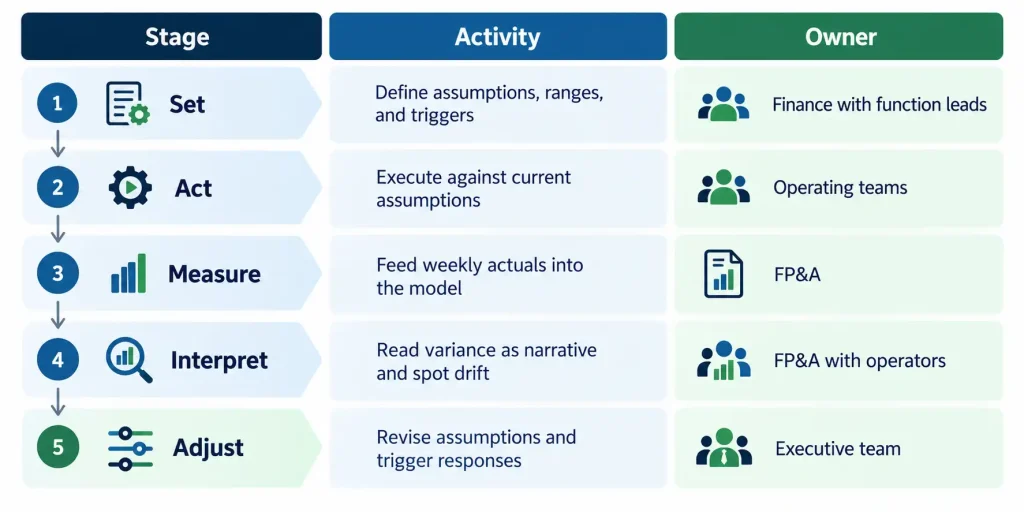
The Closed Loop That Sustains Operational Excellence
Across every function, assumptions inform behavior, and behavior must inform assumptions in return. FP&A evolves into an internal analytics consultancy that runs learn-test-respond cycles in every unit. Strong companies bring the forecast into product reviews, pipeline meetings, and weekly standups as a strategic drumbeat. Operational excellence shows up when the company learns faster, spends smarter, pauses sooner, and scales with confidence.
The Forecaster’s Mindset Behind Operational Excellence
The best CFOs hold data and doubt in the same breath, and their edge rests on three traits of mind:
- Humility toward time, treating the forecast as the present leaning forward
- Rigorous imagination, building several plausible worlds from incomplete signals
- Relational fluency, translating tension between ambition and feasibility into trust
Humility That Turns Misses into Lessons
Great forecasters do not fall in love with models or defend projections; they learn from them. Each miss becomes a teacher: did bookings outperform because of a pull-forward in demand or a durable signal? Questions like these turn the forecast into a feedback loop for operational excellence, provided leaders face the data without political softening.
Imagination Wielded with Precision
Rigorous imagination asks what becomes true in three or six months if a weak signal continues. When a CEO hesitates between pulling back and pushing forward, the wise CFO offers three futures instead of one answer. Boards of listed companies executing more than $100M in cross-border M&A, as in gaming and digital entertainment, need that option set. Each scenario lays bare the logic, the leverage, and the leeway behind a decision.
Relational Fluency and Narrative Trust
The best forecast in the world stays inert if the organization does not believe it. The CFO must speak to marketing in time-to-value, to product in activation windows, and to HR in workforce optionality. A forecast should never become a weapon; it should become a shared lens through which operational excellence becomes a habit.
Conclusion: Acting Wisely in Time
To forecast well is to listen to the signals a company sends about where it is headed. The goal is not being right but becoming ready to learn from variance and adjust without panic. Operational excellence, in its truest form, is the discipline of acting wisely in time. The CFO who invites the whole company into forecasting stewards time as much as capital.
Three Key Takeaways
- Treat the forecast as a rehearsal for decisions, not a scorecard for accuracy. Ranges, scenarios, and pre-agreed triggers prepare teams to act the moment assumptions shift.
- Move to a rolling, driver-based forecast refreshed at the speed of operations. Weekly inputs from sales, product, and supply chain keep the model relevant and the business predictable.
- Translate the forecast into each function’s language so operators use it every week. Operational excellence follows when every team shares one rhythm of execution.
Disclaimer: This article is intended for informational purposes only and does not constitute legal, tax, or accounting advice. You should consult your own tax advisor or counsel for advice tailored to your specific situation.
Hindol Datta is a four-time CFO and senior finance executive with over 25 years of leadership experience across cybersecurity, SaaS, gaming, logistics, digital marketing, medical devices, consumer products, and nonprofit organizations. He has led more than $120M in fundraising and over $150M in M&A transactions while building the financial and operational systems that let complex businesses scale with confidence. He is the author of seven books in the Systems CFO Series and holds active CPA, CMA, and CIA credentials.
AI-assisted insights, supplemented by 25 years of finance leadership experience.