
Executive Summary
Operating leverage measures how sharply profit responds to a change in revenue. It is set by the mix of fixed and variable costs a company chooses to carry. For a CFO, every lease, hire and platform commitment is a wager on future demand. When those wagers sit on top of financial leverage, earnings swing harder in both directions.
This article treats operating leverage as a design choice, a source of risk when growth stalls, and a path to durable advantage. It offers practical frameworks for reading fixed costs, pairing them with debt decisions, and unwinding them with speed and care.
Operating Leverage as a Mirror of CFO Decision Making
Textbooks reduce operating leverage to fixed costs and breakeven points, yet it behaves more like a posture toward the future. Each time a finance leader chooses a fixed cost over a variable one, that choice quietly declares several beliefs:
- Demand will hold steady long enough to absorb the commitment.
- Core processes will stay stable rather than require reinvention.
- Growth will arrive on a schedule close to the plan.
Those beliefs explain why a failed bet on fixed costs carries such heavy consequences. A ten-year lease or a large hiring wave leaves little room for graceful retreat, and only time separates foresight from folly.
Rail and transportation finance shows the lesson in its plainest form, since route profitability depends on throughput filling fixed infrastructure. A few points of volume can turn a profitable lane into a drain overnight.
The deeper danger lies in mistaking one good season for a permanent change in climate. Companies double SG&A ahead of products that never find traction, usually because confidence in the forecast ran ahead of the evidence.
Cost Structure Design and the Language of Fixed Costs
A cost structure reveals what a company believes with more honesty than any mission statement. Owned servers over cloud capacity, in-house marketing over agencies, and full-time staff over contractors are strategic declarations, not accounting footnotes.
Consider a logistics business that adopts the mantra “own the stack” and spends two years building infrastructure and signing leases. Margins swell until demand flattens and key assumptions prove less elastic than expected. Infrastructure that once signaled boldness then signals rigidity, since fixed costs stay loyal only to the calendar.
High Fixed Versus Flexible Cost Structures
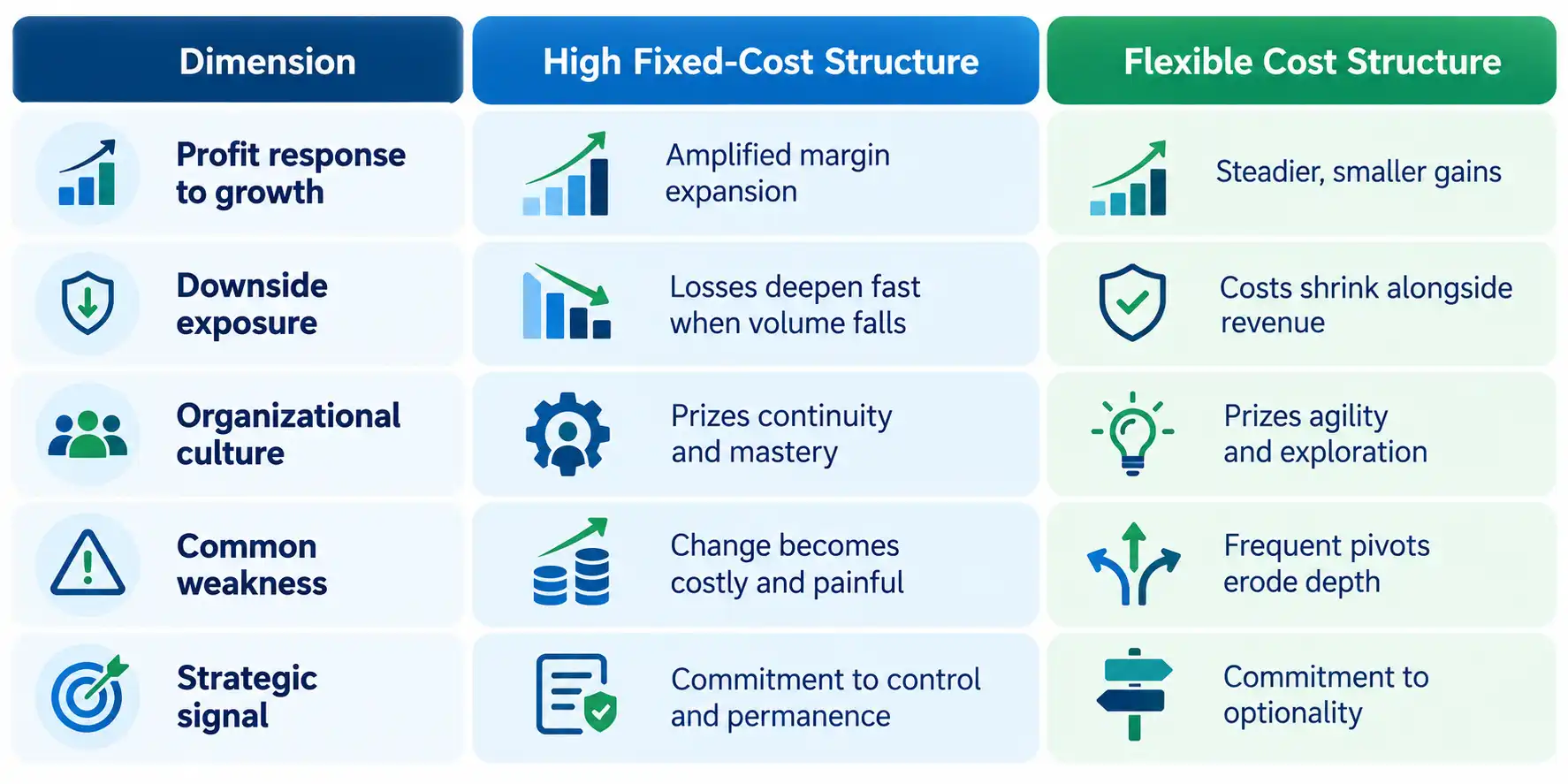
A cybersecurity and identity access management company with roughly $30M in ARR illustrates the balance in practice. Its delivery model blended full-time engineers with subcontractors, keeping bench utilization under 5% to 7% during rapid growth. Fixed headcount carried the core capability, while variable capacity absorbed the swings in demand.
Reading Cost Lines as Strategic Signals
A cost structure can be read like testimony, with attention paid to what goes unsaid:
- R&D treated as a variable cost suggests innovation is optional.
- Outsourced customer support suggests the relationship is transactional.
- Overcapitalized product development raises questions about returns on technical debt.
- Leased global offices over remote work signal a belief that presence matters.
Unexamined faith in asset-light models deserves equal scrutiny, since platform language can mask a refusal to commit. Many enduring companies-built railroads and semiconductor fabs, paying for permanence that was right-sized and right-timed.
How Operating Leverage and Financial Leverage Compound Risk
Operating leverage concerns fixed operating costs, while financial leverage concerns fixed financing costs such as interest on debt. The first magnifies how sales move operating income, and the second magnifies how operating income moves earnings per share. Together, they set the total volatility of earnings.
The Three Leverage Measures
| Measure | Formula | What It Tells the CFO |
| Degree of operating leverage (DOL) | % change in EBIT ÷ % change in sales | How hard operating profit reacts to revenue |
| Degree of financial leverage (DFL) | % change in EPS ÷ % change in EBIT | How hard shareholder earnings react to operating profit |
| Degree of total leverage (DTL) | DOL × DFL | Combined sensitivity of earnings to sales |
A company with a DOL of 3 and a DFL of 2 carries a DTL of 6. A 10% revenue decline would cut earnings per share by roughly 60%, a result few boards anticipate until it lands. Businesses with heavy fixed cost bases should treat financial leverage with restraint, while flexible ones can carry more debt.
A $127M global consumer products company offers a constructive example of pairing the two. Its $12M growth financing arrived alongside a push that lifted inventory turns from 3x to 7x, releasing trapped working capital. Debt served the business best because cash conversion improved at the same time.
Carrying Fixed Costs Through the Wait for Scale
The space between a fixed commitment and its result may stretch a quarter, a year or a full cycle. In a typical international expansion, offices and local talent arrive before revenue, and margins tighten while board scrutiny rises. When customer acquisition finally unlocks, contribution margins widen fast enough to offset the earlier strain.
Visibility decides whether that wait is endured or abandoned. A publicly listed gaming company operating in five countries adopted a single revenue definition across every subsidiary. That consistency made it possible to judge whether each fixed investment was earning its keep. Without consistent data, disciplined patience and costly denial become impossible to tell apart. Fixed cost functions as the part of a business that stays constant while everything else changes.
Leading Indicators Worth Watching
Finance teams can separate costs that are symptoms from costs that are investments by tracking a few signals:
- Demand patterns that repeat across periods instead of one-off spikes.
- Customer retention and expansion strong enough to prove stickiness.
- Contribution margin per unit trending upward as volume grows.
- Pipeline conversion rates holding steady across several quarters.
When Operating Leverage Turns into a Liability
Operating leverage rarely fails suddenly; it decays until the failure becomes structural. A warehouse opens six months before volume vanishes, or a product team scales ahead of product-market fit. Variable costs shrink when business slows, yet leases, systems and long-term contracts sit impassive on the ledger.
Failure here is a consequence, not a sin, and the real danger lies in refusing to reinterpret it. Sunk-cost thinking assumes growth will return next cycle and that patience alone will fix the model. Leverage behaves like a spring until it snaps, and high financial leverage shortens that fuse because interest payments do not wait for recovery.
An early-stage email marketing SaaS company shows what decisive correction looks like. A focused operational turnaround cut monthly burn from $800K to $200K and let the business operate within its means.
A Response Framework for Leverage Gone Wrong
- Reinterpret openly by retesting assumptions and telling the board the world has changed.
- Act swiftly with one deep cut, since indecision compounds the cost of every month.
- Preserve dignity by keeping the numbers cold and the process humane.
- Rebuild trust through a candid narrative, because morale recovers slower than balance sheets.
Turning Operating Leverage into Durable Competitive Advantage
At its best, a cost structure stops being a constraint and becomes a source of strength. A manufacturer invests in proprietary automation while competitors outsource, or a logistics firm buys its fleet instead of brokering space. Early margins run thin in each case, but once scale arrives, the economics improve faster than variable-cost rivals can match.
Three Disciplines Behind Strategic Leverage
| Discipline | Core Question | Warning Sign |
| Clarity | Where can this model uniquely win? | Chasing leverage where merely competent |
| Sequencing | Is revenue reliable, not just rising? | Fixed commitments ahead of repeatable demand |
| Culture | Does the organization operate to justify the cost? | Owned assets without operational literacy |
Culture often decides the outcome of these bets. One company in-sourced customer service, and its CFO turned customer feedback into a weekly executive ritual that refined product, training and policy. A global software firm took a similar path with hybrid cloud deals, and its costs grew in harmony with strategy.
The Operating Leverage Lifecycle
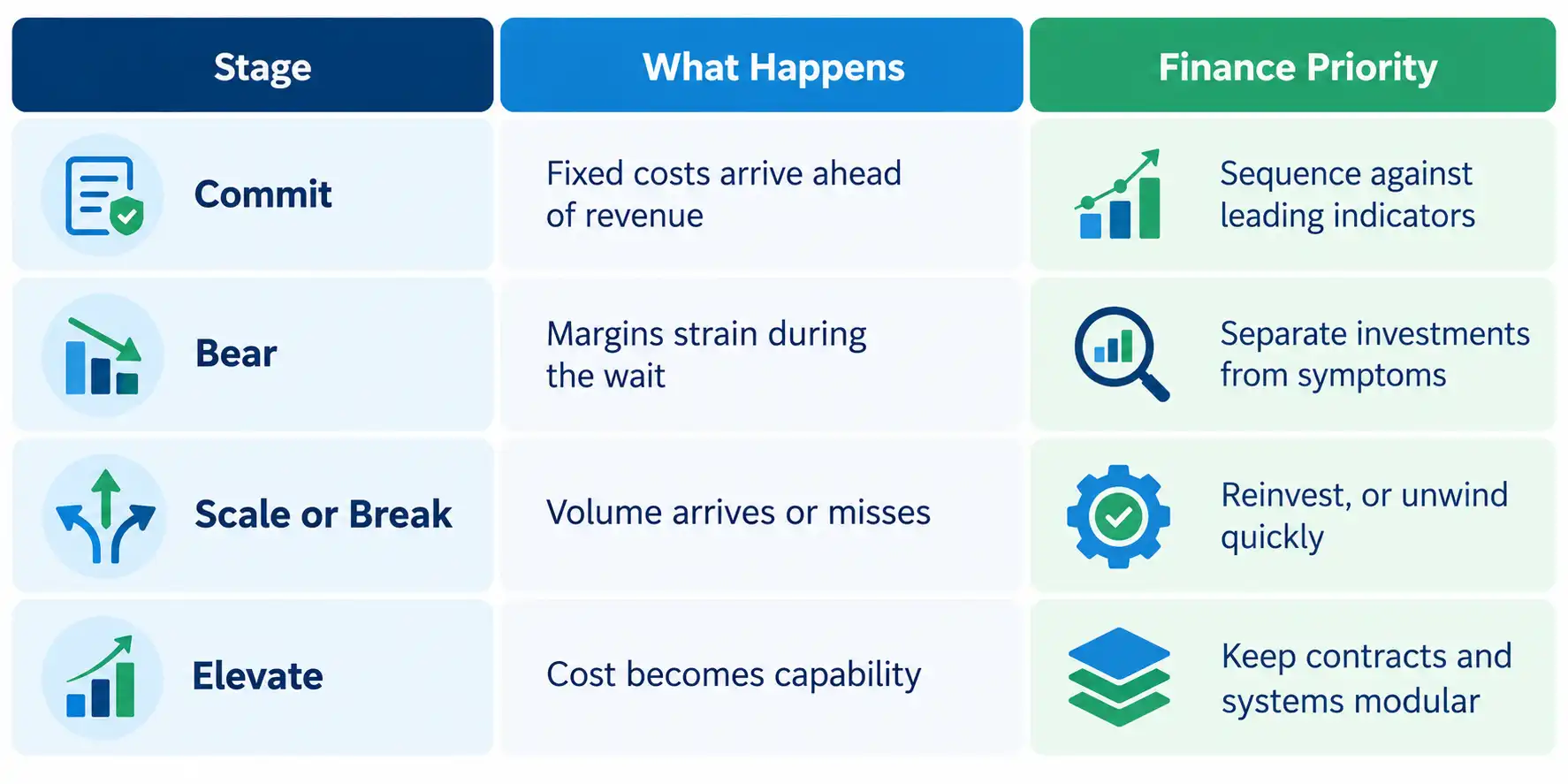
The goal is to install capability rather than cost, because the cost may disappear while a nurtured capability endures. Flexibility within commitment keeps advantage alive through contracts that scale, systems that modularize and talent that learns. Finance leaders should not fear fixed cost; they should fear fixed thinking.
Three Key Takeaways
- Operating leverage reflects beliefs about demand, process and growth, so every fixed commitment deserves the scrutiny of a capital investment.
- Financial leverage multiplies operating risk, so a business with heavy fixed costs should borrow with restraint and track total leverage.
- Fixed costs become a competitive advantage only when clarity, sequencing and culture align, and when leaders unwind failed commitments quickly and humanely.
Disclaimer: This article is intended for informational purposes only and does not constitute legal, tax, or accounting advice. You should consult your own tax advisor or counsel for advice tailored to your specific situation.
Hindol Datta is a four-time CFO and senior finance executive with over 25 years of leadership experience across cybersecurity, SaaS, gaming, logistics, digital marketing, medical devices, consumer products, and nonprofit organizations. He has led more than $120M in fundraising and over $150M in M&A transactions while building the financial and operational systems that let complex businesses scale with confidence. He is the author of seven books in the Systems CFO Series and holds active CPA, CMA, and CIA credentials.
AI-assisted insights, supplemented by 25 years of finance leadership experience.



