
Executive Summary
Foreign exchange volatility does not occasionally disrupt globally connected businesses; it structurally defines what it means to operate across borders. Finance leaders can pair natural hedging with instruments such as forward contracts, options, cross-currency swaps, and balance sheet structuring. Together, these tools convert volatility into something governable, not something merely absorbed. The objective is never to forecast currency direction. It is to build a program that keeps earnings, margins, and forecasts stable regardless of which way a currency moves.
This article maps the three categories of FX exposure. It then walks through the five instruments most commonly used to manage them, with particular attention to natural hedging. It also lays out the operating disciplines that separate a functioning hedge program from a reactive one. A short field example closes the piece. It shows how a natural hedge and a layered instrument mix worked together inside a real, high-growth business.
FX Volatility Is a Certainty, Natural Hedging Turns It into a Plan
A company might source components in yuan, sell subscriptions in euros, or consolidate results in U.S. dollars. In every case, currency movements can erode margins, distort earnings, and cloud decision-making. Left unmanaged, these exposures do not stop at the P&L. They undermine confidence among investors, lenders, and boards who expect a forecast to hold.
Businesses do not apply hedging as a single tactic uniformly across the organization. It is an operating decision shaped by the nature of the exposure, the time horizon involved, and the organization’s tolerance for risk. Some of that decision is financial, executed through derivatives. Natural hedging, however, addresses a meaningful share of it structurally: it aligns revenue and cost currencies so that a swing in one direction offsets internally rather than hitting the income statement.
Mapping FX Exposure Before Choosing a Hedge
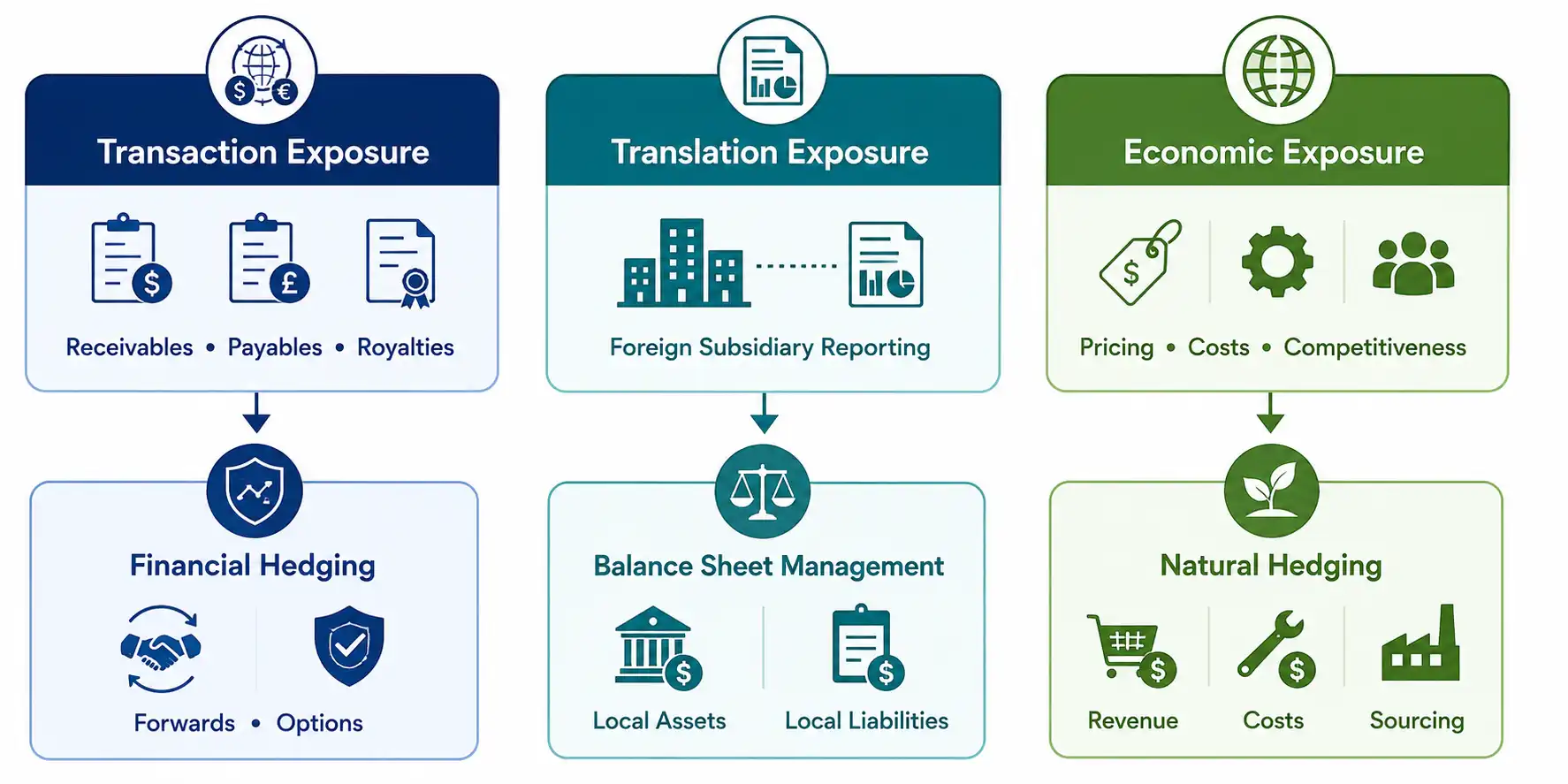
Before selecting an instrument, the more useful question is what the business needs to hedge. FX exposures generally fall into three categories, and each demands a different response.
- Transaction exposure covers future cash flows denominated in a foreign currency, including payables, receivables, and royalties. This is the most direct and the most hedgeable form of exposure.
- Translation exposure reflects the accounting impact of converting a foreign subsidiary’s results into the parent company’s reporting currency. Finance teams typically manage it through balance sheet structuring rather than derivatives.
- Economic exposure is the long-term, competitive impact of currency movement on cost structure and pricing power. It is strategic in nature and is often addressed operationally, through natural hedging and sourcing decisions, rather than financially.
A U.S.-based buyer sourcing $1.25M in components from an Indian supplier at 80 rupees to the dollar illustrates transaction exposure well. If the rupee weakens to 87, the same purchase costs closer to $1.15M; if it strengthens to 75, the cost climbs toward $1.33M. Neither outcome reflects a change in operations, only in the exchange rate, and a swing of that size can move gross margin by several percentage points on a single contract.
Five Instruments for Managing Currency Risk, From Natural Hedging to Cross-Currency Swaps
Each instrument fits a different exposure profile, a different level of certainty, and a different appetite for cost versus flexibility.
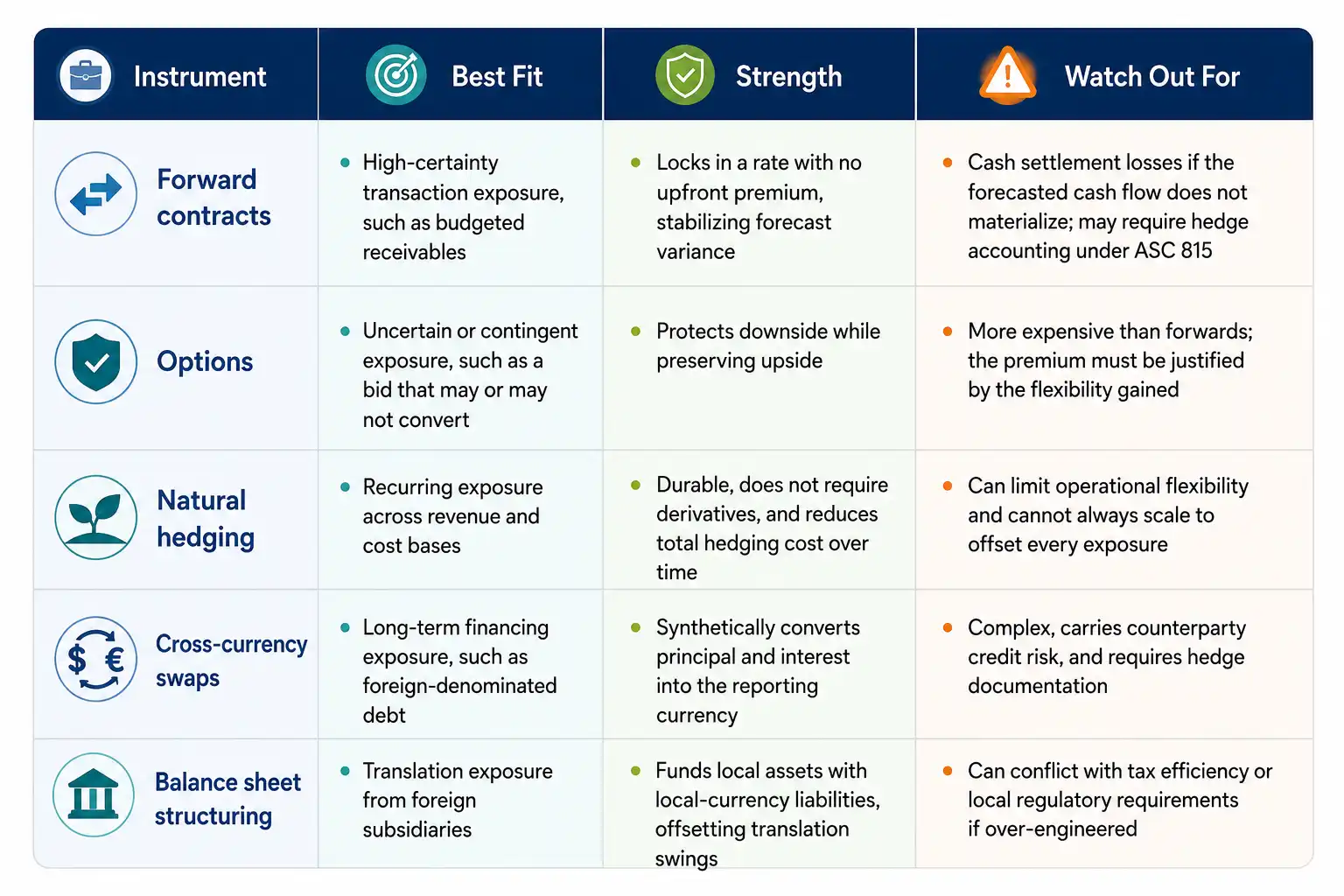
Natural Hedging: Aligning Currencies Instead of Buying Protection
Among these five, natural hedging is the one instrument that requires no derivative, no premium, and no counterparty. It works by matching the currency of revenue to the currency of cost, so that depreciation on one side of the ledger is offset by a corresponding decline on the other. A company billing in pounds that shifts a portion of its engineering payroll to a U.K. office creates a natural hedge: pound-denominated revenue is now matched against pound-denominated expense, and net exposure narrows without a single financial instrument changing hands.
This kind of structural alignment tends to be the most durable form of protection a business can build, precisely because it lives inside the operating model rather than on top of it. It is also the reason many CFOs favor natural hedging as a first line of defense before layering in forwards or options for whatever exposure remains after the operational offset. In a high-growth cybersecurity and identity access management business running delivery centers across the United States, Canada, Mexico, India, and Nepal, aligning local billing and local payroll currencies reduced the residual exposure that needed to be hedged financially at all, freeing the treasury function to concentrate its forward book on the transactions that genuinely could not be offset internally.
Building an FX Risk Program That Holds Up
An effective program is not built to eliminate volatility. It is built to make volatility predictable, and it rests on a few consistent disciplines.
- Start with exposure mapping: which currencies, what amounts, and what timing.
- Embed hedging in the forecasting and budgeting process; a hedge disconnected from the forecast is a bet, not a policy.
- Reflect the company’s capital and liquidity position, since hedge costs, margin requirements, and settlement flows all draw on cash.
- Document the program under ASC 815, with contemporaneous evidence of purpose, effectiveness, and method.
- Report FX exposure to the board as a strategic lens, not a treasury footnote.
A Practitioner’s View from the Field
At one venture-backed international SaaS company, currency exposure became material once revenue from Latin America crossed 20 percent of annual recurring revenue, and forecasting grew erratic as the Brazilian real moved. The response combined all three approaches covered above: forward contracts for the cash flows that were highly certain, options for renewals with variable outcomes, and natural hedging through local hiring that matched a growing share of cost to the currency of revenue. Within three quarters, forecast variance dropped from 18 percent to under 5 percent. Similarly, in a $127M global consumer products business sourcing from China and Vietnam, disciplined currency and working capital management, paired with demand planning, supported an increase in inventory turns from three times to seven times, a reminder that FX discipline and operational discipline tend to reinforce each other.
Three Key Takeaways
- Exposure mapping comes before instrument selection; transaction, translation, and economic exposures each call for a different tool, and applying the wrong one adds cost without adding protection.
- Natural hedging deserves first consideration because it reduces exposure at the structural level, lowering the volume of financial instruments a treasury team needs to buy and the total cost of the hedging program overall.
- A hedging program earns board credibility only when it is documented, embedded in the forecast, and reported as a strategic discipline rather than a reactive response to a bad quarter.
Disclaimer: This article is intended for informational purposes only and does not constitute legal, tax, or accounting advice. You should consult your own tax advisor or counsel for advice tailored to your specific situation.
Hindol Datta is a four-time CFO and senior finance executive with over 25 years of leadership experience across cybersecurity, SaaS, gaming, logistics, digital marketing, medical devices, consumer products, and nonprofit organizations. He has led more than $120M in fundraising and over $150M in M&A transactions while building the financial and operational systems that let complex businesses scale with confidence. He is the author of seven books in the Systems CFO Series and holds active CPA, CMA, and CIA credentials.
AI-assisted insights, supplemented by 25 years of finance leadership experience.