
Executive Summary
Multiple expansion is the most coveted and least understood source of value in private equity. Deal teams often credit it to timing or a persuasive banker. Yet the multiples that survive diligence come from a business whose future has become more knowable and whose earnings have become more durable.
This article treats multiple expansion as a strategic craft that finance leaders can learn and govern. It covers what a multiple prices, how multiple expansion vs earnings growth differ, the six levers that earn a premium, the narrative behind multiple arbitrage, and the cadence that makes expansion repeatable.
Why Multiple Expansion Is Earned, Not Found
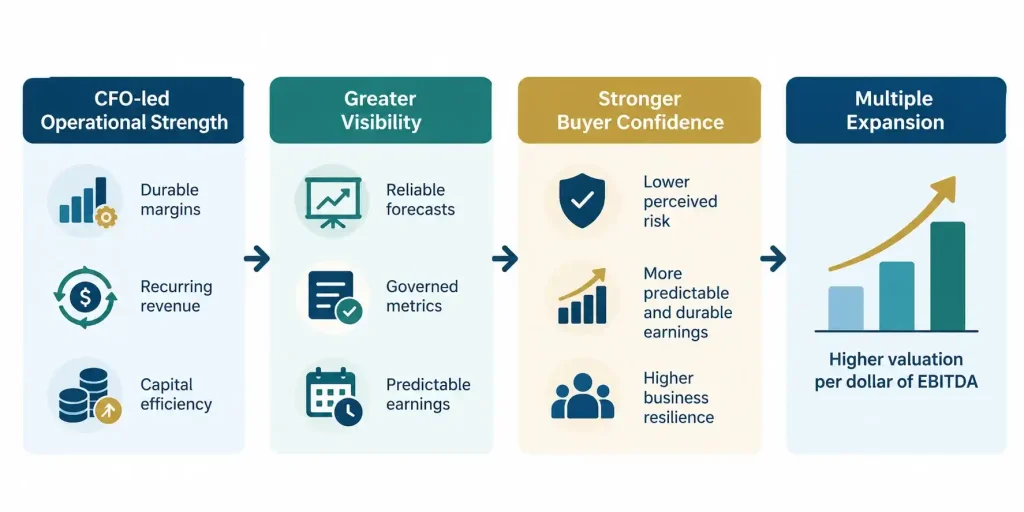
Spectators describe the expanding multiple as a reward for buying what others missed. Practitioners inside the portfolio, and the CFO above all, see it differently. A multiple expands when the market believes a company can earn returns above its cost of capital, at scale and over time.
Entry valuations are stretched, talent moves quickly, and capital is impatient. The real task is to create conditions under which a buyer will pay more for the same cash flows, built on coherent execution, disciplined capital allocation, and a consistent narrative.
Seen this way, multiple expansion is a compression of uncertainty. The buyer recognizes that the future of the business has become more predictable and more durable than it was at entry. The CFO works on two tracks: building systems that produce trustworthy signals, and proving through evidence why the business deserves a richer valuation.
What a Valuation Multiple Prices
The Multiple as Compressed Belief
A valuation multiple looks like a simple coefficient that turns EBITDA into enterprise value. In practice it is a compressed probability distribution, a shorthand for judgments about risk, growth, quality, and scarcity. When perceived risk falls, investors accept a lower expected return and pay a higher multiple.
The multiple also measures how long returns will last. A buyer paying 12x EBITDA believes those earnings form a durable baseline, not a temporary spike. Buyers pay for the machine that produces earnings, not for last quarter’s output. During buy-side diligence on an IT services acquisition, quality-of-earnings work surfaced material EBITDA adjustments where reported earnings had drifted from economic reality, and those findings reshaped the price.
Buyers rarely read every line of the ledger. Instead, they look for proxies such as gross margin trajectory, churn, payback period, and revenue per employee. Each credible answer about sales repeatability and delivery standards lowers uncertainty and supports a higher price.
Comparability with Distinction
Valuation also carries a social layer that spreadsheets rarely capture. The market prices a company partly by how easily it fits a known category. When a firm resembles a known peer but outperforms on a specific dimension, the market borrows the peer’s multiple and adjusts upward. The imperative follows: belong to a recognizable class while earning a superior rank inside it.
Multiple Expansion vs Earnings Growth
Private equity returns come from earnings growth, deleveraging, and multiple expansion. The debate over multiple expansion vs earnings growth often frames the two as rivals, yet the strongest exits combine both. Earnings growth enlarges the base, while multiple expansion raises the price paid for each dollar of it.
Comparing the Two Value Drivers
| Dimension | Earnings Growth | Multiple Expansion |
| What changes | The size of EBITDA or cash flow | The price paid per dollar of EBITDA |
| Primary driver | Revenue lift, margin gains, acquisitions | Lower perceived risk, higher durability, stronger positioning |
| Who controls it | Management and operators | Management, plus market perception and buyer belief |
| Main risk | Growth that stalls or erodes margin | Gains tied to market timing that reverse in a downturn |
| Evidence buyers want | Audited results and pipeline | Repeatable systems, governed metrics, coherent narrative |
When entry multiples are already high, the burden of proof rises. Multiple arbitrage, buying at a lower multiple and selling at a higher one, cannot depend on optics or a rising market. The company must move from founder-led intuition to institutional process and prove that its economics scale without decay.
Six Levers That Make a Business Worthy of Multiple Expansion
Multiple expansion grows out of the operating architecture of the business. Six interlocking levers move market perception from acceptable to trusted.
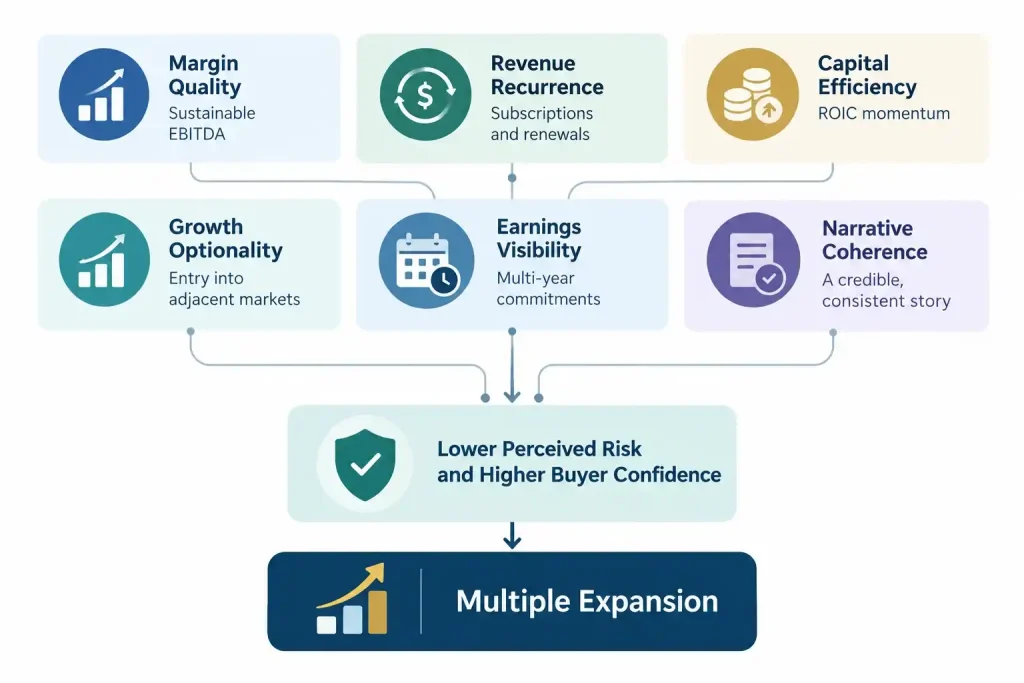
- Margin quality and stability: Buyers pay for sustainable EBITDA, anchored in sticky customers, structured contracts, and reliable sourcing.
- Revenue mix and recurrence: Subscriptions, renewals, and long-term contracts make the future easier to project and lift valuation.
- Capital efficiency and ROIC momentum: Sophisticated buyers test the return on incremental capital, not only current ROIC.
- Growth optionality: Modular products and platform layers let a company enter adjacent markets, provided buyers find the option credible.
- Earnings visibility: Multi-year commitments and a transparent cost base let buyers forecast with confidence.
- Narrative coherence: The CFO binds margin, growth, capital efficiency, and strategy into one plausible whole.
In a cybersecurity and identity access management business with roughly $30M in ARR, two of these levers moved together. A driver-based forecasting engine held actuals within 5% of forecast for 8 consecutive quarters. Pricing discipline and workforce mix lifted gross margin by 12%, and board-grade reporting carried the business through acquisition diligence.
An Integrated SaaS Case
Consider a SaaS portfolio company whose margins beat the industry average through automation and regional pricing power. More than 85% of its revenue recurs, with average customer tenure above 24 months. Productized onboarding yields high returns on incremental capital, and the platform now extends into adjacent verticals. With multi-year contracts making earnings visible, the CFO can show that the business has become more resilient and more trusted, not merely bigger.
Here, a stretched multiple becomes a rational response instead of speculation. Expansion happens only when performance, capital, narrative, and governance align.
Building the Narrative Behind Multiple Arbitrage
Two companies with nearly identical earnings can sell at 9x and 14x EBITDA. The difference lies in interpretation, since one looks mature while the other looks strategic.
Sophisticated buyers look for repeatability, scalability, and resilience. Margin gains must trace to structural change, not a one-time cost cut. Growth must come from a repeatable go-to-market engine.
Forward Visibility for Buyers
Multiple expansion depends less on last quarter than on what this quarter says about next year. Forward visibility rests on a few core instruments:
- Operational dashboards that track leading indicators alongside lagging results
- Pipeline health data that supports future revenue expectations
- Efficiency ratios that show economies of scale as growth arrives
- Capital expenditure discipline that supports capital-light scalability
These metrics belong in board packs, investor letters, and all-hands meetings. By the time diligence begins, the buyer hears a language the company already speaks fluently.
Benchmark Anchoring and Buyer Psychology
Buyers triangulate against comparable companies, precedent deals, and their own models. A vertical SaaS firm whose public peers trade at 10x to 12x forward EBITDA must show why it ranks high within that group. At a Series B marketplace SaaS platform, cohort and unit economics models built across US and Polish operations held up under scrutiny during a $20M raise.
Buyers also want a thesis they can explain to their own investors. A premium becomes more likely when growth looks halfway realized, with systems built and inflection points in motion. Overstatement destroys this advantage, so the deal room and the weekly operating review must tell the same story.
Institutionalizing Multiple Expansion Through Culture and Cadence
The most common mistake in private equity treats multiple expansion as episodic, a reward for a good quarter or a hot market. Firms that master it treat expansion as an expression of governance maturity.
Culture and Metric Discipline
Culture sets the ultimate limit on how far a multiple can stretch. A company that does not prize intellectual honesty will inflate metrics and sell a story it cannot sustain. The CFO therefore keeps definitions unambiguous, keeps metric lineage traceable, and diagnoses variances instead of excusing them. At a publicly listed gaming company operating across five countries, one unified definition of revenue across every subsidiary shortened statutory reporting cycles under IFRS and US GAAP.
Cadence and the Valuation-Ready Firm
Cadence is what turns raw data into a signal buyers can trust. Weekly dashboards, monthly variance reviews, and quarterly board narratives build institutional memory about what drove performance. A valuation-ready firm synchronizes data flow and story development through practices such as these:
- Functional leaders submit the reasons behind trends, not only the metrics
- Each strategic initiative links to financial KPIs that finance tracks continuously
- Market data enters operating reviews to give context to shifts
- Leaders code and model risks openly instead of hiding them
This discipline demands investment in systems and analyst talent, and it can surface uncomfortable truths. The return compounds, however, because the company learns to communicate performance in language the market can price. Valuation then stops being an accident of timing and becomes a byproduct of coherence.
Three Key Takeaways
- Multiple expansion reflects a compression of uncertainty, so the surest route to a higher multiple runs through visible earnings, durable margins, and a repeatable operating model.
- Multiple expansion vs earnings growth is a false choice, and multiple arbitrage built on optics alone tends to reverse under diligence.
- Narrative coherence must be lived across the holding period, supported by governed metrics and a steady reporting cadence.
Disclaimer: This article is intended for informational purposes only and does not constitute legal, tax, or accounting advice. You should consult your own tax advisor or counsel for advice tailored to your specific situation.
Hindol Datta is a four-time CFO and senior finance executive with over 25 years of leadership experience across cybersecurity, SaaS, gaming, logistics, digital marketing, medical devices, consumer products, and nonprofit organizations. He has led more than $120M in fundraising and over $150M in M&A transactions while building the financial and operational systems that let complex businesses scale with confidence. He is the author of seven books in the Systems CFO Series and holds active CPA, CMA, and CIA credentials.
AI-assisted insights, supplemented by 25 years of finance leadership experience.