
Executive Summary
Multi entity consolidation is more than the aggregation of trial balances. It determines whether a group of subsidiaries, divisions, and affiliates plans as one enterprise or as a collection of local stories. This article explains how CFOs can build a reliable multi entity consolidation model, align planning frameworks, model scenarios, and govern the process.
Planning across corporate borders is a tool for cohesion and not only for control. Readers will find a practical structure for integration, cascading, scenarios, and governance.
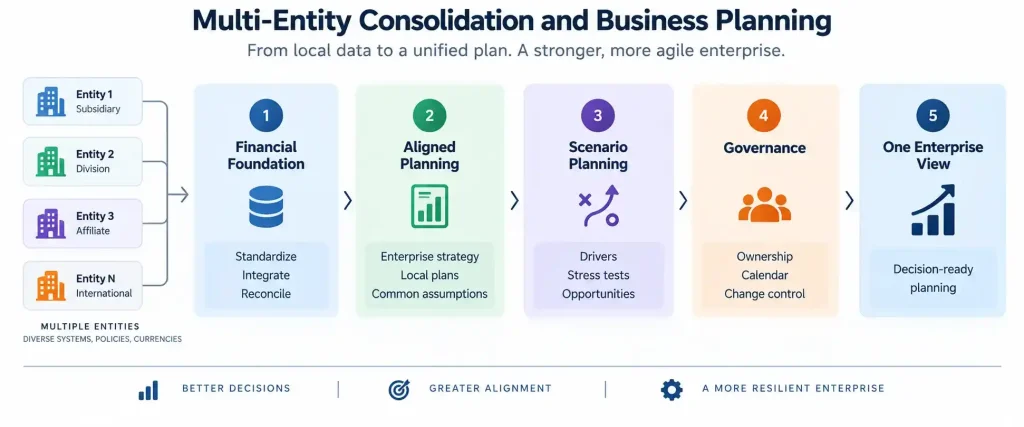
Building the Financial Foundation for Multi Entity Consolidation
Multi entity consolidation looks mechanical at first glance. Trial balances are rolled up, eliminations applied, currencies translated, and intercompany balances reconciled. The real challenge lies in the diversity of operating realities across entities. Different ERPs, accounting policies, calendars, and charts of accounts all create friction. Without financial integrity in multi entity consolidation, every later planning step loses credibility.
Structural Alignment and System Integration
A unified chart of accounts built on a global template with local extensions gives each entity relevance while preserving comparability. Standard account hierarchies, cost centers, and segment codes allow reliable mapping without forcing rigid uniformity. The goal is a common language that does not erase local nuance.
System integration matters just as much as structure does. Legacy platforms and unevenly deployed ERP modules produce inconsistent data flows, delayed closes, and high reconciliation costs. Integration middleware, common data lakes, and automated consolidation tools are foundational infrastructure. They should track eliminations, currency translation, minority interests, and ownership changes with audit-level clarity.
At a public gaming and digital entertainment company operating across five countries, a global ERP and business intelligence rollout gave multi entity consolidation one definition of revenue across every subsidiary. Statutory reporting shortened under both IFRS and US GAAP.
Process Discipline and Intercompany Complexity
Multi entity consolidation cannot depend on heroic effort at year-end. It requires a repeatable month-end close with clear ownership, timelines, and handoffs. Each entity is accountable for its inputs, while corporate finance validates, reconciles, and interprets. That cadence turns annual planning into a strategic exercise instead of a reactive scramble.
A consolidated planning model then captures interdependencies instead of summing separate forecasts. Three areas of the consolidated planning model deserve particular care:
- Intercompany flows: transfer pricing affects margins but not cash, and royalties change one entity cost base and another income. Models must separate third-party activity from intra-group flows.
- Currency: planning tools should show constant currency and actual currency views. This separates operational signals from macroeconomic noise in reported results.
- Structural change: entities are acquired, divested, and merged, and tax treatments shift. The platform must absorb these changes without destabilizing the model.
The payoff of multi entity consolidation extends beyond compliance. Executives gain decision-grade visibility across entities, and the CFO moves from reporting history to interpreting potential.
Planning Frameworks That Connect Enterprise Strategy to Local Execution
Once multi entity consolidation is stable, the challenge shifts to orchestration. The CFO must design a framework in which local goals support the broader strategic narrative.
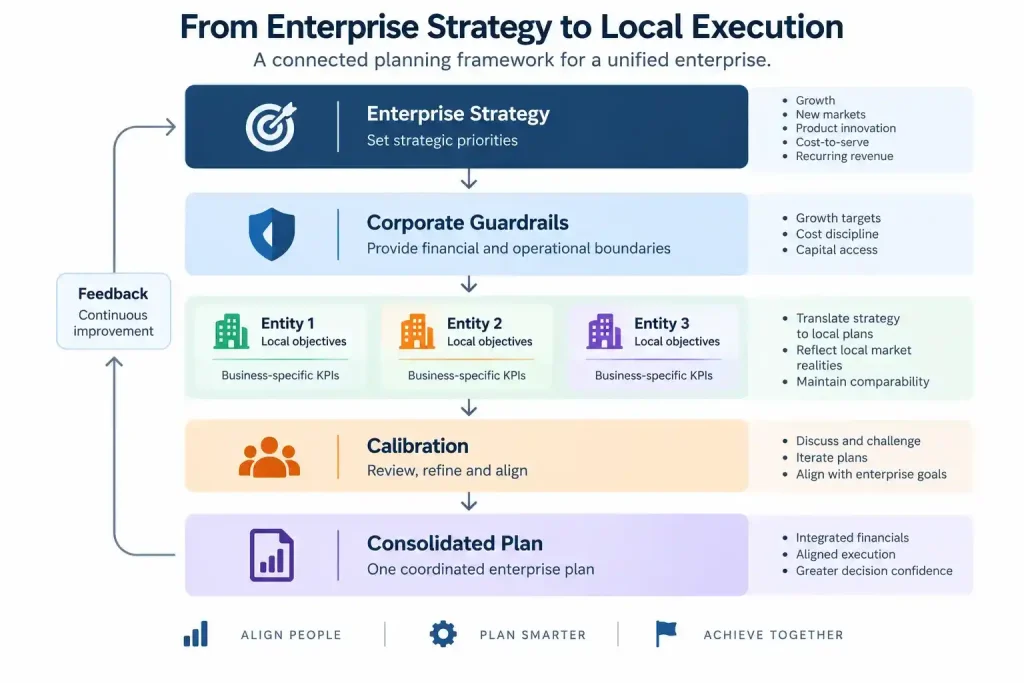
Anchors, Cascades, and Calendars
Planning begins with enterprise strategic anchors that set direction. These are directional priorities such as new markets, product innovation, better cost-to-serve, or a shift toward recurring revenue. Each entity then translates them into local objectives.
Headquarters cannot dictate targets in isolation from the entities. Corporate finance sets guardrails on growth, cost discipline, and capital access, while entity leaders propose detailed plans. Calibration cycles then review and refine those plans, which preserves local ownership. A synchronized calendar with milestones for drafts, reviews, iterations, and approvals keeps the process coherent.
| Planning element | Enterprise role | Entity role |
| Strategic anchors | Define directional priorities | Translate them into local objectives |
| Guardrails | Set growth, cost, and capital limits | Propose detailed plans within limits |
| Calendar | Enforce one synchronized cycle | Meet submission and review milestones |
| Templates and KPIs | Standardize structure | Vary content by business model |
| Scenarios | Require common stress cases | Model local sensitivities |
Roles, Business Models, and Incentives
Matrixed reporting can blur accountability, so the framework must name the preparer and reviewer for revenue, headcount, opex, capex, and cash. Business model diversity also needs room within the framework. A manufacturing subsidiary prioritizes throughput and cost control, while an acquired startup pursues user growth. A common template with context-specific KPIs handles both.
Budgeting authority must be explicit, consistent, and enforced. Some enterprises grant full P&L control locally, while others keep pricing, hiring, or capital levers at corporate level. Either model works when it is clear, and ambiguity invites plan padding.
Incentives complete the picture of alignment across the entire group. Entity leaders will not prioritize corporate objectives if pay depends only on local P&L. The CFO and CHRO should reward contribution to strategic projects and cross-border synergies as well. Collaborative planning platforms help, though process discipline must enforce alignment.
Scenario Planning for Multi Entity Consolidation
The most dangerous planning assumption in any enterprise is certainty. A base case describes one path through volatile terrain, and shocks rarely affect every entity evenly. Strategic modeling must therefore extend beyond the base case.
Drivers, Scenarios, and Roll-Up
Clarity matters more than complexity in strategic modeling. The CFO first defines the key drivers, which combine macroeconomic variables, commercial metrics, and internal variables such as operating leverage and working capital efficiency. Each driver is mapped to its impact path, since inflation affects manufacturers and SaaS divisions differently.
Scenarios are structured narratives with internal logic and not random permutations. A downturn case might combine revenue contraction, FX depreciation, cost pressure, and working capital drag. A disruption case might model a supply chain fracture or regulatory penalty. Entity leaders, risk officers, and strategic planners should build them together.
Each entity stress-tests its income statement, balance sheet, and cash flow, and the results feed multi entity consolidation without distorting intercompany dynamics. A negative FX shock may reduce revenue in one entity while lowering COGS in another that sources internationally. The point applies directly to a $127M global consumer products company with a supply chain spanning China and Vietnam.
From Scenario Outputs to Decisions
Scenario outputs must inform decisions, not only variances. If revenue in an Asia-Pacific entity falls 15%, leadership should know whether to cut discretionary spend, pause hiring, or reduce capital deployment. If rates rise 200 basis points, the model should show which covenants trigger and where refinancing risk sits. This creates optionality before panic sets in across the group.
Opportunity scenarios deserve equal attention alongside downside cases. Demand may outpace expectation or an acquisition may accelerate growth, and planning should expose capacity constraints and funding limits. Scenario work also builds capital reallocation readiness, so the CFO can shift capital, defend liquidity, and back growth bets while others retrench.
Finance should partner with treasury, HR, operations, and legal to understand tax exposure from moving cash, effects on shared services, and regulatory filings triggered by restructuring. Driver-based platforms make simulation dynamic, yet human judgment gives the models meaning. The dialogue itself has value, because leaders who rehearse uncertainty together respond faster when a scenario unfolds.
Governing Multi Entity Consolidation and Planning Over Time
Planning is a rhythm of leadership and not an annual ritual.
Philosophy, Calendar, and Ownership
Governance of multi entity consolidation begins with an explicit planning philosophy. Leaders should decide whether authority is centralized or decentralized, how much autonomy entities hold, and whether corporate finance directs or facilitates. Without this clarity, planning becomes negotiation instead of orchestration.
A unified calendar covers strategy articulation, budget kickoffs, mid-cycle reviews, rolling forecasts, and board submissions. One late entity can delay consolidation, so deadlines must be enforced with clear purpose for each stage. Every deliverable also needs an owner, combining business ownership from local GMs or divisional CFOs with functional accountability from HR or operations.
Assumptions, Change Control, and Technology
The CFO office should act as neutral arbiter of macro inputs such as exchange rates, inflation, demand forecasts, and commodity prices. Central sourcing shows whether variance comes from execution or from assumption divergence. Change control then specifies when re-forecasting is warranted, how it is documented, and who approves it.
Spreadsheets and offline models are dangerous in multi entity consolidation because version confusion and formula errors erode confidence. Enterprise planning systems should preserve data lineage, remain auditable, and connect live to ERP and data warehouse platforms. At a cybersecurity and identity access management company with entities across five countries, an end-to-end NetSuite implementation compressed monthly close from 18 days to 10. A driver-based forecasting engine held actuals within plus or minus 5% of forecast for 8 consecutive quarters.
Culture, Feedback, and Reporting
Governance is also behavioral, and culture shapes how well it works. Entity finance teams need training in sensitivity analysis, margin structure, working capital mechanics, and cost absorption. Business unit heads should participate as decision-makers in planning reviews.
Each cycle should end with a post-mortem covering accurate assumptions, systematic biases, and bottlenecks. Governance reporting then measures planning accuracy alongside outcomes. Repeated forecast misses trigger root cause reviews, and an unannounced budget overrun signals a governance failure.
Three Key Takeaways
- Treat multi entity consolidation as the engine of planning by standardizing the chart of accounts, integrating systems, and running a disciplined monthly close.
- Cascade strategy through guardrails, a synchronized calendar, clear ownership, and incentives, while allowing KPIs to reflect each entity business model.
- Rehearse uncertainty with driver-based scenarios and govern the multi entity consolidation cycle through centrally sourced assumptions, change control, and post-cycle learning.
Disclaimer: This article is intended for informational purposes only and does not constitute legal, tax, or accounting advice. You should consult your own tax advisor or counsel for advice tailored to your specific situation.
Hindol Datta is a four-time CFO and senior finance executive with over 25 years of leadership experience across cybersecurity, SaaS, gaming, logistics, digital marketing, medical devices, consumer products, and nonprofit organizations. He has led more than $120M in fundraising and over $150M in M&A transactions while building the financial and operational systems that let complex businesses scale with confidence. He is the author of seven books in the Systems CFO Series and holds active CPA, CMA, and CIA credentials.
AI-assisted insights, supplemented by 25 years of finance leadership experience.