
Executive Summary
Most companies treat the month end close process as a compliance ritual. They see it as a recurring cost of accountability that yields accurate ledgers but little foresight. This article argues that finance teams can redesign month end close accounting into a forward-looking capability. That capability shapes decisions instead of merely recording them. The article also walks through the inefficiencies, tools, signals, and cultural habits that make the shift possible.
Readers will find a practical view of how automation, a rolling cadence, and disciplined variance review work together. These practices free finance teams to spend the close window on interpretation. The goal is a close that informs pricing, capital allocation, and risk conversations while it remains fully auditable.
The Hidden Cost of the Traditional Month End Close Process
The month end close process arrives in most finance teams with the regularity of a tide. Checklists appear, reviewers work through journals, and accruals and eliminations take shape. Eventually the team declares the books sealed, accurate, and balanced. The price of pursuing that precision every 30 days rarely shows up on any budget line. Yet companies pay it in overtime, lost reflection, and decisions made without the benefit of interpretation.
Inward-Facing Mechanics Create a Black Box
Treated only as an operational deadline, month end close accounting becomes a historical document instead of a diagnostic. Teams validate metrics rather than question them. They explain variances rather than interrogate them. The structure of the process rewards speed, and it measures itself in days to close instead of insight generated. Business leaders respond by treating the close as a black box. They receive reports as artifacts rather than instruments, with little discussion of assumptions, drivers, or momentum.
Manual Reconciliations and Fragmented Systems Add Risk
One cybersecurity and identity SaaS company had roughly $30M in ARR and five country entities. Its close once stretched to 18 days. Reconciliations lived in emailed spreadsheets, and data standards differed by geography. An end-to-end ERP implementation compressed the cycle to 10 days. The team put the recovered time into forecast reviews. Those reviews held actuals within plus or minus 5% of plan for 8 consecutive quarters.
Diligent teams always catch the errors, but energy spent correcting the past cannot be spent shaping the future. Investors, auditors, and regulators feel the same friction. They lose confidence when the close runs slow, and they extend only limited trust when it runs fast but shallow. Most CFOs sense all of this. Yet altering a ritual so embedded in the operating rhythm provokes resistance that feels like changing gravity. CFOs should read that resistance as evidence that redesign is due.
Reengineering the Month End Close Process with Automation, Tempo, and Trust
Modernizing the close is about intelligent completion rather than faster completion, and it depends on tools, process architecture, and the tempo of collaboration working together.
Continuous Accounting and Intelligent Automation
Automation now reaches well beyond the simple reduction of keystrokes in finance operations. Continuous accounting flows, real-time validations, and exception-based intervention allow transactions to be matched and resolved throughout the month, which spreads the analytical load across the cycle and turns month end into a moment of synthesis rather than scramble. The supporting stack includes cloud ERP platforms that consolidate ledgers, workflow engines that track journal approvals, analytics platforms that blend transactional and operational data, robotic process automation for reconciliations, and AI-driven anomaly detection that flags unusual trends before they become problems.
Process Architecture Before Technology
Tools enable transformation, but the deeper change lies in process architecture. A traditional month end close process is built around silos in which accounting owns the ledger, FP&A prepares the management view, and operations sit downstream, so redesign begins with mapping the cycle end to end to find delays, rework, controls that add friction without value, and unclear handoffs. A shared accrual engine can replace six teams preparing separate accruals, rules engines can close subledgers based on activity, and rolling dashboards can show what is closing, lagging, and trending.
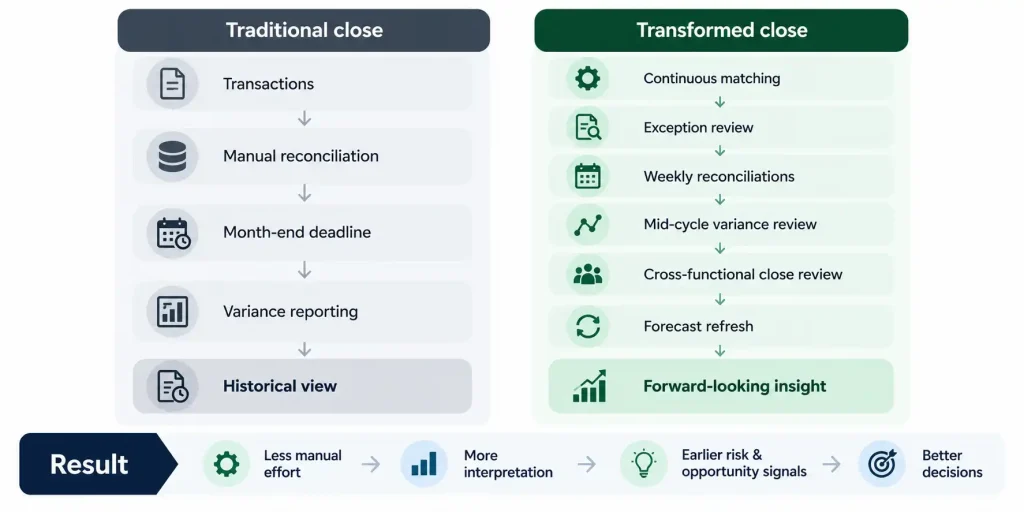
The redesigned flow below shows how insight moves through the cycle instead of arriving at the end.
A Rolling Close Cadence
Leading organizations replace the end-of-month sprint with a rolling close in which pressure is distributed and rhythm replaces frenzy. The cadence typically includes the following elements.
- Transactions matched continuously, with exceptions resolved as they arise
- Accounts reconciled weekly
- Variance reviews held mid-cycle
- Forecasts refreshed daily
- A cross-functional review at period end
Teams that manage rhythm rather than deadline find space for dialogue and scenario planning, which moves finance from historian to navigator.
Trust Through Transparency
Neither tempo nor tools succeed without trust. Controllers must believe that automation will not weaken control, business leaders must believe that earlier insight is reliable, and finance teams must accept that releasing manual effort is a gain in value rather than a loss of diligence. Visible close dashboards, shared exception logs, explainable automation rules, and controls embedded in workflows build that belief.
Turning Month End Close Accounting into a Source of Strategic Signals
From Archive to Analysis
The close is archaeological rather than archival, since each line item and each movement across accounts describes behavior, momentum, and change. Variance analysis should therefore question gaps instead of merely reconciling them, asking whether a marketing overspend was tactical or strategic and what a regional divergence in revenue implies about the assumptions inside the forecast. A series of trailing closes then reveals inflection points, and growth rates can be compared with prior momentum as well as with plan.
In a venture-backed digital marketing company that scaled from $9M to $180M in 24 months, contribution margin and customer acquisition cost reviews at every close kept growth disciplined, because each month posed the question of which bets deserved doubling down.
Predictive Insight and Reporting That Provokes Reflection
Feeding close data into forecasting and scenario engines shifts finance from descriptive to prescriptive. If margin compression has accelerated for three consecutive months, the implications for pricing and cost discipline deserve immediate discussion, and if headcount growth has outpaced productivity, the relevant levers become visible. This requires dashboards, heat maps, and trend lines with narrative context in place of dense transactional packages.
In a public gaming company operating across five countries, a single definition of revenue across every subsidiary, supported by a global ERP and business intelligence rollout, cut statutory reporting cycles under both IFRS and US GAAP and made this kind of analysis possible.
Risk and Opportunity Signals
Each cycle should conclude with a cross-functional review in which finance and business leaders walk through the why behind the numbers, and the signals below often surface there.
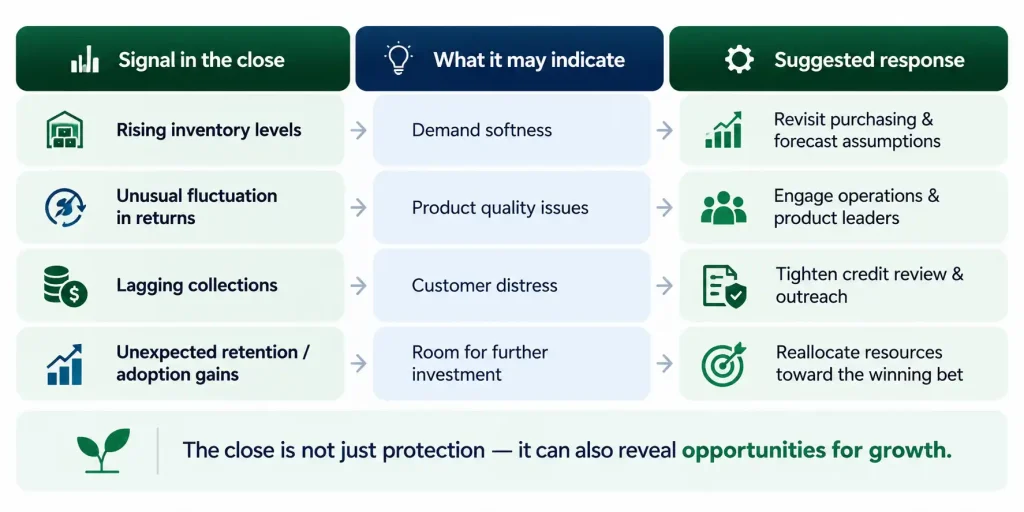
Opportunities appear as well, which makes strategic signals a source of propulsion as much as protection.
Embedding a Culture Around the Month End Close Process
Culture is the most difficult shift and the most enduring, because tools can be updated with relative ease while beliefs require cultivation. The CFO must present the close as a leadership event and an instrument of enterprise learning, which begins with language. Teams that talk about opening the view rather than closing the books look for velocity, trajectory, risk, and opportunity instead of variances alone.
Forums, Training, and Recognition
Cross-functional forums at the end of each cycle should be conversations about the future rather than recitations of the past. Training in storytelling, visualization, and scenario planning expands influence without diluting rigor. Recognition should evolve as well, so that the fastest close is not celebrated above a close that informed a key decision, surfaced a risk early, or enabled a reallocation of resources.
Governance and Leadership Modeling
Clear protocols for access, usage, and interpretation of new dashboards protect against fragmented insight and allow the wider organization to use financial data responsibly. In a professional services firm that grew from $12M to $63M in eight months across five business units, engagement-level profitability and utilization reporting gave leadership its first clear view of where margin was created and where it quietly leaked, and it took leaders using that data in every executive conversation to make it stick. The CFO reinforces rigor by referencing close data in board briefings, executive meetings, and coaching, and by acting promptly on the signals it reveals.
Change arrives one cycle and one conversation at a time, until the month end close process becomes a rhythm of insight rather than a race against the clock.
Three Key Takeaways
- Redesign the month end close process around continuous matching and a rolling cadence so that the close window becomes a moment of synthesis instead of scramble.
- Use month end close accounting to question variances, read trends, and feed forecasting models, because early signals about risk and opportunity are worth more than another balanced ledger.
- Embed the change through language, cross-functional forums, recognition, and visible leadership use of close data, since culture sustains what tools and processes begin.
Disclaimer: This article is intended for informational purposes only and does not constitute legal, tax, or accounting advice. You should consult your own tax advisor or counsel for advice tailored to your specific situation.
Hindol Datta is a four-time CFO and senior finance executive with over 25 years of leadership experience across cybersecurity, SaaS, gaming, logistics, digital marketing, medical devices, consumer products, and nonprofit organizations. He has led more than $120M in fundraising and over $150M in M&A transactions while building the financial and operational systems that let complex businesses scale with confidence. He is the author of seven books in the Systems CFO Series and holds active CPA, CMA, and CIA credentials.
AI-assisted insights, supplemented by 25 years of finance leadership experience.