
Executive Summary
Most companies treat market expansion strategy as a revenue announcement rather than a capital decision. That framing is the first mistake. A sound market expansion strategy behaves less like a growth slide and more like a portfolio of asymmetric bets. A modest, capped commitment buys real signal about a new geography before the organization commits its balance sheet. New market expansion, done well, is a system of sequencing, entry design, and measurement. It is not a single leap justified by a market-size chart.
This article lays out a practical framework for CFOs and finance leaders evaluating new market expansion. It shows how to sequence markets by signal strength rather than size. Choosing an entry model that leaves an exit ramp is another focus. The framework also covers how to measure return across four dimensions instead of one. Finally, it explains how to know when a market has stopped earning its keep.
Why New Market Expansion Fails When Treated as a Revenue Story
The familiar pitch sounds reasonable on its face. The product works in Market A, and Market B looks similar, so growth should follow. That logic quietly erases a long list of variables. Regulatory friction, cost-to-serve curves, competitive saturation, and the time it takes to earn local trust all disappear from the picture. Expansion tends to move along an S-curve rather than a straight line. Upfront costs run high, and efficiencies take a long stretch to compound.
The finance function usually inherits this optimism in the form of a plan that assumes near-immediate return, which is rarely how new geographies behave in practice. Growth is not guaranteed by a market expansion strategy; optionality is. Treating each new market as a call option, where the downside is capped and the upside is uncapped, changes the questions asked before capital moves. Instead of asking how large the market is, the better question becomes how cheaply the organization can learn whether the market wants what it is selling.
Sequencing New Markets Instead of Choosing Them
New market expansion is rarely a binary decision. It is a sequencing problem, and the order in which markets are entered often determines whether the third and fourth markets succeed at all.
The Signal-to-Capital Ratio
The market worth entering first is not necessarily the largest one. It is the market that returns the most reliable insight per dollar spent, a concept sometimes called the signal-to-capital ratio. A high-growth cybersecurity and identity access management company operating with roughly $30M in annual recurring revenue across the United States, Canada, Mexico, India, and Nepal built its multi-entity finance architecture in this order, entering geographies that offered fast, legible feedback before tackling more complex jurisdictions, and holding actuals within five percent of forecast for eight consecutive quarters as a result.
Sequencing decisions typically weigh:
- Total addressable market and procurement cycle speed
- Regulatory friction and time to establish legal presence
- Local talent cost and operational footprint
- Digital infrastructure maturity, including payment rails and cloud adoption
- Currency volatility and political risk
A smaller, English-speaking market with fast sales cycles and stable payment infrastructure often teaches more per dollar than a larger, more complex one entered first out of ambition.
Choosing an Entry Model Without Locking in the Balance Sheet
Market expansion does not require a full operational buildout on day one. Each entry model carries a different mix of cost, control, and reversibility, and the right choice depends on how much signal the company has already gathered.
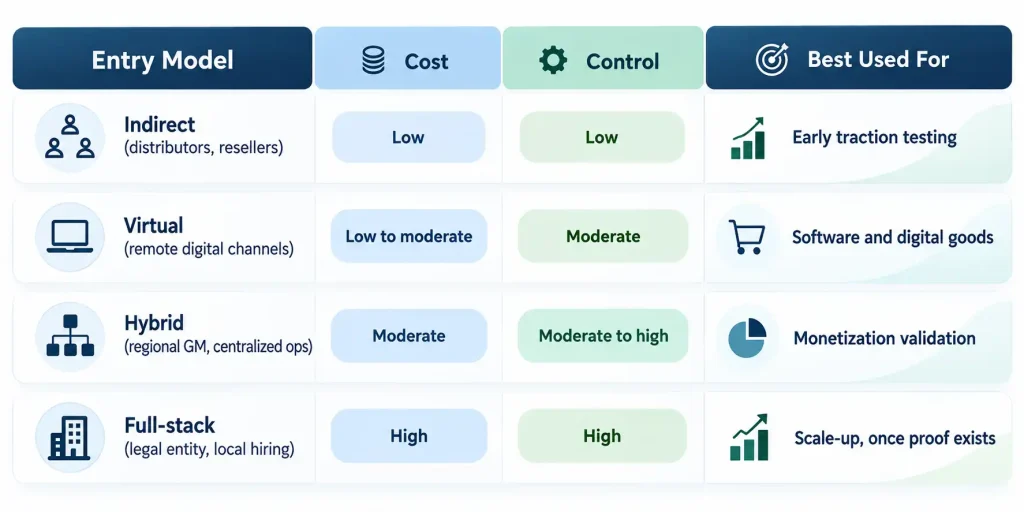
The obligation of the CFO in this decision is less about picking a model and more about preserving an exit ramp: temporary leases, limited-term contracts, and variable compensation structures that let the organization retreat with data intact rather than a stranded cost base. A $127M global consumer products company operating direct-to-consumer, Amazon, and wholesale channels across a supply chain spanning China and Vietnam approached new distribution relationships the same way, testing logistics partnerships before committing to owned infrastructure, which helped double inventory turns from three times to seven times as demand planning matured.
Measuring Expansion ROI Beyond the Top Line
Judging new market expansion by revenue alone is dangerously incomplete, because the earliest and most durable returns often show up elsewhere first. A useful market expansion strategy tracks four dimensions in parallel.
Commercial traction covers pipeline velocity, win rates against local incumbents, and customer acquisition cost measured against the home market rather than in isolation.
Operational scalability asks whether the model is portable: how long it takes to stand up a legal entity, localize the product, or reach system uptime parity with the core market. Each answer should shrink the timeline for the next market entered.
Talent market intelligence matters when expansion is driven as much by access to skilled labor as by revenue, and it is measured through hiring cost, time to fill, and attrition relative to headquarters benchmarks.
Strategic and competitive positioning captures the harder-to-quantify value of blocking a competitor, building brand recognition, or opening a partnership pathway, and it is the dimension most often missing from a board deck.
A Euronext Paris-listed gaming and digital entertainment company operating across the United States, France, the United Kingdom, Singapore, and South Korea illustrates why the four-dimension view matters: its cross-border transactions exceeding $100M and its unified revenue definition across every subsidiary, achieved through a single consolidated financial systems rollout, created strategic and reporting value that no single market’s revenue line could capture on its own.
Governance, Capital Pacing, and Knowing When to Exit
Capital misallocation, deploying too much too soon and in the wrong form, is one of the most common failure patterns in new market expansion. Milestone-based investment tranches, where capital releases against pipeline velocity and customer health rather than a calendar date, keep spending honest.
A venture-backed digital marketing organization that scaled revenue from $9M to $180M within twenty-four months relied on this same discipline, tying each funding round and each geographic push to customer acquisition cost, lifetime value, and contribution margin thresholds rather than to a fixed timetable, while raising $36.5M across three rounds along the way.
Early indicators that a market has stopped earning its keep include:
- Customer acquisition cost running three to four times higher than the core market
- Low retention even after genuine localization effort
- Regulatory burden eroding margin faster than it can be priced for
- Persistent absence of ecosystem or partnership traction
Exiting a market is not failure when it preserves capital and produces a documented lesson for the next attempt. The discipline lies in writing down why the decision was made, not in avoiding the decision itself.
A Simple Operating System for Repeatable Expansion
Durable companies do not treat expansion as a single maneuver. They build it as an operating system with five connected modules, each feeding the next:
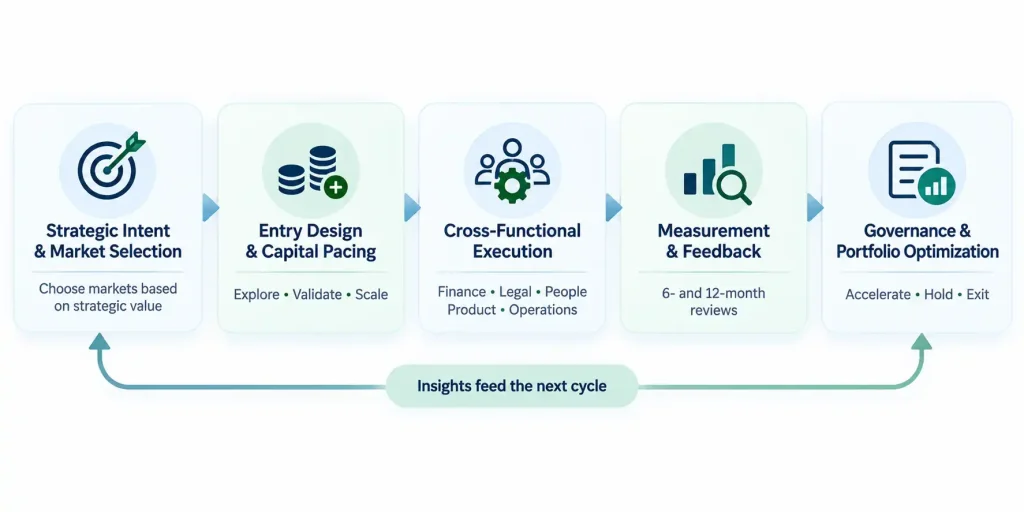
- Strategic intent and market selection: mapping candidate markets against revenue diversification, margin improvement, talent access, product learning, or competitive defense
- Entry design and capital pacing: staging capital in exploration, validation, and scaling tranches
- Cross-functional execution: finance, legal, people, product, and operations each owning a workstream rather than treating expansion as a sales initiative
- Measurement and feedback loops: post-entry reviews at six and twelve months that feed a reusable playbook
- Governance and portfolio optimization: quarterly reviews of which markets to accelerate, hold, or wind down
When these modules run in sequence rather than in isolation, new market expansion stops behaving like a gamble and starts compounding like a system.
Three Key Takeaways
- New market expansion should be evaluated as a portfolio of capped, asymmetric bets rather than a single revenue commitment, with sequencing driven by signal-to-capital ratio rather than market size alone.
- Entry models should be chosen to preserve an exit ramp, and expansion return should be measured across commercial traction, operational scalability, talent intelligence, and strategic positioning, not revenue in isolation.
- A repeatable market expansion strategy depends on governance discipline: milestone-based capital tranches, documented post-entry reviews, and a willingness to exit a market cleanly when it stops earning its keep.
Disclaimer: This article is intended for informational purposes only and does not constitute legal, tax, or accounting advice. Readers should consult their own tax advisor or counsel for advice tailored to their specific situation.
Hindol Datta is a four-time CFO and senior finance executive with over 25 years of leadership experience across cybersecurity, SaaS, gaming, logistics, digital marketing, medical devices, consumer products, and nonprofit organizations. He has led more than $120M in fundraising and over $150M in M&A transactions while building the financial and operational systems that let complex businesses scale with confidence. He is the author of seven books in the Systems CFO Series and holds active CPA, CMA, and CIA credentials.
AI-assisted insights, supplemented by 25 years of finance leadership experience.