
Executive Summary
A management presentation compresses an entire company into roughly 90 minutes before bidders who are judging it against competing options. In competitive sale and fundraising processes, the management presentation often decides which team earns capital, because investors leave the room with beliefs about the business as much as data about it.
This article sets out how to structure a winning management presentation, separate signal from noise, compete for investor confidence under incomplete information, and disclose risk responsibly. Finance leaders and CEOs will find a practical framework for turning complexity into credible, durable conviction.
Why the Management Presentation Decides Competitive Processes
Buyers arrive at a management presentation with scorecards but leave with impressions of confidence, unease, clarity, or doubt. The numbers may be precise, yet the final judgment is often intuitive, which makes the presentation the closest thing finance has to theater. Teams that treat it as a glorified earnings call or a chronological company history surrender their advantage to rivals who understand what is being judged.
Shaping Buyer Beliefs Under Asymmetric Information
Every bidder enters with a prior view shaped by the confidential information memorandum, the banker’s pitch, and early diligence. The presentation adds new signals, and each slide, comment, or hesitation either confirms or disturbs that prior. Effective teams do not try to eliminate doubt; they direct it, shaping where questions fall and where confidence settles.
Where Most Presentations Fail
Most presentations fail in substance rather than polish. They speak in metrics but not mechanisms, showing margin expansion without its cost or customer wins without pipeline conversion decay. Buyers are also evaluating the team, scanning for subtle contradictions between executives, and once suspicion of spin enters the room, no metric can remove it.
Designing the Narrative Architecture of a Management Presentation
In a management presentation, sequence is a strategic choice rather than an aesthetic one. Many decks default to chronology, moving from history to org chart, products, markets, financials, and finally strategy. Buyers, however, are building a forward-looking valuation, and audiences typically retain only about three messages from any session.
Chronological Versus Causal Structure
| Element | Chronological Deck | Causal Deck |
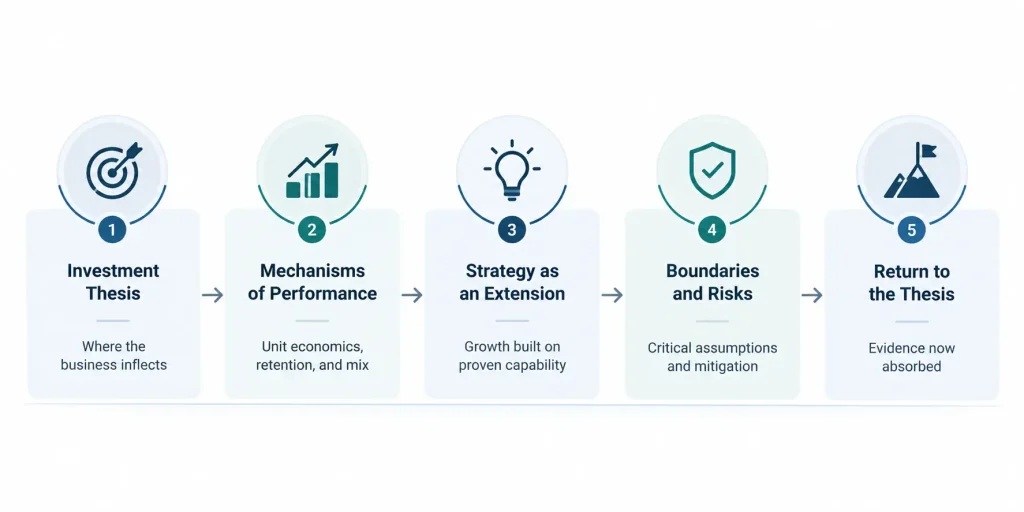
| Opening | Founding story and history | The inflection point and core investment thesis |
| Flow | Organized by department | Organized by cause and effect |
| Financials | Separate backward-looking section | Evidence for the mechanisms driving growth |
| Strategy | A new plan disconnected from results | A scaled extension of proven capability |
| Risks | Hidden or deferred to Q&A | Named, bounded, and paired with mitigation |
| Close | Generic summary | Return to the thesis with evidence absorbed |
A causal structure begins at the hinge of the story, where the business turns from defensible to inevitable. It front-loads the strongest signal, such as operating leverage in action or cohort retention dynamics, before logos or office expansion. Each section should then close with a one-slide answer to a single question about what it means for value creation, following the recommended management presentation sequence shown below.
Connecting Financials to the Strategy Presentation
The weakest moment in many decks is the handoff from financial results to the strategy presentation, which often feels like a separate document. A stronger approach presents the future as an extension of the past. Robust organisms evolve by adapting existing capabilities rather than inventing new ones, and a credible growth plan works the same way. Cohort and unit economics models built for a $20M Series B raise at a marketplace SaaS company held up under investor scrutiny because they tied every forward assumption to behavior the business had already demonstrated.
Showing Boundaries and Calibrated Belief
Investors rarely punish the admission of constraint, but they do punish concealment. Explaining, within the strategy presentation, where the company does not compete, which assumptions are critical, and how they are monitored signals operational depth. The savvy investor looks for calibrated belief rather than certainty, meaning a team that understands the variance around its growth and models it openly.
Signal Versus Noise in the Management Presentation
A signal is the part of a message that reduces uncertainty, and most management presentation content fails that test. Investors listen hierarchically, filtering for deviations from their priors, confirmations of risk, and outliers worth deeper inspection. The number of slides matters far less than the signal-to-noise ratio.
Turning Common Noise into Signal
- Swap TAM, SAM, and SOM pyramids for the rate-limiting factors on customer acquisition.
- Trade feature lists for a view of how each roadmap item raises switching costs or expands monetization.
- Cut dozens of KPIs down to interpretation of what each trend says about system dynamics.
- Show the feedback loop between usage and upsell instead of generic claims about customer centricity.
- Use one defensible 18-month CAC payback trend in place of five slides on org design.
Investors also anchor to early impressions and rely on heuristics when complexity exceeds bandwidth. A few anchoring slides should therefore be designed for memory, such as a unit economics chart, gross margin progression by customer segment, or cohort analysis with behavioral overlays. CAC, LTV, and contribution margin discipline across three funding rounds totaling $36.5M at a venture-backed digital marketing company showed how a small number of well-understood economics charts can carry an entire investor conversation.
Tone, Preemption, and Team Coherence
In any management presentation, over-assertion creates resistance while understatement invites ambiguity. The best teams anticipate skeptical questions, for example by explaining upfront how seasonality or channel shifts affect trailing CAC figures. Internal misalignment is the subtlest noise of all, since unit economics that do not square with revenue forecasts, or a product vision that implies unmodeled headcount, create signal conflict that degrades belief.
Competing for Investor Confidence Under Incomplete Information
A competitive process turns every management presentation into a multi-agent game in which bidders do not know each other’s limits and the company does not know which data point will tip conviction. The goal is not to appear flawless but to be perceived as the most credible and investable alternative, with risk shown as known, bounded, and priced.
Owning Risk Through Strategic Disclosure
Bidders evaluate the variance of the story as well as the story itself. Customer concentration offers a clear example, since the buyer’s model already assumes it, and the real unknown is management’s relationship to the risk. Surfacing it early, framing it in context, and showing mitigation does not remove the risk, but it re-prices it. Product roadmaps work the same way, because silence beyond twelve months reads as missing vision, while a calibrated projection anchored in usage data signals both ambition and awareness.
Timing, Language, and the Q&A Sub-Game
Not every signal in a management presentation needs to be front-loaded, and a product demo lands harder after operational credibility is established, and a growth channel revealed late can lift perceived upside just as the investor’s model starts to close. Strategic withholding, however, must never become concealment of material facts. Language also carries signal, so describing margin expansion as a mix shift toward automation-led modules conveys analytical precision. Q&A then tests the elasticity of the story, and unscripted answers on CAC edge cases or working capital under scale stress often form or erode conviction.
Final-round companies usually all show attractive growth and margins, so differentiation tends to be narrative rather than numerical. Teams should control tempo with calm precision rather than hints of rival interest, since overplaying scarcity damages trust. The real win condition is the deepest conviction, the point where an investor begins to imagine ownership and partnership.
The Ethics of Compression and Disclosure
Every act of compression involves a choice about what to show, smooth, or delay. Post-close surprises are rarely about facts that changed and more often about facts that were poorly expressed. Smoothing seasonal working capital, or reporting gross margin gains without separating pricing power from mix shift and one-time supplier savings, may be technically accurate while still changing what the buyer thinks it is buying.
The ethical test is whether the buyer’s resulting decision is fair, informed, and resilient to scrutiny.
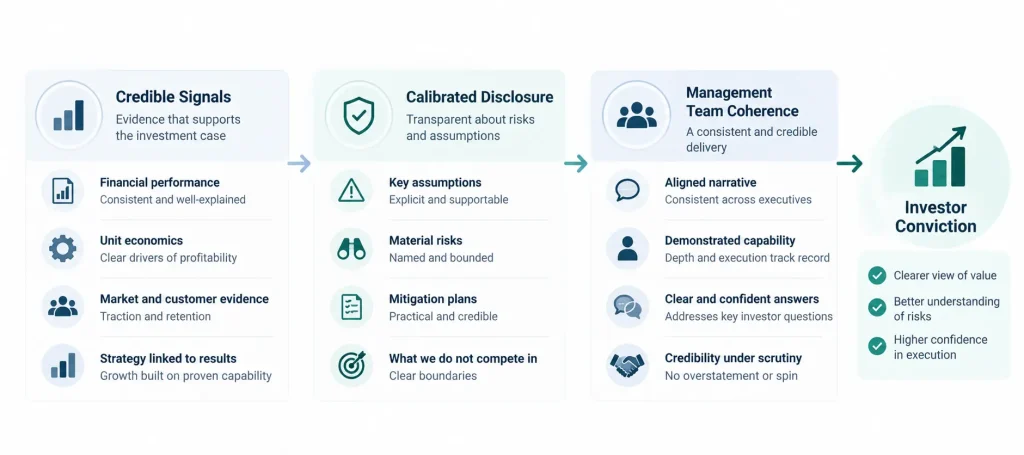
Responsible disclosure in a management presentation typically includes several practical habits:
- Explaining what drives each improvement in margin or growth
- Describing the costs of growth, including managerial and product strain
- Flagging cohorts too recent to extrapolate and metrics whose definitions changed
- Naming stress points openly, for example through a “What keeps us up at night” slide
Board-grade reporting and an ASC 606 revenue recognition framework carried a $30M ARR cybersecurity company through acquisition diligence, a reminder that transparent definitions protect value long after the presentation ends. The CFO acts as filter, custodian, and editor, deciding what complexity to retain, what volatility to explain, and what uncertainty to admit. Teams that compress responsibly may not win every process, but they consistently earn trust, which compounds across every future board meeting and audit committee review.
Three Key Takeaways
- A winning management presentation follows causal logic rather than chronology, opening with the investment thesis and presenting strategy as a scaled extension of proven capability.
- Signal-to-noise discipline, anchoring slides designed for memory, and tight team coherence determine what investors retain and act upon after the session.
- Owning risk through calibrated disclosure re-prices uncertainty in the company’s favor, and responsible compression builds the trust that carries into the post-close relationship.
Disclaimer: This article is intended for informational purposes only and does not constitute legal, tax, or accounting advice. You should consult your own tax advisor or counsel for advice tailored to your specific situation.
Hindol Datta is a four-time CFO and senior finance executive with over 25 years of leadership experience across cybersecurity, SaaS, gaming, logistics, digital marketing, medical devices, consumer products, and nonprofit organizations. He has led more than $120M in fundraising and over $150M in M&A transactions while building the financial and operational systems that let complex businesses scale with confidence. He is the author of seven books in the Systems CFO Series and holds active CPA, CMA, and CIA credentials.
AI-assisted insights, supplemented by 25 years of finance leadership experience.