
Executive Summary
A management incentive plan is one of the most misunderstood tools a CFO controls. Companies often treat it as a compensation lever, yet it works as a lever of cognition. It defines success, shapes decisions, and tells talented people where to point their effort.
This article explores the psychology behind incentives, the economics of incentive plan design, the failure modes that erode alignment, and the forces reshaping executive compensation. Finance leaders will find a practical framework for building a management incentive plan that rewards real value creation and holds up over time.
Why a Management Incentive Plan Is Strategy in Disguise
Capable executives often pursue outcomes that quietly undermine the organizations they serve. The cause is rarely a lack of motivation. It is a lack of direction, and that direction comes from how the incentive plan is built.
A management incentive plan does not simply reward outcomes; it encodes a belief system. Game theory makes the point plainly: players optimize for payoff structures, not intentions. In crafting what gets rewarded, the plan also decides what gets ignored, and fragility often begins in those unmeasured shadows.
Four Tests of a Coherent Incentive System
A well-built management incentive plan satisfies four constraints at once:
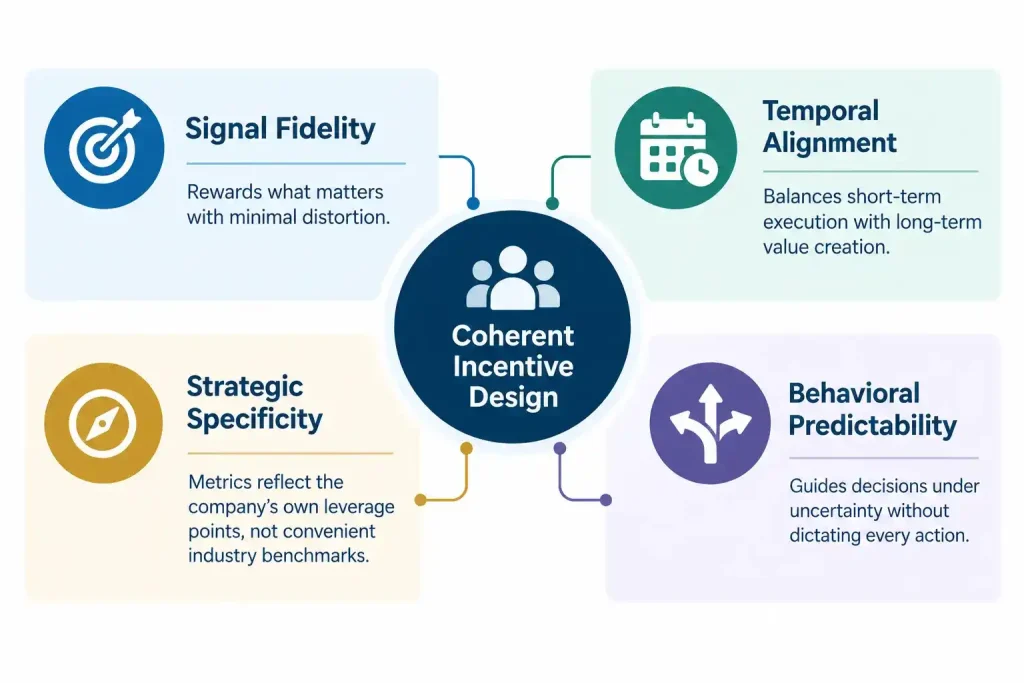
A plan that fails these tests invites distortion, and the classic EBITDA-linked bonus shows how. Built without nuance, it can trigger cuts to R&D, maintenance, and training, along with delayed hiring and aggressive revenue recognition. TSR-linked equity grants carry a similar flaw, since they often reward market beta more than operating alpha and encourage financial engineering over real operating leverage.
Ethics belongs inside the design, not after it. Major corporate scandals of the past two decades trace back to incentives that rewarded local wins at the expense of systemic integrity. The CFO must ensure that what is rewarded never outpaces what is right.
The Psychology Behind Incentive Plan Design
The people inside a management incentive plan are not spreadsheets. They are pattern-seeking, story-driven social beings with bounded rationality, and they interpret incentives instead of simply responding to them. Every management incentive plan sends a compressed message about what the institution counts, and what gets counted becomes the de facto purpose.
Over time, people become what they are rewarded to be. A bonus tied to quarterly EBITDA growth changes beliefs about what a good quarter looks like. Strategic investments start to be judged by short-term dilution, and talent decisions tilt toward margin instead of capacity.
Clarity Beats Complexity
Incentives work through narrative as much as through calculus. The familiar balanced scorecard shows the risk in practice. Its aim of weighing financial, operational, customer, and people outcomes is sound, yet executives often cannot tell which dimension wins in a trade-off. Facing that ambiguity, they optimize the measurable at the expense of the meaningful.
The best plans reduce ambiguity and stay flexible in interpretation. They orient people instead of merely motivating them. When external rewards feel coercive or misaligned, behavioral economics shows they can crowd out intrinsic motivation, turning craft into transaction.
Trust Sets the Limits
A management incentive plan is only as effective as the trust beneath it. Low-trust environments need tightly specified, closely monitored plans, while high-trust environments can use flexible ones. At a mission-driven education and research institution, the CFO also ran HR. Placing performance management beside finance made it easier to tie reward design to a shared sense of fairness.
The Economics of Management Incentive Plan Design
Designing a management incentive plan is capital allocation in miniature. Every dollar paid must earn its return in behavior. The plan must therefore define the outcomes it buys, the behaviors behind them, and their cost.
Many companies borrow metrics instead of building them. Compensation committees often benchmark to industry quartiles without asking whether those quartiles reflect strategic fitness. The CFO’s task is to match the mission, not the market. A SaaS business with 80% gross margins needs a different plan from a cyclical, capital-intensive manufacturer.
Building the Metric Hierarchy
The right plan starts with economic leverage points, the inputs that move output disproportionately. In marketplaces that may be network liquidity; in roll-ups, integration velocity or free cash flow per acquisition. From those leverage points comes a metric hierarchy.
| Metric Class | Examples | Role in the Plan | Best Paired With |
| Financial | Revenue, EBITDA, cash flow, ROIC | Measures the outcome; lagging | Long-term equity |
| Operational | Churn, utilization, gross margin per unit, time to market | Measures the path; leading | Short-term bonus |
| Strategic | Customer satisfaction, innovation velocity, market entry | Measures system fitness over time | Narrative assessment |
A venture-backed digital marketing company scaled revenue from $9M to $180M in 24 months. CAC, LTV, and contribution margin served as its operating language throughout. Such metrics make strong anchors for short-term reward.
Equity, Synthetic Instruments, and Payback
Time-based vesting assumes that retention equals performance, yet tenure without contribution is subsidized inertia. Performance-based RSUs, market stock units, and premium-priced options reward the delta instead of the drift. Calibration still matters, because a metric outside the executive’s influence breeds disengagement, while one that is too narrow breeds tunnel vision.
Private companies can use phantom equity, value units, and growth shares to replicate alignment without diluting the cap table. These instruments can pay out against hurdle rates, internal IRRs, or bespoke KPIs, provided participants see them as transparent and fair. The CFO should model each management incentive plan as a share of contribution to free cash flow, not as a percentage of salary. Strong plans return $3 to $5 of economic value for every $1 paid.
Matching Payout Cadence to Feedback Loops
Bonuses paid too often induce myopia, and equity that vests too far out induces detachment. Each payout should follow the cadence at which the rewarded action can be measured.
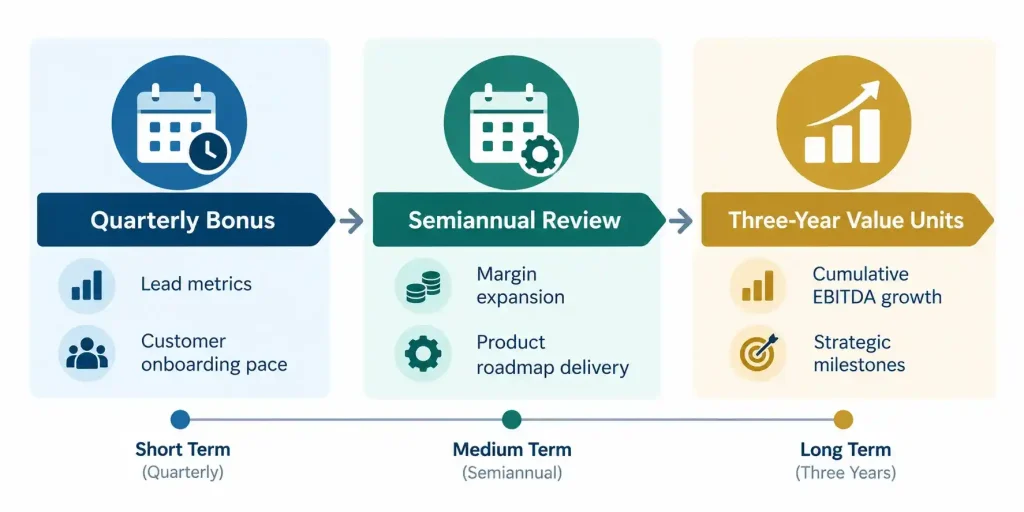
A layered management incentive plan like this can lower attrition and speed decisions during hypergrowth.
Failure Modes That Erode Incentive Alignment
Every management incentive plan accumulates friction over time. Assumptions age, and the plan gradually loses track of what it is paying for. Unearned bonuses, disengaged high performers, and departments working at cross-purposes are the common symptoms.
Five Failure Modes and Their Remedies
| Failure Mode | How It Shows Up | Remedy |
| Single-metric tyranny | The firm optimizes the KPI instead of the mission, as Goodhart’s Law predicts | Triangulate with several metrics and explain why each matters |
| Gaming | Costs get deferred and revenue accelerated to hit targets | Transparency, auditability, and links between input and output metrics |
| Temporal myopia | R&D, talent, and infrastructure get starved for near-term results | Stagger short, medium, and long-term awards |
| Siloed metrics | Sales, operations, and product each win locally while the system fragments | Shared bonus pools and cross-functional metrics |
| Trust erosion | Employees see the plan as arbitrary or political and disengage | Explainable calibration, consistent governance, and timely feedback |
Siloed metrics are hard to spot because each plan looks rational on its own. At a professional services firm with five business units, engagement-level profitability and utilization analytics revealed where margin was leaking across service lines. Shared measures like these turn zero-sum trade-offs into joint optimization. In a cybersecurity services business, holding bench utilization under 5% to 7% during rapid growth required delivery and finance to own the same FTE and subcontractor mix.
What unites these failure modes is a loss of narrative coherence. Durable plans include renewal mechanisms, such as an annual incentive health check that reviews every plan against current strategy and surfaces tensions before they harden.
The Future of the Management Incentive Plan
Three shifts are reshaping incentives: AI that augments judgment, firms that operate as constellations of full-time, fractional, and gig contributors, and a changing social consensus on fairness. As AI handles more forecasting and analysis, the human contribution moves toward judgment under ambiguity and questioning the model. Peer evaluation and scenario-based assessments can serve as proxies for that harder-to-measure contribution.
Modular organizations also invite programmable incentives, such as milestone-based payments, tokenized equity units, and contribution-scored grants. At a pre-Series A AI governance platform, an AI-first finance workflow already compressed the time from question to decision. Incentive and reward cycles may soon follow that same pace.
Five principles will guide the next generation of management incentive plan design:
- Explainability over complexity, so plans stay easy to audit and discuss
- Optionality over rigidity, so plans fit varied contributors and time horizons
- Participation over prescription, so employees help shape and review the framework
- Alignment over optics, so mission-linked metrics carry real accountability
- Resilience over optimization, so plans preserve adaptability across cycles
Three Key Takeaways
- A management incentive plan is strategy expressed as reward, so its metrics must reflect the firm’s own economic leverage points instead of borrowed industry benchmarks.
- Metric hierarchy and payout cadence decide whether a plan aligns behavior, with operational metrics anchoring short-term bonuses and financial outcomes anchoring long-term equity.
- Every incentive system decays, and regular recalibration, cross-functional metrics, and transparent governance keep the plan trusted and aligned as strategy evolves.
Disclaimer: This article is intended for informational purposes only and does not constitute legal, tax, or accounting advice. You should consult your own tax advisor or counsel for advice tailored to your specific situation.
Hindol Datta is a four-time CFO and senior finance executive with over 25 years of leadership experience across cybersecurity, SaaS, gaming, logistics, digital marketing, medical devices, consumer products, and nonprofit organizations. He has led more than $120M in fundraising and over $150M in M&A transactions while building the financial and operational systems that let complex businesses scale with confidence. He is the author of seven books in the Systems CFO Series and holds active CPA, CMA, and CIA credentials.
AI-assisted insights, supplemented by 25 years of finance leadership experience.