
Executive Summary
A management buyout is the moment when the people who run a business decide they should also own it. On paper, an MBO transfers capital and control. In practice, it reshapes incentives, governance, and culture well beyond closing.
This guide follows the deal from first intent through financing, legal safeguards, and life after close. It offers a practical view of the capital stack, fair governance, and the disciplines that make insider ownership last.
What a Management Buyout Is and Why It Begins
Most management buyouts begin quietly, with questions and frustrations long before anyone drafts a term sheet. A private equity sponsor nears the end of its hold period. A parent company may decide a division no longer fits. Elsewhere, a founder approaching retirement may realize that succession is now a real decision with a deadline.
On the other side, a management team that has stabilized operations starts to wonder whether absentee owners still add value. The MBO grows out of these shifts, and it carries both a parting and a consolidation within the same transaction.
Motivations on Both Sides of the Table
The reasons behind a management buyout are rarely symmetrical, but they often meet at a workable point. Management usually wants three things, while owners weigh a different set of priorities:
- Control, because strategy may feel dictated by distant capital instead of local insight
- Belief, because the team often sees upside the current owners lack the patience to pursue
- Economics, because owning equity converts operating knowledge into a direct financial return
- Owner liquidity, with greater confidentiality and less disruption than a full auction process
- Owner caution, given the risk of underpricing and the need to guard against insider advantage
That final concern shapes everything that follows in the process. Managers know the company better than any outside buyer, including its risks, bottlenecks, and latent opportunities. Sellers must therefore ask whether a buyout proposal reflects conviction about the future or knowledge others do not have.
Timing the MBO Window
An MBO pursued too early can disrupt momentum, while one pursued too late may arrive after value has already decayed. The strongest window tends to open after stabilization, once a turnaround is complete and the business needs reinvestment, not repair. At that point, risk has receded but upside remains, and both parties can test their intent honestly.
Management must also decide whether it wants ownership or only more autonomy inside the current structure. Ownership brings capital risk, governance duties, and the strain of leading through volatility without a sponsor behind the team.
Management Buyout Financing and the Capital Stack
Few management teams can fund an acquisition from personal resources, so management buyout financing becomes an exercise in orchestration. The capital stack must cover the price, fit the cash the business generates, and preserve incentives after close.
Typical Layers of MBO Financing
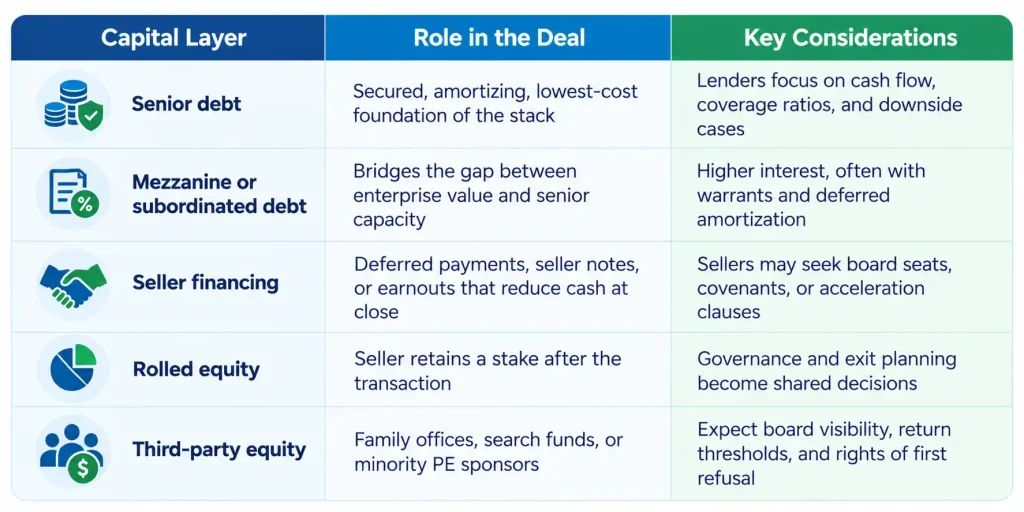
Each layer brings its own covenants and its own claim on future cash. Lenders respond to recurring revenue, customer diversification, and working capital discipline, not to management conviction. At a $127M global consumer products company, $12M in growth financing depended on proven inventory and cash discipline. The same logic governs any management buyout seeking senior debt.
Capital design in a leaner setting follows similar rules. At a mission-driven education institution, a $37M raise across equity and venture debt matched each tranche to credible cash flows.
Valuation and Stress Testing the Deal
Valuation sits at the center of every MBO, and it is harder than it looks. Management knows the business intimately, yet that knowledge carries optimism, ambition, and some nostalgia. A defensible price rests on precedent, normalized EBITDA, and cash flows that survive scrutiny from the board and outside advisors.
The framing questions matter as much as the arithmetic. Should the price reflect past performance or future potential, and how should non-recurring adjustments be treated? In a buy-side review of an IT services target, quality-of-earnings work surfaced material EBITDA adjustments. Reported earnings had drifted away from economic reality in several places. Management buyouts deserve the same rigor, because insiders are not immune to flattering their own numbers.
Stress testing should then push the structure well past the base case. Covenant headroom, seasonality, operating leverage, and capital expenditure needs all need severe sensitivity analysis. Once the deal closes, optimism stops being an advantage, and every borrowed dollar becomes a claim on future performance.
Governance and Fiduciary Duty in an MBO
A management buyout is never a true arm’s-length negotiation. The buyers are also agents of the seller, owing duties to owners while seeking a favorable price. Good intent alone cannot reconcile these roles, so a documented and defensible process has to carry the weight.
The MBO Governance Process
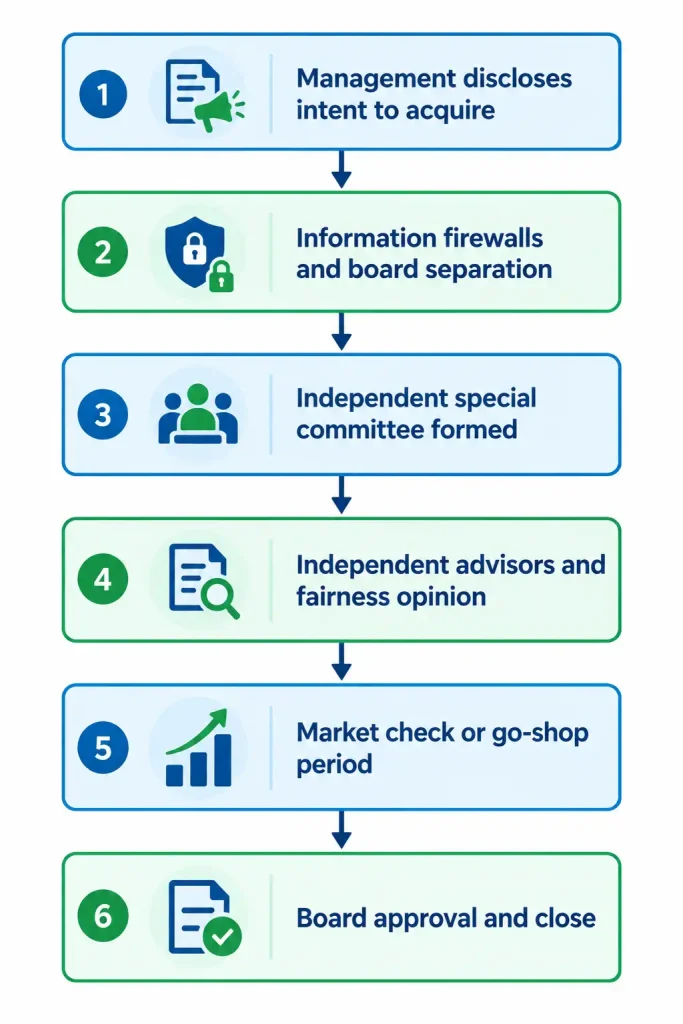
The process starts with conflict disclosure, which changes management’s position from trusted advisor to counterparty. Access to confidential forecasts may need firewalls, and board meetings may need to run in separate sessions. A special committee of disinterested directors then takes on the seller’s fiduciary role, hires advisors, and evaluates offers. That independence must be genuine, since a committee of loyalists offers a fig leaf, not a shield.
Fairness Opinions, Go-Shop Provisions, and Regulatory Review
Without the price discovery of an auction, the seller carries the burden of showing that the price is fair. Third-party fairness opinions support that case, though they cannot repair a flawed process on their own. A go-shop provision lets the seller solicit higher bids after signing, often with a right for management to match. That mechanism adds market discipline without abandoning the relational logic of the MBO.
Regulatory exposure also deserves attention, even for deals below antitrust thresholds. Transactions involving pension funds, ESOPs, or institutional investors can trigger ERISA standards, SEC guidance, or Department of Labor interpretations. Throughout, the CFO acts as custodian of truth and never shades assumptions to justify more debt.
Life After the Management Buyout: Ownership, Culture, and Discipline
Signing ends the negotiation, but closing begins a longer story written in daily decisions. Managers who were once agents now own the consequences, and autonomy arrives alongside accountability. The weekly cash call stops being a routine update and becomes a referendum on the business.
Ownership imposes a discipline that outside mandates rarely achieve. Headcount additions face harder questions, travel becomes purposeful, and marginal hires look like permanent liabilities. At an early-stage digital marketing company, cutting monthly burn from $800K to $200K showed how fast cash discipline resets culture. Post-MBO companies face the same choice, with debt service adding urgency.
Avoiding Post-Deal Inertia
The transformation from operator to owner is not automatic. Many teams keep acting as if the old permission structures still apply, deferring decisions and blurring trade-offs. The result is post-deal inertia, where the company is technically owned but practically unled.
The strongest management buyouts treat closing as a re-founding moment. Leadership must answer why the team owns this company, then build that answer into incentives, hiring, and governance.
Incentives, Board Governance, and Resilience
Several disciplines separate durable MBOs from fragile ones:
- Equity terms, including vesting, dilution, and exit scenarios, that management understands and trusts
- Shadow equity plans or performance bonuses for employees who did not participate in the buyout
- A board of independent thinkers and sector veterans who challenge management, not just receive reports
- A self-defined time horizon aimed at a future sale, recapitalization, or dividend recap
- Cash discipline and scenario planning that absorb shocks before they become covenant breaches
Predictable forecasting makes each of these disciplines far easier to sustain. At a cybersecurity and identity access company, actuals held within five percent of forecast for 8 consecutive quarters. That record carried the business through acquisition diligence. Post-close MBO teams need that same reliability, because a missed quarter now threatens debt service rather than a bonus.
Three Key Takeaways
- A management buyout succeeds only when the capital stack matches the cash the business can generate, so stress test every tranche well beyond the base case before signing.
- Insider deals demand visible fairness, which means conflict disclosure, a genuinely independent special committee, and a fairness opinion supported by a market check.
- Closing an MBO is a re-founding moment, and value depends on whether management changes its behavior, incentives, and governance to match its new role as owner.
Disclaimer: This article is intended for informational purposes only and does not constitute legal, tax, or accounting advice. You should consult your own tax advisor or counsel for advice tailored to your specific situation.
Hindol Datta is a four-time CFO and senior finance executive with over 25 years of leadership experience across cybersecurity, SaaS, gaming, logistics, digital marketing, medical devices, consumer products, and nonprofit organizations. He has led more than $120M in fundraising and over $150M in M&A transactions while building the financial and operational systems that let complex businesses scale with confidence. He is the author of seven books in the Systems CFO Series and holds active CPA, CMA, and CIA credentials.
AI-assisted insights, supplemented by 25 years of finance leadership experience.