
Executive Summary
The LP vs GP relationship sits at the center of private equity, yet many still read it as a legal arrangement instead of a working partnership. Limited partners supply capital and accept years of limited control, while general partners hold discretion over how that capital moves. This article examines how that delegated trust is designed, tested, and maintained when fund documents fall silent.
Readers will find a practical view of the structural asymmetries in the general partner vs limited partner model, how LPs judge GPs beyond returns, and which governance tools sustain alignment. The aim is a working framework for alignment that survives difficult cycles.
Why the LP vs GP Relationship Works as a Delegated Trust System
On paper, limited partners and general partners co-own a common enterprise, with one side supplying capital and the other supplying capability. Beneath that symmetry lies a structure of unequal power, information, and control. So the useful question is not what the terms say, but what governs behavior when the terms say nothing.
A private placement memorandum rarely reveals the true nature of a partnership, while conduct under uncertainty almost always does. An LP extends judgment and accepts a decade of asymmetric exposure in exchange for aligned outcomes. A GP accepts that burden, along with outside oversight and the duty to turn a thesis into returns again and again.
That compact now faces real strain on several fronts at once. Performance dispersion is widening, liquidity is tighter, and LP investment committees have grown more cautious. GPs under pressure to raise and return capital often expand strategy, and the answer lies in deeper clarity, not longer checklists.
GP vs LP Structure and the Architecture of Asymmetry
What the LP provides is deferred control, a surrender of daily governance in exchange for a pro-rata share of an unknowable future. From the moment of close, the LP receives reports instead of leading decisions, so its power is procedural, not proactive. The GP works through immediacy, executing a mandate that is part blueprint and part blank canvas. This deliberate design trades concentrated control for agility, balanced by periodic, contractual accountability.
Diagram: How Capital, Control, and Information Flow
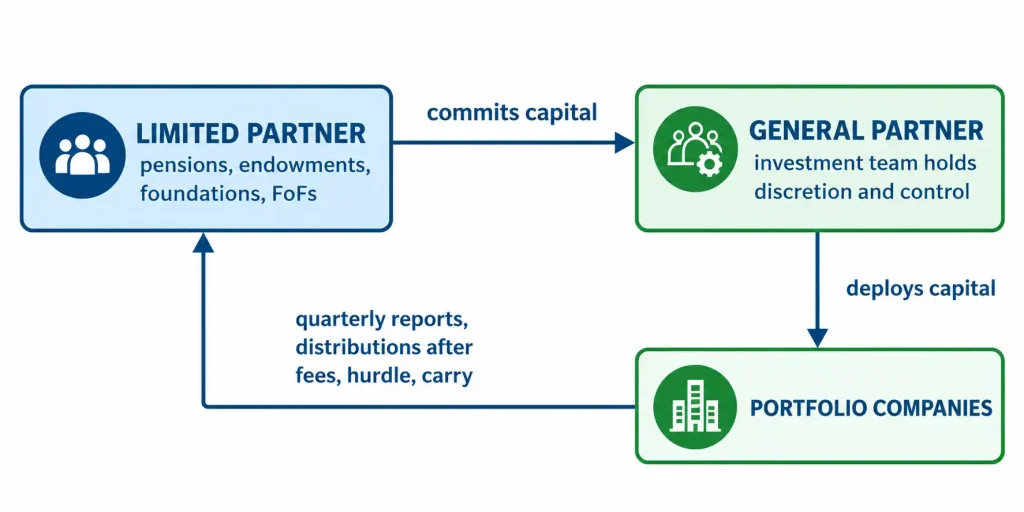
Three Structural Asymmetries in the General Partner vs Limited Partner Model
Each asymmetry is rational alone, yet together they shape behavior under pressure:
- Timing: LPs commit capital up front while GPs draw it down over years, creating friction around capital calls, recycling, and the J-curve.
- Information: GPs hold granular deal data, while LPs receive quarterly letters that are often delayed and smoothed.
- Incentives: GPs earn fees regardless of performance and carry only after a hurdle, while LPs bear risk first and share the reward.
In an IT services acquisition, buy-side quality-of-earnings analysis can reveal how far reported EBITDA drifts from economic reality. Material adjustments of this kind rarely appear in a quarterly summary, and that gap mirrors the information asymmetry an LP lives with.
Contract Terms That Act as Design Checks
The industry answers these asymmetries with a familiar set of terms:
- Preferred return and catch-up provisions regulate the sequencing of rewards.
- Clawbacks restore fairness when a GP received carry too early.
- Key-person clauses hedge against partner turnover and identity risk.
- Limited Partner Advisory Committees (LPACs) arbitrate conflicts and surface governance issues.
Terms alone cannot cover the limits of design, because the deeper challenge is behavioral. GPs need to remember that their discretion is borrowed and that transparency is not weakness. Consider a GP who delays an exit to build value, knowing it lowers short-term DPI. A partner LP understands the logic, while a mechanistic one protests. Structure does not create the relationship; it exposes whether that relationship rests on mutualism or quiet antagonism.
How LPs Evaluate GPs Beyond IRR and DPI
Gross IRR, net MOIC, DPI, and PME all matter, but treating the measurable as the whole picture misreads capital delegation. LPs invest in judgment under pressure, which no return series can fully capture. They assess it across cycles and conversations along three axes.
The Three Axes of LP Trust
- Epistemic clarity: Can the GP separate market beta from true alpha and admit what it does not know?
- Temporal behavior: Does the GP stay disciplined in good years and communicate more in bad ones?
- Narrative coherence: Do decisions match the stated thesis, or does style drift signal a gap between belief and behavior?
Over time, LPs keep an unwritten ledger of reliability, noting whether a GP called early when a deal soured. That ledger shapes reallocation more than quartile rankings, which explains why some strong performers struggle to raise.
A cybersecurity SaaS business with roughly $30M in ARR offers an operating parallel. When actuals stay within five percent of forecast for 8 consecutive quarters, board confidence grows more than it would from any single strong quarter.
Why the Time Horizon Turns Trust into Information
Private equity runs on deferred feedback, where decisions from year one surface in returns around year seven. Interim marks can mislead, so trust becomes a proxy for incomplete information. Four amplifiers tend to strengthen that trust over a fund’s life:
- Transparency in uncertainty, since overcommunication when unsure signals maturity
- Consistency in process, anchored by a documented deal filter
- Humility in success, with honest credit given to external factors
- Clarity in failure, because explaining a loss often matters more than explaining a win
LPs carry their own duties as partners in the fund. They must judge process durability over recent results and accept that an illiquid asset class cannot deliver high returns with low volatility.
LP vs GP Governance: Terms, LPACs, and Reporting Over Time
A well-structured fund works like a constitutional regime with defined rights and encoded constraints. Governance in the LP vs GP relationship acts as a signaling system that sustains alignment when incentives diverge.
Fund Economics Beyond 2 and 20
The standard model pairs a 2% management fee with 20% carried interest above a preferred return. Fee drag can outpace investment velocity when exits are scarce. Carry is back-loaded and path-dependent, which may tempt GPs toward late-fund optionality. LPs respond with tiered carry, larger GP commitments, and IRR-based hurdles that work as behavioral stabilizers, not punishments.
The LPAC and the Rhythm of Transparency
The LPAC arbitrates conflicts, grants waivers, and checks compliance with the LPA, yet its real power lies in signal. Strong LPACs ask hard questions and lend legitimacy to grey-zone decisions, while weak ones turn ceremonial. A GP that shares full memos and invites dissent shows confidence, not vulnerability. Through quarterly reports and annual meetings, the best GPs explain why results matter, track KPIs over time, and disclose valuation volatility alongside realized gains.
A mission-driven education institution raising $37M in equity and venture debt reinforces this point. Investor narratives and audit committee reporting that carry full context earn credibility that polished summaries cannot.
Succession as a Continuity Test
Succession asks whether a firm’s edge, values, and behavior survive a change in leadership. LPs watch whether the carry pool is shared and whether the investment committee decides or defers to a founder. A firm that cannot govern its own transitions cannot credibly govern outside capital.
The Ethics of Stewardship in the General Partner vs Limited Partner Compact
Capital, like time, is entrusted, and no one can reclaim it once spent. Behind every fund stand pensioners, students, and civic institutions whose mandates outlast any deal cycle. The GP sees more and acts more, while the LP hopes that decisions made in partial light match the values stated at close.
Character Questions Every GP Should Ask
Ethical stewardship means the presence of conscience, not the absence of error. Three questions help bring that conscience into daily decisions:
- Is the firm acting consistently with its own thesis?
- Has risk been priced honestly, even when the answer hurts the model?
- Would the decision hold up in front of the LP’s board if the outcome is poor?
Exiting early to lift DPI before a fundraise may be legal and even rational, but is it right? Quietly drifting into adjacent strategies raises the same question, as does delaying notice of a partner departure. Firms that answer these questions well enter the loop below, where LPs reward candor with trust that endures downturns and forgives owned mistakes.
Diagram: The Trust and Alignment Loop
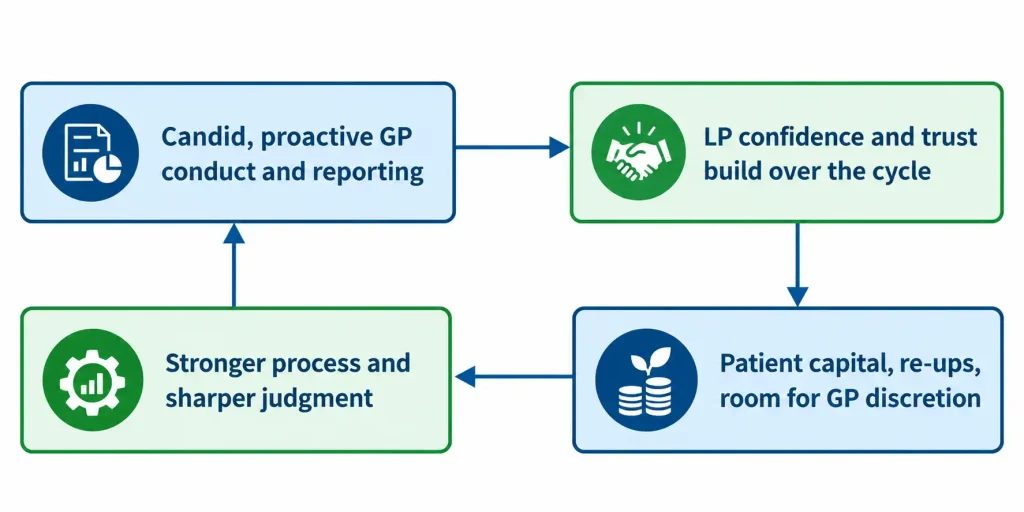
Three Imperatives for Renewing the LP vs GP Compact
Capital is plentiful and talent is mobile, but earned alignment is the one asset neither side can afford to waste, so firms and allocators can anchor on three imperatives:
- Treat alignment as a process, since a single breach can unwind years of goodwill.
- Design for transparency without losing the discretion that gives a GP its agility.
- Remember the end user of capital, or stewardship shrinks into scorekeeping.
Three Key Takeaways
- The LP vs GP relationship rests on delegated trust, so alignment depends on how a GP behaves when the fund documents are silent.
- LPs judge GPs on epistemic clarity, temporal behavior, and narrative coherence, and that unwritten reliability ledger shapes re-up decisions more than quartile rankings.
- Preferred returns, clawbacks, LPACs, and succession plans sustain alignment only when culture backs them, which turns transparency into a strategic asset for both sides.
Disclaimer: This article is intended for informational purposes only and does not constitute legal, tax, or accounting advice. You should consult your own tax advisor or counsel for advice tailored to your specific situation.
Hindol Datta is a four-time CFO and senior finance executive with over 25 years of leadership experience across cybersecurity, SaaS, gaming, logistics, digital marketing, medical devices, consumer products, and nonprofit organizations. He has led more than $120M in fundraising and over $150M in M&A transactions while building the financial and operational systems that let complex businesses scale with confidence. He is the author of seven books in the Systems CFO Series and holds active CPA, CMA, and CIA credentials.
AI-assisted insights, supplemented by 25 years of finance leadership experience.