
Executive Summary
A leveraged buyout acquires a company using modest equity and a large amount of debt. The target’s own cash flows service that debt across a defined holding period. This article explains the LBO meaning in practical terms and traces the history of the structure. It then covers the capital stack, the valuation logic, and the operating discipline that follows closing. The final sections address the ethical responsibilities that come with applying leverage to a living enterprise.
Finance leaders and board members will find a working framework for judging leveraged buyouts. It shows when a buyout creates durable value and when it merely rearranges risk. Examples from diligence, scaling, and turnaround work support each part of the framework.
LBO Meaning and Why the Structure Endures
The Core Mechanics of a Leveraged Buyout
The LBO meaning begins with a deceptively simple idea. A sponsor buys a company with a relatively small equity cheque and finances the rest with debt. The target’s cash flows then repay that debt while the enterprise grows. Behind that simplicity sits a structure of real delicacy. Too much debt strips the company of resilience, while too little leaves the return equation unable to work.
Debt in this setting does more than fund the purchase. Fixed interest payments sharpen operational focus and remove the luxury of drift. They also force management to report results against the model every month. That pressure is designed to reveal what a business can do rather than to break it.
Where a Leveraged Buyout Works Best
The mechanism functions only when the inputs are of a specific kind. A strong LBO candidate usually shows the following characteristics.
- Reliable, predictable cash flows that can carry fixed interest obligations through a full economic cycle.
- Defensible gross margins in a market where technological disruption is limited.
- Financeable assets and understandable systems that outside lenders can underwrite with confidence.
- Management that is either replaceable or deeply aligned with the new owners.
Every leveraged buyout also carries a strategic assertion: the company is underperforming its potential under current ownership. Each deal is a bet on time as well. The holding period is finite, and the clock starts at close. Sponsors must therefore weigh exit scenarios at inception. Timing shapes the capital stack, the governance model, and the value creation plan.
How the Leveraged Buyout Evolved from Arbitrage to Architecture
The earliest LBOs emerged in the postwar decades as speculative maneuvers that arbitraged the gap between market valuations and the intrinsic value of under-levered assets. The 1980s gave the structure its shape, driven by deregulation, high-yield debt markets, and sponsors who saw that many public companies suffered from internal complacency rather than external threat, so the arithmetic of debt service exposed overhead bloat, excess working capital, and siloed decision-making.
By the late 1980s the appetite for leverage had outrun the discipline of design, and the mega-deals of that period tied the term to hostile takeovers and asset stripping, a reputation the modern LBO has been slow to shed despite bearing little resemblance to its predecessor.
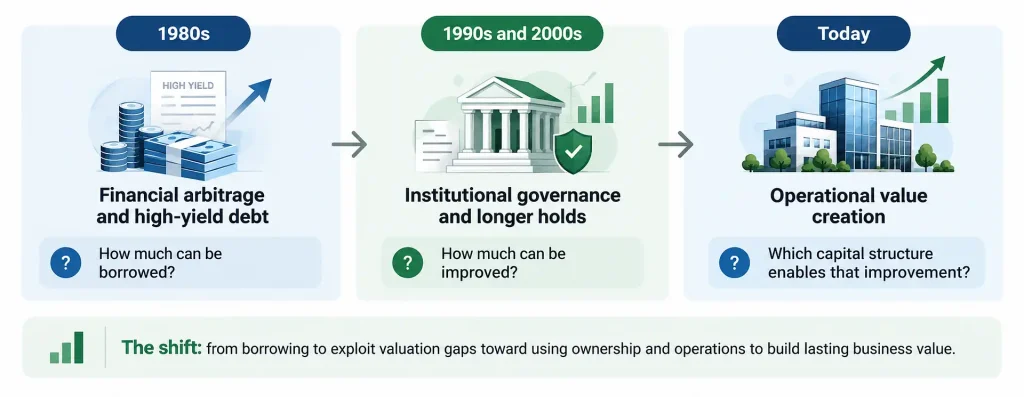
Two forces drove the shift. Private equity matured into an asset class answerable to limited partners and regulators, so returns once earned through leverage alone now had to come from pricing strategy, procurement, and digital enablement. Public markets also grew more efficient, leaving founder-owned businesses without succession, carve-outs, and companies with failed governance. The LBO became a rescue rather than a raid, while its core belief remained intact, namely that concentrated and incentivized ownership beats diffuse accountability.
The Capital Stack, Valuation, and LBO Returns
Structuring the Capital Stack
Every LBO model starts with the capital stack, the scaffold on which the transaction rests. It must carry debt service in lean years while leaving room for growth investment.
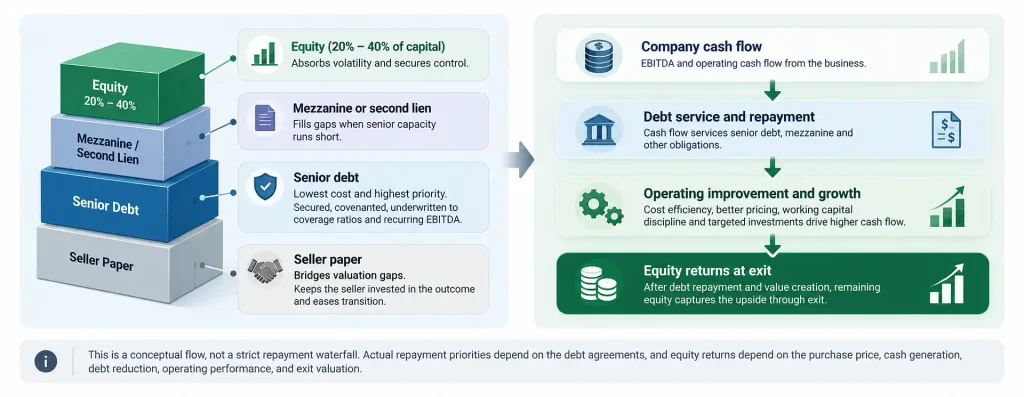
Every additional turn of leverage tightens covenant headroom, so the craft lies in optimizing leverage rather than maximizing it. In one buy-side diligence engagement on an IT services target, quality-of-earnings work surfaced material EBITDA adjustments and showed where reported earnings diverged from economic reality, which changed how much debt the structure could safely carry.
Valuation Methods and Return Expectations
Valuation rests on normalized last twelve months EBITDA and must also support the stack above it. Three approaches are common.
- Comparable company analysis, which reveals market sentiment.
- Precedent transactions, which anchor the price to what other buyers have paid.
- Discounted cash flow, which asserts a specific narrative of value creation.
The governing question is what price allows the structure to function and still deliver the required return. That return is expressed as IRR over a hold of roughly three to seven years, built on revenue growth, margin expansion, cash conversion, and multiple expansion. The model is normative rather than predictive, so it turns the capital stack into an operating mandate that covenants such as leverage ceilings and interest coverage floors enforce, which is why the CFO must act as steward of the structure.
Operating Strategy After Closing a Leveraged Buyout
Operating Rhythm and Reporting
Once the ink dries, board meetings shift from quarterly updates to monthly working sessions, forecasting becomes a rolling discipline, and EBITDA margin and cash conversion become contractual expectations. In a high-growth cybersecurity and identity company with roughly $30M in annual recurring revenue, a driver-based forecasting engine built from scratch held actuals within plus or minus 5% of forecast for 8 consecutive quarters, and the same board-grade reporting later carried the business through acquisition diligence.
Efficiency Gains and Smart Reinvestment
Performance in an LBO extends beyond topline growth, since value must be extracted from SG&A, vendor relationships, receivables, and inventory. At a $127M global consumer products company, demand planning and SKU rationalization lifted inventory turns from 3x to 7x and released trapped working capital, which shows how much value sits in the balance sheet.
Cost discipline in these deals must not harden into austerity. In an early-stage digital marketing company, reducing monthly burn from $800K to $200K held because controls and reporting were rebuilt at the same time. The best outcomes pair savings with reinvestment in pricing analytics, supply chain resilience, and product development, each justified under return logic.
Incentives, Leadership, and Culture
Incentive design is the most potent post-close lever. Management equity is reset, phantom equity or SAR plans reach key contributors, and bonuses tie to cash-on-cash returns so that sales leaders care about margin and procurement thinks in lifecycle terms. Leadership fitness is tested quickly, and culture becomes a function of credibility, because employees judge new owners by whether they communicate the plan and replace underperformers with better people rather than cheaper ones. When these elements diverge, the LBO acts as an X-ray that exposes the weaknesses beneath.
Ethics and Stewardship in a Leveraged Buyout
Leverage at scale casts a moral shadow. The first question is who pays for the value created, whether employees facing tighter cost regimes, customers, vendors pressed for working capital concessions, or the future adaptability of the company itself. Compression also creates an asymmetry of urgency, because investors measure success by fund life while employees experience that same window as an accelerant. Three safeguards help keep the structure honest.
- A board that blends operators, financial stewards, and skeptics rather than only deal veterans.
- Plain language about the power shift behind phrases such as unlocking value.
- A first-principles test of whether the deal should exist at all, driven by succession, stasis, or strategic misfit rather than available capital and appealing fees.
Done well, a leveraged buyout is a force for alignment and strategic renewal, and done poorly it camouflages weakness behind a balanced spreadsheet. The absence of design, rather than leverage itself, makes a buyout dangerous, and stewardship asks what remains after the exit and whether the company became more adaptive and more trusted.
Three Key Takeaways
- A leveraged buyout works only when predictable cash flows, a realistic capital stack, and a defined exit plan are designed together from the first day.
- Post-close value comes from operating rhythm, aligned incentives, and reinvestment, with the CFO acting as steward of the structure and not merely its modeler.
- Responsible LBO practice measures success by what the company becomes after exit, since returns alone do not distinguish building from extraction.
Disclaimer: This article is intended for informational purposes only and does not constitute legal, tax, or accounting advice. You should consult your own tax advisor or counsel for advice tailored to your specific situation.
Hindol Datta is a four-time CFO and senior finance executive with over 25 years of leadership experience across cybersecurity, SaaS, gaming, logistics, digital marketing, medical devices, consumer products, and nonprofit organizations. He has led more than $120M in fundraising and over $150M in M&A transactions while building the financial and operational systems that let complex businesses scale with confidence. He is the author of seven books in the Systems CFO Series and holds active CPA, CMA, and CIA credentials.
AI-assisted insights, supplemented by 25 years of finance leadership experience.