
Executive Summary
The leverage ratio sits at the center of nearly every private equity deal, yet few metrics get such careful modeling at entry and so little review afterward. Debt sharpens returns and enforces discipline, but it also narrows the margin for error.
This article examines how to set a financial leverage ratio against the real volatility of a business, how to manage debt across the holding period, and how leverage shapes investor psychology and firm culture. The goal is a leverage philosophy that protects returns while keeping room to respond when plans deviate.
What a Leverage Ratio Really Measures in Private Equity
On a term sheet, leverage carries the appearance of precision. Debt divided by EBITDA, or debt as a share of enterprise value, shows how much borrowed capital supports an asset. The number is clean and comparable, which explains both its appeal and its danger.
The Assumptions Hidden Inside Debt-to-EBITDA
Behind every leverage ratio sits a stack of judgments about cash flow durability, margin stability, reinvestment needs, and cyclicality. Precedent, optimism, and pressure to make the deal work often shape those judgments. The EBITDA figure itself deserves as much scrutiny as the debt. Quality-of-earnings work on an IT services acquisition, for example, surfaced adjustments where reported earnings diverged from economic reality, so the true debt multiple sat higher than the headline suggested.
After closing, those assumptions harden into the lens for reading all later performance. Pricing power can erode, input costs can climb, and working capital can prove less fluid than forecast. The leverage ratio on paper stays the same while its meaning shifts, because debt does not adjust to risk and only equity absorbs the change.
Why Leverage Amplifies Fragility as Well as Return
A company that misses plan under modest debt disappoints its board. The same miss under heavy debt can breach covenants, trip the revolver, and open restructuring talks. Performance is identical in both cases, and only the tolerance for error differs.
Advocates argue that debt disciplines management and accelerates exit, and often that holds true. Discipline born of fear, however, differs from discipline born of clarity. An over-constrained capital structure strips out optionality along with waste, delaying growth investment and pushing management to optimize for cash rather than value.
Matching the Financial Leverage Ratio to the Business
The right question is not whether to use leverage but how much a specific business can carry without losing its ability to adapt. Too little debt and the fund underperforms its cost of capital; too much and the portfolio turns brittle. Setting the financial leverage ratio should start with the business itself rather than industry comps or bank appetite, guided by a few diagnostic questions:
- How volatile are cash flows across a full cycle?
- How seasonal or concentrated is the revenue base?
- How much of the cost structure is fixed rather than variable?
- What capital expenditure will the hold period demand?
- How quickly can management correct underperformance?
Leverage Capacity by Business Profile
| Business Profile | Leverage Capacity | Primary Constraint |
| Consumer business with repeat purchases and low fixed costs | Higher | Demand shifts |
| Enterprise software with concentrated customers and long sales cycles | Moderate to lower | Revenue timing |
| Manufacturer with aging equipment | Lower | Deferred capital expenditure |
| Asset-light services firm | Moderate to higher | Utilization and talent |
Exit Market Risk and the Leverage Ratio
A business levered at six times EBITDA looks reasonable against a twelve-times exit multiple. Buyer sentiment, however, can turn toward deleveraged assets or lower valuations. The capital structure that once magnified return then constrains it, and an unchanged business trades lower because its debt makes it harder to sell.
Any leverage ratio must therefore fit the company’s path and the fund’s timeline. Sound sponsors model debt for compression as well as the base case, negotiate covenants expecting some to face testing, and hold operating reserves because trouble is never impossible. Value in private equity rarely vanishes through headline errors; it leaks away through slow slippage and delayed reactions.
Managing the Leverage Ratio After Close
If the initial structure tests foresight, its stewardship tests operational maturity. A common mistake is treating leverage as a closed loop that sponsors set at close and ignore until a refinancing appears. Every leveraged balance sheet is contingent, and the leverage ratio deserves tuning as conditions change.
Reading the Early Warning Signals
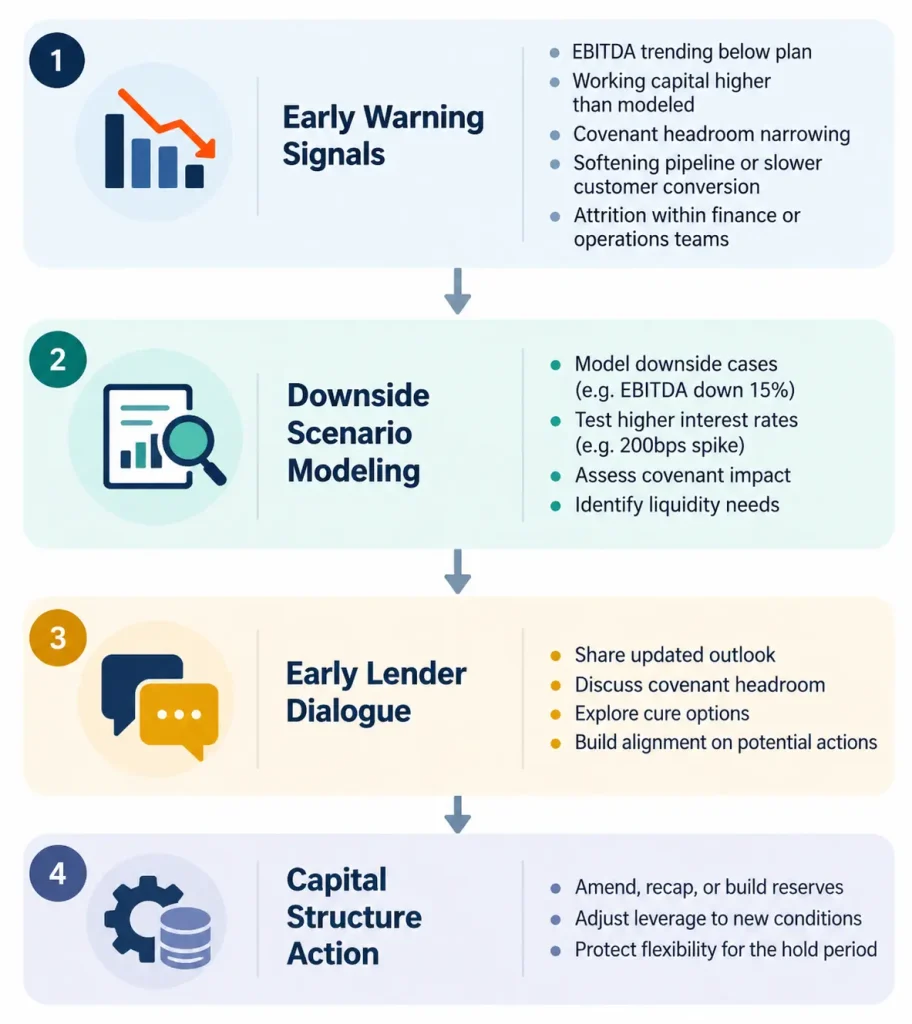
Some warning signs arrive through standard metrics, while others surface in the operating rhythm long before a covenant test:
- EBITDA trending below plan for consecutive periods
- Working capital expanding faster than modeled
- Covenant headroom narrowing each quarter
- A softening pipeline or slower customer conversion
- Attrition within finance or operations teams
Strong sponsors engage early and use downside scenarios as decision tools. What happens if run-rate EBITDA falls 15% for three quarters, or if borrowing costs spike? The flow below shows how a disciplined team moves from signal to action.
Building Covenant Fluency with Lenders
A well-run finance function knows its trigger levels, definitions, cure periods, and amendment procedures in detail, and forecast credibility underpins that knowledge. At a $30M ARR cybersecurity and identity access management company, a driver-based forecasting engine held actuals within plus or minus 5% of forecast for 8 consecutive quarters. That predictability turns lender conversations from defensive to collaborative.
Working capital is often the fastest lever for creating debt capacity. At a $127M global consumer products company, lifting inventory turns from 3x to 7x released trapped cash and strengthened the case for $12M in growth financing.
Recaps, Amendments, and Portfolio-Level Leverage
Active capital structure management also creates flexibility for the sponsor. A steady performer may support a partial recap that pulls forward DPI, while a volatile company may benefit from a preemptive amendment negotiated from strength. At the fund level, leverage can create unintended correlation when a rate spike hits several portfolio companies at once, a lesson sponsors who entered the pandemic with thin covenant flexibility learned firsthand.
The Psychology of Leverage and Investor Judgment
Leverage shapes the behavior of those who use it. The equity check is a subordinate slice of a capital stack governed by external constraint, and that constraint brings urgency along with fear. Inside organizations, fear often disguises itself as overconfidence, delay, or groupthink.
Loss Aversion and the Refusal to Update
When a portfolio company misses plan, loss aversion pushes sponsors to hold on too long, adjusting assumptions instead of decisions. Cutting leverage feels like admitting the original bet was overconfident. Bayesian thinking offers a better posture, treating prior assumptions as provisional and revising them as evidence shifts. An early-stage digital marketing SaaS company that cut monthly burn from $800K to $200K shows what decisive updating looks like.
When Redemption Seeking Replaces Judgment
Redemption seeking poses an even greater danger to returns. A partner rescuing a weak performer may push an acquisition, a revenue-inflating price change, or a recap that drains cash for DPI optics. Each move is defensible alone, yet together they form desperation disguised as decisiveness. A firm’s reputation rests less on its average leverage ratio than on how it behaves when that leverage begins to bite.
How Leverage Shapes Private Equity Firm Culture
Over time, a leverage strategy can harden into institutional identity, and the drift tends to follow a recognizable cycle.
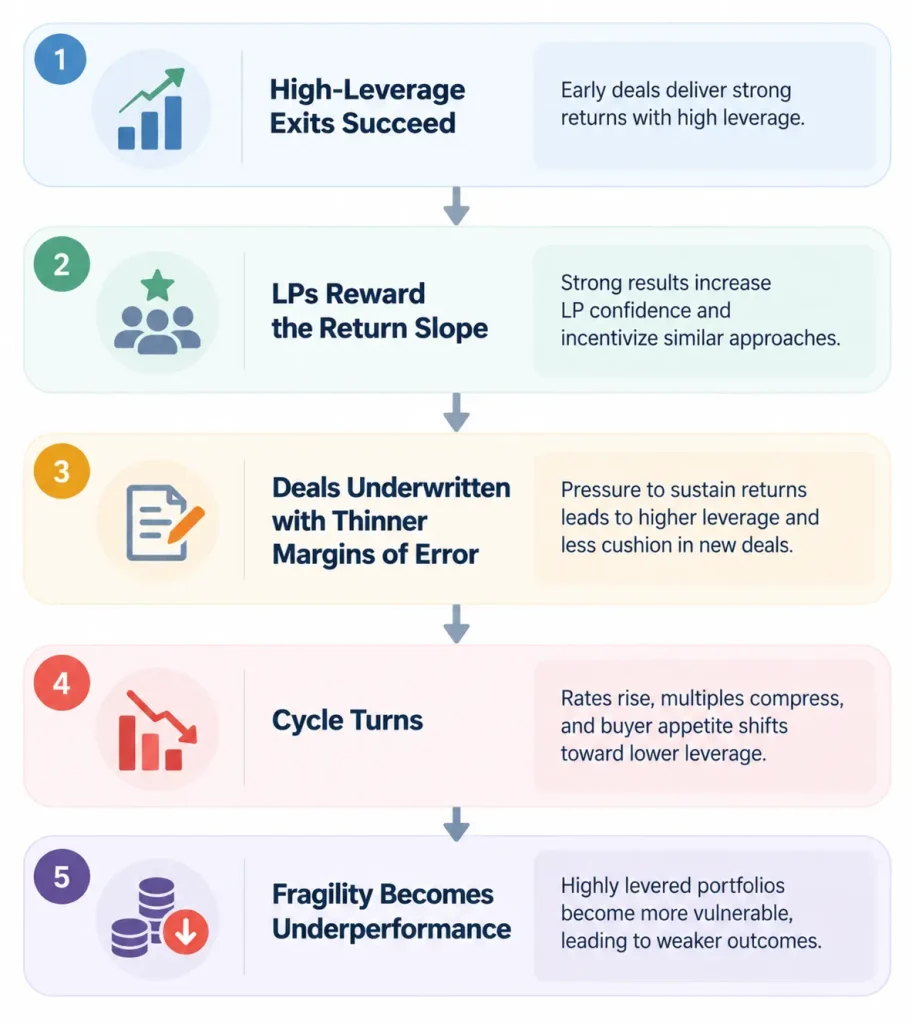
Some firms recognize this drift and recalibrate, accepting lower headline IRRs for wider bandwidth and structural cushions. Others double down with continuation vehicles and structured equity until the model falters from over-application. The most durable firms revisit their leverage stance annually, asking how much debt they should carry given what they now believe, not merely how much a business can bear.
Building a Leverage Philosophy That Survives the Cycle
Leverage multiplies consequence as readily as it multiplies cash. A sound leverage philosophy gets revisited in success, not only after failure, and commits the firm to a few principles:
- Underwrite debt with both ambition and restraint
- Structure for growth without betting the company
- Use leverage to align incentives rather than distort behavior
- Exit when the story matures, not merely when coverage improves
Judgment remains the rarest edge in private equity, and it shows in the choices made when the plan deviates and returns hang in the balance.
Three Key Takeaways
- A leverage ratio is only as reliable as the EBITDA and assumptions behind it, so debt should reflect each business’s real volatility, capital needs, and exit risk.
- Active management of the financial leverage ratio after close, through warning signals, covenant fluency, and timely amendments, lets sponsors act from strength.
- Leverage works best as a living doctrine reviewed in good years, because unexamined debt distorts judgment and eventually reshapes firm culture.
Disclaimer: This article is intended for informational purposes only and does not constitute legal, tax, or accounting advice. You should consult your own tax advisor or counsel for advice tailored to your specific situation.
Hindol Datta is a four-time CFO and senior finance executive with over 25 years of leadership experience across cybersecurity, SaaS, gaming, logistics, digital marketing, medical devices, consumer products, and nonprofit organizations. He has led more than $120M in fundraising and over $150M in M&A transactions while building the financial and operational systems that let complex businesses scale with confidence. He is the author of seven books in the Systems CFO Series and holds active CPA, CMA, and CIA credentials.
AI-assisted insights, supplemented by 25 years of finance leadership experience.