
Executive Summary
Working with lawyers under deadline pressure is one of the most persistent friction points in growing companies. Most of that friction comes from confusion about priority, not from the legal work itself. When every contract, hire, and financing document arrives on counsel’s desk with equal urgency, review slows down. It settles to the pace of the most cautious lawyer in the room. The fix is not to push lawyers to move faster. It is to give legal teams a structure that tells them where genuine risk lives. That structure lets speed and diligence stop competing with each other.
This article lays out a practical framework for working with lawyers when time is short. It covers a color-coded triage system and a discipline for briefing counsel before a document lands in their inbox. It also makes a case for treating templates as infrastructure rather than paperwork. Examples drawn from finance leadership roles across cybersecurity, gaming, consumer products, and mission-driven organizations show the same pattern. It holds across industries. Companies that build a repeatable process for legal review close faster and make fewer costly mistakes. Counsel becomes an accelerant rather than a checkpoint.
Reframing Legal Review as Risk Triage, not a Bottleneck
Founders and finance leaders tend to experience legal review as drag. A deal is close to signing, an offer letter needs to go out, and counsel raises a question nobody anticipated. That reaction is understandable, but it misreads what is happening. Lawyers are trained to notice details that create liability years later. That vigilance is the entire point of having them in the process.
The companies that move fastest with legal support rarely have the largest legal budget. They are the ones that separate genuine risk from routine paperwork before anything reaches counsel. A high-growth cybersecurity and identity access management company generated close to $30M in annual recurring revenue across five countries. Its finance function operated under a similar discipline, where not every contract required the same depth of review. That same logic applies to how legal requests should be sorted.
The Green, Yellow, and Red Framework for Legal Triage
Not every legal question carries the same weight. Treating all of them as equally urgent is what causes queues to back up. A simple three-tier system gives both business teams and counsel a shared language for prioritization.
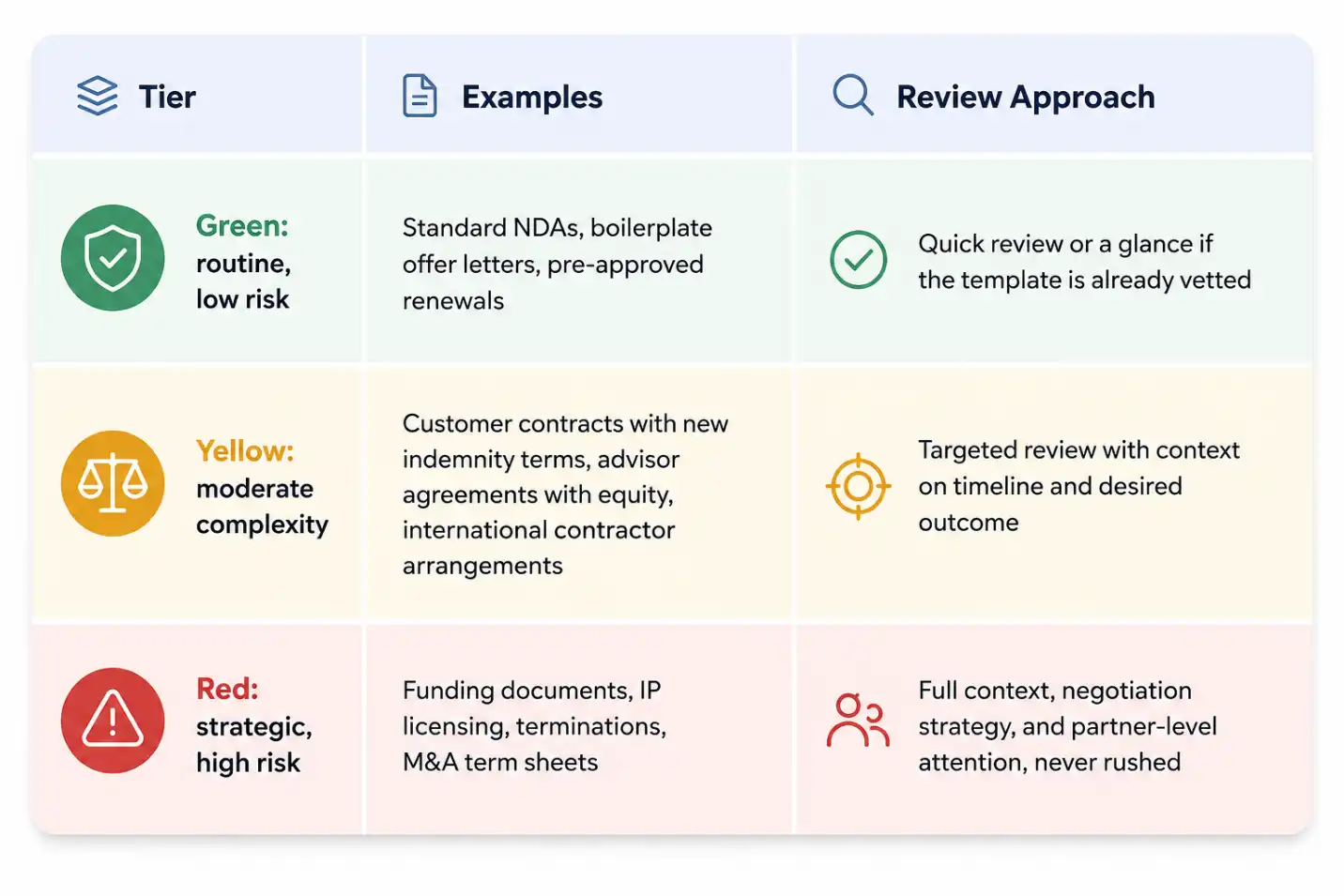
This structure does not remove risk from the business. It aligns attention with what matters. That is the only way legal teams can move quickly on routine work while slowing for decisions that carry long-tail consequences. A $127M global consumer products company with a supply chain spanning two continents used a similar discipline when triaging vendor and logistics contracts. It reserved deep review for agreements touching freight liability and international trade terms. Standard purchase orders, by contrast, moved through a lighter process.
Give Lawyers the Playbook Before They See the Document
Ambiguity is the single biggest driver of delay in lawyer-client communication. When a contract arrives with no context, counsel must reconstruct business intent before assessing risk, and that reconstruction quietly adds days to a review.
The fastest legal teams are not the ones with the largest headcount. They are the ones that receive the clearest inputs.
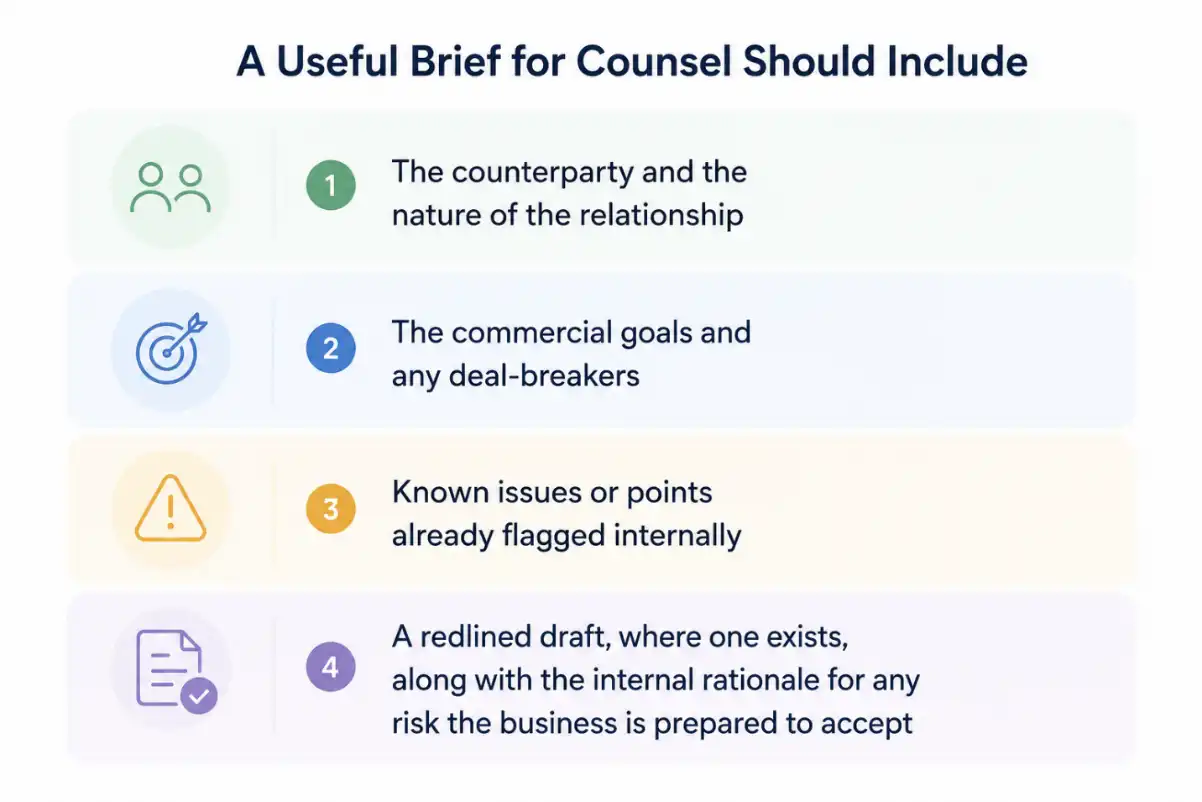
Legal review should begin with context, not discovery. During a global gaming and digital entertainment company’s IPO-readiness process, involving legal counsel from the earliest point, alongside investment bank underwriters and Big Four auditors, made it possible to shape disclosure strategy proactively rather than react to it later. Lawyers function as interpreters of business intent, and the more clearly that intent is communicated, the more focused their work becomes.
Templates Are Speed Infrastructure, Not Paperwork
Companies that scale without process eventually hit a wall. One of the most effective tools for legal speed is a set of pre-approved templates covering NDAs, MSAs, offer letters, option agreements, and vendor contracts. Templates accelerate review only when the underlying documents are genuinely standardized and consistently used.
During a scale-up phase at a venture-backed performance marketing and digital services company that grew revenue from $9M to $180M in twenty-four months, a recurring bottleneck emerged in customer contract review, largely because nearly every agreement was assessed from a blank page. An internal audit found that most contracts were close to identical in substance. Building a clean template alongside a playbook for the sales team cut turnaround time roughly in half the following quarter. Templates function as launch pads rather than rigid forms; teams still flag deviations, but a strong base document lets legal concentrate on exceptions instead of re-litigating fundamentals.
Train Teams to Flag Risk, Not Just Submit Requests
Legal departments often receive a steady stream of requests with no internal prioritization, which forces counsel to do the triage work before reviewing anything. A better model trains business teams to recognize what looks unusual: exclusivity clauses, indemnities, long-term commitments, or unfamiliar jurisdiction terms.
The goal is not to turn every employee into a lawyer. It is pattern recognition. A team taught what to flag can hand counsel a document with the relevant clause already circled, sharpening lawyer-client communication and removing the need to re-read the entire agreement. In one vendor renewal, an exclusivity clause buried in standard language went unflagged, later creating a channel conflict that took weeks to unwind, a cost that a few minutes of trained review would have prevented.
Bring Legal in Early on High-Stakes Deals
Some of the strongest legal work happens under genuine time pressure: fundraising rounds with investor-driven deadlines, customer contracts tied to quarter-end, acquisitions on compressed timelines. The difference between a smooth close and a scramble often comes down to when counsel joined the conversation.
Across three acquisitions led during rapid growth at the same performance marketing company referenced earlier, and again through more than $100M in cross-border M&A executed at the gaming company, involving legal from the first substantive conversation rather than at the documentation stage consistently produced better outcomes. Counsel was able to shape deal structure, flag regulatory exposure early, and help design earn-out terms before positions hardened. The earlier counsel enters a deal, the more leverage the business retains, because lawyers who help shape a transaction do different work than lawyers cleaning one up after the fact.
Knowing What Cannot Be Rushed
Speed and compression are not the same thing, and confusing the two is where founders and finance leaders get into trouble. Board approval for option grants takes the time it takes. Investor consents need lead time. Term sheets should never be signed before counsel reviews the control provisions, regardless of how badly the round needs to close.
Rushing a legal step rarely saves the time it appears to save. The cost of renegotiation or remediation after the fact is almost always higher than the cost of proper review up front. A missed clause granting investor veto rights over key hires, discovered only after a term sheet was signed on a compressed timeline, can stall a critical executive search for months. Intentional speed protects the business; reckless speed simply moves the cost to a later, more expensive date.
Build the Muscle Before the Pressure Hits
Legal speed is less about lawyers working faster and more about an organization building the muscle of clarity, triage, and process before a crisis demands it. That muscle strengthens when business leaders set expectations for what counsel needs and treat legal as a partner embedded in strategy rather than a gate at the end of the process.
At a mission-driven education and research institution, running Finance alongside HR, IT, Legal, and Facilities made the connective tissue between these functions hard to ignore: audit committee engagement, board reporting, and legal risk oversight were never separate conversations. Organizations that plan ahead, brief counsel properly, and triage risk turn legal from a perceived bottleneck into a genuine strategic asset. Under real time pressure, well-prepared lawyers are not the obstacle. They are buying the business time it did not know it needed.
Three Key Takeaways
- A simple three-tier triage system, sorting legal requests into green, yellow, and red categories, gives business teams and counsel a shared language for prioritization and prevents routine matters from consuming the same attention as strategic ones.
- Clear, upfront communication, including counterparty context, commercial goals, and known issues, removes the discovery work that otherwise slows down legal review and strengthens lawyer-client communication at every stage of a deal.
- Bringing legal counsel into high-stakes conversations early, rather than at the documentation stage, consistently produces better deal terms and fewer surprises than treating legal as a final checkpoint before signature.
Disclaimer: This article is intended for informational purposes only and does not constitute legal, tax, or accounting advice. You should consult your own tax advisor or counsel for advice tailored to your specific situation.
Hindol Datta is a four-time CFO and senior finance executive with over 25 years of leadership experience across cybersecurity, SaaS, gaming, logistics, digital marketing, medical devices, consumer products, and nonprofit organizations. He has led more than $120M in fundraising and over $150M in M&A transactions while building the financial and operational systems that let complex businesses scale with confidence. He is the author of seven books in the Systems CFO Series and holds active CPA, CMA, and CIA credentials.
AI-assisted insights, supplemented by 25 years of finance leadership experience.