
Executive Summary
There is a moment in nearly every startup life cycle when the founder hesitates before calling the lawyer. The clock is ticking, the budget feels tight, and handling a contract without outside help feels efficient. Across four CFO seats and twenty-five years of finance and operations leadership, I have seen this hesitation play out often. It’s one of the most expensive habits a founder can carry. Strategic legal counsel, brought in early, does not slow a company down. It builds the foundation that lets a company move fast later. That’s when the stakes are higher and the margin for error has narrowed. Legal fees cost real money. But strategic counsel preserves valuation, prevents litigation, and keeps transactions moving instead of stalling. Founders who treat lawyers as leverage tend to outperform those who treat them as a cost to be minimized.
The Real Cost of Avoiding Legal Counsel
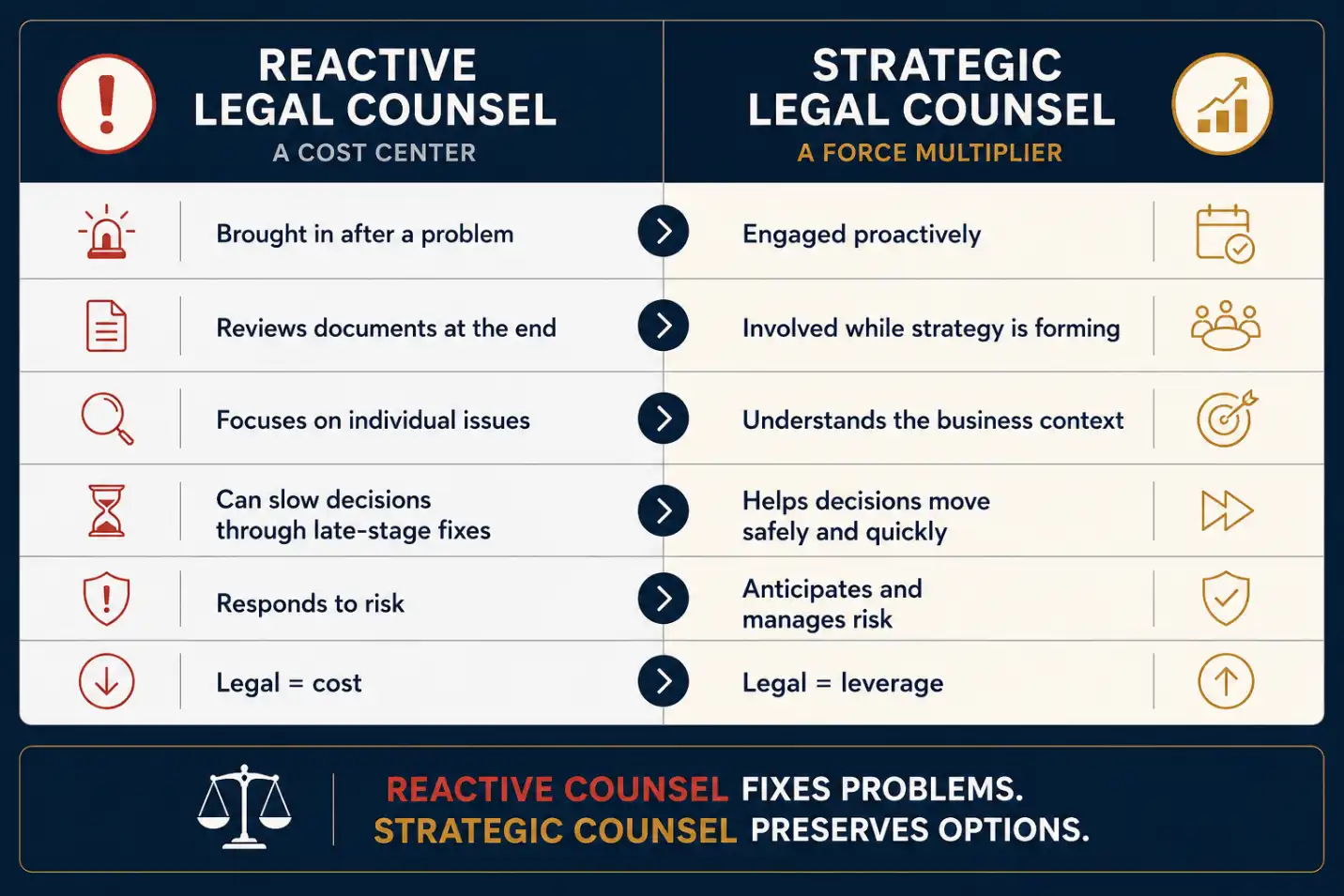
I’ve worked as an operational CFO across venture-backed companies for three decades. In that time, I’ve watched founder-lawyer dynamics play out in every possible way. Some founders sideline lawyers, assuming legal involvement injects unnecessary caution into a deal that needs speed. Others wait too long, believing good lawyers should only appear once a problem has taken shape. Both instincts misread what legal partnership is for.
Lawyers are not adversaries or mere document reviewers. Engaged well, they function as force multipliers. This shows up most visibly in boardroom governance, investor alignment, and the eventual exit. They preserve valuation, prevent litigation, and unlock transactions a less prepared team would have lost. That value only materializes when founders engage counsel proactively; reluctant engagement produces reluctant results.
Where the Fear Comes From
The hesitation stems partly from a real constraint: legal fees accumulate, and early-stage budgets are fragile. Spending scarce capital on legal work can feel like trading creativity for compliance understandable, but short-sighted.
Avoiding lawyers does not eliminate risk it defers it, and deferred risk tends to compound. A SAFE agreement skimmed too quickly, an IP assignment left incomplete, a generic-template employment agreement. Each one creates a pocket of future uncertainty. That risk surfaces eventually, in diligence, in a dispute, in a regulatory inquiry. And the cost of fixing it then dwarfs what prevention would have required. I have sat across the table from acquirers and lenders who found exactly this kind of gap. The leverage it hands the other side is difficult to recover.
Many founders also fear losing control of their company’s pace. That comes from unfamiliarity. Good lawyers who understand startup velocity don’t block decisions. They steer them toward outcomes that hold up under scrutiny.
Building Board Governance Through Strategic Legal Counsel
One of the most misunderstood places where strategic legal counsel earns its keep is inside the boardroom. Corporate governance, done well, is a strategic exercise, not a procedural formality. Legal counsel translates board dynamics into decisions that are accurate, well-timed, and defensible later.
As CFO of a mission-driven education institution in Silicon Valley, I owned Finance, HR, IT, Legal, and Facilities. I also raised $37M in equity and venture debt while structuring the capital stack behind it. That work taught me how much a board’s fiduciary duties depend on legal framing done ahead of time, not cleanup done afterward. A single well-drafted resolution can avert weeks of disagreement. Boards function with real cohesion when counsel is briefed in advance and aligned with the CEO’s intent.
I have also watched dysfunction take hold when counsel was looped in only after positions had hardened. As CFO of a Euronext Paris-listed gaming company operating across five countries, I led S-1 preparation and IPO-readiness alongside underwriters and Big Four auditors work that made clear how much public-company board and audit oversight depends on counsel being embedded from the start.
Governance as a Strategic Exercise, not a Formality
A board’s fiduciary duties are rooted in corporate law, not convention. Legal counsel helps frame discussions, ensure procedural fairness, and reduce the risk of claims surfacing later. When counsel is integrated early, minutes read cleaner, voting rights are unambiguous, and investor relations settle into a rhythm that compounds across every fundraise.
M&A Due Diligence and the Myth of Waiting on Legal Counsel
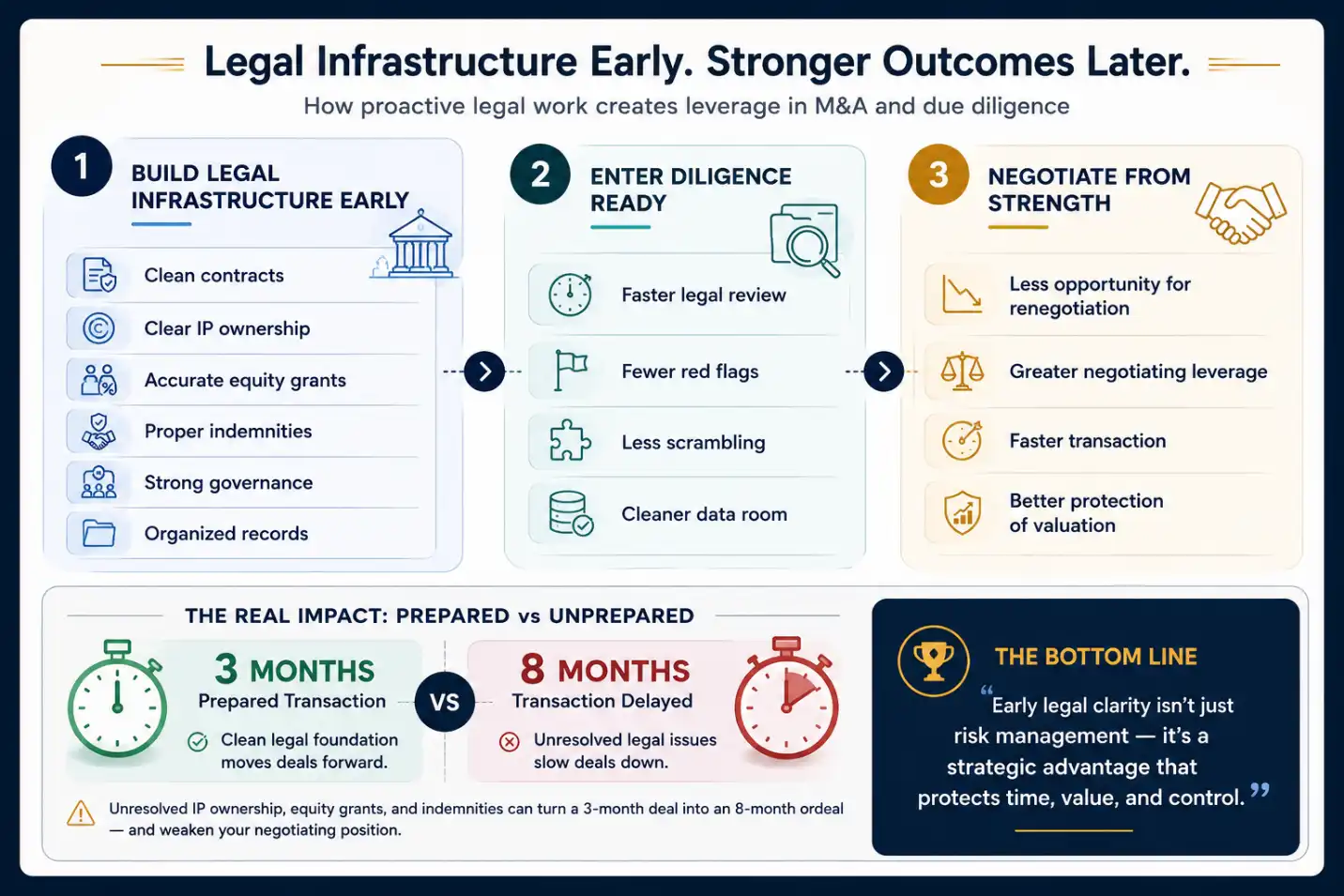
Nowhere is legal delay more dangerous than in M&A. I have advised companies where founders waited until the letter of intent stage to retain serious counsel, and the delay proved costly every time a three-month transaction stretching to eight, with IP, equity, and indemnity red flags giving acquirers leverage to renegotiate valuation downward.
Good M&A outcomes are built over years, not born in the term sheet. As CFO of that gaming company, I executed over $100M in cross-border M&A with full diligence and post-merger integration responsibility, and later led three acquisitions at a performance marketing company after scaling its revenue from $9M to $180M in twenty-four months. In both settings, companies with clean data rooms and accurate representations negotiated from strength rather than catch-up, because counsel had been engaged in the underlying contracts years earlier.
What Early Legal Infrastructure Buys You in Diligence
I have worked on deals where legal diligence completed in days rather than months, purely because the groundwork was already in place. Founders who invest in legal infrastructure early are future-proofing a company that will eventually face a diligence process it did not choose the timing of.
The pattern holds outside pure M&A too. As de facto head of finance for a cybersecurity company with roughly $30M in ARR and 230 employees across five countries, I built the revenue recognition framework and controls environment that carried the business through acquisition diligence without the usual scramble not glamorous work, but the reason diligence felt uneventful.
Turning Outside Counsel into a Strategic Legal Partner
Turning outside counsel into a strategic asset begins with context: lawyers need to understand the business and its strategic intent to give advice that fits. A founder who forwards a contract for review gets a generic memo back; one who explains why a clause is being negotiated gives counsel the chance to be genuinely useful.
It continues with trust: lawyers do their best work when they know the client values speed alongside risk-balanced decisions, not cutting corners but calibrated advice at the pace the business runs. I have worked with legal teams who adapted their style to a founder’s tempo, learning when to flag a genuine hard stop and when to suggest workaround language instead.
Finally, it requires rhythm monthly check-ins, early reviews of major deals, and pre-board briefings that keep counsel informed rather than perpetually behind, so the relationship feels like leverage rather than expense.
Building a Legal-First Culture Around Governance and Risk
Founders rarely extend the same cultural attention they give product and sales to compliance and legal risk. A company where legal is sidelined sends a quiet signal breeding informal contracting, untracked stock options, and verbal commitments no one remembers the same way six months later. That undermines enterprise value in ways hard to see until a diligence process or dispute forces the issue into the open.
A culture that integrates strategic legal counsel from the start builds institutional confidence instead: proper offers for new hires, clean updates for investors, contracts actually reviewed rather than rubber-stamped. That reputation pays dividends when the company scales or enters a regulated market where informality costs more.
I saw this directly inside a $127M global consumer products company where I served as CFO, overseeing DTC, Amazon, and wholesale channels alongside a supply chain spanning China and Vietnam. Four consecutive clean external audits while owning that P&L were only possible because governance and controls had been treated as a growth function from early on the same lesson that showed up at the cybersecurity company, where holding actuals within five percent of forecast for eight straight quarters depended on a control’s environment counsel had helped build.
Rethinking the Founder-Counsel Relationship
Founders must stop thinking of lawyers as necessary evils tolerated only when a signature is required. It is more accurate to see strategic legal counsel as a navigator: mapping risk, translating ambiguity, and preserving optionality for decisions not yet made. Counsel used this way protects a company’s ability to move fast later, when speed matters more than it does today.
When founders avoid lawyers, they borrow confidence at the cost of future control, and that loan comes due at the worst possible moment mid-diligence, or mid-dispute, when earlier structure would have prevented it. The real question is not whether legal bills are affordable today, but whether the company can afford the confusion that shows up later.
So, call the lawyer. Not when the problem has erupted, but before it takes shape. Not when the contract is final, but while the strategy is still fluid enough to shape. Treat strategic legal counsel as a founder’s other co-pilot a genuine partner in clarity, not a compliance filter bolted onto the end of the process.
There is little regret, in my experience, attached to the cost of good legal advice. The cost that lingers is the one attached to its absence.
Three Key Takeaways
- Strategic legal counsel functions as leverage, not overhead founders who engage lawyers proactively in governance, contracting, and capital structure preserve more valuation than those who wait until a problem surfaces.
- Legal delay is most expensive in M&A and fundraising, where clean data rooms and accurate representations, built years in advance, let a company negotiate from strength rather than scramble during diligence.
- A legal-first culture, built through context, trust, and cadence with outside counsel, becomes a growth engine rather than a cost center, signaling seriousness well before any transaction puts it to the test.
Disclaimer: This article is intended for informational purposes only and does not constitute legal, tax, or accounting advice. You should consult your own tax advisor or counsel for advice tailored to your specific situation.
Hindol Datta is a four-time CFO and senior finance executive with over 25 years of leadership experience across cybersecurity, SaaS, gaming, logistics, digital marketing, medical devices, consumer products, and nonprofit organizations. He has led more than $120M in fundraising and over $150M in M&A transactions while building the financial and operational systems that let complex businesses scale with confidence. He is the author of seven books in the Systems CFO Series and holds active CPA, CMA, and CIA credentials.
AI-assisted insights, supplemented by 25 years of finance leadership experience.