
Executive Summary
Every leadership development framework claims to shape judgment, yet the strongest teacher in most companies sits on the dashboard. Financial KPIs decide what gets rewarded, what earns trust, and what a serious leader chooses. Rising managers absorb those signals long before any workshop reaches them. When metrics only grade outcomes, they produce leaders who can optimize a model but struggle to imagine a future.
This article reframes KPIs as developmental tools instead of evaluative ones. It covers five shifts: metrics as mentors, a judgment layer, financial courage, reviews as workshops, and the CFO’s own influence. Together they form a practical leadership development framework for finance leaders who want sharper leaders, not just sharper numbers.
How Financial KPIs Quietly Shape Leadership Development
A high-potential director once explained why she had shelved a risky, forward-looking initiative. “It just does not score well on ROIC right now,” she said, half apologetic and half calculating. She was right on paper, yet the organization had taught her that convergent metrics, not divergent bets, earned reward and trust.
That lesson rarely appears in an HR strategy document. Leadership development happens in high-pressure moments of calculation, when someone must decide what is worth doing. The answer depends on what finance has taught them to see. Every dashboard, forecast model, and earnings call prep quietly defines what mature judgment looks like.
The Silent Curriculum Inside Every Metric
KPIs live in comp plans, quarterly business reviews, and succession conversations, where they signal what matters for pay and promotion. For ambitious emerging leaders, that signal becomes gospel. Without deliberate design, the curriculum produces predictable distortions:
- KPIs that reward only growth create leaders who stay silent as risk metastasizes.
- KPIs that obsess over margin quietly push innovation out of the building.
- Performance systems with no room for reflection produce leaders who never learned to pause.
- A CFO who treats metrics as neutral builds a culture that mirrors what it measured, not what it intended.
The pattern shows up in Fortune 500 companies and Series B startups alike. Young executives learn to call every tradeoff “accretive” and reduce every idea to a ratio. They become financially literate yet strategically nearsighted, which no leadership development framework intends. Metrics are partial tools, and partial tools mistaken for whole truths lead good people astray.
Five Pillars of the Leadership Development Framework
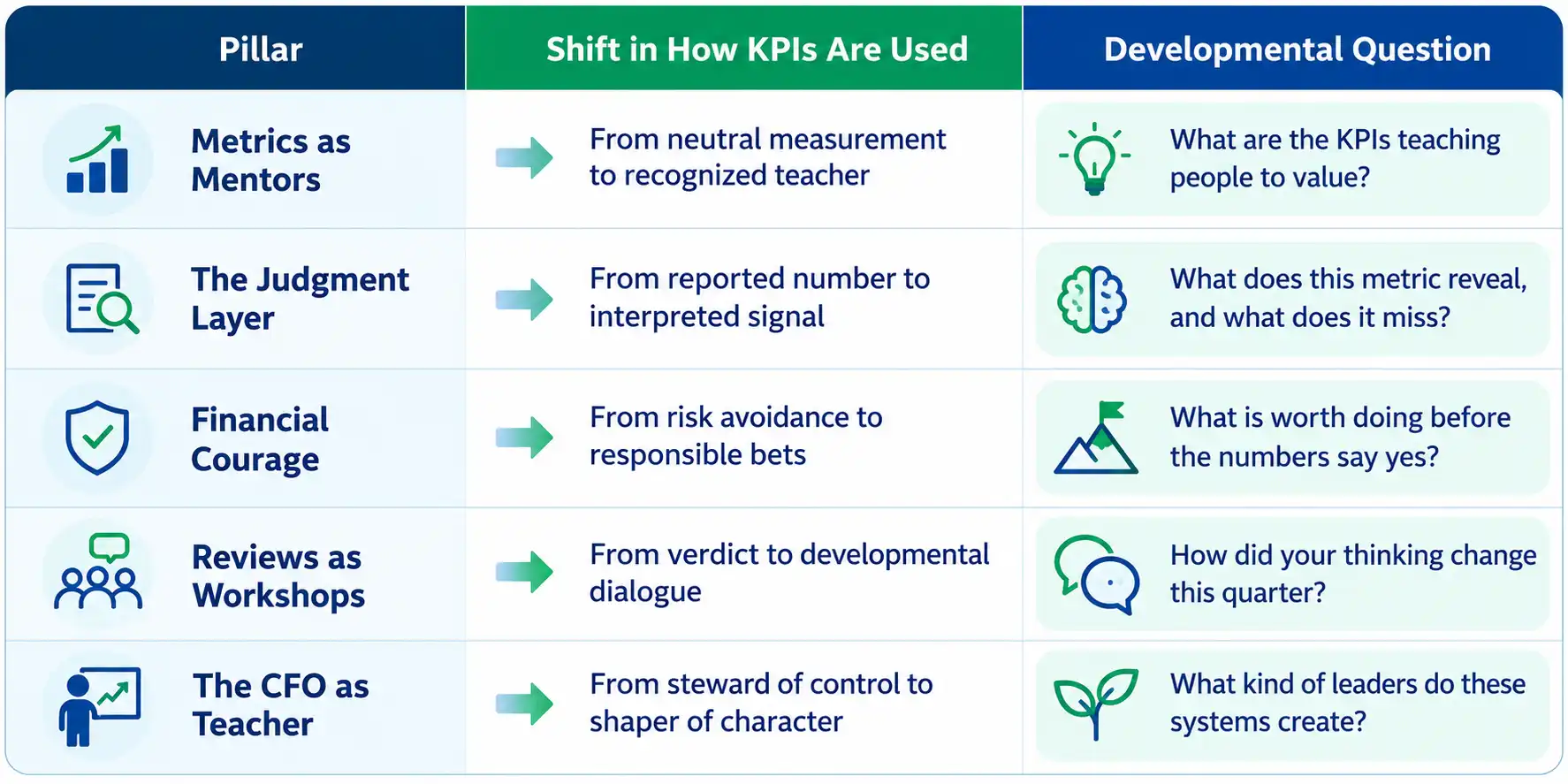
The Judgment Layer in a Leadership Development Framework
A spreadsheet can hold many truths, but never the full one. Consider a business case with an IRR above the hurdle and payback inside 30 months. The CEO asked the finance lead a single question: “Do you believe this?” The reply, “The numbers are sound,” missed the point. Presenting a forecast differs from standing behind a judgment.
What the Dashboard Cannot Show
Analytical leaders tend to want the right answer. The judgment layer offers no right answer, only the practiced ability to hold conflicting truths and still make a call. Here is what several common metrics leave unsaid about the business:
- CAC may be improving while the brand quietly cheapens.
- Opex may sit within range while burnout accumulates in the team.
- Budget adherence may look flawless while the budget itself has become obsolete.
At a cybersecurity company with $30M in ARR, a driver-based forecast held actuals within five percent for 8 consecutive quarters. That accuracy earned board confidence, but the more durable value came from leaders who could explain what the forecast assumed and where it might break.
Designing KPIs With Interpretive Space
Judgment cannot be taught directly, but a sound leadership development framework can design for it. One practice works well: add a prompt beneath each KPI asking, “What does this reveal, and what does it hide?” Status updates then start to resemble strategic debates. Leaders begin flagging numbers that look good but mislead.
Consider a division leader who hit every financial target yet could not produce a credible strategy update. He had managed the dashboard, not the business. A dashboard can be followed, but a business must be interpreted.
Teaching Financial Courage Through KPIs
A thin line separates prudence from fear, and most people cross it without noticing. Finance has long treated risk as something to score, hedge, and defer. Yet the CFO’s job is to distinguish irresponsibility from imagination, not to eliminate risk.
When only predictable, low-variance projects win approval, young leaders learn to sand the edges off every idea. Every meaningful pivot or reinvention, however, began with someone who believed before the idea was measurable.
Giving Leaders Air Cover
A cautious product leader once held back a new pricing model because her P&L did not justify it in year one. Launching would be messy, she admitted, but it would force an overdue rethink of the customer base. Her request to finance was striking: “Permission to not look efficient for a while.” She needed air cover more than a better KPI.
At a venture-backed digital marketing company that grew from $9M to $180M in 24 months, CAC and LTV discipline made bold bets safer. Rigor and courage worked in tandem, not in tension, inside that company. In the best organizations, unconventional proposals meet questions instead of silence:
- What is the team not seeing yet?
- What future does this open up?
- What could the company miss by waiting?
Redesigning Performance Reviews for Leadership Development
The most scripted meetings in a company are also the most revealing. Quarterly reviews arrive with tight decks, known questions, and trailing decimals. Too often, nobody discusses how the person across the table is forming judgment. The review evaluates a result but rarely develops a leader.
From Verdict to Dialogue
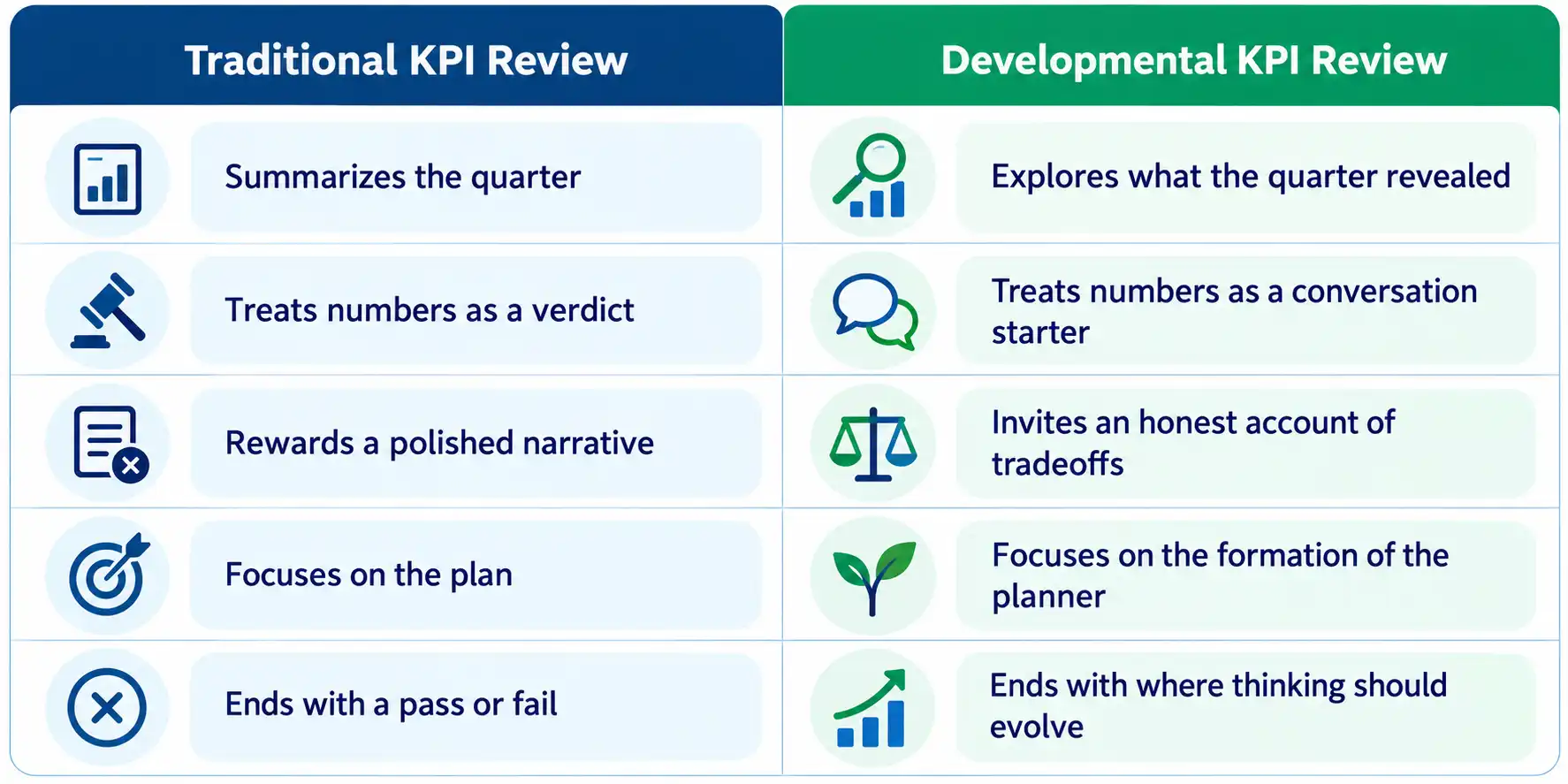
In one mid-year review, a business unit head opened with the story of the quarter as he lived it. He described a divisive product decision and regret over a voice he had not heeded. He also named a hiring call that never moved a KPI but lifted his team’s confidence. Those ten minutes revealed more than a year of updates. A leadership development framework built on reviews might use prompts like these:
- Which assumptions did you carry into the quarter, and which ones cracked?
- What surprised you, and what did you resist seeing?
- Where were you too cautious, and where did you lean too hard on certainty?
- What are you proud of that does not appear on the slide?
Growing a finance team from 1 to 12 people reinforced the same point. The strongest hires could explain why they hesitated and how they weighed risk.
The CFO’s Role in a Leadership Development Framework
Systems do not stay still; they soak into culture. The ratios a CFO prioritizes become the intuitions others develop. Over time, KPIs harden into theology because people mistake them for truth.
At a Euronext Paris-listed gaming company, a firmwide Oracle and MicroStrategy rollout created one definition of revenue. That precision had value, yet tighter systems can narrow the thinking inside them, and people start managing metrics instead of the business. A CFO who acts as a moral editor of the measurement system responds with specific behaviors:
- Asking for the most honest explanation, not the cleanest one.
- Treating a miss as information about what the plan failed to see.
- Saying openly, “This quarter looks good, but the judgment was poor.”
- Protecting ideas whose returns are not yet visible but whose logic holds.
- Showing that a transparent miss is worth more than a win delivered in fear.
Every CFO becomes a teacher, whether by intention or by default. Seen this way, leadership development is less a track than a provocation to become more principled and more awake.
Three Key Takeaways
- Financial KPIs already act as the most influential leadership development framework in most companies, so CFOs should audit what their metrics teach as carefully as what they measure.
- Pairing every KPI with an interpretive question builds the judgment and financial courage that dashboards alone cannot supply.
- Performance reviews become leadership workshops when the numbers open a conversation about assumptions and growth instead of closing it with a verdict.
Disclaimer: This article is intended for informational purposes only and does not constitute legal, tax, or accounting advice. You should consult your own tax advisor or counsel for advice tailored to your specific situation.
Hindol Datta is a four-time CFO and senior finance executive with over 25 years of leadership experience across cybersecurity, SaaS, gaming, logistics, digital marketing, medical devices, consumer products, and nonprofit organizations. He has led more than $120M in fundraising and over $150M in M&A transactions while building the financial and operational systems that let complex businesses scale with confidence. He is the author of seven books in the Systems CFO Series and holds active CPA, CMA, and CIA credentials.
AI-assisted insights, supplemented by 25 years of finance leadership experience.



