
Executive Summary
KPI management is one of the few disciplines that lets finance shape behavior across every function. Yet most dashboards still report activity without explaining why it matters. This article traces the causes of metric dysfunction and the design principles that make a KPI change behavior. It also covers the orchestration that cross-functional accountability demands and the culture that sustains it all.
The perspective is a practitioner’s. It comes from finance work in SaaS, consumer products, digital marketing, gaming, and professional services. Readers will find a working framework, a set of paired metrics, and a governance approach. A CFO can start applying all three within a single planning cycle.
Why KPI Management Fails When Measurement Loses Meaning
The Substitution of Visibility for Clarity
Every enterprise begins with intention. Its first performance indicator is usually visceral, as founders ask whether the business is still alive. As the company grows, abstractions accumulate and metrics emerge to scale judgment rather than replace it. Somewhere between the first metric and the thousandth, measurement drifts from the mission. Dashboards that sparkle with color begin to conceal a quiet corrosion.
Teams end up chasing numbers that are mathematically sound but strategically empty. Others chase numbers that once mattered and now survive as vestiges of an earlier chapter, calcified into quarterly reviews. Sound KPI management starts from the recognition that more data does not produce more insight. A quota attainment figure means little when the revenue is non-recurring. An NPS score is hollow when churn is rising. An efficiency ratio misleads when fixed costs are shifting underneath it.
Functional Silos and Competing Incentives
The dysfunction deepens when each department defines success for itself. Sales optimizes for bookings, marketing for leads, product for usage, finance for margin, and operations for throughput. Each set of indicators is rational alone, yet together they pull against one another in patterns that repeat across nearly every growing company.
- Marketing drives lead volume at the expense of lead quality.
- Product ships engagement features that dilute monetization.
- Sales accelerates low-margin deals that undermine profitability.
- Finance tightens margin targets without visibility into the customer journey.
This is a failure of cohesion rather than intelligence. In a professional services firm that scaled from $12M to $63M in revenue within eight months, engagement-level profitability and utilization analytics across five business units gave leadership its first clear view of where the firm created margin and where it quietly leaked it. Every unit had been meeting its own targets while the enterprise absorbed the cost of the gaps between them.
The problem is also cultural. When performance conversations turn punitive, KPIs become shields, teams sandbag forecasts, and assumptions disappear from view. In healthy organizations, people trust metrics because everyone shares them, and those metrics provoke inquiry rather than blame.
Designing KPI Management Around Behavior
Clarity, Causality, and Consequence
A useful KPI is a behavioral commitment that a team expresses in numerical form. It states the outcome the team agrees to answer for and the system of actions the team is willing to change in order to reach it. The most effective indicators share three attributes.
- Clarity means the KPI is defined without ambiguity, so that everyone knows what it measures and how it is calculated.
- Causality means the team genuinely believes its actions influence the outcome.
- Consequence means performance against the KPI shapes recognition, resource allocation, or decision rights.
Clarity is harder to achieve than it appears. In a publicly listed gaming and digital entertainment company with subsidiaries across five countries, agreeing on a single definition of revenue and rolling it out through a unified financial and analytics platform did more for alignment than any dashboard redesign could have done, and it shortened statutory reporting cycles under both IFRS and US GAAP.
Causality fails when product teams are measured on adoption while the marketing strategy sits elsewhere, or when sales carries a revenue target while pricing is set without their input. A well-designed KPI creates line of sight between effort and impact, and responsibility and result.
Balance, Pacing, and Language
Every metric becomes toxic when pushed to an extreme, which is why strong KPI management pairs indicators that hold one another accountable.
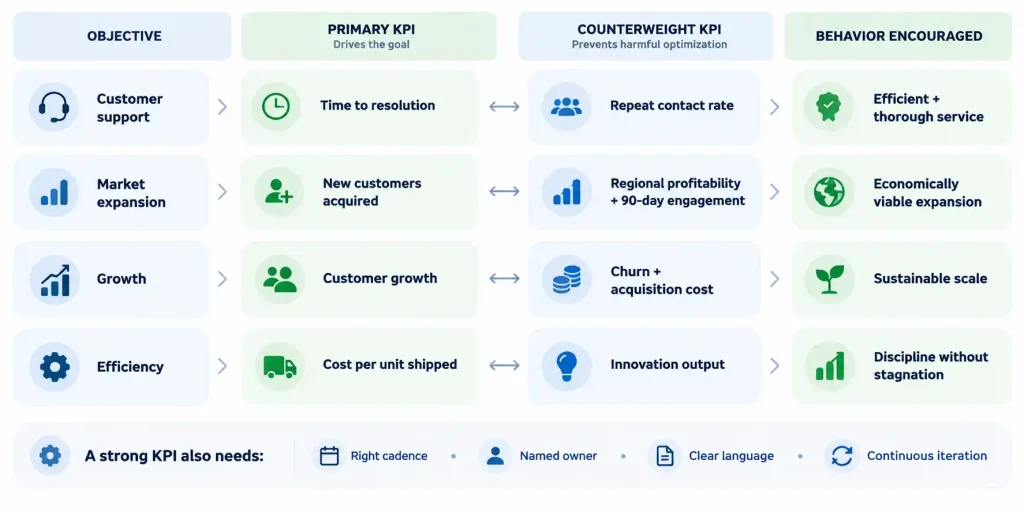
Pacing matters as well, because the review interval must match the rhythm of the decision. A pricing team reviewed once a year will not iterate with urgency, while a long-cycle infrastructure modernization reviewed weekly will devolve into superficiality.
Language shapes ownership. A goal such as improving operational efficiency invites defensive reporting, whereas reducing cost per unit shipped by 8% through process redesign invites a named owner and a defined set of actions. Each KPI also needs a home beyond the dashboard, ideally a cross-functional pod, because indicators without owners get reported but never changed.
No metric survives first contact with reality unchanged, so iteration is part of the design. When behavior does not shift, the answer is a redesign of the measure rather than another dashboard. CFOs lead this work best through facilitation, asking what behavior a metric will incentivize, what trade-offs it ignores, whether it leads or lags, and whether it measures outcome or learning.
Orchestrating KPI Management Across Functions
Treating Metrics as Systems
Most enterprise value is created between functions rather than within them, and no KPI exists in a vacuum. Every output metric has at least two upstream inputs and one downstream implication. Customer lifetime value is often assigned to product, yet it is driven by acquisition cost, retention, expansion, support efficiency, and engagement, which touch marketing, success, engineering, and finance alike. It is a company metric that too many dashboards present as a departmental one.
A shared indicator such as CAC payback shows how the chain works in practice.
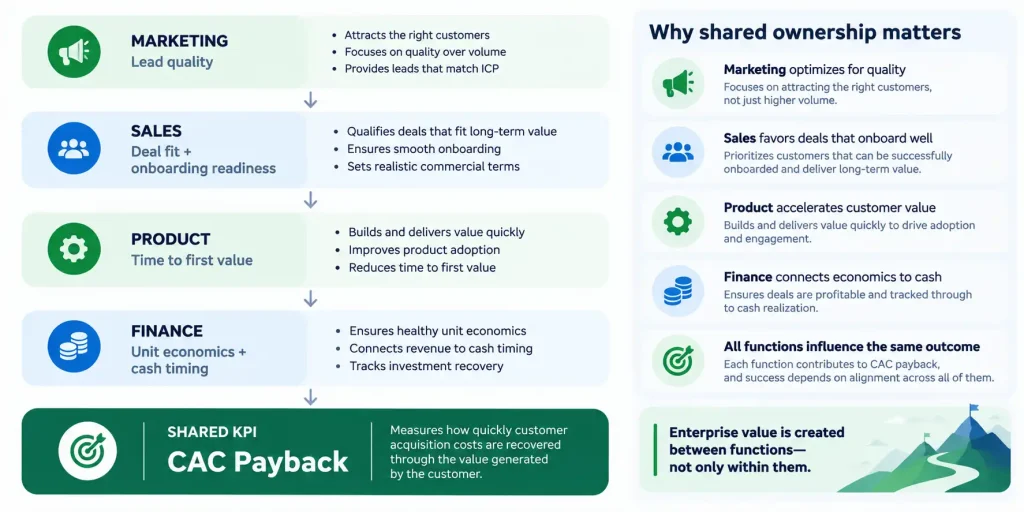
In a venture-backed performance marketing company that grew from $9M to $180M in revenue within 24 months, customer acquisition cost, lifetime value, and contribution margin were treated as a connected discipline rather than as separate departmental scorecards. Marketing tuned for lead quality, sales favored deals that onboarded well, and the growth that followed was growth the balance sheet could actually carry.
Shared Ownership and Governance
Consider a SaaS company struggling with net revenue retention. The instinct is to push harder on upsell, but once sales, product, customer success, and finance sit in the same room, a different picture emerges. Expansion is constrained by inconsistent onboarding, delayed feature adoption, and contract structures that limit flexibility. New indicators follow, namely onboarding time to first value, feature utilization after 30 days, and a contract expansion flexibility score, and retention improves because the system behind it was tuned rather than chased.
Effective cross-functional KPI governance is a ritual rather than a meeting. Teams review shared metrics, reconcile tensions, and redesign processes around collective responsibility. Cadence deserves the same care, since marketing works in campaigns, engineering in sprints, and finance in quarters, and a review that lands mid-campaign or pre-release will miss the context that gives the number meaning.
Conflict will surface, and that is a feature of a well-built system. Trade-offs between growth and margin, quality and speed, or scale and customization become visible, and the CFO helps teams navigate them by modeling the economic implications of each path. Accountability matures when the conversation moves from defensive justification to informed decision.
Building a KPI Culture Where Metrics Become Mindsets
Modeling, Narrative, and Accessibility
Culture is transmitted through modeling, and what leaders attend to becomes what the organization learns to emulate. When a CEO asks about gross margin before revenue, or a CFO praises a team for declining a tempting but unprofitable deal, prudence gains standing. Attention, sustained over time, becomes culture.
Modeling needs narrative to endure. Finance contributes most when it explains the story behind a number, such as why a 72% gross margin sits 12 points above the industry median and what that signals about pricing power, operational discipline, and capacity to invest. Accessibility completes the picture, because a KPI culture cannot live behind permissioned spreadsheets. Some companies run internal KPI academies that teach every function how each metric is calculated, which levers move it, and why it matters, so that the numbers become a common language rather than a specialist dialect.
Consequence Without Rigidity
Metrics that matter must guide hiring, investment, prioritization, and recognition. In a high-growth cybersecurity and identity SaaS company with roughly $30M in ARR, building a driver-based forecasting engine and a disciplined reporting cadence held actuals within plus or minus 5% of forecast for 8 consecutive quarters. The result came less from the model than from leadership acting on what the numbers said, and people learned that evidence carried weight.
Consequence does not require rigidity. A product team that misses an activation target while running the right experiments has not failed, and a marketing team that overspends but generates long-tail lifetime value may deserve recognition. Mature KPI management teaches teams when to trust a metric and when to interrogate it, and a strong sign of maturity is when teams begin debating the definition of churn rather than defending the result.
The CFO Role in KPI Management
The CFO serves as steward of meaning rather than enforcer of metrics, ensuring that each reported number maps to a decision someone is empowered to make. That means convening the right functions, modeling dependencies, and connecting every team to the enterprise value map. The purpose of KPI management is progress rather than precision, which is the ability of an organization to move together toward outcomes that matter.
Three Key Takeaways
- Design every KPI for behavior by testing it against clarity, causality, and consequence, and pair it with a counterweight metric so that no single number can be optimized at the expense of the enterprise.
- Assign shared indicators such as CAC payback or net revenue retention to cross-functional pods, and review them on a cadence that follows decision cycles rather than the calendar.
- Build the KPI culture through leadership modeling, financial narrative, and consistent action on results, so that teams debate definitions and trade-offs instead of defending scores.
Disclaimer: This article is intended for informational purposes only and does not constitute legal, tax, or accounting advice. You should consult your own tax advisor or counsel for advice tailored to your specific situation.
Hindol Datta is a four-time CFO and senior finance executive with over 25 years of leadership experience across cybersecurity, SaaS, gaming, logistics, digital marketing, medical devices, consumer products, and nonprofit organizations. He has led more than $120M in fundraising and over $150M in M&A transactions while building the financial and operational systems that let complex businesses scale with confidence. He is the author of seven books in the Systems CFO Series and holds active CPA, CMA, and CIA credentials.
AI-assisted insights, supplemented by 25 years of finance leadership experience.