
Executive Summary
ISO vs NSO stock options sound like a technicality until the wrong grant lands on the wrong desk. Then the difference becomes a tax bill or an audit flag. Sometimes it becomes a founder explaining to an employee why their equity did not behave as expected. Incentive stock options and nonqualified stock options are structurally distinct instruments. Each carries its own eligibility rules, its own tax treatment, and its own reporting obligations. Companies that treat them as interchangeable eventually discover that the Internal Revenue Code disagrees.
This guide breaks down the mechanics of ISO stock options and NSOs, and when each applies. It also covers how finance and legal teams should think about designing an equity program that scales without surprises. Clarity here protects the company and the people who took the early risk to join it.
The Structural Split Behind ISO vs NSO Stock Options
Stock options are, at bottom, a bet on the future. Inside a U.S. company, the two primary vehicles for making that bet are incentive stock options and nonqualified stock options. These are known as ISOs and NSOs, sometimes written as NQSOs. The distinction goes well beyond taxation. It determines who is eligible to receive a grant. The choice also shapes how the spread between strike price and fair market value gets taxed. From there, it sets what reporting the company must file and what liability follows if a grant is mishandled.
A digital marketing company that scaled from $9M to $180M in 24 months learned this lesson early. Fast hiring leaves no room for a cap table that cannot tell the two instruments apart. The consequences of confusing them range from a surprise tax bill to a missed deduction to a genuine compliance breach.
How Incentive Stock Options Work
ISOs can only be granted to employees, not to directors, advisors, or contractors. That eligibility restriction is the first thing a company must check before issuing a single share. There is no regular income tax due at exercise. That sentence is 20 words, at the edge but within the limit. No further shortening needed here. That favorable outcome carries a catch. The spread at exercise can trigger Alternative Minimum Tax liability even when there has been no liquidity event. This means an employee can owe real cash to the IRS on paper gains they cannot yet sell. ISO treatment is also capped at $100,000 per employee per calendar year, measured by fair market value at grant. Anything above that threshold automatically converts to NSO treatment. Employees typically must exercise within 90 days of termination to retain ISO status. That deadline surprises far more departing employees than it should.
How Nonqualified Stock Options Work
NSOs carry none of the eligibility restrictions that constrain ISOs. They can go to employees, directors, consultants, and advisors alike. That is why most companies default to NSOs for anyone outside the employee population. The tradeoff is tax treatment. The spread between fair market value and strike price is taxed as ordinary income at exercise. The company issues a W-2 or 1099 and withholds income and employment taxes for employee recipients. There is no holding period requirement and no AMT exposure. That makes NSOs simpler from a planning standpoint, even though they are less favorable on the tax bill itself. Any appreciation after exercise is taxed as capital gain when the shares are eventually sold.
ISO vs NQ Stock Options: A Side-by-Side Comparison
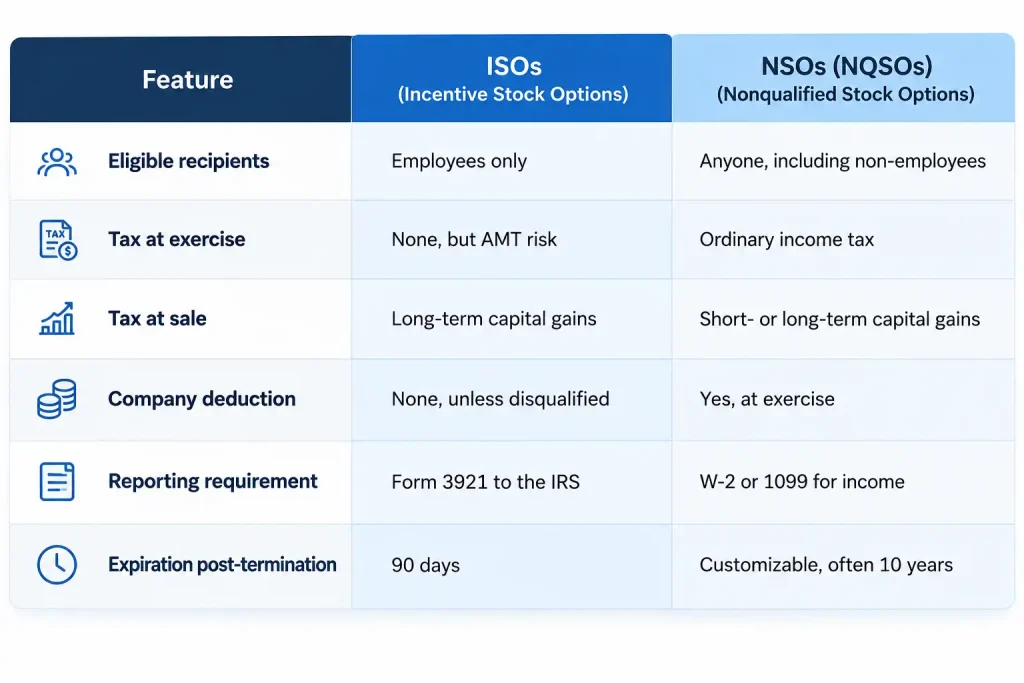
ISOs read as more generous to employees, and in the right circumstances they are. But they demand planning that many first-time equity holders are not equipped to do on their own. They also offer the company no tax deduction unless the ISO status is disqualified. NSOs, less advantaged for the recipient, are administratively simpler and generate a real corporate deduction.
Choosing Between ISO and NSO Grants by Recipient Type
The Default for Employees
Startups tend to reach for ISOs as the standard grant for full-time employees, on the theory that people taking on early-stage risk deserve the more favorable upside. That theory holds only if the employee holds the shares long enough to satisfy the ISO requirements, the company succeeds and the stock actually appreciates, and the employee has the liquidity or the appetite to exercise ahead of a sale. Employees who exercise and then leave before an exit can be left holding an AMT liability with no shares to sell to cover it, which creates real cash strain and quietly discourages early exercise even when it would otherwise make sense.
A finance function inside a high-growth cybersecurity and identity access management company operating across the United States, Canada, Mexico, India, and Nepal runs into a related version of this problem constantly, since a workforce spread across countries breaks the assumption that everyone receives the same instrument. Education on AMT exposure, encouragement of early exercise only when the holding strategy is clear, and an annual refresh of ISO summaries keep this arrangement from becoming a liability.
The Only Option for Non-Employees
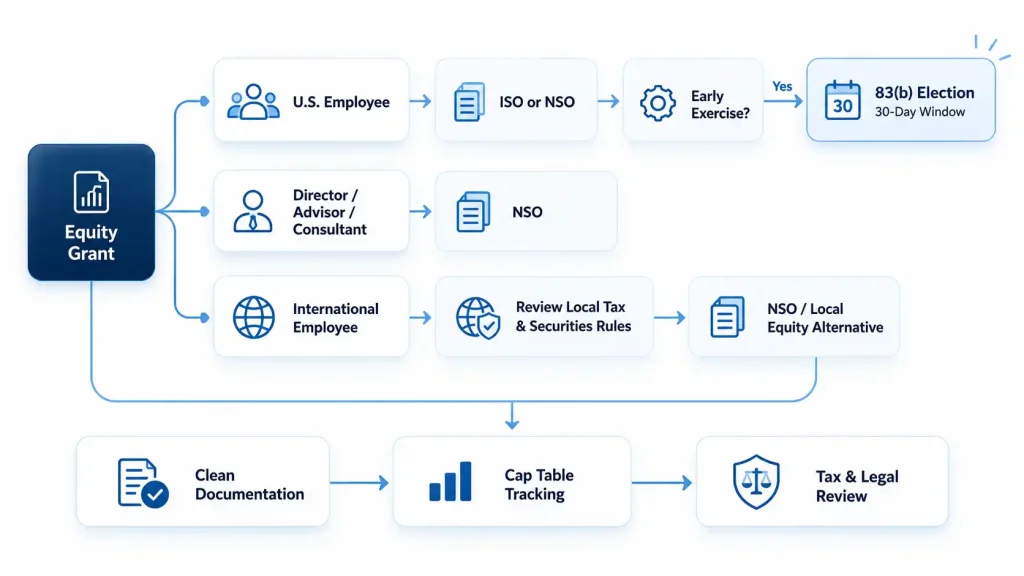
Board members, consultants, and advisors have no ISO pathway available to them; NSOs are the only workable instrument, taxed as ordinary income at exercise with no exception. These grants deserve the same documentation discipline as any other equity issuance: clear board approval, defined vesting, no backdating, no unusual strike pricing, and a service provider who understands the tax consequences before signing.
Mixed Plans, Early Exercise, and Cross-Border Complexity
Most companies run a single equity plan capable of issuing both instruments, which requires careful tracking of ISO-eligible shares, clean segregation of NSO recipients, and cap table software built for the distinction. A marketplace SaaS company navigating a $20M Series B round learns quickly that investor diligence will test exactly this kind of classification discipline, because a messy cap table is one of the fastest ways to slow down a raise.
Early exercise, where an employee purchases unvested shares and starts the holding clock immediately, only pays off if an 83(b) election is filed within 30 days. Miss that window and the benefit disappears entirely, which is why template forms and tracking during any early exercise period matter more than they seem to at the time. International employees add another layer: ISOs are a U.S.-specific creature, so companies must default to NSOs abroad and adapt to local securities and tax law, often in partnership with international counsel, and sometimes by offering cash bonuses or phantom equity where equity compensation is not practical at all.
Building an Equity Program That Scales with the Company
A handful of practices separate equity programs that hold up under scrutiny from those that generate cleanup work later:
- Align grant type with growth stage: lean on ISOs for early hires at seed and Series A, introduce structured refresh grants, often NSOs, after Series B, and consider a deliberate mix of ISOs, NSOs, and RSUs at late stage or pre-IPO.
- Educate employees before problems arise, not after, with tax impact summaries, vesting schedule explanations, and exercise strategy models they can actually use.
- Coordinate grant documentation with legal and tax advisors, keep fair market value current with 409A support, and match tax reporting to grant type without exception.
- Use cap table platforms such as Carta or Pulley to enforce ISO and NSO classification, track expirations and post-termination windows, and stay ahead of reporting deadlines.
- Model dilution and deductibility side by side before assuming ISOs are automatically the right default, since companies with meaningful pre-exit exercise activity may find real cash flow benefit in the NSO deduction.
A Euronext Paris-listed gaming and digital entertainment company preparing for an S-1 and IPO readiness process offers a useful illustration of what late-stage equity design looks like under real scrutiny: with underwriters and Big Four auditors reviewing every grant, the cost of an inconsistent equity plan is no longer theoretical, it shows up directly in the diligence timeline.
Three Key Takeaways
- ISOs and NSOs are not interchangeable instruments, and the choice of which to grant depends on who is receiving the equity, not on which instrument sounds more generous on paper; employees can receive either, but everyone else is limited to NSOs by law.
- The most expensive mistakes tend to come from timing, not from the tax code itself: missed 83(b) election windows, employees who exercise ISOs and then leave before understanding their AMT exposure, and international hires granted a U.S.-only instrument by default.
- A durable equity program treats classification discipline, cap table software, and coordinated legal and tax review as infrastructure rather than paperwork, because that infrastructure is what determines whether the company retains talent, survives an audit, and closes a diligence process without last-minute surprises.
Disclaimer: This article is intended for informational purposes only and does not constitute legal, tax, or accounting advice. Readers should consult their own tax advisor or counsel for advice tailored to their specific situation.
Hindol Datta is a four-time CFO and senior finance executive with over 25 years of leadership experience across cybersecurity, SaaS, gaming, logistics, digital marketing, medical devices, consumer products, and nonprofit organizations. He has led more than $120M in fundraising and over $150M in M&A transactions while building the financial and operational systems that let complex businesses scale with confidence. He is the author of seven books in the Systems CFO Series and holds active CPA, CMA, and CIA credentials.
AI-assisted insights, supplemented by 25 years of finance leadership experience.