
Executive Summary
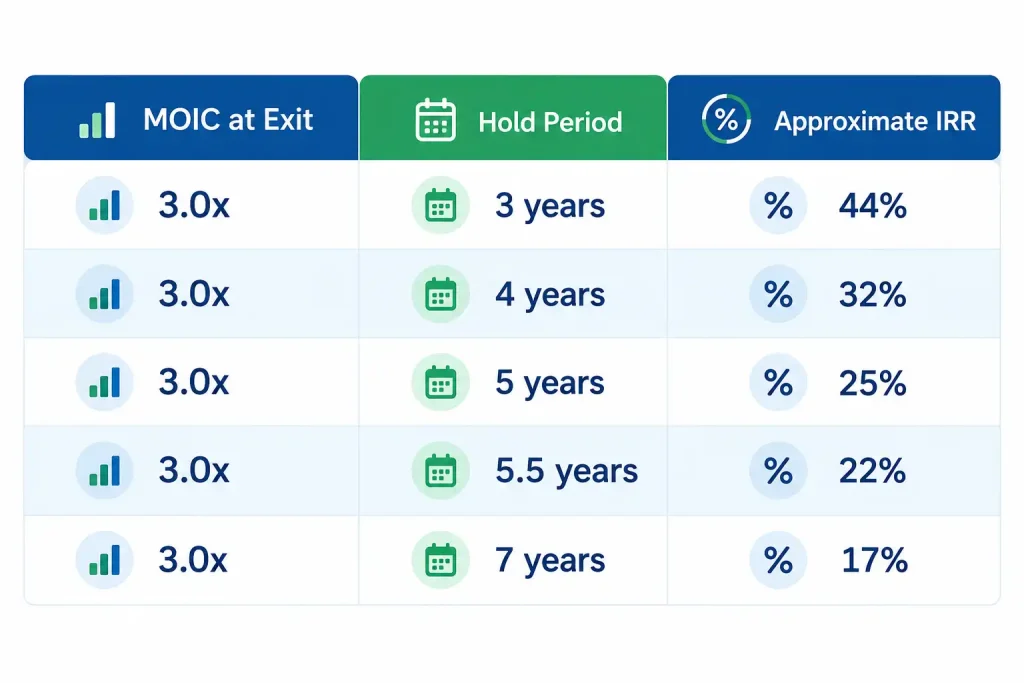
IRR in private equity measures more than profit, because it also measures when that profit arrives. A 3.0x return in three years and the same multiple in seven tell different stories to limited partners. That gap shapes capital recycling, GP credibility, and the strategic posture of the firm. The real discipline lies in lifting private equity IRR without trading durable value for an early victory.
The sections below cover the logic of the metric, the exit narrative, exit timing, and final deal structure. Each stage carries its own temptations, and each rewards preparation over raw speed. The result is a practical framework for exits that earn their acceleration instead of borrowing it.
Why IRR in Private Equity Rewards Velocity Over Endurance
On paper, internal rate of return is a compound growth rate, the algebraic sibling of NPV. In practice, it works as a clock embedded inside the compass. Multiple on invested capital (MOIC) rewards endurance, while private equity IRR rewards velocity. Every idle quarter and every month of drift quietly bends the return curve downward.
Same MOIC, Different IRR
The Cost of Delay in the Hold Period
The IRR formula punishes delay in a nonlinear way. On a five-year deal at 3.0x, a six-month slip costs about as much IRR as a 10% cut in proceeds. Time therefore becomes a scarce strategic resource for the sponsor. Each initiative must earn its place through both impact and payback velocity. This pressure shapes how sponsors staff the business, allocate working capital, and run governance.
The Paradox of Slow Value Levers
The most durable levers, such as culture change and platform re-architecture, also take the longest to mature. Many sponsors respond with a fast-fix playbook built on tested, measurable moves:
- Procurement centralization and vendor consolidation
- Price harmonization across segments and channels
- Salesforce restructuring and quota redesign
- Working capital release through tighter inventory and receivables
These levers often deliver results within the first year of ownership. Applied reflexively, though, they turn the company into a machine of compression instead of a system of adaptation. Early over-optimization can crowd out innovation, alienate talent, and leave the business brittle. A firm cannot absorb change faster than its people can metabolize it.
Behavioral Signals and Capital Structure
Teams sense an approaching exit when hiring freezes appear and attention shifts toward EBITDA stability. Those signals can sap momentum just as the company must shine. Short-duration tranches, tight covenants, and mezzanine debt add pressure through forced refinancing events. A sound capital stack builds time into the debt and preserves options if the exit slips.
Designing an Exit Strategy for IRR in Private Equity From Day One
Exit strategy is an architectural feature of the investment, not a terminal act. Strong returns tend to follow when three forces converge, and sponsors should design the hold period toward that point.
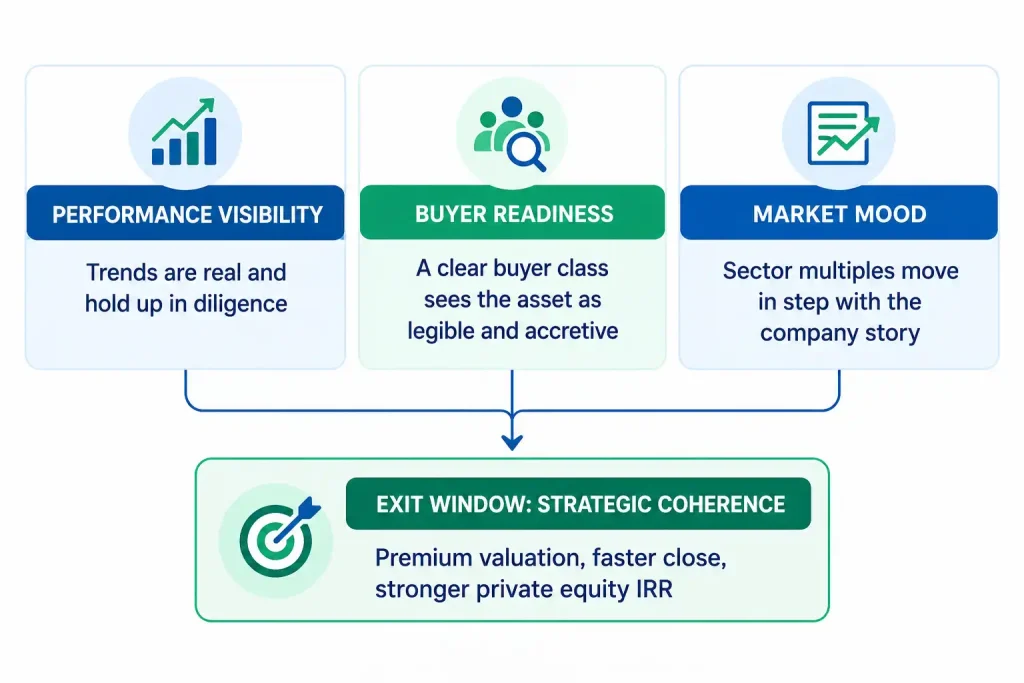
Designing for this convergence means sequencing initiatives for narrative symmetry as well as operational need. Systems should yield clean data, and financials must withstand scrutiny of every underlying assumption.
The Exit Narrative as a Driver of Private Equity IRR
Valuation depends on the buyer’s conviction that cash flows will continue under new ownership. A strong exit narrative therefore works as a thesis, and it must answer three questions with precision:
- What did the ownership team change in the business?
- What measurable difference did those changes produce?
- What new options exist for the next owner because of that work?
Vague answers invite a buyer discount instead of a premium. A cybersecurity and identity access management business with roughly $30M in ARR shows the opposite outcome. Its finance team held actuals within five percent of forecast for 8 consecutive quarters. That record, backed by an ASC 606 framework and board-grade reporting, carried the company cleanly through acquisition diligence.
Signal Versus Noise in the Exit Book
The confidential information memorandum should open with what the company does and why it wins. Unit economics and cohort retention come afterward, and every chart must earn its place.
| Noise That Erodes Trust | Signal That Builds Trust |
| Topline growth charts that hide churn | Clear cohort retention analysis |
| Inorganic growth presented as organic | A transparent organic versus acquired split |
| Activity metrics without outcomes | A gross margin bridge tied to initiatives |
| Adjusted EBITDA with loose add-backs | A clean walk from EBITDA to free cash flow |
Buy-side quality-of-earnings work on an IT services target shows why this matters. That analysis surfaced material EBITDA adjustments where reported earnings diverged from economic reality.
Leaving Room for the Buyer and the Team
The strongest narratives make complexity legible and show real strategic optionality. They also avoid claiming every ounce of future upside, since buyers pay for value they can still earn. Team continuity completes the story, because buyers invest in the people who make projections real.
Timing the Exit Window to Protect IRR in Private Equity
A 25% EBITDA grower can look undervalued in a cold market and overpriced in a hot one. Three interacting forces shape that context for every sponsor.
| Force | What to Watch | Effect on Buyer Behavior |
| Sector appetite | Comparable transactions and peer guidance | Hot sectors set valuation floors, and weak peers drag multiples down |
| Capital availability | Fundraising cycles, leverage access, LP distributions | Tight capital pushes buyers toward predictable EBITDA |
| Macro regime | Interest rates, inflation, regulation | Rising rates deepen DCF discounts on future cash flows |
Exit timing for private equity IRR works as a Bayesian exercise. Every peer transaction, rate move, or busted deal should update the investor’s assumptions. Waiting carries real costs, including team fatigue, an aging story, and steady IRR decay. Great exits happen when readiness and receptivity converge, not when timing reaches perfection. A useful readiness test asks whether the current data, story, and team would hold up in a full market process today.
Structuring the Exit to Protect Private Equity IRR and Trust
Deal structure decides how the parties share value and allocate risk at exit. All-cash buyouts close the capital cycle cleanly, but each added device affects both proceeds and signals.
| Structural Device | What It Can Achieve | What It Can Signal or Risk |
| Earnout | Bridges valuation gaps in strategic sales | Metric disputes and defensive management behavior |
| Rollover equity | Projects confidence and alignment | Coerced participation or a disguised partial exit |
| Seller note | Fills a financing gap | Buyer caution or limited financing capacity |
| Escrow and indemnities | Protects buyers in sponsor-to-sponsor deals | Delayed realization and lower effective IRR |
| Reps and warranties insurance | Caps liability and speeds closing | Added cost and third-party enforcement |
A $200M deal with $20M held in escrow for 18 months does not function as a $200M exit. Across more than $100M in cross-border M&A at a listed gaming company, post-close obligations shaped realized value as much as headline price.
Management Incentives, Tax, and Reputation
A demotivated CEO can erode momentum faster than any integration challenge, so the management package deserves real care. Purchase price allocation, goodwill treatment, and NOL usage show up directly in net returns to LPs. Reputation compounds as well, and a fair exit earns access to future founders and co-investors.
Three Key Takeaways
- IRR in private equity punishes delay nonlinearly, so exit strategy must begin at entry and every initiative should earn its place through payback speed.
- Buyers pay for belief, and belief comes from a causal, evidence-backed exit narrative that leaves room for the next owner.
- The best exits pair reasonable timing with the simplest structure that protects all parties, preserving both returns and reputation.
Disclaimer: This article is intended for informational purposes only and does not constitute legal, tax, or accounting advice. You should consult your own tax advisor or counsel for advice tailored to your specific situation.
Hindol Datta is a four-time CFO and senior finance executive with over 25 years of leadership experience across cybersecurity, SaaS, gaming, logistics, digital marketing, medical devices, consumer products, and nonprofit organizations. He has led more than $120M in fundraising and over $150M in M&A transactions while building the financial and operational systems that let complex businesses scale with confidence. He is the author of seven books in the Systems CFO Series and holds active CPA, CMA, and CIA credentials.
AI-assisted insights, supplemented by 25 years of finance leadership experience.