
Executive Summary
IR in business is too often treated as a back-office reporting duty that only matters during a raise. Treated that way, a strong set of metrics can still produce a disappointing valuation, because investors are reacting to a fragmented narrative rather than a compelling one.
This guide reframes IR in business as a capital strategy, not a communication chore. It covers how to build a repeatable investor relations system, how that system signals quality and reduces perceived risk, and how the strongest CFOs institutionalize IR as a leadership discipline that compounds trust over years, not just during a funding window.
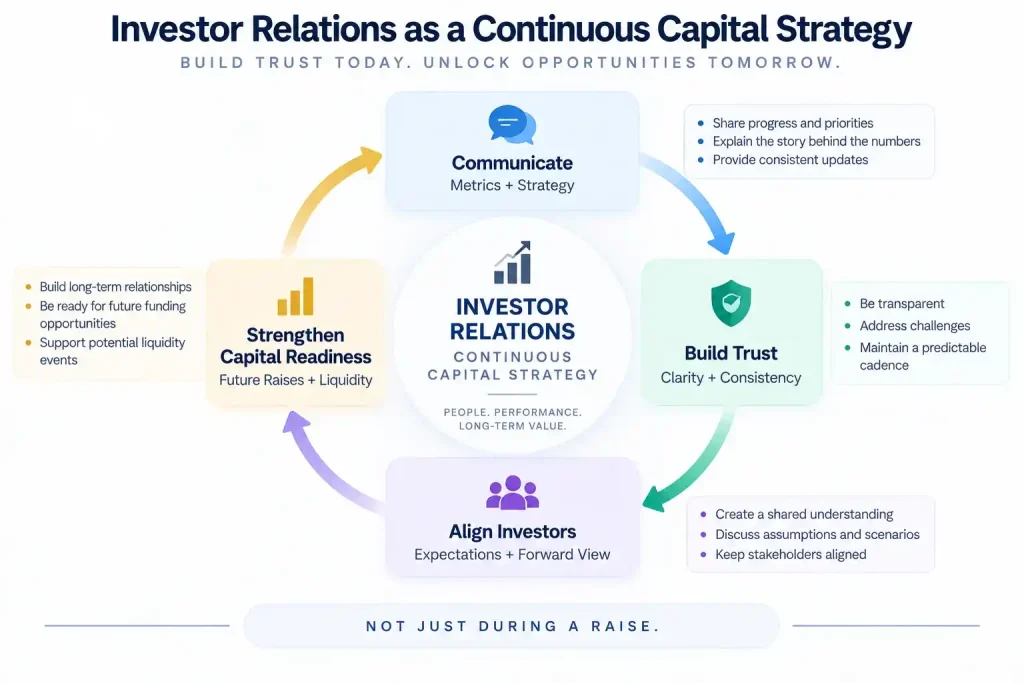
Why IR in Business Should Be a Capital Strategy, Not a Compliance Exercise
Public companies operate under disclosure requirements that enforce consistency. Private companies have far more latitude, and that freedom often produces IR that is either mechanical, treating updates as status reports, or purely transactional, surfacing only when capital is needed. Both approaches undersell the function.
IR in business works best framed as dialogue rather than disclosure. It gives capital providers a window into how leadership sees the market, what assumptions are being tested, and how performance connects to strategy. Investors tend to commit not because of trailing twelve-month metrics alone, but because a CFO can explain what those metrics imply going forward. Clarity invites confidence, and consistency builds trust over time.
Investor relations is also a continuous cycle rather than a fundraising-only activity. It shapes capital formation strategy, aligns stakeholders on performance expectations, builds scenario-based thinking, manages narrative risk during downturns, and signals readiness for future liquidity events. A healthtech company that maintains a steady six-week update cadence, with no funding ask attached, tends to arrive at its next raise with pre-warmed interest from the investors it actually wants at the table. That outcome reflects deliberate relationship-building, not luck.
The right IR approach also shifts with company stage and capital conditions. Early on, IR is founder-led and vision-driven. As a company matures, it becomes more data-centric and financially nuanced. In bull markets, growth narratives dominate; in tighter capital environments, capital efficiency and path to profitability take over. A burn multiple that markets tolerated in a hot fundraising cycle can look like a warning sign a few years later unless it comes paired with a strong LTV to CAC ratio and a short payback period.
Building a Best-in-Class Investor Relations System
Companies that handle IR well treat it as an ongoing system rather than a scramble that starts the moment a raise begins. That system rests on four pillars: audience segmentation, a predictable cadence, a consistent update structure, and clear internal ownership.
Segment the Investor Audience
- Active institutional investors, often board members, who expect detail and commentary on any deviation from plan
- Passive or syndicate investors, who need less frequency but still expect consistency, since their perception shapes future rounds
- Prospective investors, who track a company informally before committing
- Strategic or corporate partners, who care most about product roadmap and differentiated insight
Institutionalize a Predictable Cadence
| Communication | Frequency | Purpose |
| Investor update email | Monthly or quarterly | Concise view of metrics, wins, challenges, and priorities |
| Board package | Quarterly | Deep dive into performance against plan and scenario implications |
| Investor briefing or town hall | Twice a year | Live conversation and richer, two-way engagement |
| Capital planning review | Annually | Strategy check-in, especially valuable before a raise or major pivot |
Structure Every Update the Same Way
- A handful of well-chosen metrics that reflect health, efficiency, and trajectory, not a data dump
- Strategic commentary explaining what the metrics mean, not just what they are
- Honest highlights and headwinds, including why challenges are happening and what is being done about them
- Milestones and a forward view tied back to what was promised previously
- A brief capital position update covering runway and any material change to the forecast
A clear IR lead, typically the CFO, a centralized metrics dashboard, and a secure investor data room turn this from a scramble into a repeatable function. Alignment between the CEO and CFO on messaging matters just as much as the infrastructure. In one Series B company, early disagreement between an optimistic CEO framing and a cautious CFO estimate on breakeven timing created confusion investors did not need. A short pre-brief ritual before every major update, where leadership agrees on key messages ahead of time, closes that gap and produces fewer post-meeting clarifications.
Using IR to Signal Quality and Reduce Perceived Risk
Investor perception often has less to do with raw performance than with how that performance is framed. Companies with tight communication, disciplined follow-up, and narrative consistency tend to receive what amounts to a quality premium: less dilution during raises, stronger confidence-adjusted valuations, and more resilience during market corrections.
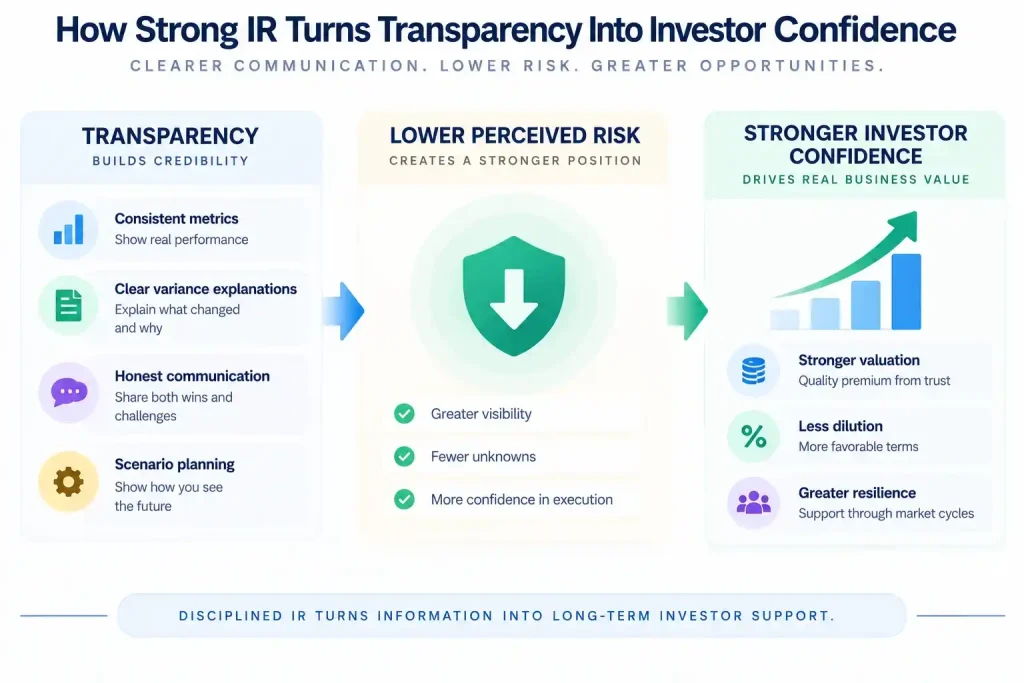
Specific signals reduce perceived risk directly. A consistent CAC definition across quarters, a clear reconciliation between forecast and actuals with root cause analysis, defined capital allocation priorities, and scenario planning that shows real adaptability all shift the investor question from whether to trust the forecast to how to help the team move faster.
Transparency during turbulence matters more than most founders expect. A CFO who reports a sudden jump in churn, breaks it down by segment, ties it to a specific coverage gap, and lays out a corrective plan with a tracking metric tends to keep investor confidence intact through the disruption. A robotics company facing a multi-quarter manufacturing delay earned more investor respect from a clear two-page breakdown of the impact and mitigation plan than it would have from downplaying the issue. Obfuscation, not bad news itself, is what erodes trust.
At inflection points, such as entering a new market, approaching an IPO, or navigating a down round, the IR system needs to become more frequent and more anticipatory. A fintech company expanding into a new region that details regulatory approvals, local hires, and early traction well before its next raise tends to find investors already educated and aligned by the time the round opens.
Institutionalizing IR as a Leadership Discipline
Early-stage IR can run informally on founder charisma and a spreadsheet. Past Series B, that informality gets expensive: miscommunication compounds, diligence turns defensive, and time to term sheet stretches. Institutionalizing IR means assigning clear leadership, typically to the CFO, building a cross-functional working group, and maintaining a live investor content repository.
Liquidity readiness extends this discipline further. Clean quarterly metric tracking, audit-ready financials, mature cap table management, a documented history of investor communications, and scenario-based valuation analysis all signal a company that is capital-market fluent, not just performance-oriented. That fluency creates real optionality when market sentiment shifts.
The CFO’s role expands accordingly, into leading capital raise strategy, owning the data room and diligence narrative, and translating product milestones into economic terms. A cross-border SaaS company that shifted from ad-hoc updates to a full investor engagement model, forecasting capital needs six quarters out and briefing international investors ahead of each planning cycle, had real options available when market sentiment shifted abruptly. Competitors without that discipline down-rounded or folded in the same window.
The discipline also runs inward. When teams know that gross margin will be a recurring narrative topic, engineering prioritizes cost-efficient scalability. When go-to-market leaders know CAC payback will face scrutiny, spending decisions get sharper. Investor discipline becomes internal performance alignment, and rotating rising leaders through IR exposure builds judgment and enterprise-level perspective well beyond their formal role.
Three Key Takeaways
- IR in business works best as a continuous capital strategy, not a fundraising-window activity. Companies that maintain a steady cadence without an ask attached tend to arrive at their next raise with pre-warmed investor interest.
- Perception shapes pricing as much as performance does. Consistent metric definitions, honest variance explanations, and transparency during turbulence all reduce the perceived risk that drags down valuation.
- Institutionalizing IR, through clear ownership, a predictable cadence, and liquidity-readiness infrastructure, turns investor relations from a defensive scramble into a compounding source of trust and optionality.
Disclaimer: The insights in this article reflect general professional perspectives on advising high-growth companies. They are intended for educational and strategic reflection. Always consult legal, tax, and capital advisors when structuring investor communications and capital strategy for a specific organization.
Hindol Datta is a four-time CFO and senior finance executive with over 25 years of leadership experience across cybersecurity, SaaS, gaming, logistics, digital marketing, medical devices, consumer products, and nonprofit organizations. He has led more than $120M in fundraising and over $150M in M&A transactions while building the financial and operational systems that let complex businesses scale with confidence. He is the author of seven books in the Systems CFO Series and holds active CPA, CMA, and CIA credentials.
AI-assisted insights, supplemented by 25 years of finance leadership experience.