
Executive Summary
Every investment committee hears the phrase “investment thesis,” yet few teams interrogate what the thesis really claims. A real investment thesis is an architecture of belief, describing what a company could become through specific actions, constraints, and timing. When the thesis becomes ritual rather than reckoning, it turns into a script of reassurance built backward from a target IRR.
This article covers the anatomy of a sound thesis, how to write an investment thesis through disciplined inquiry, and how to turn it into post-close execution. It closes with the three ways a thesis breaks and how firms should respond. The aim is an investment thesis that guides capital, not one that decorates a deck.
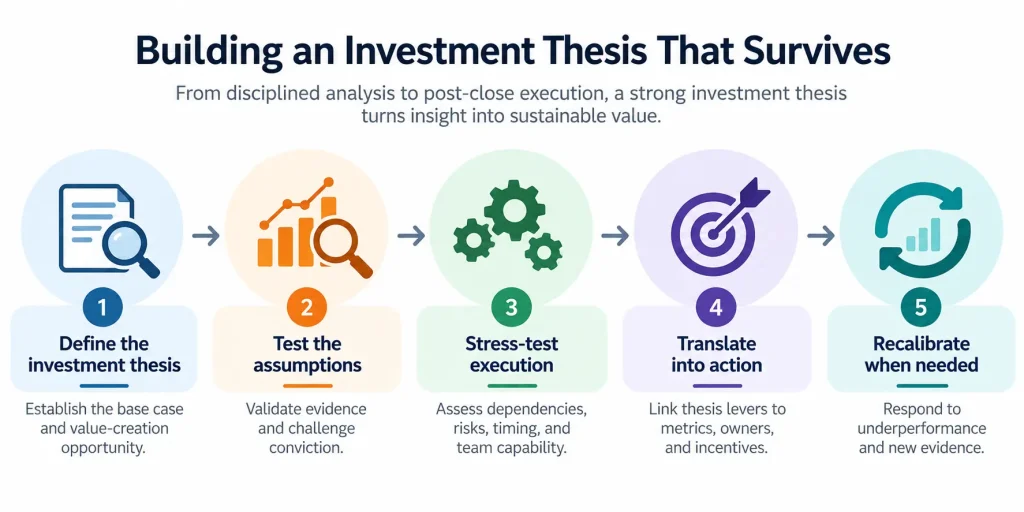
What an Investment Thesis Must Answer
An investment thesis is neither hope nor guess, but a probabilistic stance formed from imperfect data, shaped by diligence, and tested by skepticism. Four questions sit at its core, and each one loops back into the others:
- What is this business at its core? The answer is its mechanism of value creation, whether price leadership, brand premium, scale, or workflow ownership.
- What can change without breaking it? Margins can improve, but culture may suffer, and headcount cuts may erode service levels.
- What is the time geometry of the transformation? A plan that pays off in year five but demands full debt service in year two is a misalignment.
- Who must change, and are they willing? Founders, sales teams, customers, and boards all carry their own volatility and latency.
Once written, the thesis also works as a contract. It shapes the diligence agenda, the post-close roadmap, the budget, and the incentive plan. A vague thesis lets execution drift, while a precise one gives execution a spine. A weak thesis also harms people, committing leaders to plans they cannot deliver and inviting overreach followed by blame.
The Anatomy of a Strong Investment Thesis
Novice investors often write a tidy line: “EBITDA can grow from $30M to $50M through pricing, efficiency, and M&A.” That sentence names familiar levers, but it describes rather than designs. A disciplined investment thesis specifies which levers move, in what order, at what cost, and against what resistance.
| Component | What It Defines |
| Base case | The unlevered trajectory if no intervention occurs |
| Value creation model | Levers linked to the dependencies that make them work |
| Friction analysis | Behavioral, technical, and market resistance to each lever |
| Sequencing | Lead times aligned against the debt schedule and covenants |
| Risk asymmetry | Upside weighed against the downside each lever exposes |
| Belief calibration | Confidence held in proportion to the evidence |
Dependencies, Friction, and Risk Asymmetry
A price increase may add $5M in gross margin, but only if churn stays below 3% and competitors hold back. That same increase might also put $20M of topline revenue at risk. A sourcing improvement may save $4M, provided vendor contracts are open and quality holds. Many theses model impact without modeling execution latency, the gap between knowing a task and building the capability to do it. At a $30M ARR cybersecurity company, a twelve percent gross margin gain came from three levers working together. Pricing discipline, workforce mix, and delivery cost control each depended on the others.
Calibration and the Psychology of Conviction
Every growth rate and margin assumption rests on someone’s judgment. A Bayesian approach assigns prior probabilities from comparable deals, then updates them as each new signal arrives. Teams also want to believe, above all when a partner has championed the deal. Healthy firms build anti-narrative mechanisms, including a red team, a dissenting partner, and forced failure scenarios. Without that tension, the IRR becomes gospel and sensitivities become optional appendices. Ownership matters too, because an investment thesis forgotten after close was only ever a sales tool.
How to Write an Investment Thesis Step by Step
Building a thesis is methodical accumulation, not a creative burst. The best insights often sit at the edge of noise, in a mispriced contract or a manager too capable for the title. The process below shows how to write an investment thesis that can withstand scrutiny.
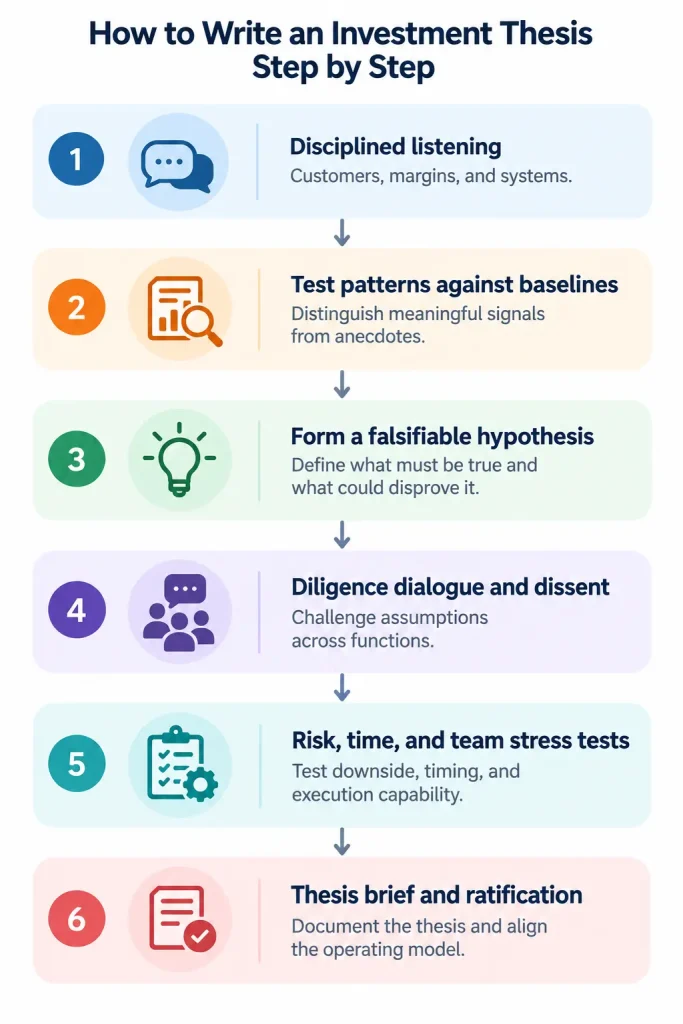
From Listening to Hypothesis
Disciplined listening means structured exposure, such as coded call notes, customer interviews mapped against churn, and segment profitability over time. The richest signal often lies in half-built initiatives and under-resourced teams. Pattern recognition helps, though it overweights recent events and anecdotes, so every pattern needs a comparative baseline. A hypothesis then takes shape, for example: professionalizing the salesforce could expand EBITDA by 600 bps in 24 months. The team must ask what supports the claim, what would falsify it, and what success requires.
Stress Testing Before Commitment
Diligence dialogue sharpens the hypothesis through argument by design. An operating partner may ask whether the deal lead has walked the plant or studied the labor model. A finance lead may flag fixed cost leverage, while a go-to-market advisor flags channel conflict. The thesis must also pass several further tests:
- Risk adjustment: map confidence intervals and a plan B for each lever.
- Time constraints: model when value arrives against when covenants demand it.
- Team compatibility: ask whether this team, with the right tools, can deliver in time.
- Failure simulation: test what happens if pricing power proves illusory or the CRO departs.
The resulting thesis brief states what the firm is, what it can become, what must change, and which metrics will track progress. It circulates as an invitation to dissent, then gains ratification through the operating model, board cadence, and incentive framework.
Operationalizing the Investment Thesis After Close
Execution of the investment thesis starts with translation, because management teams speak in throughput and cycle time rather than IRR. “Improve gross margin by 500 bps” must become concrete actions, such as shifting mix toward high-margin SKUs or reducing scrap in one plant. The first 90 days matter most, since the organization is most malleable then. During that window, the operating plan, budget, leadership OKRs, and board agenda should all reflect the thesis levers.
The Thesis-to-Metrics Map
High-performing firms link each lever to observable indicators that specific owners track in real time. Without that visibility, the firm flies blind, and without ownership the thesis dissolves into abstraction.
| Thesis Lever | Leading Indicators to Track |
| Pricing power | Average realized price and monthly churn |
| Salesforce efficiency | CAC payback and pipeline velocity |
| Margin expansion | Gross margin by SKU and scrap rates |
| Working capital release | Inventory turns and cash conversion cycle |
At a $127M consumer products company, inventory turns rose from 3x to 7x once demand planning and SKU rationalization had clear metrics and named owners. That shift released trapped working capital and turned a thesis lever into a weekly operating habit.
Governance, Incentives, and Tempo
Boards should use each meeting to calibrate the thesis, asking which assumptions have aged poorly. Incentives must match the thesis arc, since a CFO paid only on revenue will not chase margin. Department heads and second-layer managers also need thesis immersion, so their execution reflects conviction rather than compliance. Variance becomes information, and leading indicators take priority over lagging ones. The pace of change must also respect the organization’s absorption rate, even under leverage. Over time, the thesis should shape strategic plans, executive onboarding, and eventually the exit narrative.
When an Investment Thesis Breaks
Thesis failure arrives slowly, then all at once, through a missed KPI, a departure, and finally a broken assumption. Diagnosing the type of failure comes first, because each type demands a different response.
| Failure Type | What Went Wrong | Core Lesson |
| Execution | Sound logic, but the organization could not deliver | Pace the plan to the organism, not the capital clock |
| Design | Levers interacted in ways the model ignored | Second-order effects compound and interfere |
| Assumption | Customers, competitors, or markets behaved differently | Belief must be held with epistemic humility |
The greatest danger is defending a failing thesis rather than diagnosing it. Underperformance gets explained as timing, and the IRR slides into years beyond the hold period. A stronger response to a failing investment thesis combines four disciplines:
- Diagnostic clarity: check whether variance clusters around one assumption or spreads across many.
- Governance courage: re-scope ambition and re-underwrite a new path instead of riding toward a write-down.
- Ethical awareness: communicate openly, protect morale, and stabilize incentives for people who believed the plan.
- Institutional memory: capture what was misread so the firm’s pattern recognition matures.
Recalibration works best when leaders act early, as an early-stage email marketing company showed by cutting monthly burn from $800K to $200K. Each failed thesis is tuition, and the best firms build meta-theses about their own decision-making.
Three Key Takeaways
- A strong investment thesis defines the base case, links each lever to its dependencies, and weighs upside against the risk each lever exposes.
- Learning how to write an investment thesis means testing patterns, inviting dissent, and stress testing time, team, and failure before committing capital.
- A thesis only creates value once it lives in metrics, incentives, and board rhythms, and it must evolve when evidence shows it breaking.
Disclaimer: This article is intended for informational purposes only and does not constitute legal, tax, or accounting advice. You should consult your own tax advisor or counsel for advice tailored to your specific situation.
Hindol Datta is a four-time CFO and senior finance executive with over 25 years of leadership experience across cybersecurity, SaaS, gaming, logistics, digital marketing, medical devices, consumer products, and nonprofit organizations. He has led more than $120M in fundraising and over $150M in M&A transactions while building the financial and operational systems that let complex businesses scale with confidence. He is the author of seven books in the Systems CFO Series and holds active CPA, CMA, and CIA credentials.
AI-assisted insights, supplemented by 25 years of finance leadership experience.