
Executive Summary
An investment memorandum is the document that speaks for a deal after the meeting ends. It must hold conviction when the room is empty and competing options press for attention. Too many teams treat it as a compliance summary, yet it should work as a forward instrument for decisions.
This article covers how to build the memo around a thesis and treat each section as evidence. It then examines why investor objections arise and how the CFO turns resistance into alignment.
Why the Investment Memorandum Is a Forward Instrument
A management presentation persuades in real time, while the investment memorandum must persuade in absentia. Once the adrenaline fades and calendars resume, the written case is all that remains. Every word, argument, and omission becomes a matter of record and a signal to capital.
Readers of an investment memo want compression, which means synthesis instead of simplification. The best memos are not exhaustive, yet they are exhausting to challenge. They explain what is true, why it matters, and what could go wrong. Capital flows toward clarity of thesis, mechanism, and consequence, not toward certainty.
Structuring an Investment Memorandum Around the Thesis
The opening paragraph should state the investment idea, not describe the business. Is this a growth story, a platform play, a market timing thesis, or a transformation case? The edge belongs up front too, whether it comes from differentiated insight or an information advantage. A memo that cannot answer these questions early is already speaking in someone else’s language.
Every later section should feed the core claim, because a chronology of facts does not create conviction. If the thesis rests on scalable unit economics, market fragmentation should explain low CAC. Product modularity should justify gross margin leverage, and team experience should underwrite go-to-market agility. A memo is not a mosaic of facts; it is a system where each part reinforces the whole.
How the Investment Thesis Flows Through Each Section
The diagram below shows how one idea travels from the opening thesis to the committee decision.
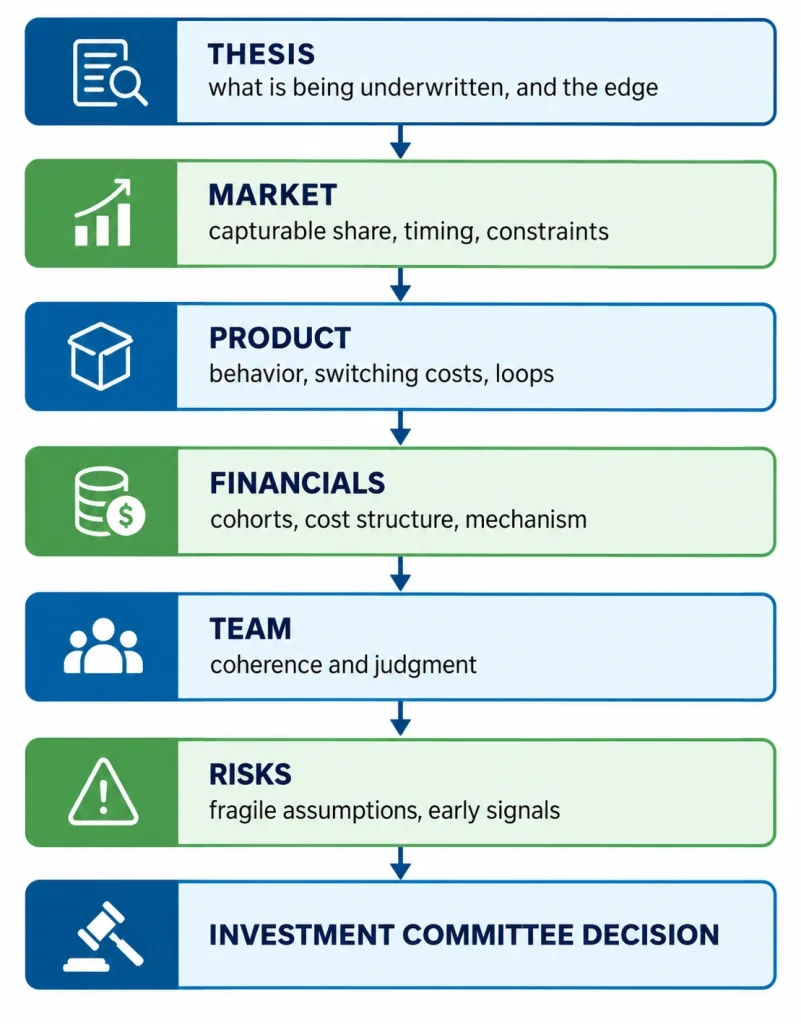
Writing the Market, Product, and Financial Sections as Evidence
Market Size Versus Capturable Opportunity
TAM is theory and sometimes fantasy, so it cannot carry the market section alone. A memo that cites a $10B market but cannot isolate the capturable $500M loses credibility fast. The reader wants the rate-limiting constraints that slow penetration, such as:
- Regulation and compliance hurdles
- Customer awareness and education cycles
- Channel density and distribution reach
- Integration friction with existing systems
Product Behavior Over Feature Lists
Features describe a product, but investors want to understand the behavior it induces. Strong product sections explain which customer actions it drives, what switching costs it imposes, and which feedback loops it creates. Calling a product best in class means little unless the claim ties to retention, upsell, or advocacy.
Financials as Proof of Mechanism
A revenue figure without cohort behavior is noise, and an unexplained margin can mislead. Investors underwrite mechanism, so the financial section must explain why results occurred and whether they will persist. Is the flywheel real, is the cost base elastic, and is growth purchased or earned?
Cohort and unit economics models often decide diligence in a $20M Series B raise for a marketplace SaaS company. Likewise, a performance marketing business scaling from $9M to $180M in 24 months must prove through CAC and LTV discipline that growth was earned.
Presenting the Team and Framing Risk in an Investment Memorandum
Coherence Over Credentials
The team section tempts writers into biography, listing prior employers and university degrees. Investors care less about pedigree than about coherence with the problem at hand. A single anecdote about a hard decision, such as a pivot that preserved burn, says more than pages of credentials.
Writing Risks That Demonstrate Awareness
Most risk sections recycle boilerplate such as customer concentration and key person dependency. Those are known risks, while the dangerous ones hide in assumption fragility and system complexity. A strong investment memorandum frames each risk through three questions:
- Which assumptions, if wrong, would most change the view of the deal?
- Which early signals would reveal deviation from the plan?
- Where does the risk sit structurally, and what mitigates it?
The Ethics and Style of a Persuasive Investment Memo
Writing an investment memorandum means holding asymmetric knowledge and treating it with respect. The memo shapes allocation, pricing, and governance, so every adjective must bear scrutiny. Competitive pressure can turn exposition into salesmanship, and the CFO must anchor the narrative when that happens.
Strong memos are dense, built to be scanned yet rewarding to read in full. Each chart should carry a claim, and a chart that does not change belief does not belong. The memo must carry belief instead of begging for it, avoiding both hedging and hype.
Why Objections Arise When Selling the Deal
Every deal eventually meets resistance, however polished its numbers or presentation. Objections signal dissonance between the presented story and the buyer’s internal underwriting model. They look like factual concerns about churn or margin volatility, but their roots are often psychological.
A concern about scalability can carry several different meanings beneath the surface. It may question sales replicability, margin durability, cultural strain from hiring, or the team’s track record. Skilled dealmakers decode the unspoken premise before they respond.
Building Entropy Resistance into the Narrative
Objections also stem from signal loss as the story passes through the CIM, banker summaries, and diligence. Numbers survive this journey, but the logic connecting them degrades along the way. Buyers then fill the gaps themselves, and they seldom fill them optimistically. Slides must compress meaning, and follow-ups must reduce ambiguity instead of adding to it.
Classifying Investor Objections by Function
Not every objection carries equal weight, and the CFO must sort each one by its purpose. The table below sets out four categories common to competitive processes.
| Objection Type | What It Signals | Typical Examples | Best Response |
| Deal-killers | Systemic threats to value | Customer dependency, declining unit economics | Confront early with data and context |
| Deal-shapers | Concerns about structure or timing | Working capital swings, integration readiness | Address with transparency and flexibility |
| Negotiating smoke | Leverage-seeking tactics | Late, weakly supported concerns | Acknowledge, document, and re-anchor |
| Cultural misalignment | Discomfort with decision style | Questions on leadership or reporting cadence | Invite the concern and show alignment |
Unaddressed deal-shapers tend to mutate into escrow disputes, earnout fights, or holdbacks. Quality-of-earnings work on an IT services acquisition often surfaces EBITDA adjustments that expose a gap between reported and economic earnings.
A Tactical Playbook for Responding to Investor Objections
The most common error is over-defense, treating each concern like a cross-examination. Too much detail amplifies the worry, while too little feels evasive. Framed acknowledgment works better and follows a simple three-step sequence.
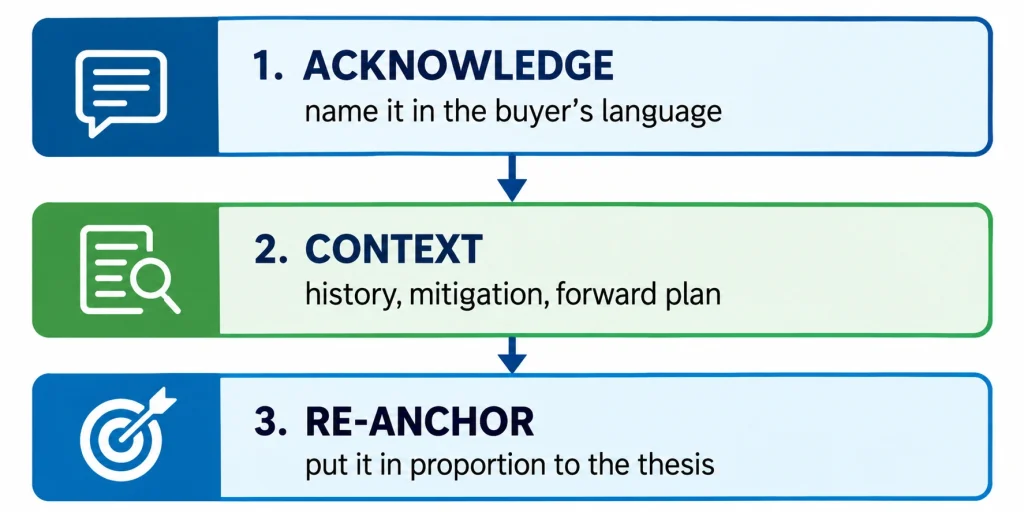
Consider a buyer who flags gross margin compression in Q2. A strong answer traces it to a one-time supplier renegotiation and a temporary channel mix shift. It then cites stabilized pricing and margin normalizing near 58%, while EBITDA margin kept expanding.
Managing Objections Outside Management’s Control
Some objections reflect the buyer, not the company, through fund dynamics or LP preferences. A growth fund may balk at a dividend recap, and a deep value investor may reject a high-multiple SaaS platform. Triage works better than re-litigating philosophy, because conviction often lives with another bidder. Patterns across buyers still reveal where churn framing or TAM addressability needs sharper explanation.
The CFO as Architect of Clarity in the Deal Process
The CFO sits where data, narrative, and credibility intersect, which makes the role central to objection handling. This is a design function, not a defensive one. The CFO anticipates objections, seeds answers into materials, and keeps metrics coherent across channels. Consider a cybersecurity SaaS company whose forecasting engine holds actuals within 5% of plan for 8 consecutive quarters. A record of that kind can carry a business through acquisition diligence. Seasoned CFOs welcome objections because they signal engagement, while silence usually means detachment.
From Objection to Closure
As the deal approaches the term sheet, each objection must be addressed, parked, or priced. Unresolved concerns migrate into escrow, earnouts, or post-close integration plans. The aim is to align belief on the shape of the business and its value levers. Capital flows to the team that makes risk legible and owned, and the investment memorandum is where that work begins.
Three Key Takeaways
- Build the investment memorandum around a clear thesis in the opening paragraph, then make every later section reinforce that single claim.
- Treat financials and risks as evidence of mechanism, showing whether growth is purchased or earned and which assumptions could change the decision.
- Classify objections by function and answer them through acknowledgment, context, and re-anchoring, so that resistance becomes alignment before the term sheet.
Disclaimer: This article is intended for informational purposes only and does not constitute legal, tax, or accounting advice. You should consult your own tax advisor or counsel for advice tailored to your specific situation.
Hindol Datta is a four-time CFO and senior finance executive with over 25 years of leadership experience across cybersecurity, SaaS, gaming, logistics, digital marketing, medical devices, consumer products, and nonprofit organizations. He has led more than $120M in fundraising and over $150M in M&A transactions while building the financial and operational systems that let complex businesses scale with confidence. He is the author of seven books in the Systems CFO Series and holds active CPA, CMA, and CIA credentials.
AI-assisted insights, supplemented by 25 years of finance leadership experience.