
Executive Summary
A tax structure can look elegant on a spreadsheet and still fail a simple test. Can someone explain it to a board in one sentence, without flinching? An international tax strategy that cannot pass that test usually is not a strategy. It is an artifice built to defer scrutiny, not to reflect how the business actually works.
This article sets out five questions that shape a durable international tax strategy. It covers alignment between structure and substance, and transfer pricing governance. It also covers exposure to Pillar Two and digital service taxes. And it covers unclaimed credits and incentives, along with the balance between optimization and reputational risk.
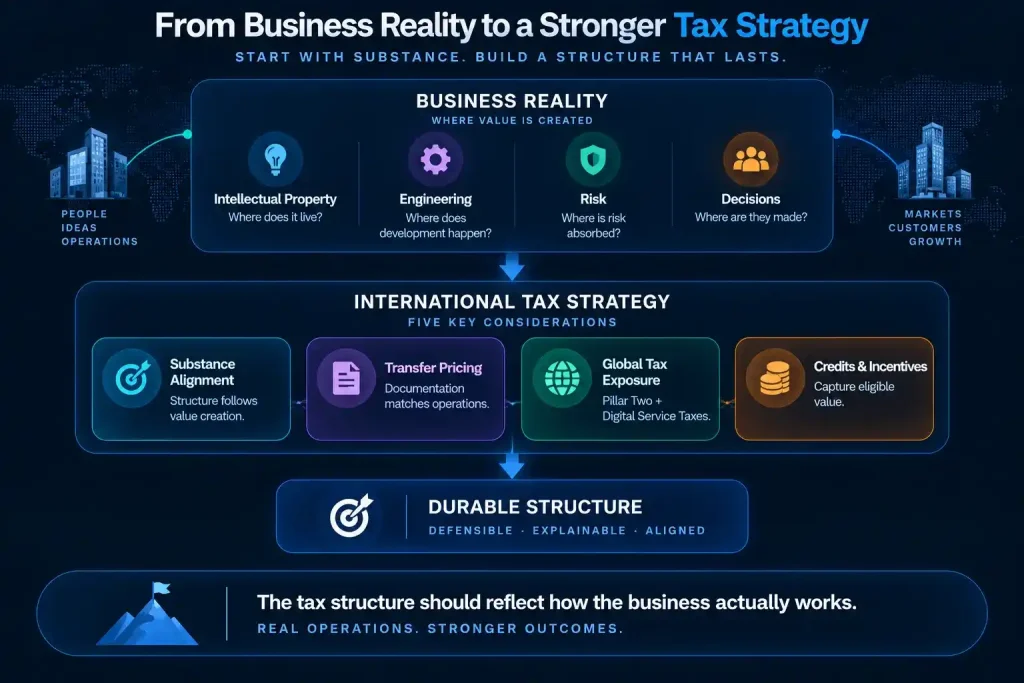
Is Our Tax Strategy Aligned With Business Substance?
A tax structure should reflect where value actually gets created. Where does the intellectual property live? Does the engineering sit in the same place? And who ends up absorbing the risk? Sometimes the answers to those questions diverge from where profit gets reported. When that happens, the structure has drifted from the business it is supposed to describe.
The OECD’s Base Erosion and Profit Shifting framework, known as BEPS, formalized a principle that most finance leaders already sensed. Profit should get taxed where economic activity occurs. An international tax strategy built on that principle survives an audit more easily than one built purely for deferral. The story it tells matches the operations behind it.
Alignment does not require symmetry. An R&D hub can sit in one country while customer deployment happens in another. Financing can flow from a third. What alignment requires is intention. The structure should reflect that distribution honestly, rather than route profit toward wherever the rate happens to be lowest.
How Do We Govern Transfer Pricing Under Growing Scrutiny?
Transfer pricing sets the internal price for code written in one country and deployed in another. The same logic applies to a brand built in one market and monetized in a different one. It sounds narrow. Yet it carries some of the largest questions in an international tax strategy. Who controls the risk? Who performs the development? Where do decisions actually get made?
Governments now expect documentation to match that narrative at every level. A Master File, a Local File, and country-by-country reporting each tell the same story from a different angle. Any inconsistency between them invites a challenge, and the burden of proof sits with the company.
Case: Rebuilding a Transfer Pricing Narrative
A Euronext Paris-listed gaming and digital entertainment company operating across five countries once faced this exact test. Its consolidated finance system had to reconcile a single, unified revenue and cost definition across every entity in the group. That work compressed statutory reporting cycles under both IFRS and US GAAP ahead of an IPO-readiness process. Auditors reviewed the structure, and the underlying documentation held together. The transfer pricing narrative matched the operational reality it described.
Documentation like this is not a clerical task. It is a strategic one. It forces a company to look honestly at where its own value creation actually happens.
What Is Our Exposure to Pillar Two and Digital Service Taxes?
The OECD’s Pillar Two framework sets a 15 percent global minimum tax, applied jurisdiction by jurisdiction rather than in aggregate. That single change breaks a common assumption behind older international tax strategy models. A company can no longer let low-tax profits offset high-tax ones across a global average.
Digital service taxes add a separate layer. They target revenue, not profit, and several jurisdictions enforce them regardless of physical presence. A company that monetizes data or digital platforms can end up taxed on gross income in a market. It may have no meaningful operations there at all.
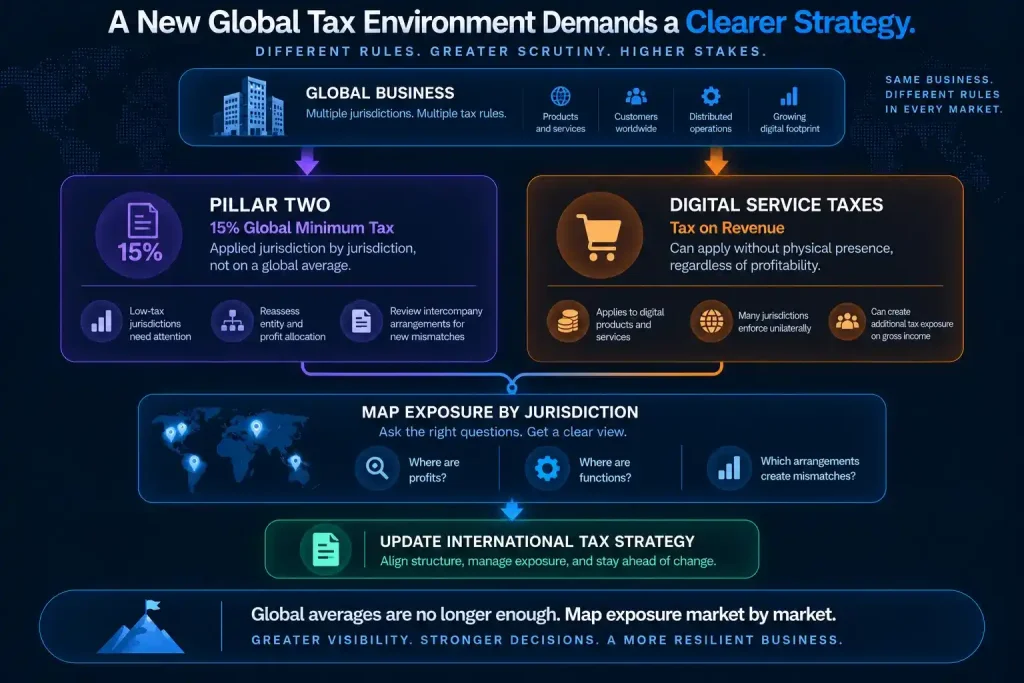
Mapping exposure to both frameworks means asking direct questions.
- Which jurisdictions currently fall below the new minimum threshold
- Which functions and profits sit inside those jurisdictions today
- Which intercompany arrangements, once efficient, now create a mismatch under the new rules
Are We Capturing Every Eligible Tax Credit and Incentive?
Most tax planning conversations focus on risk. Fewer focus on incentives that already exist and simply go unclaimed. Research and development credits exist in more than forty countries, in forms ranging from super deductions to refundable credits. Each rests on the same premise: innovation deserves a reward, but that reward has to be requested.
Claiming it takes real cross-functional work. Someone has to translate an engineering roadmap into the technical language a tax authority recognizes. That means distinguishing a genuinely novel build from a routine deployment of known code.
Case: Mapping R&D and Capital Investment Incentives
A venture-backed manufacturing company built its finance function, including its chart of accounts and its GAAP framework, entirely from scratch. That build gave the company a foundation from day one. It could track equipment purchases, R&D spend, and capital investment activity by category. Green energy credits and capital equipment incentives later expanded. The company already had its underlying data well structured. Identifying what it could claim took far less work than reconstructing years of spend after the fact.
Few companies outside the sustainability sector map their full incentive exposure. That gap represents real cash sitting unclaimed inside an existing capital plan.
How Do We Balance Optimization With Reputational Risk?
Legality alone no longer guarantees legitimacy. An effective tax rate can be entirely compliant and still draw scrutiny. That happens when the underlying narrative feels evasive under public pressure. Investors ask questions. Employees notice. Country-by-country reporting changed something fundamental. A structure that once stayed private is now something a rating agency or an activist fund can read directly.
A useful test still holds. Would the structure survive being described plainly, in public, without embarrassment? A structure built for genuine business reasons usually passes that test. One built purely to minimize disclosure usually does not.
The companies that manage this balance well share one habit. They articulate the principles behind their international tax strategy clearly. That clarity lets them explain the why behind the where. The explanation does not change depending on the audience.
Three Key Takeaways
- An international tax strategy holds up only when it mirrors where value actually gets created. A structure that cannot survive a plain, one-sentence explanation is usually optimized for deferral, not built for durability.
- Transfer pricing documentation is not paperwork. It is the narrative a company tells about its own operations. Any inconsistency across a Master File, a Local File, or country-by-country data invites an audit challenge.
- Pillar Two and digital service taxes have already changed the arithmetic behind international tax strategy. Mapping exposure jurisdiction by jurisdiction matters now. So does capturing every credit already available, more than designing one more clever structure to defer the bill.
Disclaimer: This article is intended for informational purposes only and does not constitute legal, tax, or accounting advice. You should consult your own tax advisor or counsel for advice tailored to your specific situation.
Hindol Datta is a four-time CFO and senior finance executive with over 25 years of leadership experience across cybersecurity, SaaS, gaming, logistics, digital marketing, medical devices, consumer products, and nonprofit organizations. He has led more than $120M in fundraising and over $150M in M&A transactions while building the financial and operational systems that let complex businesses scale with confidence. He is the author of seven books in the Systems CFO Series and holds active CPA, CMA, and CIA credentials.
AI-assisted insights, supplemented by 25 years of finance leadership experience.