Executive Summary
Many companies treat intercompany transfer pricing as a compliance exercise. Yet it shapes how value, incentives, and accountability flow across every entity in a global business. When teams inherit models instead of designing them, those models drift away from how the company creates value. That gap produces strategic drag, weak forecasting, and teams that no longer see themselves in the numbers.
The sections ahead cover four layers of the discipline, starting with its purpose and the design of intercompany pricing models. They then turn to daily operation and the effect on culture. Together they show how finance leaders can build a model that satisfies regulators while telling the truth about the business.
What Intercompany Transfer Pricing Is Meant to Do
Every complex company eventually discovers that it is many companies, not one. Legal entities, tax jurisdictions, shared services, and innovation hubs all connect through prices that one part of the business charges another. If cash is the lifeblood of an enterprise, intercompany transfer pricing is the architecture of its veins.
A Mirror of How Value Is Created
Intercompany agreements often reveal more about an organization than its mission statement. They show who controls IP, who carries risk, who earns margin, and who receives only cost recovery. Markup percentages, royalty terms, and functional profiles frequently tell a story the company never meant to tell.
A compliant model can still misrepresent the business. A model might price a regional distribution arm as a low-value logistics node even after that arm takes on customer success, market strategy, and pre-sales work. Meanwhile, an IP-holding entity may collect royalties with little operational relevance, leaving the structure tax-efficient on paper but disconnected from reality.
Why Neutrality Is Not the Same as Fairness
Legacy models often treat neutrality as fairness, but neutrality is an abstraction while fairness is operational. A good model passes audit and also passes understanding, because it makes the business legible to itself. Over time, rising regulatory pressure and the comfort of templates pushed many teams toward defending their models instead of designing them.
Modern business models make this gap harder to ignore. IP is co-created across borders, teams work across time zones, and products and services arrive bundled. The strongest intercompany pricing starts with operational interviews instead of the rulebook. Product and commercial leaders can explain where value truly originates far better than any template.
Designing an Intercompany Pricing Model That Reflects Reality
Designing a transfer pricing model means deciding what the company believes about itself. Every choice rests on assumptions about the unit of value, where that value originates, and which functions drive economics. Too many companies inherit frameworks like old furniture, familiar but poorly suited to the present business.
Common Misalignments
Inherited models drift from operating truth in predictable ways. Several common patterns illustrate how that drift appears in practice:
- Resale-minus pricing applied to a SaaS company whose value comes from usage instead of goods
- Cost-plus contracts for R&D teams that shape the product instead of simply executing specifications
- Licensing terms that assume exclusive IP ownership when several teams co-develop it
- Regional teams priced as routine distribution while they drive localization and customer relationships
When a regional team shapes product-market fit, a residual profit split may reflect reality better than a thin cost-plus markup. Such a model assigns baseline returns to routine functions and then splits residual profit based on contribution. It involves judgment and some messiness, yet it tends to deepen collaboration and sharpen forecasting.
Choosing the Right Method
No single method fits every business, but the economics must always match behavior. The choice depends on how autonomous each function is and how much value teams create together.
Intercompany Transfer Pricing Models Compared
| Model | Best Suited For | Key Consideration |
| Transactional (cost-plus, resale-minus) | Genuinely routine, autonomous functions | Simple and auditable, but can undervalue strategic work |
| Profit split | Innovation, brand, or customer value created jointly | Requires a clear narrative and consistent budgets to support it |
| Contribution-based | Distributed value creation across many teams | Harder to operate, yet mirrors how global companies work |
The CFO does more than approve a method; the role is to name the logic behind it. That means asking what the model rewards and whether it encourages the behavior the company wants to scale. Reclassifying a services team as a strategic co-creator, for instance, can change how that team understands its own contribution.
Operating Intercompany Transfer Pricing in the Real World
A great model differs from a functional one mainly through discipline. Intercompany transfer pricing lives in ERP configurations, intercompany invoices, forecast assumptions, and cash repatriation plans. Between spreadsheet and ledger, even strong designs begin to drift when settlements lag and variances go unreconciled.
Integration, Instrumentation, and Intention
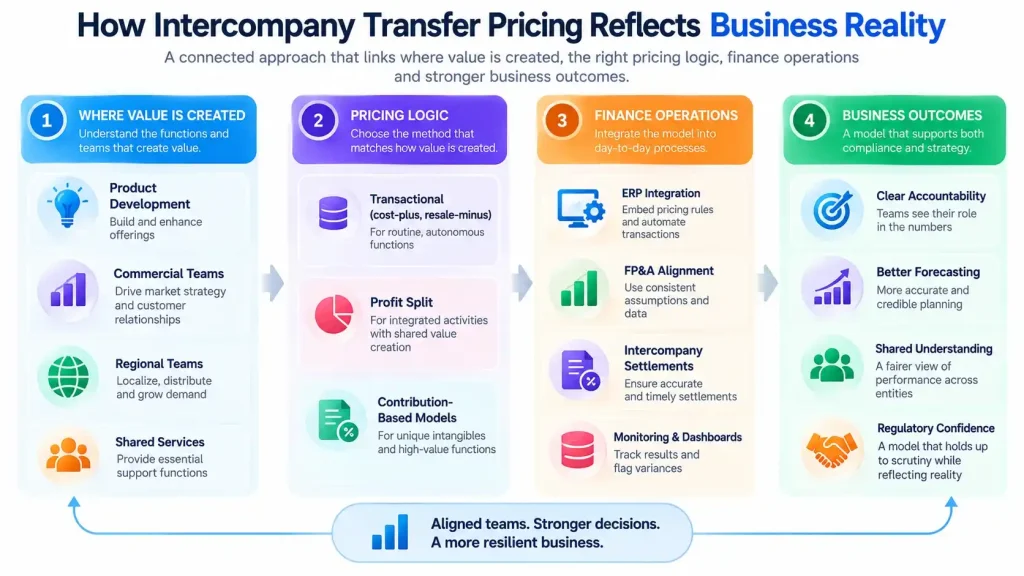
Once a model moves into daily operations, it needs ongoing support. Three elements keep an intercompany pricing model working over time:
- Integration: aligning cost centers, project codes, and FP&A plans with intercompany settlements so data flows cleanly from planning to close
- Instrumentation: dashboards that track deviations from expected profit splits, cross-entity margin compression, and billing status
- Intention: a CFO who keeps explaining why the model exists, so pressure from one region or one short-term win does not bend it
A cybersecurity and identity SaaS company with entities in the US, Canada, Mexico, India, and Nepal shows why integration matters. A multi-entity finance architecture and a NetSuite implementation across five country entities cut the monthly close from 18 days to 10. Clean intercompany flows were a large part of making that speed possible.
A marketplace SaaS company with US and Polish operations offers a second reference point. Its consolidated reporting framework across both countries anchored investor diligence during a $20M Series B. Consistent cross-border reporting of this kind depends on intercompany pricing that finance teams can explain and defend.
Keeping the Model Alive
When people forget the reasons behind a model, its mechanics unravel and it becomes an artifact instead of an asset. Training finance leads in every entity on the philosophy behind the model, not only the math, builds shared understanding. Regular internal updates that explain trends and emerging deviations keep the model credible across the organization.
Intercompany Transfer Pricing as an Act of Fairness
Building a model that reflects values as well as regulation takes quiet courage. It may mean assigning profit to a region because it contributes strategically, not because it sits in a low-tax jurisdiction. When that happens, people begin to trust the numbers, and that trust becomes a strategic advantage.
The Cultural Cost of Oversimplification
Flat cost-plus markups and fully centralized IP are easier to administer, but simplification carries a cultural tax. Teams that drive innovation yet find themselves priced as cost centers often stop trying, because they no longer see themselves in the numbers. Intercompany pricing cascades into budgets, headcount, and strategic support, so these signals travel far.
A Euronext Paris-listed gaming company with operations in the US, France, the UK, Singapore, and South Korea shows the scale of this challenge. More than $100M in cross-border M&A added new entities to the structure. Consolidated reporting under IFRS and US GAAP then required one unified definition of revenue across every subsidiary. That consistency gave each region a clear and comparable view of its contribution.
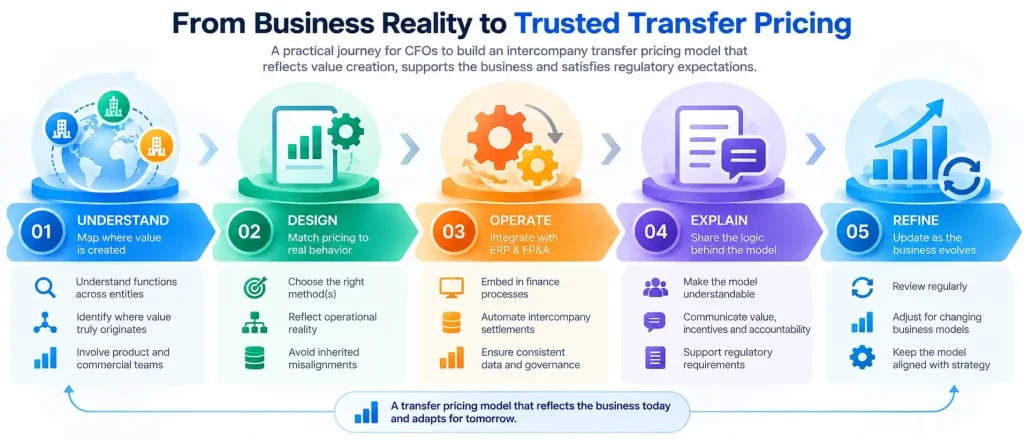
The Intercompany Transfer Pricing Lifecycle
| Understand | Design | Operate | Explain | Refine |
| Map where value is created | Match the method to real behavior | Integrate with ERP and FP&A | Share the logic behind the model | Update as the business evolves |
Fairness in intercompany pricing means recognition, not equality. It credits contribution wherever it happens, such as a market team that localizes a product. A support group that turns customer pain into product insight deserves the same recognition. The strongest intercompany transfer pricing models do more than minimize the effective tax rate. They build internal trust and tell a story the company is proud to live inside.
Three Key Takeaways
- Intercompany transfer pricing should reflect how the company creates value, not just what regulations allow. Mapping the operating truth through interviews with product and commercial leaders is the starting point.
- The right intercompany pricing method depends on how autonomous and collaborative each function is. Transactional, profit split, and contribution models each fit different operating realities.
- A model only works when integrated into systems, instrumented for visibility, and explained with clear intent. Handled this way, it builds trust and recognizes contribution wherever it happens.
Disclaimer: This article is intended for informational purposes only and does not constitute legal, tax, or accounting advice. You should consult your own tax advisor or counsel for advice tailored to your specific situation.
Hindol Datta is a four-time CFO and senior finance executive with over 25 years of leadership experience across cybersecurity, SaaS, gaming, logistics, digital marketing, medical devices, consumer products, and nonprofit organizations. He has led more than $120M in fundraising and over $150M in M&A transactions while building the financial and operational systems that let complex businesses scale with confidence. He is the author of seven books in the Systems CFO Series and holds active CPA, CMA, and CIA credentials.
AI-assisted insights, supplemented by 25 years of finance leadership experience.