Executive Summary
A consolidated income statement can show record gross margin, strong EBITDA, and healthy free cash flow, and still be wrong. This happens when finance teams treat intercompany elimination as a back-office footnote rather than a core discipline of the close. Sales, loans, royalties, and inventory transfers between entities under common control are not third-party economics. If they survive consolidation, the group is reporting profit that exists only on paper.
For finance leaders running multi-entity structures, whether across borders, shared services, or a matrixed legal footprint, getting elimination entries in consolidation right is not a compliance exercise. It is the mechanism that tells a board, a lender, or an acquirer whether the numbers in front of them describe the business or describe an illusion built from internal noise.
Why Intercompany Elimination Exists in Consolidated Reporting
Consolidated financial statements treat a group of related entities as a single economic unit reporting to the outside world. That premise only holds if the close strips out every transaction between entities under common control. Only then do the numbers reach a reader untouched by internal noise. This includes sales, services, royalties, loans, and inventory transfers. Subsidiary A might sell product to Subsidiary B at a markup. Recognizing that profit in consolidated cost of goods sold misstates the group’s actual performance. No cash or value ever left the organization. The same logic applies to interest income on an intercompany loan. If the lender and the borrower both sit inside the group, that income has to disappear on consolidation. From the outside looking in, the group did not earn anything from itself.
The standard this work must meet is simple to state and harder to execute: only revenue, expense, assets, and liabilities involving genuine third parties should survive into the consolidated statements. Everything else is internal choreography, and choreography does not belong in a P&L.
A Multi-Country Reality Check
In a high-growth cybersecurity and identity access management company with roughly $30M in annual recurring revenue and entities spanning the United States, Canada, Mexico, India, and Nepal, this was not an abstract accounting question. A five-country structure with intercompany service charges, cost allocations, and cross-border staffing meant that elimination entries in consolidation had to be built into the close cadence from day one, not bolted on after the fact. That structure, paired with a full NetSuite implementation, compressed the monthly close from eighteen days to ten, largely because intercompany balances were reconciled continuously rather than chased at month end.
What Intercompany Transactions Elimination Actually Covers
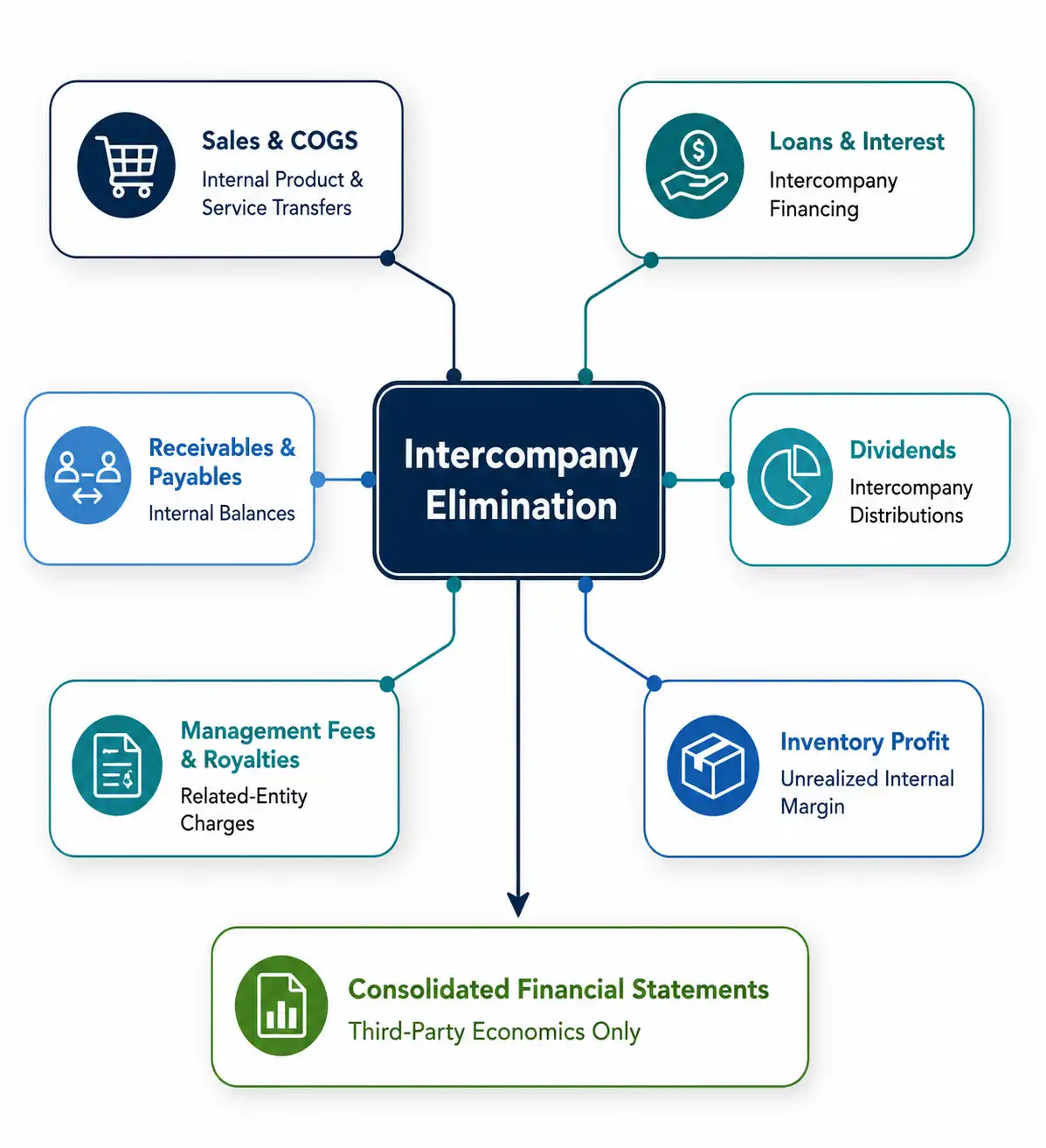
The scope of intercompany transactions elimination is broader than most finance teams initially assume, and each category carries its own timing and documentation demands. The common items include:
- Sales and cost of goods sold on product or service transfers between group entities
- Interest income and expense on intercompany loans
- Intercompany dividends, which inflate consolidated income if left unremoved
- Receivables and payables between entities, which must net to zero
- Unrealized profit sitting inside unsold intercompany inventory
- Management fees and royalties charged between related companies
- Equity investments in partially owned subsidiaries or affiliates
None of this is simply zeroing out a number in a spreadsheet. It requires a working understanding of transaction flow, ownership percentage, and the accounting policy each entity operates under, which is precisely why elimination breaks down in organizations that have grown faster than their systems.
Elimination Entries in Consolidation: The Inventory Profit Trap
Unrealized intercompany profit in ending inventory is the category that causes the most damage, largely because it is the easiest to miss. If Entity A sells $1M of product to Entity B at a 20 percent markup, and Entity B has not yet sold that inventory to an outside customer, the $200K of profit embedded in that transfer is unrealized. Generally accepted accounting principles require that profit to be deferred until the inventory actually leaves the group, and skipping that step is how gross margin ends up overstated in exactly the businesses that can least afford the distortion: supply chain-heavy operations with multiple manufacturing or distribution entities.
Where This Shows Up in Practice
At a $127M global consumer products company selling through DTC, Amazon, and wholesale channels, with a supply chain spanning China and Vietnam, inventory sat at the center of nearly every consolidation risk. Inventory turns improved from three times to seven times over the course of the mandate, through demand planning, SKU rationalization, and logistics optimization, and every one of those transfers between manufacturing and distribution entities carried embedded margin that had to be tracked and deferred correctly at each period close. Four consecutive clean external audits followed, and that result depended directly on the discipline applied to unrealized profit in inventory, not on the size of the finance team.
Why Elimination Breaks Down in Growing Organizations
Intercompany elimination rarely fails because anyone intends to misstate the numbers. It fails because the underlying infrastructure was never built to support it. The recurring causes include:
- Decentralized systems, where entities operate on separate ERPs or disconnected subledgers
- Asynchronous closes, where one entity closes early and other lags behind
- Absent intercompany agreements, leaving no documented transfer pricing or service-level terms
- Manual reconciliation, relying on spreadsheets, email threads, and exception-based checks
- Poor data granularity, with no tagging of intercompany transactions at the point of entry
Without automation and a disciplined cadence, elimination becomes reactive rather than structural, and finance leadership often does not discover the exposure until due diligence or an audit forces the question. That is the worst possible moment to learn the answer.
A Euronext Paris-listed gaming and digital entertainment company operating across the United States, France, the United Kingdom, Singapore, and South Korea faced this exact risk at scale. Creating one unified definition of revenue across every subsidiary required a global rollout of Oracle Financials and MicroStrategy, which materially cut statutory reporting cycles under both IFRS and US GAAP and gave the group a consolidation process that could withstand the scrutiny of an S-1 filing and Big Four audit review.
Building a Process That Holds Up
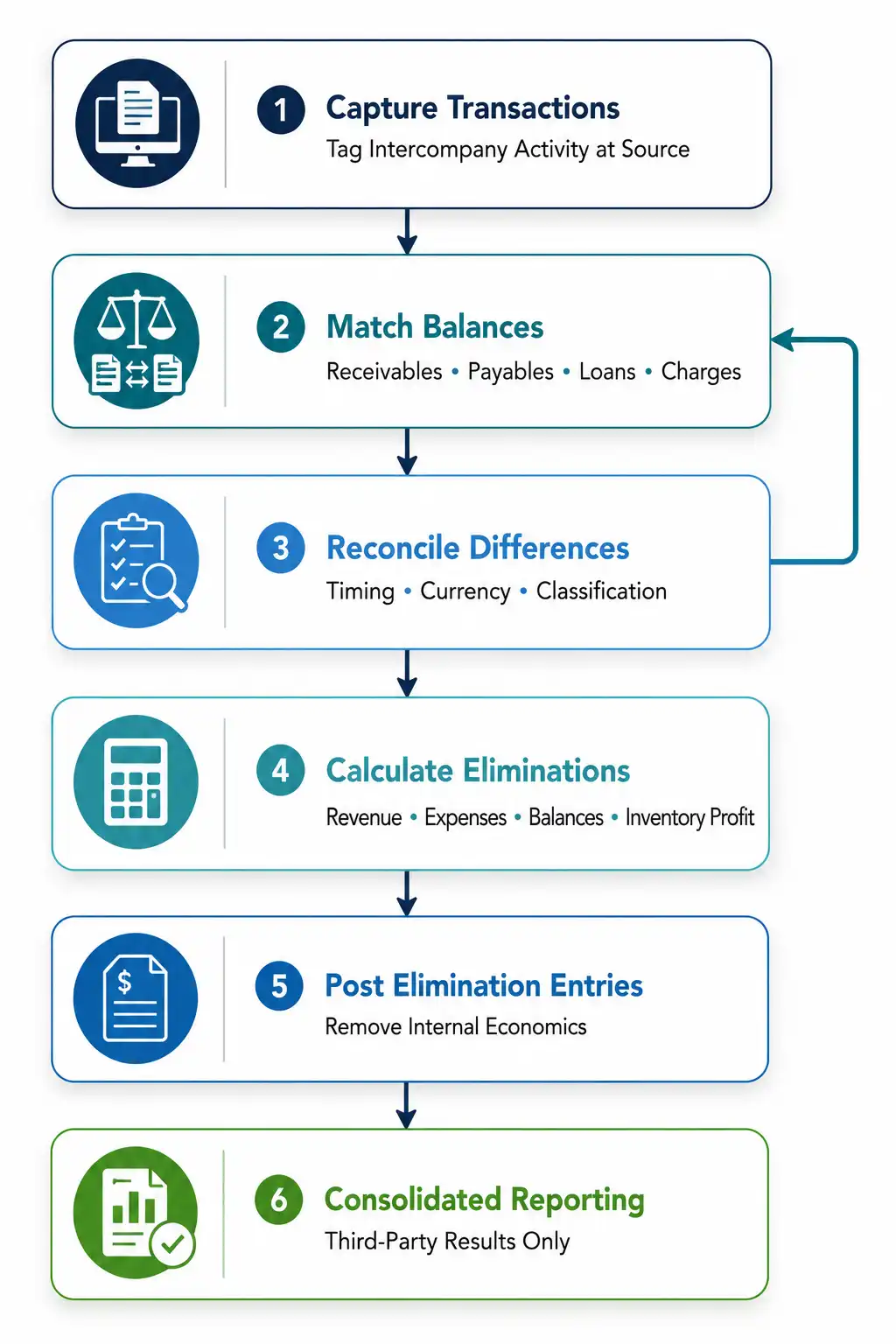
The practices that separate audit-ready consolidations from reactive ones are not complicated, but they require consistency:
Map every intercompany flow
Go beyond sales to capture loans, royalties, allocations, and inventory transfers between entities.
Document intercompany agreements
Formalize transfer pricing, service-level terms, and cost-sharing models so the accounting matches the legal form.
Tag transactions at the source
Build intercompany tagging into the ERP so eliminations can be generated automatically rather than reconstructed after the fact.
Reconcile monthly
Treat elimination as a core close activity, not a year-end cleanup project.
Track unrealized profit in inventory
Build reporting that follows intercompany transfers through to external sale so deferred profit is calculated accurately, not estimated.
Coordinate with tax and legal
Intercompany flows carry transfer pricing and permanent establishment implications that finance cannot address alone.
This discipline showed up again in a $170M global medical device manufacturer with plants in Copenhagen, Cork, and Taiwan, where standard costing and bill of materials management across three international sites meant that intercompany transfer pricing was not a side conversation. It was embedded in the cost accounting system itself, because a regulated industry does not tolerate estimates where actuals are required.
Three Key Takeaways
- Intercompany elimination is not a footnote to the close; it is the mechanism that determines whether consolidated statements describe the business or describe an accounting illusion, and treating it as a core monthly discipline rather than a year-end adjustment is what protects margin credibility.
- Unrealized profit in intercompany inventory is the most consequential and most frequently overlooked elimination category, and organizations with multi-entity supply chains should build reporting that tracks transfers through to external sale rather than relying on estimates.
- Elimination processes fail because of infrastructure, not intent, so tagging intercompany transactions at the source and reconciling monthly, backed by documented intercompany agreements, is what allows a growing multi-entity organization to scale without accumulating hidden restatement risk.
Disclaimer: This article is intended for informational purposes only and does not constitute legal, tax, or accounting advice. You should consult your own tax advisor or counsel for advice tailored to your specific situation.
Hindol Datta is a four-time CFO and senior finance executive with over 25 years of leadership experience across cybersecurity, SaaS, gaming, logistics, digital marketing, medical devices, consumer products, and nonprofit organizations. He has led more than $120M in fundraising and over $150M in M&A transactions while building the financial and operational systems that let complex businesses scale with confidence. He is the author of seven books in the Systems CFO Series and holds active CPA, CMA, and CIA credentials.
AI-assisted insights, supplemented by 25 years of finance leadership experience.