
Executive Summary
Many people picture the investment committee as either a temple of rational capital allocation or a theater of narrative and pattern recognition. Both views are partial, because the committee exists to construct conviction under uncertainty and to decide whom the institution will trust.
This article examines how committee structure shapes outcomes, which behavioral biases steer the room, and how investment memos persuade rather than predict. It closes with the fiduciary weight of the vote and the practices that turn a committee into a learning institution.
What an Investment Committee Decides
The committee’s real function is neither oracle nor obstacle, but an instrument of institutional judgment that balances fiduciary duty against irreducible uncertainty. Sponsors often express conviction in numbers, yet numbers filter decisions more than they make them. A model is a compressed belief system dressed in the language of objectivity, so the committee must examine what the model presupposes. The real questions are what the firm thinks it knows, how it knows it, and what it is prepared to bet. In that sense, an investment committee allocates belief as much as capital, and belief sets obligations in motion that are hard to reverse.
How Investment Committee Structure Shapes Decisions
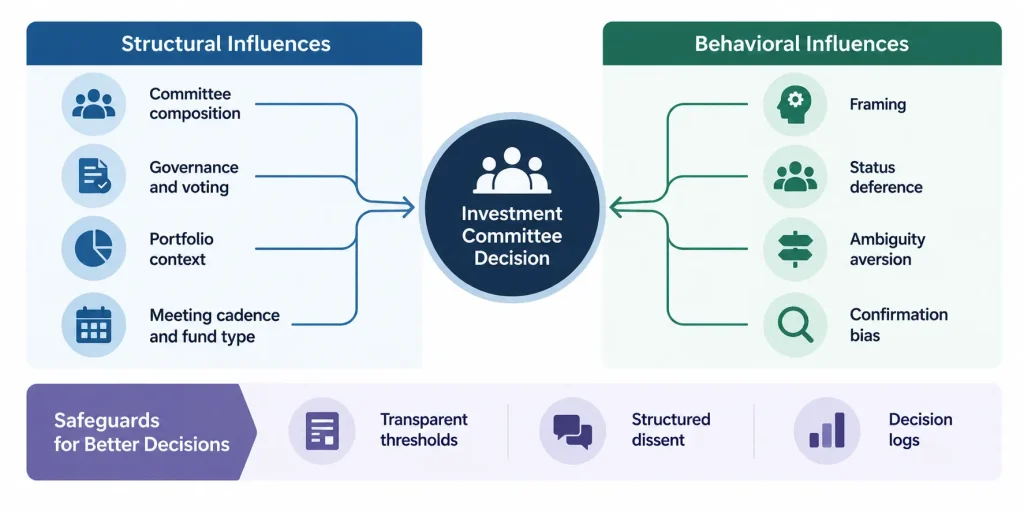
No committee is neutral, because its composition, cadence, and governance encode priorities that are partly explicit and partly tacit. Those priorities decide which deals get seen, how teams frame them, and what counts as convincing.
Composition, Governance, and Deal Sponsorship
Most committees draw on partners, managing directors, and chief investment officers who carry institutional memory. That memory holds past regrets, silent red lines, and hard-won convictions. It guards against pattern blindness but can also overfit on past trauma. A deal that resembles an old failure may never get a neutral hearing, while a founder who feels like a past success may get unearned benefit of the doubt.
Domain experts, risk managers, and legal counsel add insight but rarely decide outcomes, since influence follows fiduciary burden. Governance models vary as well, and voting lets members record dissent and then ignore it. Consensus raises the bar for conviction but invites performative alignment. Deal sponsorship adds another layer, because the presenting partner must both defend and deliver the deal. The conversation then drifts from whether the deal is good to whether the sponsor can manage its risk.
Portfolio Context, Cadence, and Fund Type
Committees never judge deals in isolation from the wider portfolio. Several structural forces shape every decision before a sponsor even speaks:
- Portfolio context: a strong deal may fail because of adjacent exposure, while a mediocre one may pass because it closes a strategic gap.
- Cadence: weekly meetings in growth equity or credit allow continuous refinement, while quarterly meetings push teams to over-polish deals.
- Fund type: a venture capital fund can tolerate high-variance bets that a credit vehicle cannot.
- Fund maturity: first-time funds guard their reputation, while legacy funds favor models resembling past winners.
Purpose matters most, because an investment committee must act as clearinghouse, courtroom, and conscience at once. Decisions degrade when it drifts into ritual, and three design disciplines keep it honest:
- Transparency of thresholds: define a yes as a multi-factor test of whether the deal is both underwritten and ownable.
- Memory with discipline: let past lessons inform judgment without blinding it.
- Separation of person and thesis: treat trust in the sponsor as one variable, not the sole determinant.
Behavioral Biases Inside Venture Capital Investment Committees
Inside venture capital and private equity firms alike, the investment committee is a marketplace of belief, not a court of fact. Bounded rationality means members test their priors instead of eliminating them, and how something is said can outweigh what is said.
Framing and Status Dynamics
Framing shapes how an investment committee metabolizes risk, and its effect is easy to underestimate. Present a deal as a chance to disrupt a $10B market, and members lean forward. Describe the same company as cash-flow negative in a crowded space, and caution replaces curiosity. Sponsors know this, so decks arrive as narrative hypotheses dressed in financial language.
Status dynamics compound the problem, since a junior partner may hold the sharper model yet stay silent when a founding partner disagrees. That deference becomes passive risk acceptance, driven by inertia and the habit of trusting voices that delivered past wins.
Structured Dissent and Ambiguity Aversion
The strongest committees ritualize dissent instead of merely tolerating it. They assign devil’s advocates and ask two questions: what must be true for this deal to succeed, and what unknown could break it? Specific, humble critique turns the debate from adversarial to exploratory.
Ambiguity aversion is the most enduring constraint on committee judgment. Faced with a clean low-return deal and an ambiguous transformative one, committees tend to choose the former. Nobody loses a job for passing on an uncertain bet, while backing one that fails can end careers. That logic is rational for individuals but corrosive for the firm, which drifts toward the mediocrity of the known. Institutional courage requires structure, including decision logs that track reasoning and post-mortems that reward clear thought over lucky outcomes.
Belief formation also starts long before the pitch, through informal conversations and familiarity with the sponsor. When minds arrive made up, the meeting becomes a confirmation ritual. Members must be willing, and even rewarded, to update their views during discussion.
The Investment Memo as Storytelling Architecture
The investment memo presents itself as a neutral ledger of assumptions and risks, yet it works as an instrument of persuasion. Its power lies in what it renders believable.
Models as Belief Maps
For any venture capital investment committee, a financial model is a compression algorithm that defines the boundaries of possible futures. The most useful committee question is not whether the numbers are right, because they never are. Instead, members should ask what they must believe for the model to hold, and whether that belief survives pressure. Excess complexity can become a shield against interrogation, and a model that cannot be narrated should not be funded.
The Series B raise of a marketplace SaaS company shows how this plays out. Its cohort and unit economics models held up through investor diligence on a $20M round because each lever had a clear causal story behind it.
The Four Acts of a Strong Investment Memo
Strong sponsors move from belief to validation, not from detail to summary. The flow below shows the four acts that give a memo its rhythm.
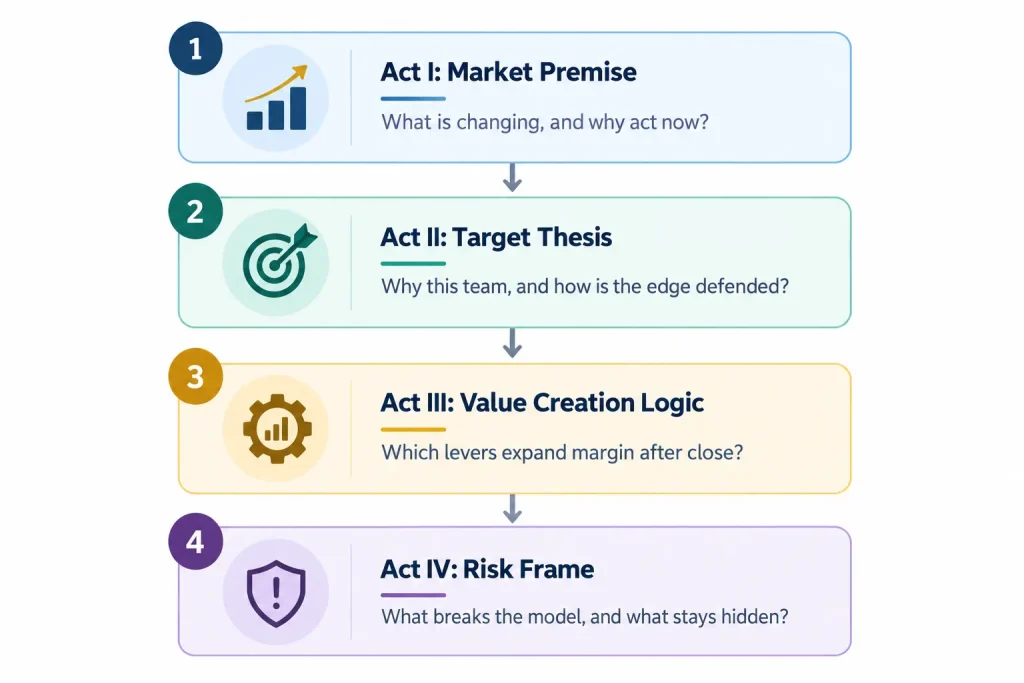
Act III separates thinkers from tourists, since it must show evidence for each value lever. Act IV is not a disclaimer but a diagnostic of confidence. A disciplined memo becomes a covenant recording what the team believed and will answer for.
From Model to Steward
In the room, the numbers fade and the committee asks whether the storyteller will adapt when reality diverges from the model. A yes therefore means the committee trusts this person to navigate what the numbers cannot show.
Buy-side diligence on an IT services acquisition illustrates the point. Quality-of-earnings work surfaced material EBITDA adjustments that shaped the buyer’s decision more than any valuation output.
The Fiduciary Weight of the Investment Committee Vote
Every meeting reaches a moment when someone asks whether the group is ready to proceed. That vote is the closest thing private capital has to a civic act, because it co-signs a theory of the future.
What a Yes Commits the Institution To
A yes is first a fiduciary action that must pass tests of prudence, loyalty, and care. It must serve the capital’s long-horizon obligations, whether a pension’s liabilities or a foundation’s mission. Raising $37M in equity and venture debt for a mission-driven education institution required that same alignment between capital and purpose.
The vote is also a judgment call made at the edge of uncertainty, closer to a Bayesian update than a verdict. Over-indexing on precision makes a committee brittle, while ignoring uncertainty makes it blind. Each vote is also a cultural act, because it reinforces whom the firm trusts and what it rewards.
Memory completes the obligation, so committees should document what they believed, on what evidence, and what they missed. That habit builds an institutional immune system and separates good bets that lost from bad decisions that happened to win. Five commitments sustain a high-functioning investment committee over time:
- Clarify structure: make purpose, voting mechanisms, and conviction thresholds explicit.
- Normalize dissent: log objections and treat contrary views as signal, not obstruction.
- Interrogate framing: demand transparent assumptions and narrative discipline.
- Preserve memory: record declined deals as carefully as approved ones.
- Align with mission: ask whether a deal is the institution’s kind of good.
Three Key Takeaways
- An investment committee allocates belief, not just capital. Its structure, from composition to cadence, decides which deals reach the table and what counts as convincing.
- Behavioral forces such as framing, status deference, and ambiguity aversion steer the room. Ritualized dissent and decision logs protect judgment from conformity.
- Treat every memo as a belief map and every vote as a fiduciary covenant. Capital and models are replicable, but principled judgment remains the only durable moat.
Disclaimer: This article is intended for informational purposes only and does not constitute legal, tax, or accounting advice. You should consult your own tax advisor or counsel for advice tailored to your specific situation.
Hindol Datta is a four-time CFO and senior finance executive with over 25 years of leadership experience across cybersecurity, SaaS, gaming, logistics, digital marketing, medical devices, consumer products, and nonprofit organizations. He has led more than $120M in fundraising and over $150M in M&A transactions while building the financial and operational systems that let complex businesses scale with confidence. He is the author of seven books in the Systems CFO Series and holds active CPA, CMA, and CIA credentials.
AI-assisted insights, supplemented by 25 years of finance leadership experience.