
Executive Summary
Learning how to measure stakeholder engagement starts with the performance indicators a company chooses to track and share. Investors, boards, lenders, and employees cannot see inside the business, so they read its KPIs as signals of strategy and honesty. The way a company defines, explains, and defends those metrics shapes whether stakeholders stay engaged and confident.
The sections ahead examine five aspects of that work, beginning with the anatomy of a meaningful KPI. They also weigh what is measurable against what matters. Later sections cover how metrics shape internal culture, how they build credibility with capital markets, and how they sustain trust when results disappoint. Together they show the CFO as the custodian of the signals that keep stakeholders engaged.
Why KPIs Shape Stakeholder Engagement
Every KPI appears objective, yet each metric reflects choices about what matters and what the company is willing to miss. For example, a growth-stage firm that tracks gross merchandise volume bets on future monetization. A mature company that emphasizes free cash flow over EBITDA signals a shift from promise to permanence.
A KPI as a Hypothesis
A well-built indicator makes a causal claim: if this number moves, the business is improving. The most common design error is conceptual, not mathematical. Companies adopt Net Promoter Score because peers do, or report active users while ignoring cohort churn. Those metrics survive because they are easy to plot, not because they explain performance.
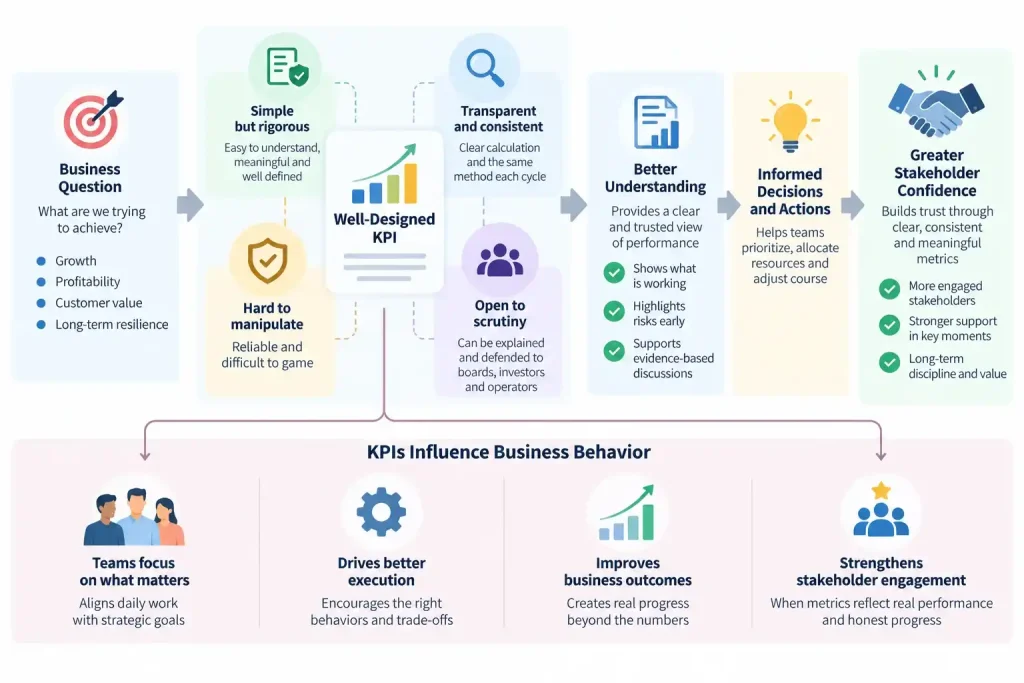
Once a KPI enters the organization, it starts to shape behavior. A sales team rewarded for ARR may bundle services or reclassify renewals as new bookings. A product team measured on monthly active users may push log-ins that add activity without adding value. Strong indicators and stakeholder engagement metrics share several traits:
- Simple in form while staying rigorous in meaning
- Transparent in calculation and consistent from one cycle to the next
- Hard to manipulate and easy for the governed team to explain
- Open to scrutiny from boards, investors, and operators
A Euronext Paris-listed gaming company with subsidiaries in five countries shows why definitions matter. A firmwide rollout of Oracle Financials and MicroStrategy created a single, unified definition of revenue across every subsidiary. That consistency gave stakeholders one trusted view of performance.
How to Measure Stakeholder Engagement Across Groups
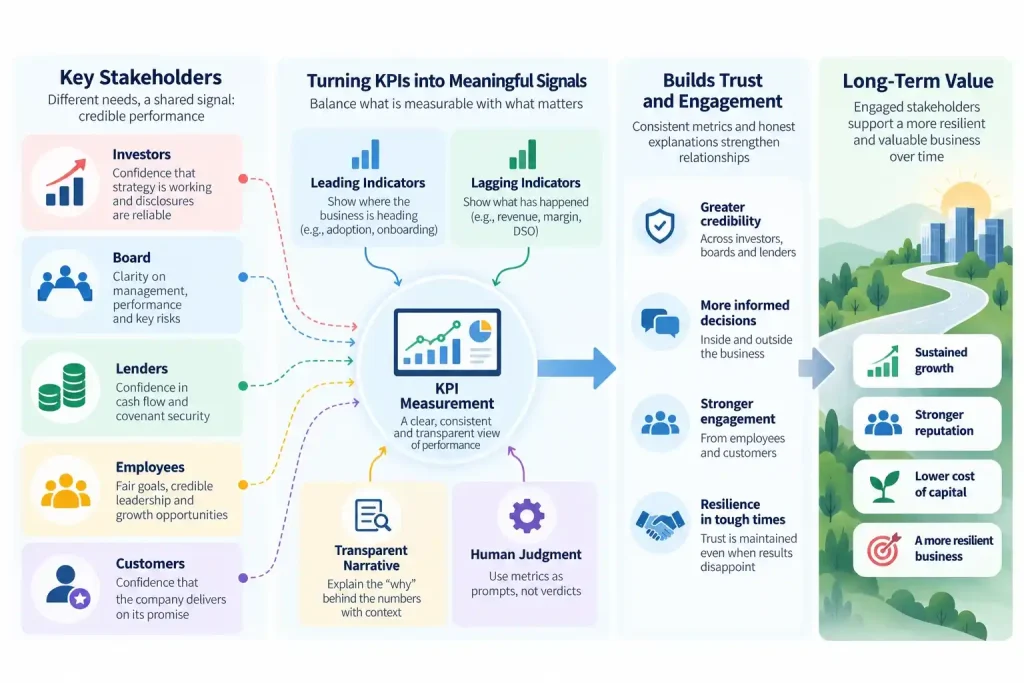
Each stakeholder group engages with the company for different reasons, so a single dashboard seldom captures the full picture. The CFO should match metrics to what each audience needs to believe. Tracking both behavior and perception gives a clearer view than either alone.
Stakeholder Groups and Engagement Indicators
| Stakeholder Group | What They Need to Believe | Sample Engagement Indicators |
| Investors | Strategy is working and disclosures are reliable | Meeting attendance, follow-on participation, analyst questions, valuation patience after misses |
| Board | Management understands the business and its risks | Quality of board discussion, time spent on strategy versus explanations, information requests |
| Lenders | Cash flow and covenants are secure | Covenant headroom, renewal terms, speed of credit approvals |
| Employees | Goals are fair and leadership is credible | Retention, engagement survey trends, internal mobility |
| Customers | The company delivers on its promise | Retention, expansion revenue, referral rates |
Balancing leading and lagging indicators matters as much as choosing the right audience. Gross margin, conversion rates, and days sales outstanding are clean and familiar, but they describe the past. Leading signals such as product adoption velocity or onboarding friction often explain future results better. When finance relies only on lagging data, it resembles a driver watching only the rear-view mirror on a winding road.
Stakeholder engagement metrics should act as prompts, not verdicts. A missed KPI may reveal a flawed metric or conditions that changed faster than the model. A met target may reflect real progress, or it may reflect sandbagging and low ambition. Human judgment must sit beside every number on the dashboard.
How Metrics Shape Internal Culture
Every company teaches a hidden curriculum through what it measures. The numbers that drive bonuses and dominate meetings become the real statement of values. When the measure becomes the target, people start performing for the metric instead of the mission.
Aligning What Is Counted With What Is Valued
Consider a company that calls itself customer-first while performance reviews focus almost entirely on quarterly sales. Customer issues that do not affect near-term revenue slip down the list, and feedback loops break. The brand promise erodes through quiet, unmeasured compromises instead of a single scandal.
Balanced performance systems help companies avoid this kind of drift. Measuring only output rewards speed but not quality, and measuring only efficiency can erode innovation. Rewarding individual results without cross-functional impact can undermine collaboration. KPIs must be accurate and constructive, guiding behavior in the direction the company wants to go.
Employee engagement improves when teams help design their own metrics. Imposed KPIs feel like surveillance, while co-developed ones become a shared language of ambition and accountability. A cybersecurity SaaS company with roughly $30M in ARR shows the payoff of disciplined, shared measurement. Its driver-based forecasting engine and steady reporting cadence held actuals within plus or minus five percent of forecast for 8 consecutive quarters.
Building Credibility With Capital Markets
In capital markets, belief is a fragile currency that depends on evidence and repetition. Investors, analysts, and lenders interpret performance through KPIs, and a misread signal is hard to repair. This is where knowing how to measure stakeholder engagement becomes a practical advantage.
Pairing Metrics With Narrative
Consider two companies that both report slowing revenue growth. One offers flat figures with only vague explanations for investors. The other explains cohort behavior and macroeconomic effects, and it shows that leading indicators such as pipeline velocity and net expansion remain strong. The headline number is the same, yet the more transparent company earns patience while the other loses trust.
Sophisticated stakeholders discount spin and look for consistency. They ask whether the same metrics appear each quarter, whether definitions stay stable, and whether the company discloses misses as openly as wins. Changing metrics midstream, such as reframing churn as retention, can look evasive unless the company explains the change openly.
Signals That Build or Erode Stakeholder Confidence
| Practice | Builds Confidence | Erodes Confidence |
| Metric selection | Stable KPIs tied to strategy | Frequent changes that favor good news |
| Definitions | Published and consistent | Vague or quietly revised |
| Misses | Explained with cause and next steps | Buried or reframed |
| Leading indicators | Shared alongside results | Withheld until results appear |
Private companies preparing to raise capital face the same test, often with closer scrutiny. A marketplace SaaS company with operations in the United States and Poland offers a useful example. Consolidated cross-border reporting and cohort and unit economics models anchored investor diligence during a $20M Series B.
Sustaining Trust When Results Disappoint
At some point, every company sees its numbers turn against it. When dashboards stop reassuring, stakeholders look past the metrics to the leaders behind them. That moment reveals the true purpose of performance indicators.
Using KPIs With Integrity
Pressure tempts leaders to stretch the framing, redefine a segment, or shift the mix until a number looks better. That elasticity carries a cost, because each stretch reduces the weight of leadership’s word. Investors grow impatient, boards turn skeptical, and employees lose faith.
When leaders acknowledge misses openly and revise targets with reasons instead of excuses, trust can grow through failure. Stakeholders learn that the company will always explain what it is attempting and how it measures success. Several habits help sustain that confidence over many reporting cycles:
- Keep core KPI definitions stable and announce any change with its rationale
- Report misses with root causes and planned responses
- Share leading indicators so stakeholders can see trends early
- Use variance reviews to learn instead of to assign blame
A venture-backed digital marketing company that raised $36.5M across three rounds illustrates the value of credible metrics. Rigorous analysis of CAC, LTV, and contribution margin supported each funding conversation. Investors could trace growth to clear unit economics instead of headline revenue alone.
The goal of the modern CFO is a company that stakeholders believe even when results wobble. The most valuable statement after a weak quarter is a calm explanation of what happened, why, and what comes next. That clarity, repeated over time, is the strongest answer to the question of how to measure stakeholder engagement.
Three Key Takeaways
- Knowing how to measure stakeholder engagement begins with KPIs that are simple, consistent, and tied to the beliefs each stakeholder group needs to hold.
- Balanced leading and lagging indicators, designed with the teams they govern, shape a healthy culture and prevent the metric from replacing the mission.
- Stable definitions, honest explanations of misses, and clear narrative turn performance indicators into lasting stakeholder confidence.
Disclaimer: This article is intended for informational purposes only and does not constitute legal, tax, or accounting advice. You should consult your own tax advisor or counsel for advice tailored to your specific situation.
Hindol Datta is a four-time CFO and senior finance executive with over 25 years of leadership experience across cybersecurity, SaaS, gaming, logistics, digital marketing, medical devices, consumer products, and nonprofit organizations. He has led more than $120M in fundraising and over $150M in M&A transactions while building the financial and operational systems that let complex businesses scale with confidence. He is the author of seven books in the Systems CFO Series and holds active CPA, CMA, and CIA credentials.
AI-assisted insights, supplemented by 25 years of finance leadership experience.



