Executive Summary
Every quarter, a forecast becomes a test of credibility, and the test rarely announces itself as such. Long before an investor asks about growth strategy or margin trajectory, the sharper question sits underneath: did the company understand its own business well enough to predict where it was headed. Learning how to improve forecast accuracy is not a technical exercise reserved for finance teams alone; it is one of the clearest signals leadership sends about discipline, self-awareness, and the maturity of the systems running underneath the numbers.
This article examines why forecasting is important to the way boards and investors evaluate management, what an acceptable range of inaccuracy actually looks like in practice, and how finance leaders can turn a forecast miss into evidence of a company that learns rather than one that hides. The goal throughout is practical: a forecast that earns trust, quarter after quarter, without demanding the impossible standard of perfection.
Why Forecasting Is Important to Investor Confidence
Trust between a company and its investors rarely gets built in a single presentation. It accumulates, forecast by forecast, in the space between what leadership predicted and what actually arrived. When that gap stays narrow and explainable, investors read it as evidence that management understands the levers driving the business rather than simply hoping the business performs. When the gap widens or goes unexplained, skepticism follows quickly, regardless of how strong the underlying growth story might be.
At a Euronext Paris-listed gaming and digital entertainment company operating across five countries, board and audit committee engagement depended less on hitting every number precisely than on the ability to explain, quarter after quarter, why the numbers moved the way they did. Consolidated reporting under both IFRS and US GAAP only carried weight with the board because the underlying forecast had already earned credibility through consistency.
This is the deeper reason forecasting matters beyond the mechanics of budgeting. A forecast functions as a proxy for managerial judgment. It answers, indirectly, whether sales cycles are diagnosed or guessed, whether expenses are planned with intention or assembled after the fact, and whether the leadership team can be trusted with capital during periods when markets no longer reward promise alone.
How to Improve Forecast Accuracy Without Sandbagging or Overreaching
Two temptations threaten forecast accuracy, and both are more common than most finance functions want to admit. Sandbagging turns each earnings call into an engineered triumph, protecting downside at the cost of real visibility. Overreaching chases pipeline optimism and end-of-quarter heroics, producing forecasts that look impressive on paper and collapse under scrutiny. Improving forecast accuracy means resisting both instincts in favor of a model built on discipline rather than performance.
Building a Driver-Based Forecasting Engine
The most reliable forecasts are built from the ground up around the actual drivers of the business, not top-down targets reverse-engineered to look achievable. At a high-growth cybersecurity and identity access management company generating approximately $30M in annual recurring revenue across five countries, building a driver-based forecasting engine and capacity model from scratch made it possible to hold actuals within plus or minus five percent of forecast for eight consecutive quarters. That consistency did not come from conservative guessing; it came from treating sales cycle length, delivery capacity, and workforce composition as measurable inputs rather than assumptions.
A few habits distinguish forecasts that hold up from forecasts that do not:
- Ground revenue assumptions in pipeline velocity and historical close rates by segment, not aggregate averages
- Separate timing variance from demand variance, since the corrective action for each is different
- Rebuild the model each cycle using actualized data rather than carrying forward last quarter’s assumptions unchanged
- Treat Sales, Marketing, and Product as co-authors of the forecast, not passive inputs Finance consolidates after the fact
Setting an Acceptable Range of Inaccuracy
No forecast achieves perfect precision, and pretending otherwise invites the very sandbagging or overreach that erodes trust. What experienced operators and investors tend to accept is a defined tolerance band rather than an exact number.
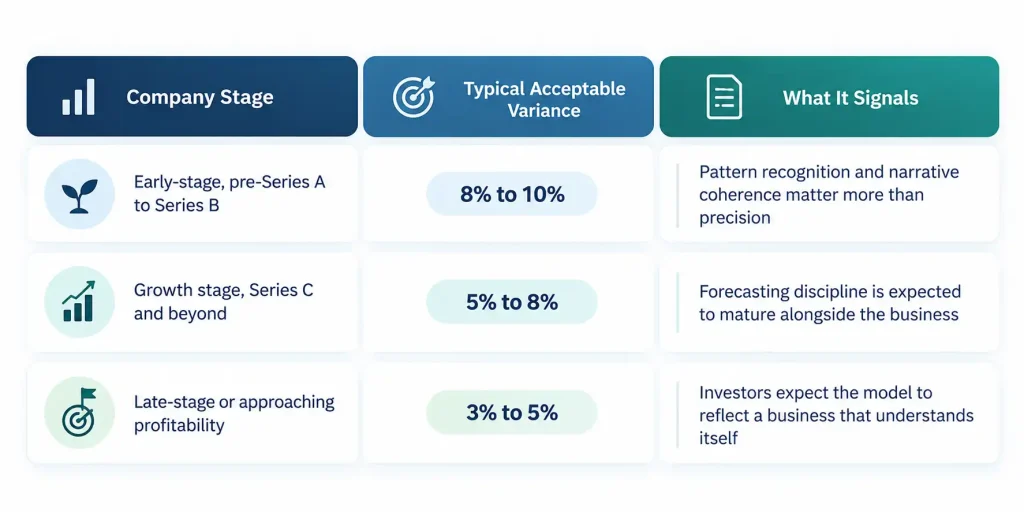
The point of the range is not to excuse misses. It gives a forecast room to breathe while still holding leadership accountable for explaining what happened when actuals depart from plan.
Turning a Forecast Miss into a Story Investors Believe
A miss, handled candidly, rarely damages trust as much as leadership assumes it will. What erodes trust is silence, or a variance explanation that reads as spin rather than diagnosis. The strongest variance explanations pair two disciplines: precise data and honest narrative.
The data discipline starts with a reconciliation bridge, tracing each deviation across revenue, gross margin, opex, and EBITDA back to its root cause rather than a vague reference to timing or macro headwinds. A revenue miss attributed broadly to market conditions explains nothing useful. A revenue miss traced to a 24-day extension in enterprise sales cycles, driven by procurement teams asking sharper questions about governance and compliance, gives the board something to act on.
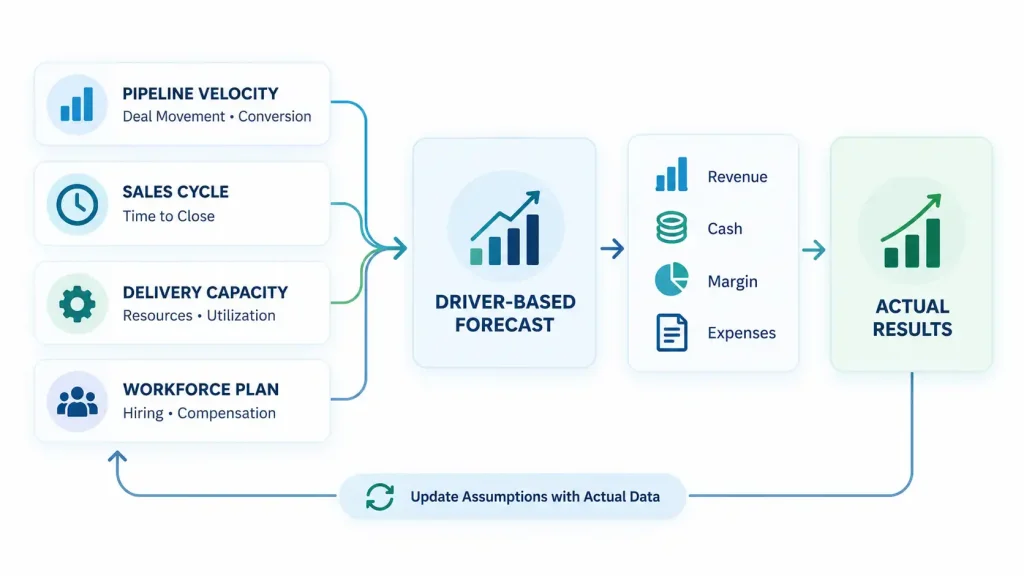
The narrative discipline gives that data shape. During a period of rapid scaling from $9M to $180M in revenue over twenty-four months at a venture-backed performance marketing company, the customer acquisition cost, lifetime value, and contribution margin framework built to sustain that growth also became the language used to explain variance whenever growth outpaced or lagged the model. Numbers without a narrative sound like noise, and a narrative without numbers sounds like excuse-making; together, they read as a company that understands itself.
A useful sequence for any material variance explanation:
- State the number plainly before framing it
- Trace the variance to specific, quantified root causes rather than general conditions
- Distinguish timing issues from demand or execution issues
- Describe the concrete response already underway
- Close with what the organization learned, not simply what it lost
Building a Culture That Forecasts with Conscience
Forecast accuracy, over time, becomes less a finance discipline and more a cultural one. Organizations that treat a miss as an investigation rather than an indictment tend to see accuracy improve, not because employees fear being wrong, but because they trust that a miss will be studied rather than buried, and over time that trust compounds into something structural. Boards become partners rather than prosecutors, and forecasts become instruments teams use to navigate the business rather than scoreboards used to grade them.
Three Key Takeaways
- Forecast accuracy functions as a proxy for managerial judgment, and investors read it as evidence of whether leadership understands the levers actually driving the business, independent of how strong the growth story sounds in a pitch.
- A driver-based forecasting engine, built around measurable inputs like sales cycle length and delivery capacity rather than top-down targets, produces the consistency that lets a company hold actuals within a defined and defensible tolerance band quarter after quarter.
- A forecast miss explained with a precise reconciliation bridge and an honest narrative of what changed and what the organization is doing about it tends to deepen investor trust rather than damage it, while silence or vague attribution to macro conditions erodes credibility far faster than the miss itself.
Disclaimer: This article is intended for informational purposes only and does not constitute legal, tax, or accounting advice. Readers should consult their own tax advisor or counsel for advice tailored to their specific situation.
Hindol Datta is a four-time CFO and senior finance executive with over 25 years of leadership experience across cybersecurity, SaaS, gaming, logistics, digital marketing, medical devices, consumer products, and nonprofit organizations. He has led more than $120M in fundraising and over $150M in M&A transactions while building the financial and operational systems that let complex businesses scale with confidence. He is the author of seven books in the Systems CFO Series and holds active CPA, CMA, and CIA credentials.
AI-assisted insights, supplemented by 25 years of finance leadership experience.