
Executive Summary
Every company that wants to invent its future must first learn how to improve cash flow in ways that last. Free cash flow is not a leftover from a good quarter; it is earned through working capital discipline, CapEx restraint, tax clarity and careful timing.
This article covers how free cash flow is built, allocated, optimized and communicated, and how finance leaders carry the weight of funding the unproven. Readers will leave with practical levers and a staged funding model.
Why Innovation Depends on the Ability to Improve Cash Flow
Every firm eventually faces a question no spreadsheet can settle: can the business afford to invent its future? That question surfaces when strategy presses against liquidity.
Free cash flow is often described as surplus, which misses the point. It is earned through mastery of operating rhythm, working capital, tax strategy and capital investment restraint, not through gross revenue or reported earnings.
Many firms treat innovation and cash discipline as opposites, as if creativity were allergic to fiscal boundaries. This is a dangerous fiction, because innovation without cash discipline becomes either reckless experimentation or paralyzed idealism. Each budget cycle forces a decision on whether leadership funds what it understands or what it believes. The goal is to right-size belief, giving the future what it needs without starving the present.
The Anatomy of Free Cash Flow and Why It Must Be Earned
Free cash flow is the purest measure of what a firm controls, since bookings, backlog and adjusted EBITDA all tell partial stories. It comes from thousands of small acts of restraint in procurement, collections and lean capital decisions. Together, they form a culture that prizes durability over dazzle. Any serious effort to improve cash flow starts with this culture, not with a one-off cost program.
The Four Levers Behind Free Cash Flow
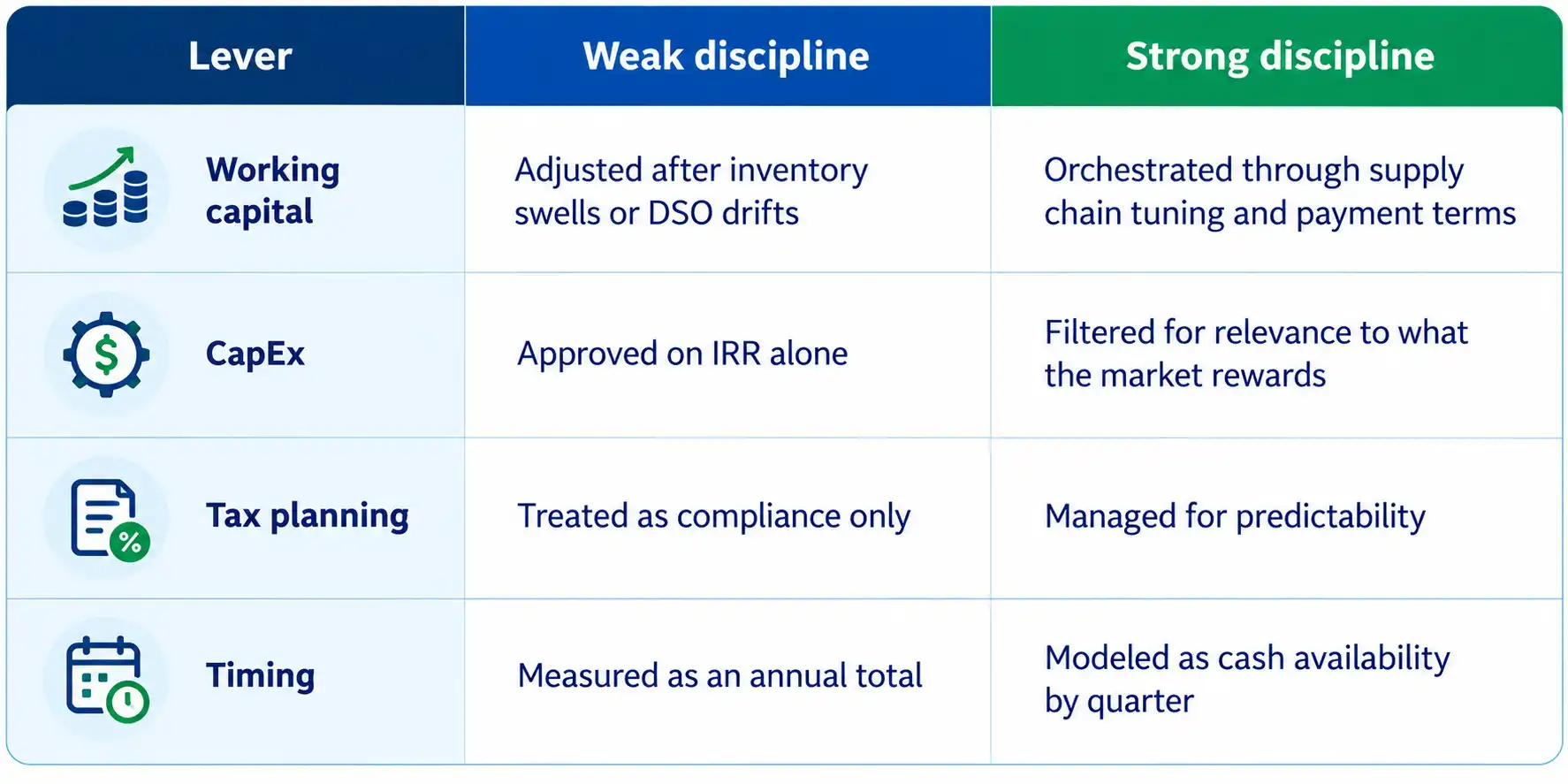
Every dollar placed into a fixed asset loses mobility, which innovation depends on. Timing deserves equal weight, because a program that needs funding in Q1 cannot rely on liquidity arriving in Q3.
Protecting the Integrity of Free Cash Flow
Delaying CapEx, shifting timing or claiming one-time efficiencies can inflate free cash flow on paper. False liquidity is dangerous because the enterprise believes it can move, then discovers mid-leap that the ground has given way.
Allocating Free Cash Flow to Innovation as a Portfolio
The moment a new idea receives funding rarely looks dramatic, yet the idea becomes a bet. The common error is treating innovation as a discretionary indulgence, trimmed when times tighten. Firms that shape their industries apply portfolio logic instead, allocating with curiosity balanced by rigor and patience.
Why Innovation Funding Fails in the Middle
Innovation rarely fails at the start, when optimism runs high, or at the end, when the decision is plain. It fails in the long middle, when the prototype partly works and the market responds only in part. ROI questions grow louder than questions of trajectory, and funding fatigue sets in. The real question is not whether the company can afford to start, but whether it can afford to sustain.
A Staged Model for Funding Innovation
Large upfront allocations tend to sit unspent and harden into politics. Staged release, borrowed from venture capital, ties capital to strategic milestones.
| Stage | Funding posture | Milestone that unlocks the next tranche |
| Exploration | Small, fixed allocation | Validated problem and early customer signal |
| Validation | Moderate tranche with checkpoints | Working prototype and evidence of demand |
| Scaling | Larger commitment tied to unit economics | Repeatable acquisition and healthy margin |
| Decision | Launch, spin out or stop | Clear evidence for or against the thesis |
Some investments reveal partners, technology limits or customer behavior before they produce income. These outcomes count as strategic tuition, not failure. For example, in a venture-backed digital marketing company that scaled from $9M to $180M in 24 months, CAC, LTV and contribution margin discipline determined which growth bets received the next dollar.
Over-romance floods ventures with cash they cannot absorb, while over-caution forces them to prove too much too soon. The healthiest stance is committed skepticism, which means funding an idea while watching closely how the capital is used.
How to Improve Cash Flow Through Working Capital and CapEx Discipline
Cash flow optimization is not the art of saying no but the art of saying yes for longer. Knowing how to improve cash flow starts with treating it as a designed environment, shaped by four main levers:
- Receivables: tune collections through incentive design, credit policy and customer relationships, since a modest DSO gain can free real room for innovation.
- Payables: align payment timing with value delivered, avoiding both prideful early payment and delays that damage supplier trust.
- Inventory: question how much stock the business must hold to feel safe, and what that safety costs in frozen cash.
- CapEx: treat it as the most permanent drain on liquidity, because it converts flexible cash into buildings, machines and systems.
In a $127M global consumer products company with supply chains in China and Vietnam, inventory turns rose from 3x to 7x through demand planning and SKU rationalization, which released working capital and reshaped the cash conversion cycle.
How Operating Discipline Becomes Innovation Runway
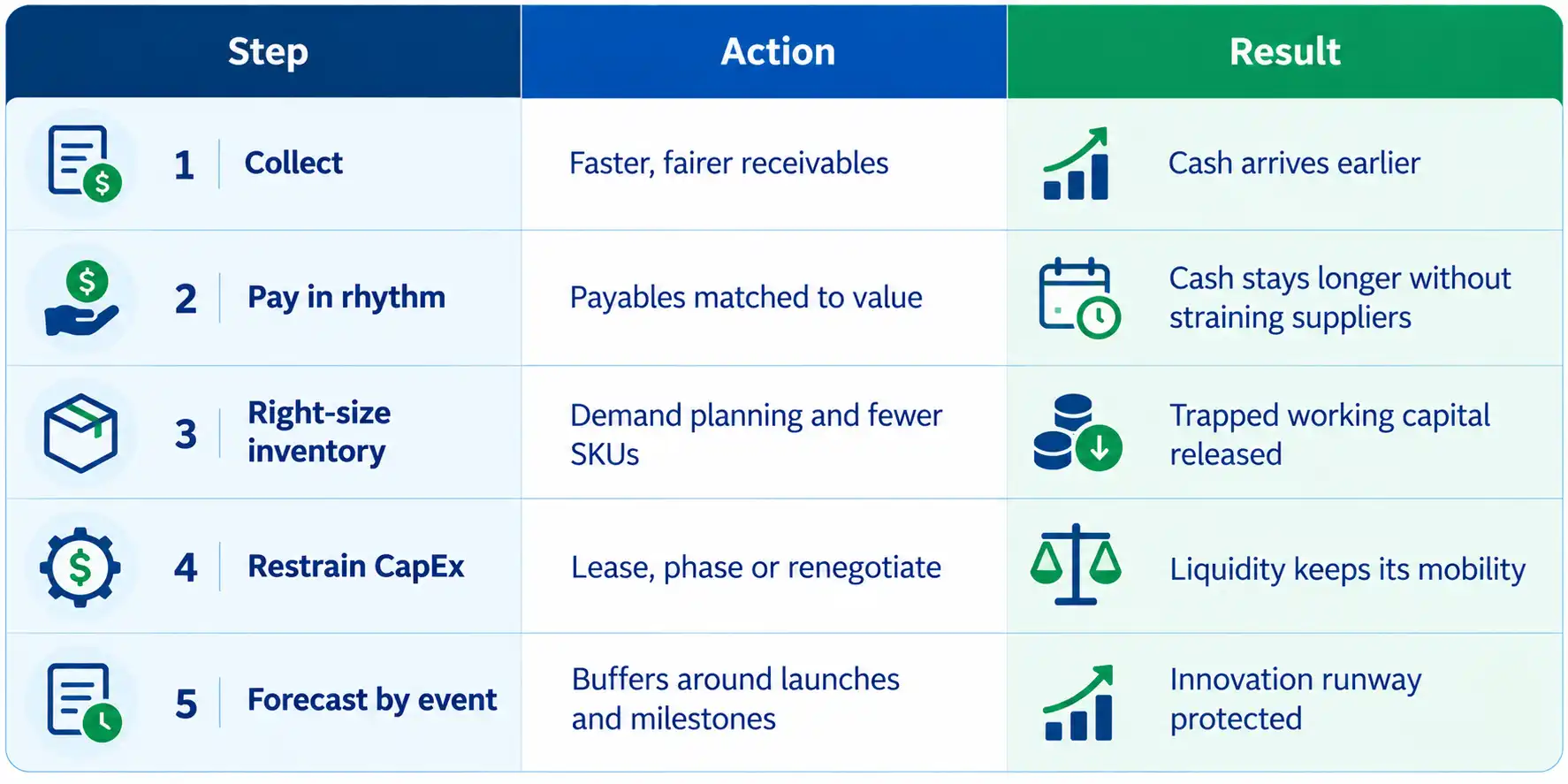
Cash flow forecasting should run by strategic event as well as by month, because launches and regulatory milestones create moments of cash sensitivity. In a $30M ARR cybersecurity company, a driver-based forecasting engine held actuals within 5% of forecast for 8 consecutive quarters. That level of predictability made longer-horizon investment decisions possible.
Visibility should never turn into rigidity, since optimization that kills responsiveness defeats its own purpose. Consider a company that funds a three-year runway for a new platform while cutting capital expenditures by 18%. Renegotiated equipment timelines, leasing instead of buying, and better tax treatment of depreciation make that possible. The reservoir did not remove risk, yet it bought time for real learning to occur.
Communicating Innovation Liquidity to Investors, Employees and Customers
How a firm splits surplus between dividends, debt reduction, R&D and acquisitions becomes a message markets read with care. A company that champions innovation while channeling cash into buybacks invites skepticism and, often, a lasting valuation discount.
Investors want governed conviction instead of theatrical promises, and effective finance leaders build it by sharing:
- Operating cash flow patterns and their seasonality
- Thresholds for discretionary investment
- Guardrails that trigger expansion or pause
- Context for volatility instead of attempts to hide it
During a $37M raise across equity and venture debt for a mission-driven education and research institution, investor confidence rested on a clear account of how funds would be governed across variable funding scenarios. Companies that improve cash flow and explain the structure behind it earn patience that slogans cannot buy.
Employees and customers read the same signals, since innovation teams wonder whether they will be cut when the quarter turns. Enterprise customers see a cash-backed roadmap as proof that the vendor will still be here tomorrow.
The Human Side of Funding What Has No Guarantee
Some decisions arrive after the models are clean, yet doubt remains about whether to fund the idea at all. No internal rate of return captures the emotional math behind that choice, which lives in questions such as:
- What if the project fails and damages the finance team’s credibility?
- If it succeeds too late, will the company still benefit?
- Could it absorb more liquidity than the core business can spare?
- What if the company declines, and a braver competitor funds the same idea?
Declining a promising project carries its own weight as well. When an early-stage digital marketing SaaS company cut monthly burn from $800K to $200K, attractive initiatives paused, yet that restraint kept future bets possible. Learning how to improve cash flow under pressure often decides whether a company gets a second chance to innovate.
A company that never funds the unproven becomes an observer of the future, retreating into solvency without sovereignty. Fear guards against hubris and waste, but it should not become the ethic. The better path is measured boldness: funding what might not return, shielding it long enough to learn, and owning the outcome if it falters.
Three Key Takeaways
- Free cash flow is earned through working capital, CapEx relevance, tax predictability and timing, and its integrity matters as much as its size when it underwrites innovation.
- The surest way to improve cash flow for innovation is to design the operating cycle for breathing room, then release capital in stages so ventures survive the difficult middle.
- Liquidity choices send signals to investors, employees and customers, so finance leaders should explain the structure behind innovation funding and practice measured boldness when the math cannot decide.
Disclaimer: This article is intended for informational purposes only and does not constitute legal, tax, or accounting advice. You should consult your own tax advisor or counsel for advice tailored to your specific situation.
Hindol Datta is a four-time CFO and senior finance executive with over 25 years of leadership experience across cybersecurity, SaaS, gaming, logistics, digital marketing, medical devices, consumer products, and nonprofit organizations. He has led more than $120M in fundraising and over $150M in M&A transactions while building the financial and operational systems that let complex businesses scale with confidence. He is the author of seven books in the Systems CFO Series and holds active CPA, CMA, and CIA credentials.
AI-assisted insights, supplemented by 25 years of finance leadership experience.



