
Executive Summary
The real question behind how companies use debt to fund innovation is not whether debt is available. It is whether finance leaders can shape it to match the uneven, non-linear rhythm of research, development, and commercialization. A well-built debt management strategy treats borrowed capital as a timing instrument rather than a blunt source of cash. It sequences term loans, venture debt, and convertible structures against the milestones that innovation actually produces. The calendar a lender prefers matters less.
This article works through the mechanics of that decision. It covers how to frame the leverage question relative to strategic risk tolerance. It looks at how to structure debt instruments. The goal is repayment cadence that tracks R&D and commercialization cycles instead of fighting them. And it examines how to manage the financial ratios and credit-agency perception that follow. It closes with the governance discipline that separates companies. Some use debt to fund innovation successfully; others mortgage their flexibility to service a covenant.
The Capital Signal Behind Every Innovation Bet
Capital structure is never a neutral fact sitting quietly on a balance sheet. It is a signal. Boards, lenders, and competitors read it closely to gauge how a company perceives the odds of its own bets. Internal cash suggests confidence and patience. Equity suggests a long horizon and a willingness to dilute in exchange for optionality. Debt suggests something else entirely: discipline, a belief in near-term return, and a tolerance for fixed obligations.
For finance leaders weighing how companies use debt to fund innovation, the appeal is straightforward. Debt is non-dilutive and frequently cheaper than equity on an after-tax basis. It also imposes a rigor on innovation teams that unstructured internal funding rarely does. A high-growth cybersecurity and identity access management company generated approximately $30M in annual recurring revenue. There, a driver-based forecasting engine built from scratch held actual results within five percent of forecast for 8 consecutive quarters. That predictability made lenders more comfortable extending credit against future recurring revenue rather than only against hard assets.
That comfort, however, is conditional. Every debt instrument carries covenants, and covenants are not merely legal boilerplate. Parties who prize stability over reinvention write these constraints. Finance leaders must weigh them against strategic leverage. That is the ability to redirect resources when the market shifts, without triggering a technical default.
Building a Debt Management Strategy Matched to Innovation Stage
The central design question is not how much debt a company can carry. That instrument must fit the maturity of the innovation it will fund. A near-commercial software platform ready for scaling behaves differently, financially, than a fundamental research effort with no defined revenue horizon. A debt management strategy that ignores this distinction creates problems. It produces overly rigid terms. Or it leaves an unfunded gap between what internal cash can cover and what the innovation actually needs.
Matching Instrument to Innovation Maturity
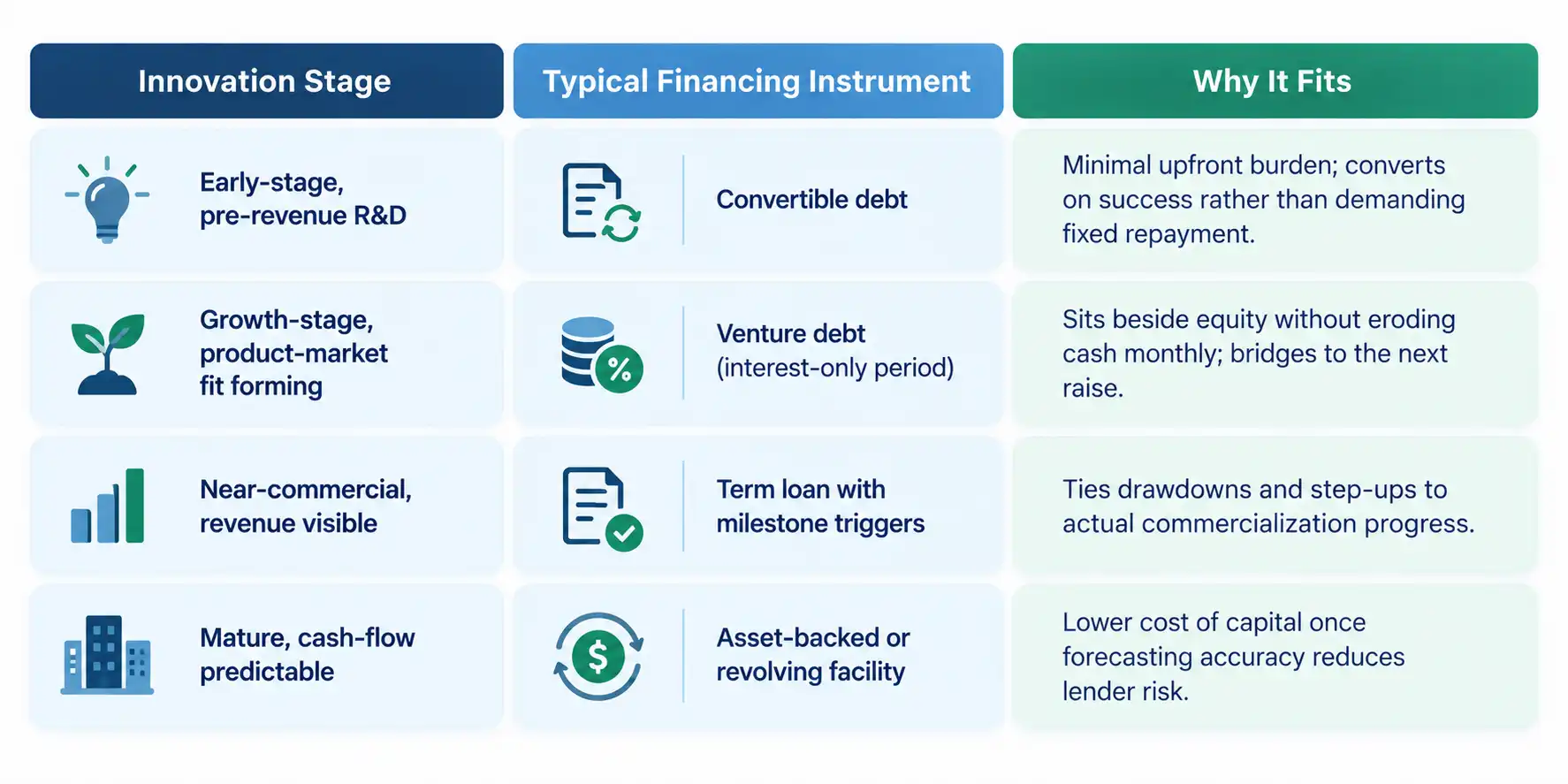
Convertible debt suits early-stage innovation well. It asks little upfront, accrues quietly, and aligns repayment with success rather than mere survival. Venture debt works best positioned beside equity rather than above it. Structured with interest-only periods, it keeps product teams from diverting cash toward monthly principal erosion while a prototype is still finding its market. Term loans, in more mature organizations, can be tuned differently. Step-up repayment schedules or milestone-based drawdowns replace a fixed amortization table that assumes revenue arrives in a straight line.
A mission-driven education and research institution raised $37M across equity and venture debt, structuring the capital stack so that the debt portion carried covenant terms tied to philanthropic and earned-revenue scenarios rather than a single rigid coverage threshold, which preserved the flexibility the organization needed while it built a multi-year financial model under variable funding conditions.
Structuring Debt Instruments Around R&D and Commercialization Cycles
Debt, in its conventional form, is indifferent to cycles. It wants interest paid on schedule and covenants kept regardless of whether a prototype is six months from launch or delayed by a regulatory review. Innovation, by contrast, moves unevenly: R&D burns cash without promising a return date, commercialization can stall on supply chains or a market not yet ready, and the resulting cash flow looks more like a wave than a trickle.
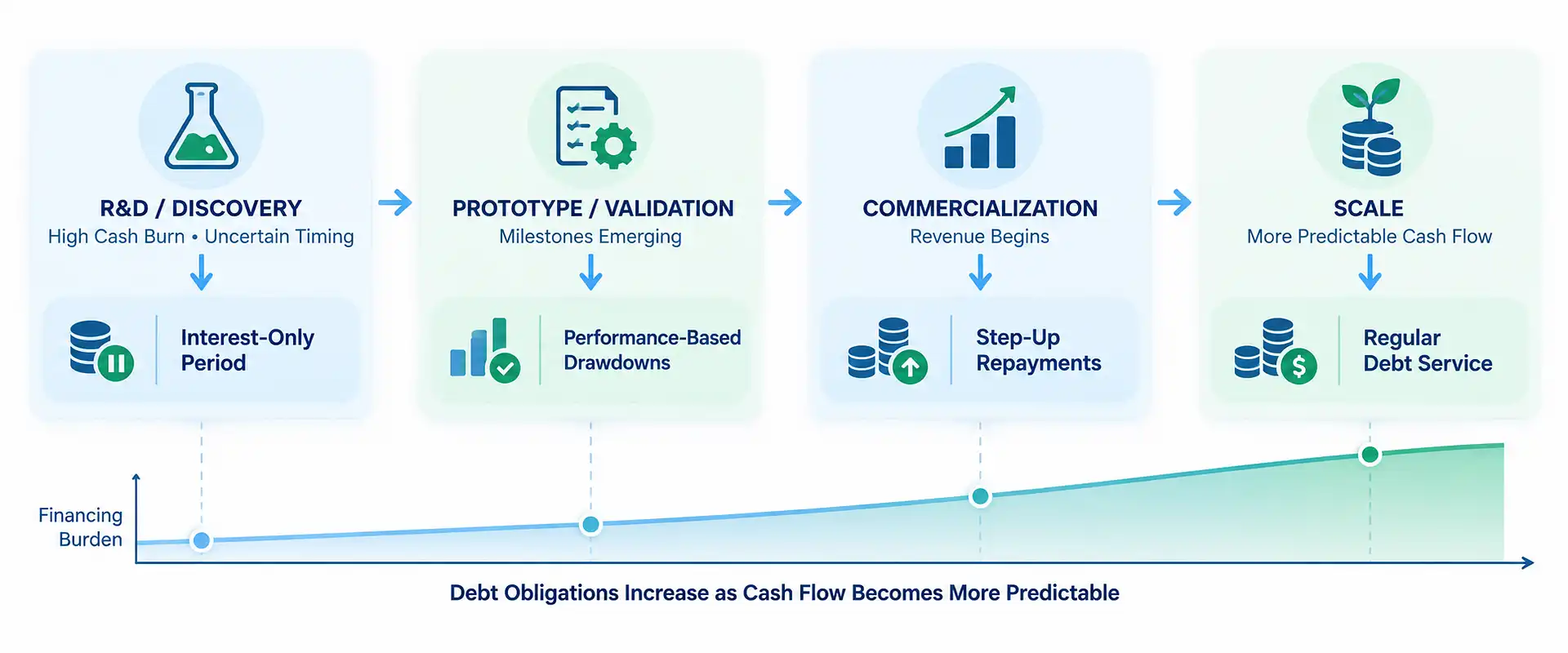
Timing debt to this rhythm is possible, but only when the instrument is built with memory of the underlying lifecycle. Seasonal amortization schedules, performance-based drawdown triggers, and interest-only bridge periods all give a company room to breathe through the discovery phase without breaching a covenant the moment a milestone slips.
A venture-backed digital marketing organization that scaled revenue from $9M to $180M within twenty-four months raised $36.5M across three funding rounds, sequencing each round so that the capital arrived just ahead of the operational scaling it was meant to support rather than sitting idle on the balance sheet or arriving too late to fund the growth already underway.
The lesson generalizes beyond any single sector: liquidity should be matched to need, not distributed evenly across the calendar simply because that is how conventional term debt is structured.
How Debt-Funded Innovation Reshapes Financial Ratios and Credit Perception
Taking on debt to fund innovation moves the numbers that rating agencies and shareholders watch most closely. Leverage rises, interest expense grows, and return on invested capital can dip in the short term if monetization lags the spending. The debt-to-equity ratio may look strained, and interest coverage, the ratio that functions as an early warning system for solvency, can drift uncomfortably close to a covenant threshold.
None of that is disqualifying on its own. Credit rating agencies distinguish between operating leverage tied to a coherent strategy and speculative overreach with no supporting discipline, and in sectors such as pharmaceuticals or semiconductors, periods of elevated leverage during R&D cycles are simply built into the business model. What agencies and shareholders both look for is a narrative that connects capital spent to value realized: published payback curves by innovation vintage, transparent disclosure of why ratios are temporarily strained, and evidence that the borrowing reflects intent rather than desperation.
A $127M global consumer products company financed a working capital transformation with $12M in growth financing while more than doubling inventory turns from three times to seven times, and the resulting improvement in cash conversion gave lenders and auditors a clear, numeric story explaining why leverage had risen and how it was already reversing. Four consecutive clean external audits reinforced that the debt was serving a specific, monitored purpose rather than papering over weak fundamentals.
The Governance Discipline That Makes Debt-Funded Innovation Work
The difference between companies that use debt to fund innovation successfully and those that later regret the covenant package usually comes down to governance discipline built in before the term sheet is signed. A short checklist tends to separate the two outcomes:
- Model downside scenarios before negotiating terms, including a scenario where the innovation’s timeline slips by two full quarters.
- Negotiate covenant headroom explicitly around the milestones the innovation is actually expected to hit, not generic industry benchmarks.
- Preserve capital sequencing flexibility, so equity, venture debt, and term debt can be drawn in the order the innovation lifecycle requires rather than the order a single lender prefers.
- Build the forecasting and reporting infrastructure first; lenders extend better terms to companies that can demonstrate predictability, even in a business with genuinely volatile innovation cash flows.
- Track ratio movement quarterly against the payback narrative, not just against the covenant threshold, so that any drift is explained before a lender or board asks.
Three Key Takeaways
- The right debt management strategy is not a single instrument but a sequence, matching convertible debt, venture debt, and term loans to the specific stage of innovation maturity rather than applying one structure across the entire lifecycle.
- Companies that use debt to fund innovation most effectively design instruments with memory of the R&D and commercialization cycle, using milestone-based drawdowns and interest-only periods to avoid forcing product timing decisions that serve a lender’s calendar instead of the market.
- Ratio strain following a debt-funded innovation bet is manageable when it is paired with transparent reporting on payback curves and forecasting discipline, since credit agencies and shareholders judge the coherence of the narrative around leverage far more than the leverage figure in isolation.
Disclaimer: This article is intended for informational purposes only and does not constitute legal, tax, or accounting advice. You should consult your own tax advisor or counsel for advice tailored to your specific situation.
Hindol Datta is a four-time CFO and senior finance executive with over 25 years of leadership experience across cybersecurity, SaaS, gaming, logistics, digital marketing, medical devices, consumer products, and nonprofit organizations. He has led more than $120M in fundraising and over $150M in M&A transactions while building the financial and operational systems that let complex businesses scale with confidence. He is the author of seven books in the Systems CFO Series and holds active CPA, CMA, and CIA credentials.
AI-assisted insights, supplemented by 25 years of finance leadership experience.