
Executive Summary
Every CFO eventually confronts the same question from a nervous employee holding a grant letter. How do taxes treat stock options? What happens if the timing goes wrong? The tax treatment of equity compensation is not a single rule. It branches into different outcomes. What matters is the type of option, the moment of exercise, and the length of the hold before sale. Statutory options including incentive stock options and employee stock purchase plans carry the possibility of favorable capital gains treatment. Nonstatutory options, by contrast, trigger ordinary income tax the moment they convert into shares.
This guide walks through the tax lifecycle of an option from grant to sale, the deductibility and reporting obligations that fall on the company, and the financial statement consequences under ASC 718. It also lays out the design choices that separate an equity plan built for retention from one that quietly manufactures resentment and surprise tax bills.
The Tax Lifecycle of a Stock Option, From Grant to Sale
Companies often pitch equity compensation to employees as a form of free upside, and there is a reason that pitch lands. The employee owes nothing at the moment of grant, which matters for a founder conserving cash while competing for talent against deeper-pocketed rivals. What the pitch tends to omit: the absence of tax at grant only defers the question. The answer that eventually arrives depends on which door the option walked through in the first place.
At Grant: Where Section 409A Sets the Ceiling
Neither incentive stock options (ISOs) nor nonqualified stock options (NQSOs) trigger a tax event at grant. This holds as long as the strike price sits at or above fair market value on the grant date. That qualifier matters more than it appears to on first read. A below-market strike price can trigger penalties under Internal Revenue Code Section 409A. Only a current, defensible 409A valuation, done before the grant issues, reliably defends against them. One reverse-engineered after the fact during an audit will not hold up. At a $30M ARR cybersecurity company operating across five countries, the 409A valuation became a recurring calendar item. It sat right alongside quarter-close. It sat right alongside quarter-close. A stale valuation is invisible until the moment it becomes very visible.
At Exercise: Statutory Stock Options Versus Nonstatutory Options
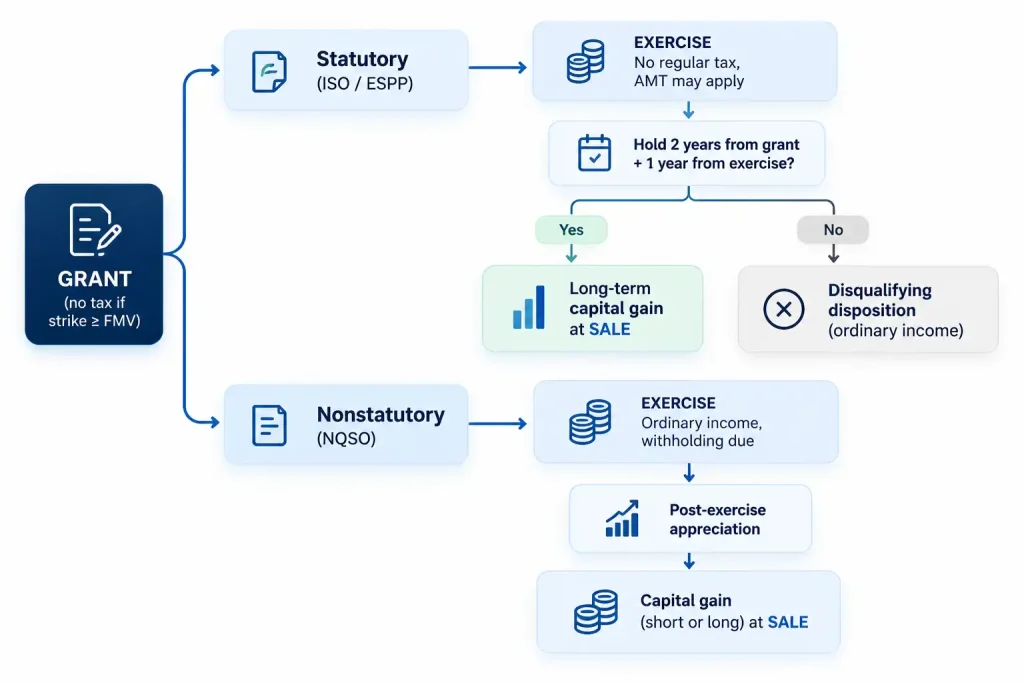
This is where the two paths diverge, and where the phrase statutory stock options starts doing real work. ISOs and employee stock purchase plans are statutory stock options under IRC Sections 421 through 424. If the plan and the employee both meet the qualification requirements, no regular income tax applies at exercise. The spread between strike price and fair market value may still expose the employee to the Alternative Minimum Tax. This parallel tax system affects a minority of taxpayers. It can generate a real cash liability when a large exercise coincides with a year of otherwise ordinary income.
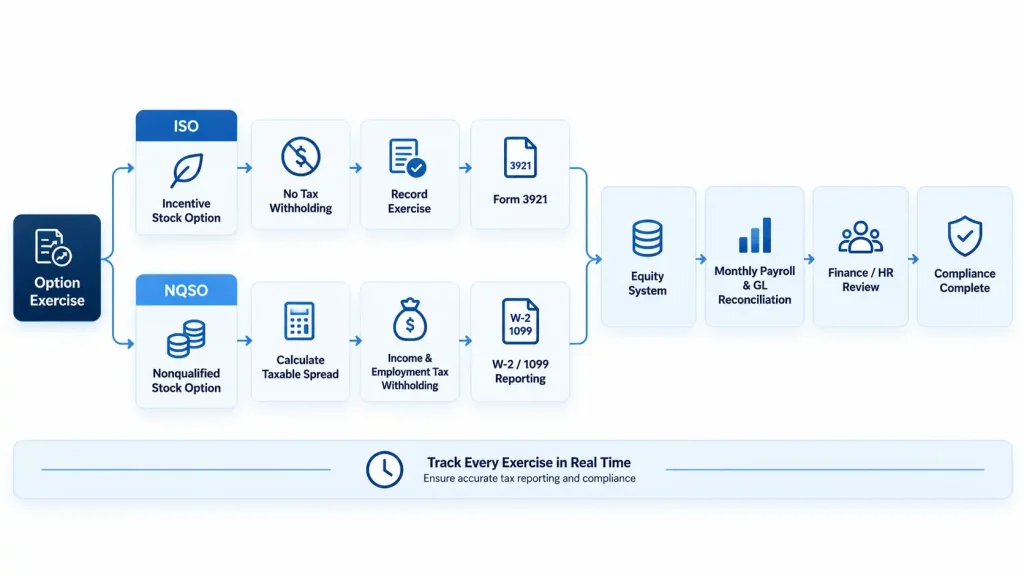
Nonstatutory options behave differently and less forgivingly. The moment an employee exercises an NQSO, ordinary income tax applies to the spread between strike and fair market value. The company reports it on a W-2 for employees or a 1099 for contractors. It’s also subject to withholding along with Social Security and Medicare. The design builds in no deferral mechanism, so CFOs must track NQSO exercises in real time. A withholding obligation created on a Tuesday does not wait for the next scheduled payroll run.
At Sale: Capital Gains, Disqualifying Dispositions, and Timing
Once the employee sells the shares, the tax question shifts from income character to holding period. For NQSOs, capital gains tax applies to any appreciation after exercise, short- or long-term depending on how long the employee held the shares post-exercise. For ISOs, the reward for patience is larger: if the employee holds the shares at least two years from grant and one year from exercise, the entire gain qualifies for long-term capital gains treatment. Miss either window or the sale becomes a disqualifying disposition, converting what would have been favorable capital gain into ordinary income, most often because no one communicated the holding-period calendar clearly at the time it mattered.
The 83(b) Election and the Cost of Waiting
Where a plan permits early exercise, an 83(b) election lets an employee choose taxation at exercise rather than at vesting, provided the employee files the election with the IRS within thirty days of exercise. In an early-stage company where fair market value is still low, this can compress a meaningful future tax bill into a small one paid today. The election is unforgiving of missed deadlines, which makes it one of the few items in equity administration where a calendar reminder functions as risk management rather than bureaucratic overhead.
The risks on the employee side cluster around liquidity. Exercising before there is any market for the shares can create a tax bill with no cash to pay it, and departing employees often discover, mid-transition, that ISOs carry a ninety-day post-termination exercise window that can quietly convert a vested benefit into an expired one. A CFO’s responsibility here is less about the tax code itself and more about translation: modeling scenarios during onboarding and refresh cycles, and partnering with legal so documentation matches what employees are actually told in the room.
How Are Stock Options Taxed for the Company? Deductibility and Reporting
The company side of the ledger mirrors the employee side in reverse. NQSOs generate a corporate tax deduction equal to the income the employee recognizes at exercise, claimed in the year that income is recognized. ISOs generate no deduction at all unless the employee triggers a disqualifying disposition, which means a workforce compensated heavily in ISOs can represent substantial equity spend with no corresponding tax benefit. That asymmetry is worth modeling explicitly, not discovering during a year-end tax provision meeting.
Withholding, W-2s, and Form 3921
NQSOs require withholding of income and employment taxes at exercise and flow through standard W-2 or 1099 reporting. ISOs require no withholding, but the company must issue Form 3921 for every ISO exercised during the year, and penalties for missing that filing accumulate quickly. A few structural habits reduce the risk of a compliance gap:
- Track every exercise event in real time rather than reconciling at quarter-end.
- Reconcile equity administration software against payroll and the general ledger monthly, not annually.
- Assign explicit ownership of Form 3921 and W-2 filings so the task does not fall between finance and HR.
Financial Statement Impact Under ASC 718
Under ASC 718, options must be expensed over the vesting period using fair value calculated at grant date, typically through a Black-Scholes or lattice model, with ongoing adjustments for forfeiture estimates and any performance conditions attached to the grant. This expense hits GAAP net income even for a private company where no cash changes hands, a distinction that surprises boards more often than it should. During an S-1 and IPO-readiness process at a Euronext Paris-listed gaming and digital entertainment company, aligning the stock compensation methodology with underwriters and Big Four auditors well before the roadshow was one item that, handled early, disappeared from the list of things anyone worried about later.
Turning Equity Tax Complexity into a Strategic CFO Advantage
None of this needs to remain a source of anxiety if the plan is designed with the tax mechanics in mind from the outset. A handful of design choices consistently separate equity programs that retain talent from those that generate friction:
- Build early exercise provisions into the plan so employees who want an 83(b) election have the option available.
- Offer extended post-termination exercise windows, often one to five years, so departing employees are not forced into a rushed decision.
- Time grants immediately after a fresh 409A valuation, when fair market value is typically at its lowest, and avoid granting equity just before a fundraise.
- Mix ISOs and NQSOs deliberately, balancing employee upside against the company’s own deductibility position.
- Run exit waterfall models that account for the after-tax proceeds employees will actually receive, not the headline valuation.
At a venture-backed performance marketing company that scaled from $9M to $180M in revenue over twenty-four months, equity retention design mattered as much as the compensation number itself, since a workforce growing that fast has every reason to compare notes on what their options are worth after tax. Equity education is not a nice-to-have appended to onboarding; it is a retention tool with a measurable return.
The lifecycle below summarizes the two paths at a glance:
Three Key Takeaways
- The tax treatment of an option is decided at the moment the plan classifies it as statutory or nonstatutory, which means the design of the equity plan itself is a tax decision deserving the same scrutiny as any other financing choice.
- Compliance failures, whether a missed Form 3921, an unfiled 83(b) election, or a stale 409A valuation, tend to surface during diligence or audit rather than when they occur, so tracking exercises in real time pays for itself well before anyone asks to see the paperwork.
- Equity education at onboarding and refresh cycles is not overhead but a retention mechanism, since an employee who understands the difference between AMT exposure and a disqualifying disposition is far less likely to make a decision that quietly destroys the value the grant was meant to create.
Disclaimer: This article is intended for informational purposes only and does not constitute legal, tax, or accounting advice. You should consult your own tax advisor or counsel for advice tailored to your specific situation.
Hindol Datta is a four-time CFO and senior finance executive with over 25 years of leadership experience across cybersecurity, SaaS, gaming, logistics, digital marketing, medical devices, consumer products, and nonprofit organizations. He has led more than $120M in fundraising and over $150M in M&A transactions while building the financial and operational systems that let complex businesses scale with confidence. He is the author of seven books in the Systems CFO Series and holds active CPA, CMA, and CIA credentials.
AI-assisted insights, supplemented by 25 years of finance leadership experience.