
Executive Summary
Hedge accounting rarely makes the board deck when a transaction is being pitched. Yet for any acquirer inheriting interest rate swaps, currency hedges, or commodity derivatives, the decision to retain or terminate an existing hedge carries real consequences. Hedge accounting in M&A touches earnings volatility and compliance with ASC 815. It also shapes the treasury risk strategy the combined entity will operate under going forward. Treated as a footnote, it becomes an earnings surprise. Treated as a diligence priority, it becomes a source of clarity.
This article walks through the mechanics acquirers need to get right. These include identifying what hedges already exist, deciding whether ASC 815 designation can continue or must be reset, and choosing between rolling over, terminating, or re-establishing a swap. It also covers the added complexity that pushdown accounting and intercompany hedges introduce. Each section draws on direct diligence and CFO experience across technology, consumer products, gaming, and manufacturing transactions. The goal is to ground the framework in decisions made under real deal timelines, not theoretical scenarios.
Identifying Existing Hedges: A Diligence Imperative
Before an acquirer can decide on hedge strategy, it needs to understand what hedges exist. Why were they put in place, and how effective have they actually been. That sounds straightforward. In practice, it rarely is.
Financial and operational due diligence on an IT services acquisition target surfaced this kind of gap. Multiple interest rate swaps sat layered across different subsidiaries. Each carried its own maturity profile and counterparty, and none had been assessed for hedge effectiveness in the prior year. A thirty-minute conversation with the target’s own treasury team surfaced a swap mismatch that a data room review alone would have missed. That team had been brought into the process early, not at the eleventh hour. Treasury teams hold institutional knowledge that a virtual data room cannot capture. Excluding them from diligence is one of the more avoidable mistakes a deal team can make.
Effective diligence should include:
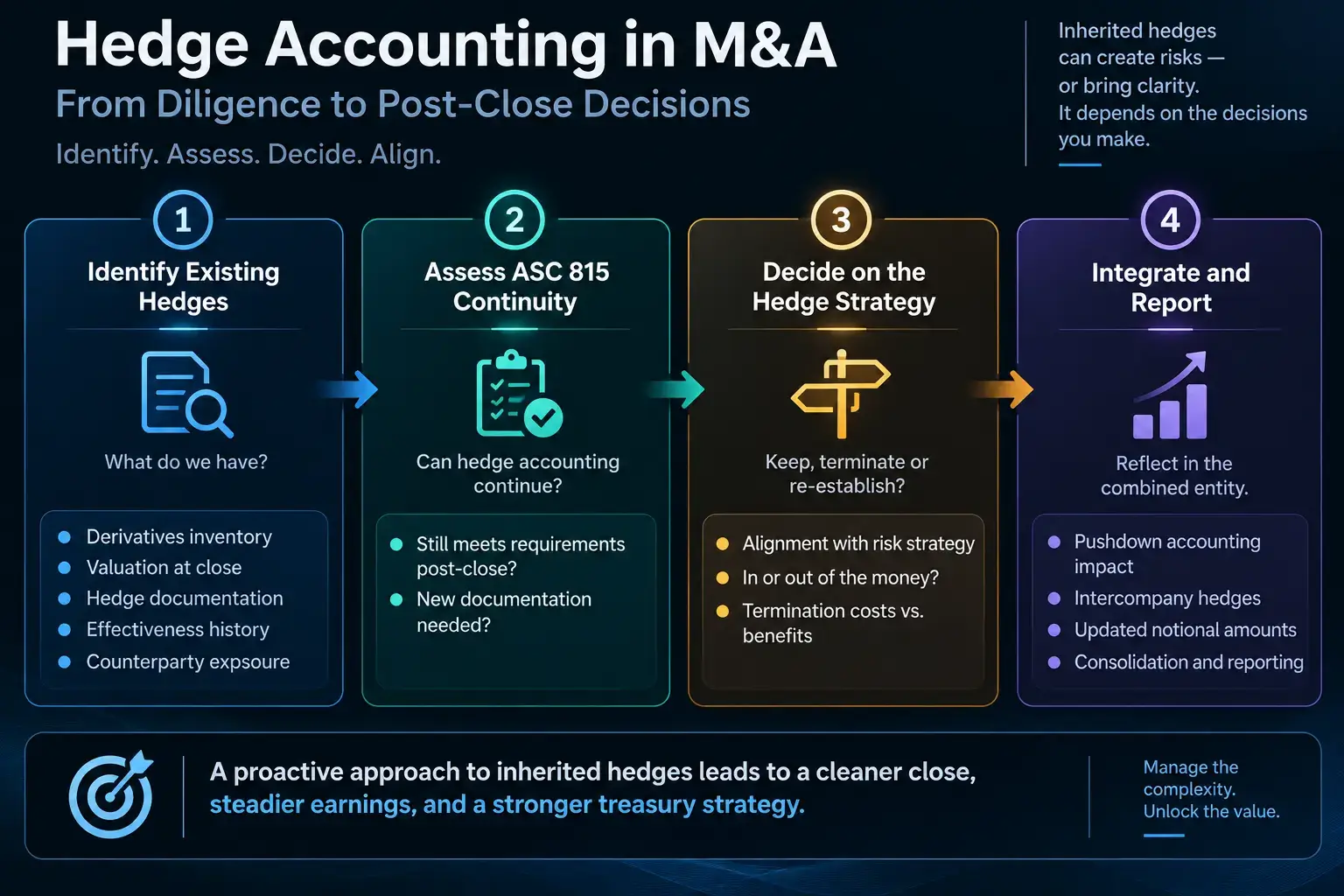
- Inventory of all derivative instruments
- Valuation as of close
- Hedge documentation, including designation memos
- Historical effectiveness testing results
- Counterparty exposure and credit risk
ASC 815 Compliance: Continuity or De-Designation
Under ASC 815, hedge accounting lets a company reduce earnings volatility by matching derivative gains and losses with the hedged item. Qualifying for that treatment requires strict documentation and effectiveness testing. Mergers are precisely the kind of event that breaks those requirements. A change in the underlying exposure, such as debt that gets extinguished at close, can force de-designation. That, in turn, can trigger immediate income statement recognition of amounts that had been sitting quietly in other comprehensive income.
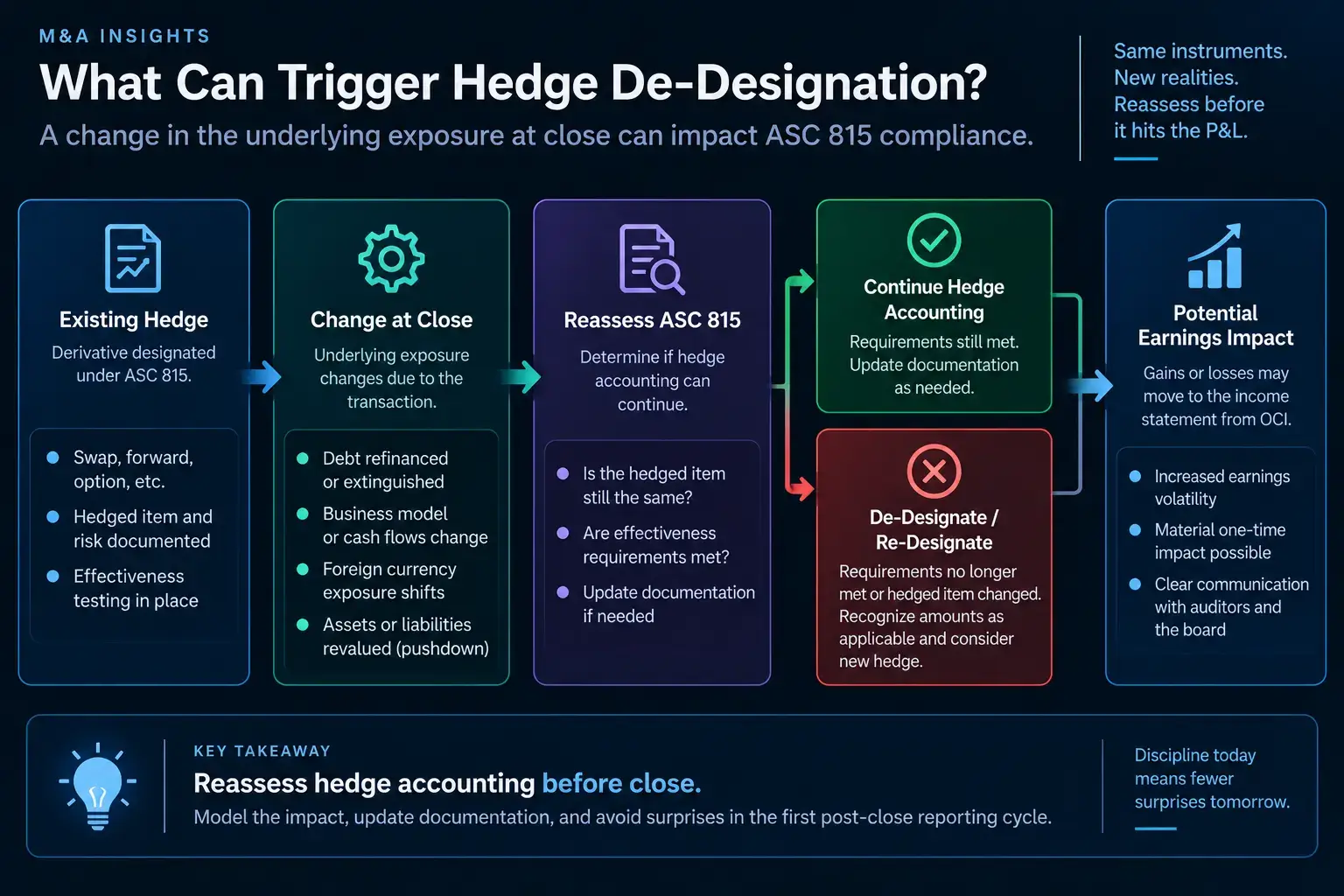
Work supporting a $127M global consumer products company illustrated the stakes directly. A cash flow hedge tied to floating-rate debt was refinanced at close. That required careful, timely de-designation and re-designation. Without that discipline, the transaction would have recorded a material hit to earnings, one that had nothing to do with the underlying business performance.
Buyers should, at minimum:
- Reassess hedge designation post-close
- Determine whether new documentation is required
- Confirm whether existing derivatives align with the acquirer’s treasury strategy
Swap Rollover or Termination: A Strategic Choice
Once the inventory is complete, the buyer faces a genuine choice. Keep the swap and roll it over. Terminate it and realize the gain or loss. Or unwind the position and re-establish a new hedge aligned to the combined entity’s actual exposure. None of these is automatically correct. The right answer depends on how the derivative interacts with the acquirer’s broader risk strategy.
Cross-border M&A execution on a Euronext Paris-listed gaming and digital entertainment company required exactly this kind of judgment call. Operations spanned the United States, France, the United Kingdom, Singapore, and South Korea. A legacy interest rate swap that was deeply out of the money was terminated instead of carried forward. A new hedge, better aligned to the combined debt portfolio, replaced it. The termination cost was booked at close. The forward benefit was a cleaner risk profile and reduced mismatch going into the first reporting cycle.
A useful decision framework weighs three factors:
- Alignment: does the hedge fit the acquirer’s ongoing risk strategy
- Valuation: is the derivative in or out of the money
- Economics: what do termination costs look like against the benefits of a cleaner position
Pushdown Accounting and Consolidation Considerations
Pushdown accounting adds a layer of complexity that is easy to underestimate. When the purchase price is pushed down and assets are revalued at the subsidiary level, derivative positions tied to those subsidiaries need to be re-evaluated as well. Intercompany hedges require particular care under ASC 815.
Multi-entity finance architecture built across a high-growth cybersecurity and identity access management company’s operations made this concrete. That footprint spanned the United States, Canada, Mexico, India, and Nepal. Intercompany eliminations have to reconcile to properly designated hedges. Reporting systems must also reflect updated notional amounts and maturities as entities are consolidated. Missteps at this stage have delayed financial close by weeks. In more serious cases, they have triggered auditor review of the consolidated statements.
Three Key Takeaways
- Diligence on inherited derivatives should start on day one, not after the term sheet. Treasury teams belong in that process from the beginning rather than the eleventh hour.
- A change in the underlying exposure at close, whether refinanced debt or a shifted revenue currency, is often enough to force hedge de-designation under ASC 815. Buyers should model that possibility before it becomes a surprise on the first post-close income statement.
- Swap rollover, termination, and re-establishment are not interchangeable defaults. Weighing alignment, valuation, and economics for each derivative produces a cleaner risk profile than defaulting to whatever the target already had in place.
Disclaimer: This article is for informational purposes only and does not constitute legal, tax, or financial advice. Always consult with qualified advisors before implementing hedge accounting or treasury policies post-acquisition.
Hindol Datta is a four-time CFO and senior finance executive with over 25 years of leadership experience across cybersecurity, SaaS, gaming, logistics, digital marketing, medical devices, consumer products, and nonprofit organizations. He has led more than $120M in fundraising and over $150M in M&A transactions while building the financial and operational systems that let complex businesses scale with confidence. He is the author of seven books in the Systems CFO Series and holds active CPA, CMA, and CIA credentials.
AI-assisted insights, supplemented by 25 years of finance leadership experience.