
Executive Summary
A graded vesting schedule and a straight-line amortization method produce the same total expense over a stock grant’s life. Yet they tell different stories in years one through four. That choice has shaped every equity compensation policy I have built across four CFO roles. Under ASC 718, the mechanics are deceptively simple: measure fair value at grant, expense it over the service period. That expense can arrive evenly, through straight-line amortization, or front-loaded, through a graded vesting schedule. Choosing between them is not simple. That decision shapes reported operating expense, EBITDA, and how much a board trusts the numbers.
This article works through the accounting architecture of ASC 718, along with the practical trade-offs between straight-line and graded vesting. It also covers the forfeiture assumptions that quietly move both, and the volatility that performance and market conditions introduce. The perspective comes from having set these policies inside venture-backed companies, a public-company gaming operator, and a mission-driven institution.
The Architecture of ASC 718 and Grant-Date Fair Value
ASC 718 requires companies to measure equity awards at fair value on the grant date, not at vesting. It also requires them to expense those awards over the requisite service period. That single sentence carries a surprising amount of judgment. For plain-vanilla stock options with time-based vesting, companies typically derive fair value from a Black-Scholes or binomial model. The inputs, expected volatility, term, risk-free rate, and dividend yield, can move meaningfully. A private company and a public one rarely land on the same number. Restricted stock units are more straightforward, with fair value generally equal to the grant date share price.
Once a company sets fair value, the only remaining question is how it recognizes expense across the vesting term. That is where a graded vesting schedule and straight-line amortization begin to diverge. The finance function grew from the ground up at a high-growth cybersecurity and identity access management company. This was not academic there. The board wanted to know why compensation expense looked understated early in a grant cycle and overstated later. The answer traced back to amortization method, not headcount or pay decisions.
Fair Value Inputs Worth Watching
Three inputs tend to drive the most disagreement between finance teams and auditors. These are expected term, expected volatility, and the discount applied for lack of marketability. None of these inputs is arbitrary, but each carries enough judgment that documentation matters as much as the calculation itself.
Straight-Line Versus a Graded Vesting Schedule
Straight-line amortization spreads total compensation expense evenly across the service period. A grant with a grant-date fair value of $100K vesting over four years produces $25K of expense each year, without exception. A graded vesting schedule instead recognizes expense in proportion to what actually vests in each tranche, treating each twenty-five percent slice as its own mini-award with its own shorter service period. The practical effect is an accelerated expense curve: more cost lands in year one and year two, less in year three and year four, because the earlier tranches are earning their vesting faster.
ASC 718 permits both methods, provided a company applies the choice consistently and can defend it to an auditor. Companies issuing RSUs tend to default to straight-line for simplicity. Companies granting options that need to match expense to retention risk more often choose the accelerated method. I have watched a Series B company move from straight-line to a graded vesting schedule while preparing for public-company readiness, and the shift required more than a journal entry, since the new expense curve looked, at first glance, like the business had suddenly become more expensive to run.
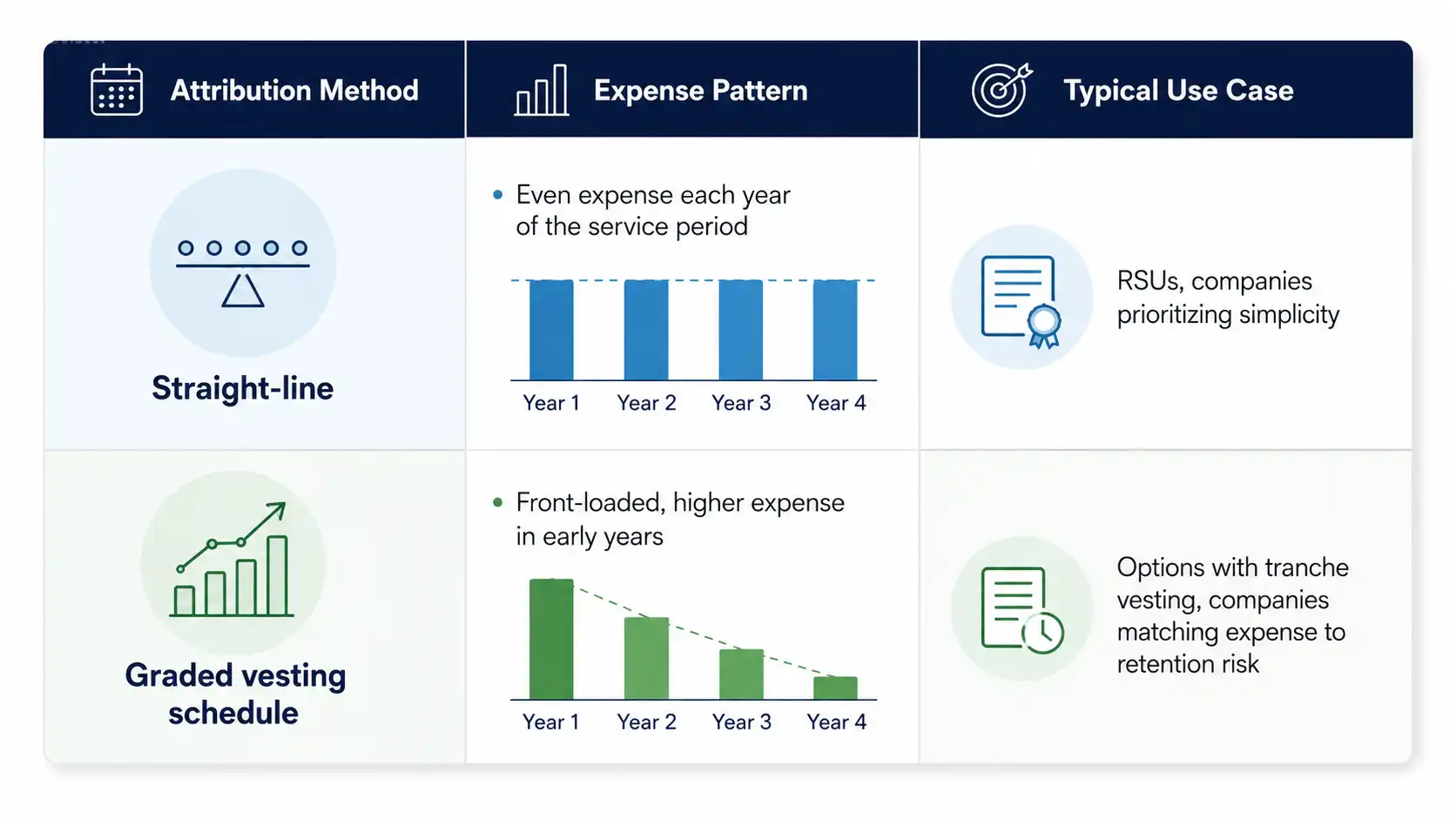
These mechanics touch operating expense, EBITDA, and period comparability, and a CFO who cannot explain why the graded vesting schedule produced a lumpier P&L than last year has handed the board a reason to distrust the rest of the model.
Cliff Vesting vs. Graded Vesting: Forfeiture and Timing
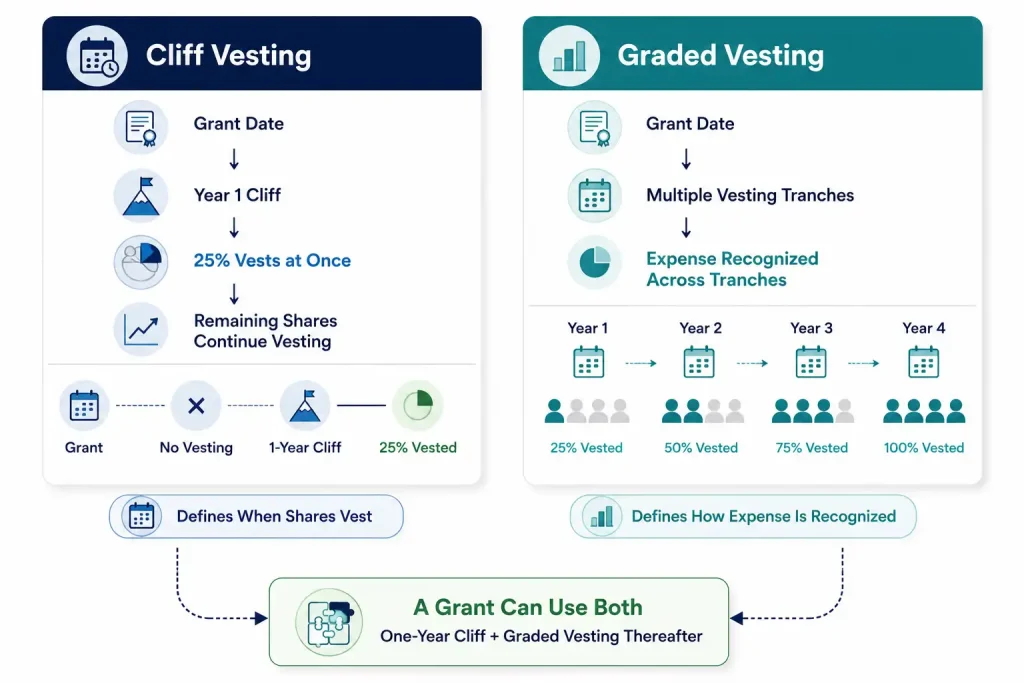
A separate layer of complexity sits underneath the amortization decision, and it involves cliff vesting. Most startups build a one-year cliff into a four-year vesting schedule, meaning no shares vest until the first anniversary of service. ASC 718 still requires expense recognition to begin on the grant date regardless, which means a company must apply a forfeiture assumption to reflect employees who leave before they hit that cliff.
The cliff vesting vs graded vesting question, or cliff vs graded vesting as it gets shorthanded in a board deck, is often framed as either-or, but the two operate on different axes. Cliff vesting describes when shares legally vest; graded vesting describes how a company recognizes expense across multiple vesting dates. A four-year grant can carry a one-year cliff and then vest monthly or annually thereafter, at which point the company still decides whether to expense the post-cliff tranches straight-line or under a graded vesting method.
Two forfeiture approaches exist under current guidance:
- Estimate forfeitures at grant and true up periodically as actual experience becomes available.
- Elect a zero-forfeiture assumption and recognize the adjustment only when an employee departs.
Mature companies with several years of attrition data tend to estimate forfeitures. Early-stage companies, lacking that history, more often use the zero-forfeiture method and true up on departure. Neither choice is inherently better, but a mismatch between the assumption and actual turnover distorts the numbers in a specific direction: a company with real attrition but no forfeiture assumption overstates expense early, while an aggressive forfeiture estimate can understate labor cost and mislead investors reading the model.
Performance-Based and Market-Based Awards
Time-based vesting, whether straight-line or graded, is only one dimension of the picture. Performance awards, tied to revenue milestones, EBITDA targets, or product launches, are expensed only once achievement becomes probable. If the condition is not probable at grant, nothing is recorded, and when probability shifts, the company records a catch-up adjustment covering the service already rendered.
That mechanic can create real volatility. At a late-stage SaaS organization where performance awards were tied to annual recurring revenue targets, the initial assumption was that the targets were not yet probable, so no expense was booked. Once it became clear the targets would be met, eighteen months of deferred expense landed in a single quarter, arriving weeks ahead of a capital raise and forcing an uncomfortable conversation about optics that had nothing to do with underlying performance. The lesson was not about the accounting rule itself. It was about modeling performance award probability alongside the operating forecast, rather than treating the two as separate exercises that only meet in the audit file.
Market-based awards, tied to stock price or total shareholder return, sit on a different track entirely. Fair value is set at grant using a model such as Monte Carlo simulation, and the resulting expense is recognized regardless of whether the market condition is ever met, because that condition sits outside management’s control and is already priced into the instrument at issuance.
Telling the Story Behind the Numbers
Stock-based compensation sits in an unusual place: it is non-cash, strategic, and dilutive all at once, which makes it one of the few line items that boards, employees, auditors, and investors read for different reasons and rarely interpret the same way. Boards want to understand what the grant means for ownership. Employees want clarity on when value arrives. Auditors want a model that survives scrutiny. Investors want confirmation that the expense reflects real alignment with performance, not a generous grant policy dressed in accounting language.
In a Euronext Paris-listed gaming and digital entertainment company where I served as CFO, board members across five countries asked versions of the same question: does the equity expense line tell us how the business is performing, or is it noise. The honest answer is that it can be either, depending on whether the underlying policy, straight-line, cliff, or a graded vesting schedule, was chosen to reflect economic reality or chosen for administrative convenience. Rapid headcount growth paired with aggressive grant sizing can inflate reported expense beyond what revenue growth alone would justify, and in a turnaround, unvested grants can become golden handcuffs anchoring the wrong people for the wrong reasons. Accounting does not resolve that tension. It only makes it visible.
Three Key Takeaways
- The choice between straight-line and a graded vesting schedule changes the shape of reported expense without changing the total, so it should be driven by how closely a company wants expense timing to mirror actual vesting and retention risk, not by which method is easiest to build.
- Cliff vesting and graded vesting answer different questions, when shares legally vest versus how expense is recognized across tranches, and conflating the two in a board deck is a common way CFOs lose credibility with directors.
- Forfeiture assumptions and performance award probability are not footnotes to the vesting policy; they determine whether the expense line understates, overstates, or fairly represents labor cost, and they deserve the same forecasting discipline finance teams apply to revenue.
Disclaimer: This article is intended for informational purposes only and does not constitute legal, tax, or accounting advice. You should consult your own tax advisor or counsel for advice tailored to your specific situation.
Hindol Datta is a four-time CFO and senior finance executive with over 25 years of leadership experience across cybersecurity, SaaS, gaming, logistics, digital marketing, medical devices, consumer products, and nonprofit organizations. He has led more than $120M in fundraising and over $150M in M&A transactions while building the financial and operational systems that let complex businesses scale with confidence. He is the author of seven books in the Systems CFO Series and holds active CPA, CMA, and CIA credentials.
AI-assisted insights, supplemented by 25 years of finance leadership experience.