
Executive Summary
Goodwill impairment rarely makes headlines until a write-down forces the conversation. For finance leaders managing acquisitions, SaaS growth curves, or market realignment, a goodwill impairment test is not a once-a-year compliance ritual but a discipline that protects the credibility of the balance sheet and the trust of the board.
This article breaks down the goodwill impairment test under U.S. GAAP, covering the qualitative assessment and the quantitative two-step model, along with the warning signs and judgment calls that separate a defensible impairment process from one that invites audit scrutiny.
Why Goodwill Impairment Testing Matters When Valuations Shift
An asset should never sit on the balance sheet above what it can realistically recover. That is the premise behind impairment. For goodwill and intangible assets such as customer relationships, trademarks, and developed technologies, this means checking regularly whether the future economic benefit still justifies the recorded value.
Unlike physical equipment, which shows visible wear, goodwill deterioration is quiet. It shows up first in operating metrics, a churn uptick, a slowdown in new contract wins, or margin compression nobody wants to name out loud in a board meeting. Catching the signal early, rather than waiting for year end, is what separates disciplined finance functions from reactive ones.
At a high-growth cybersecurity and identity access management company carrying close to $30M in annual recurring revenue, a forecasting engine and reporting cadence built from scratch held actuals within plus or minus five percent of forecast for eight consecutive quarters. That kind of forecasting discipline is what makes early impairment signals visible instead of buried.
Goodwill Impairment Test Basics Under ASC 350
Goodwill is never tested in isolation. It gets assigned to reporting units, meaning operating segments or components that benefit from the synergies of the original acquisition. Getting this assignment right matters more than most finance teams appreciate, since bundling dissimilar product lines or markets under one reporting unit can mask a real decline in one part of the business behind growth in another.
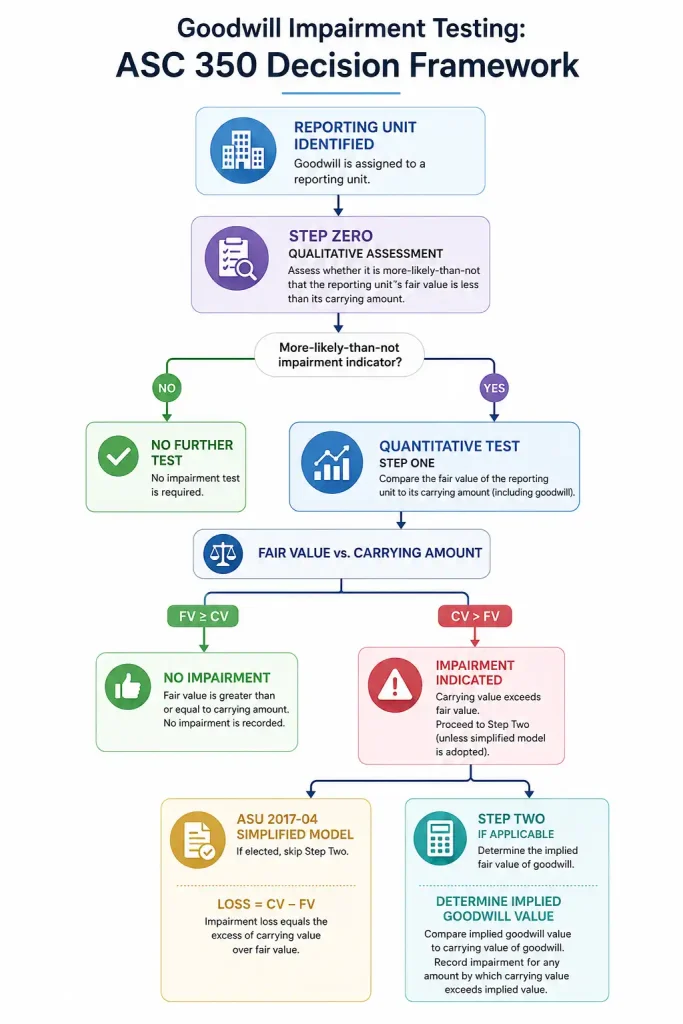
Under ASC 350, companies choose between two paths.
- Qualitative Assessment, often called Step Zero
- Quantitative Test, using a one-step or two-step approach
Reporting Units and Why Aggregation Backfires
At a Euronext Paris-listed gaming and digital entertainment company operating across the United States, France, the United Kingdom, Singapore, and South Korea, more than $100M in cross-border M&A made reporting unit precision a board-level concern rather than a technical footnote. Rolling out one unified revenue definition across every subsidiary cut statutory reporting cycles under both IFRS and US GAAP. Precision in how reporting units are drawn is a sign of financial maturity, not administrative overhead.
The Qualitative Assessment or Step Zero
Also called the more-likely-than-not test, Step Zero allows a company to assess whether there is any indication that a reporting unit’s fair value has fallen below its carrying amount. If nothing indicates trouble, no further testing is required.
Factors worth weighing include the following.
- Macroeconomic conditions, recession signals, inflation pressure, interest rate hikes
- Industry-specific issues, regulatory change, competitive threats, customer attrition
- Internal matters, loss of key personnel, negative cash flows, product delays
- Market capitalization against book value, since a persistent gap tends to trigger scrutiny
Step Zero is inherently judgmental, and audit committees need documentation supporting both the factors considered and the reasoning behind a no impairment conclusion. Too many companies treat this step as a box to check, until an investor or auditor applies hindsight with a sharper set of tools.
The Quantitative Impairment Test Step One and Step Two
When the qualitative screen suggests potential trouble, the quantitative test follows.
- Compare the fair value of the reporting unit against its carrying amount, including goodwill
- If fair value exceeds carrying value, no impairment gets recorded
- If carrying value exceeds fair value, Step Two follows, unless the entity has adopted the simplified model under ASU 2017-04
Fair Value Methods Used in a Goodwill Impairment Test
Fair value typically comes from one of three approaches, discounted cash flow analysis, market multiples drawn from comparable companies, or public company stock valuations for listed firms. Discounted cash flow remains the dominant model for private companies, yet it carries real subjectivity. Revenue growth assumptions, margin expansion, and terminal value inputs need to reconcile with the strategic plan the board actually approved, not an aspirational version of it.
A private equity buy-side engagement on an IT services acquisition target surfaced this same tension. Quality-of-earnings analysis identified where reported EBITDA diverged from economic reality, directly shaping the buyer’s view of integration risk. That divergence between reported numbers and underlying economics is exactly what a rigorous fair value assessment is built to catch.
Step Two, where it still applies, involves assigning the reporting unit’s fair value across its assets and liabilities as though acquired today, to determine the implied fair value of goodwill. If that implied value falls short of recorded goodwill, the difference gets written off. Many companies have adopted ASU 2017-04, which removes Step Two entirely, so the impairment amount simply equals the excess of carrying value over fair value.
Indefinite-Lived and Finite-Lived Intangible Assets
Intangible assets with indefinite lives, trademarks and domain names among them, are also tested annually under ASC 350. The logic mirrors goodwill, if fair value drops below carrying amount, impairment gets recognized, using relief-from-royalty methods for brand assets, multi-period excess earnings methods for customer relationships, or market approaches built on observable transactions. One nuance worth flagging, an intangible only qualifies as indefinite-lived if there are no plans or legal constraints limiting its useful life. Once plans change, reclassification to finite-lived follows, and amortization begins.
Finite-lived intangibles, patents, customer lists, and developed software among them, fall under ASC 360 and get reviewed only when a triggering event occurs rather than annually. Triggers include the following.
- Significant adverse shifts in market demand
- Unexpected underperformance or loss of key customers
- Strategic pivots or divestitures
- Negative changes in the legal or regulatory environment
The test itself is simpler, comparing undiscounted future cash flows against carrying value. Where carrying value exceeds recoverable cash flows, an impairment loss reduces the asset to fair value.
Key Judgment Areas in Impairment Testing
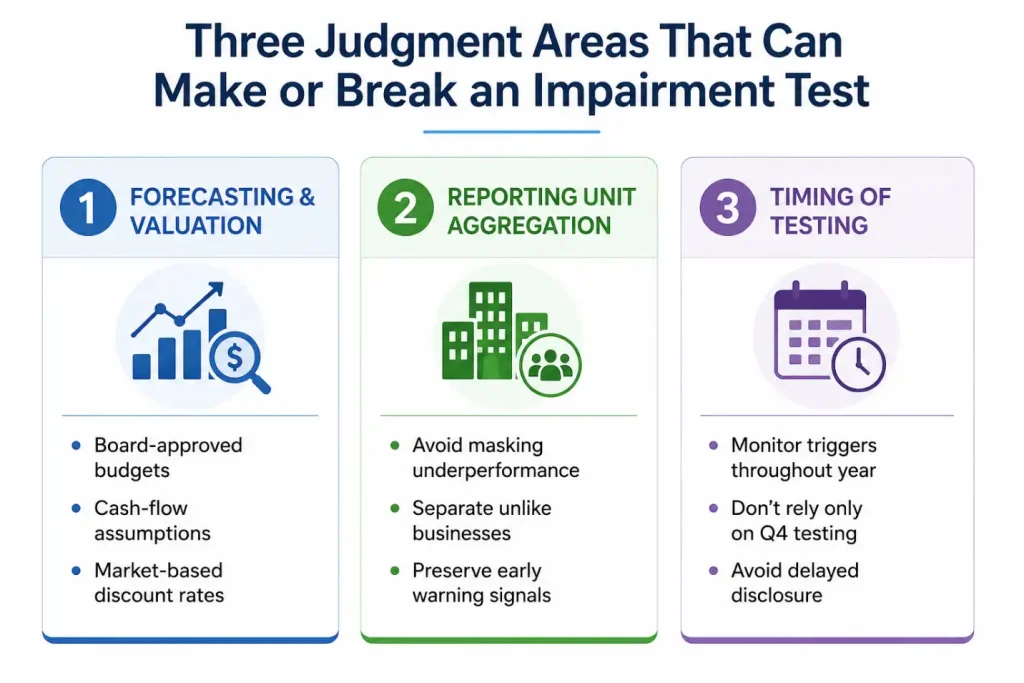
Three areas deserve special focus in any goodwill impairment test.
- Forecasting and valuation inputs, checking that cash flows tie to board-approved budgets and discount rates reflect market risk and capital structure
- Reporting unit aggregation, watching for growth in one product masking decline in another
- Timing of testing, since most companies test in the fourth quarter, yet triggering events surface mid-year and waiting until year end risks delayed disclosure
Common Missteps in Goodwill Impairment Testing
A handful of patterns show up again and again.
- Ignoring a market cap gap, since a market cap well below book value invites heightened audit scrutiny even when operations feel strong
- Assuming growth will mask everything, since aggressive terminal values unsupported by market evidence undermine the entire test
- Reusing prior-year models without updating them, since static discount rates or margin profiles that ignore inflation will not survive auditor review
A Real-World Case in Post-Acquisition Impairment
At a venture-backed digital marketing and performance media organization that scaled from $9M to $180M in revenue over twenty-four months, three acquisitions were led as part of that growth, alongside the customer acquisition cost and contribution margin discipline needed to sustain it. Bolt-on deals in fast-scaling companies often carry the same risk. One such deal, recorded with $22M in goodwill on the promise of cross-sell synergy, saw churn in that segment triple within two years while customer overlap proved minimal. Leadership held off, citing a pending strategic partnership, until a difficult third-quarter miss and investor pressure forced reassessment. The eventual $14M write-down pulled down adjusted EBITDA and forced a restated forward guidance. The lesson holds across industries. Delayed impairment does not preserve value, it distorts reality.
Tax Considerations Deferred Tax Assets and Section 382
Impairment write-downs carry tax consequences worth mapping early. Goodwill impairments under U.S. GAAP do not create an immediate tax deduction, but they can affect deferred tax assets, particularly where carryforwards are involved. In M&A-heavy companies, Section 382 limitations may restrict the use of net operating losses after a change in ownership, complicating the tax modeling. In cross-border structures, local GAAP and IFRS standards can diverge, and tax authorities may not accept a book impairment as deductible without further evidence. Coordinating with tax counsel early saves weeks of rework later.
Why Investors Watch Impairment Charges Closely
Impairment charges do not touch EBITDA, but they move operating income, GAAP earnings, and return on invested capital. They also raise pointed questions. Was the acquisition overpriced. Were synergies overstated. Are the underlying customer economics weakening. Transparency around the goodwill impairment process, paired with a clear narrative, restores investor confidence faster than silence ever does.
Three Key Takeaways
- A goodwill impairment test is a discipline, not a compliance checkbox, and the reporting unit structure chosen at the outset determines whether early warning signs are visible or buried.
- Fair value assumptions inside a discounted cash flow model must trace back to board-approved budgets and observable market evidence, because static or aspirational inputs are the fastest way to fail an audit review.
- Delayed impairment recognition does not protect enterprise value, it compounds the eventual correction, and companies that disclose early tend to recover investor confidence far faster than those that wait.
Disclaimer: This article is intended for informational purposes only and does not constitute legal, tax, or accounting advice. You should consult your own tax advisor or counsel for advice tailored to your specific situation.
Hindol Datta is a four-time CFO and senior finance executive with over 25 years of leadership experience across cybersecurity, SaaS, gaming, logistics, digital marketing, medical devices, consumer products, and nonprofit organizations. He has led more than $120M in fundraising and over $150M in M&A transactions while building the financial and operational systems that let complex businesses scale with confidence. He is the author of seven books in the Systems CFO Series and holds active CPA, CMA, and CIA credentials.
AI-assisted insights, supplemented by 25 years of finance leadership experience.