
Executive Summary
The signing ceremony ends and the real accounting work begins. Goodwill impairment is the discipline that separates companies. Some defend their acquisition price years later. Others quietly write it down. This article walks through how companies recognize goodwill. It also covers why impairment of goodwill under ASC 350 demands more than a checkbox exercise. And it shows why useful life estimates and trademark classifications carry the same weight as the headline purchase price.
Drawing on engagements across cybersecurity, consumer products, gaming, and education, the piece makes a case for a single quarterly rhythm. Finance, tax, legal, and audit should pull together, not react only once a year. That discipline pays off in fewer surprises, cleaner audits, and a board that trusts the numbers in front of it.
What Goodwill Represents on the Balance Sheet
Goodwill shows up when a buyer pays more than the fair value of the net identifiable assets it acquires. It is the accounting shorthand for brand equity, employee know-how, and customer relationships not yet on the books. It also covers the synergies a deal team promised the investment committee. No one can measure any of that with precision at close. So, goodwill sits on the balance sheet as a single, non-amortized number. And it must earn its keep every year.
Unlike a piece of equipment or a customer list with a defined life, goodwill carries no amortization. Instead, ASC 350 requires companies to run a goodwill impairment test at least annually. They must test sooner if a triggering event occurs. That single rule turns goodwill into a running commentary on whether the assumptions behind a deal are still holding up.
In one engagement leading finance for a Euronext Paris listed gaming and digital entertainment company, more than $100M in cross-border mergers and acquisitions moved through the books. This happened across several years. Each deal added its own layer of goodwill. Each layer later had to hold up in front of Big Four auditors and public market scrutiny. The lesson from that seat is simple. Goodwill is not a closing entry. It is a standing obligation that follows the company long after the deal team has moved on to the next target.
Goodwill Impairment Testing in Practice
Companies often treat goodwill impairment testing as a mechanical year-end exercise, and that is precisely where they get into trouble with the impairment of goodwill. In one acquisition of a medical software business, the acquirer recognized more than $60M in goodwill based on projected synergies and access to a fast-growing customer base. Within eighteen months, growth slowed and the market repriced the sector. A 25% drop in enterprise value triggered a formal impairment test, and the result was a $22M write down that reshaped the following board meeting.
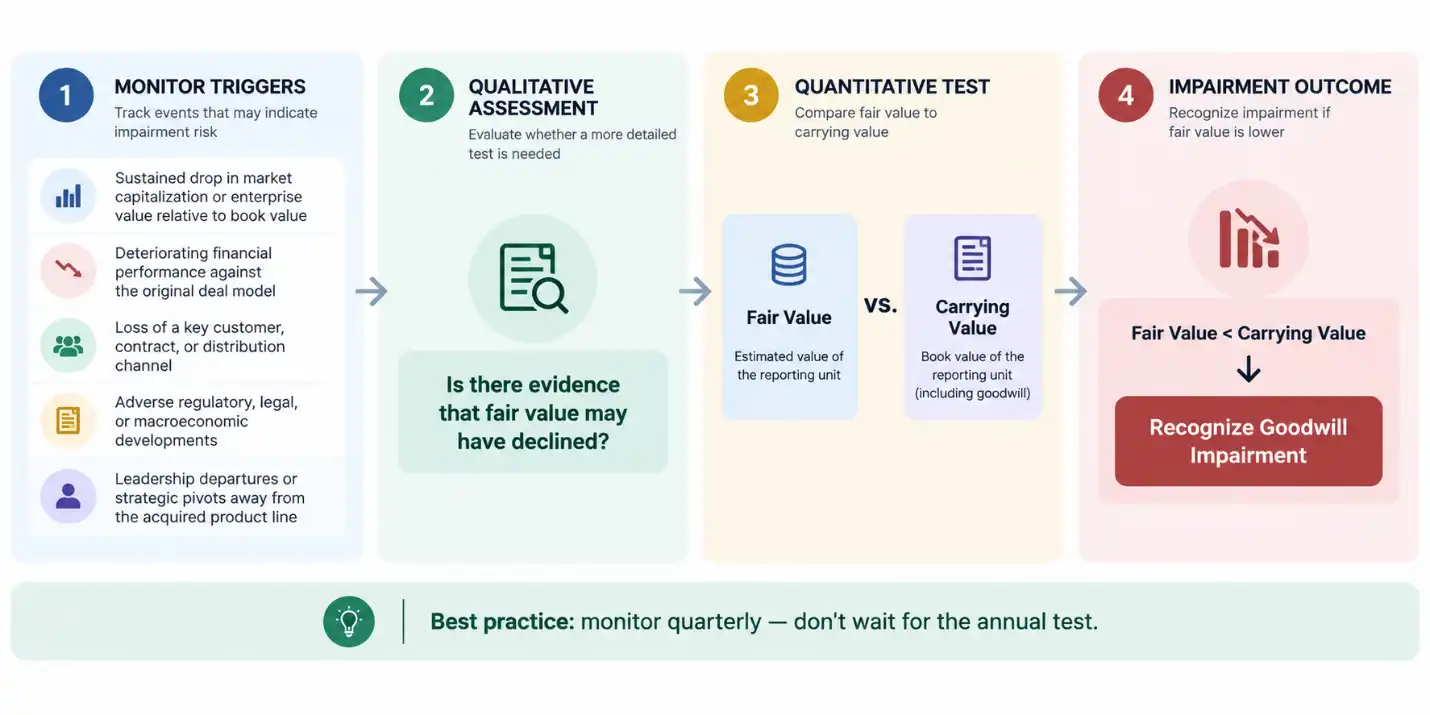
The pattern repeats across industries. A reporting unit’s fair value drifts below its carrying value, someone notices late, and the goodwill impairment write down arrives with less warning than it should have. Common triggering events worth tracking on a rolling basis include the following.
- A sustained drop in market capitalization or enterprise value relative to book value
- Deteriorating financial performance against the original deal model
- Loss of a key customer, contract, or distribution channel tied to the acquired business
- Adverse regulatory, legal, or macroeconomic developments affecting the reporting unit
- Leadership departures or strategic pivots away from the acquired product line
A simplified view of how the process should flow looks like this.
Ongoing Monitoring of Triggering Events leads to Qualitative Assessment of Fair Value Risk which leads to Quantitative Test Comparing Fair Value to Carrying Value which leads to Impairment Recognized Only if Fair Value Falls Short
The habit of running that sequence quarterly, rather than waiting for the annual test, is what separates companies that manage goodwill impairment proactively from those that experience the impairment of goodwill as an ambush. In a buy-side due diligence role assessing an IT services acquisition target, quality of earnings analysis surfaced EBITDA adjustments that would have inflated the goodwill recognized at close, had the team left them unchallenged a reminder that impairment risk often takes root well before the deal signs.
Estimating Useful Life for Finite Lived Intangibles
Not every intangible asset gets the indefinite treatment goodwill receives. Software, customer relationships, and non-compete agreements are finite lived and must be amortized over an estimated useful life, and that estimate is far more art than science. In one transaction, a core software platform was initially assigned a ten-year useful life. Customer churn and rapid technology change made that assumption look optimistic within two years, and the estimate was revised down to six years, which accelerated amortization expense and reshaped the deferred tax position.
Useful life assumptions should not sit untouched between audits. While leading finance for a high growth cybersecurity and identity access management company scaling toward $30M in annual recurring revenue, the forecasting engine and reporting cadence built for that business held actuals within five percent of forecast for eight consecutive quarters, a discipline that made it far easier to catch a technology asset drifting out of its assumed useful life before an auditor had to point it out. That same rigor applies directly to intangible asset schedules. Annual review of every material useful life, paired with documented rationale for any change, keeps a company ahead of audit challenge rather than reacting to it.
Trademarks and the Discipline of Indefinite Life
Trademarks and certain brand assets can be classified as indefinite lived, which spares them from amortization but not from annual impairment testing. That classification is a privilege that must be earned, not a default assumption. To qualify, the asset must be expected to generate cash flows indefinitely, and that expectation needs to be revisited whenever the underlying strategy shifts.
While serving as Chief Financial Officer of a $127M global consumer products company operating across direct to consumer, Amazon, and wholesale channels, brand level performance was reviewed alongside inventory and margin data on a recurring basis, since a fading brand rarely announces its own decline. A niche consumer brand acquired with a loyal but shrinking following is a familiar pattern across the industry. Once it became clear the brand was losing relevance, reclassifying it as finite lived and beginning scheduled amortization was the disciplined move, absorbing a smaller, planned expense rather than a larger, unplanned impairment charge later.
Building Cross Functional Governance Around Intangibles
Goodwill and intangible asset management is not a finance only exercise, even though finance owns the calculation.
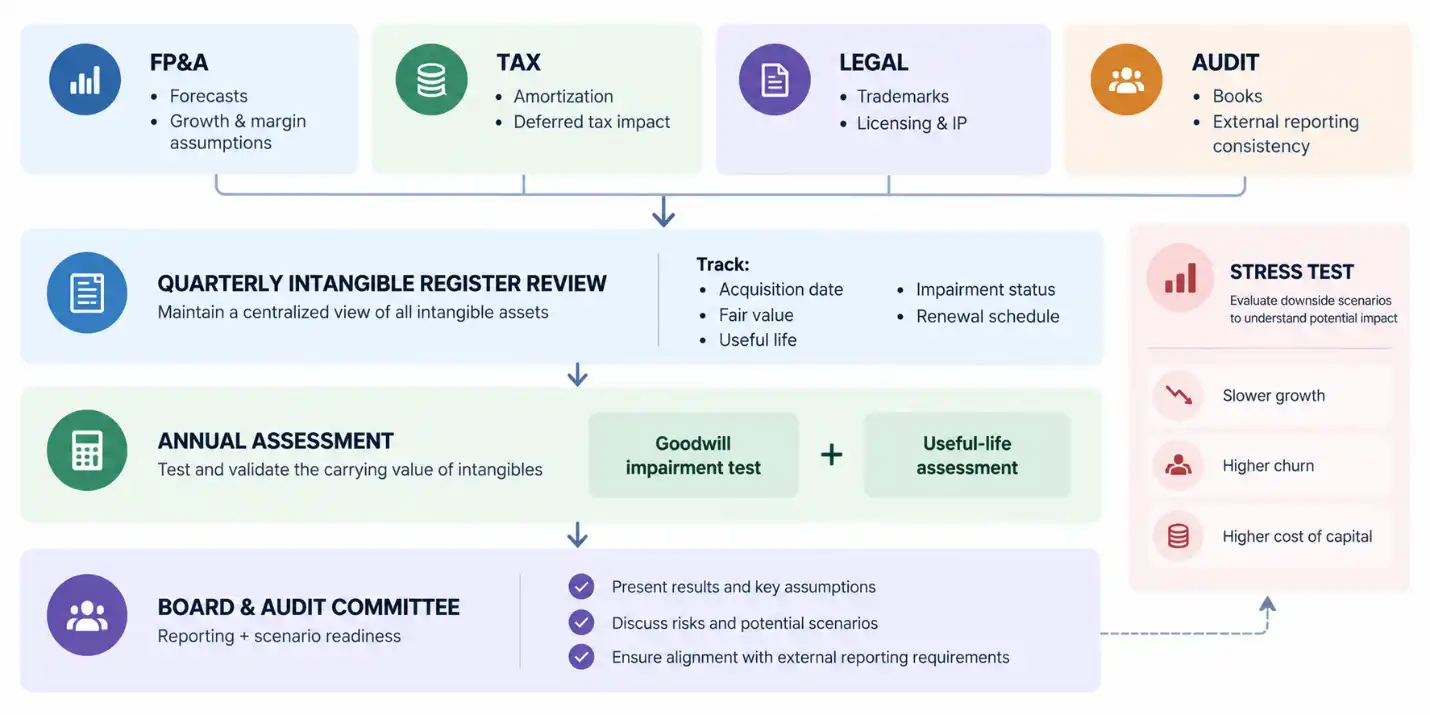
- FP&A must align forecasts with the same growth and margin assumptions used in the impairment model
- Tax must track amortization schedules and the deferred tax assets they generate
- Legal must monitor trademark renewals, licensing terms, and IP usage
- Audit must confirm consistency between internal books and external filings
While serving as Chief Financial Officer of a mission driven education and research institution, finance sat alongside HR, IT, legal, and facilities under one operating umbrella, which made it far easier to notice early when a funding assumption or program decision would eventually touch the balance sheet. That same cross functional visibility applies to any company managing acquired intangibles. A central register tracking acquisition date, fair value, useful life, impairment status, and renewal schedule, reviewed quarterly, turns goodwill impairment from a once-a-year scramble into a routine governance habit.
A Simple Governance Cadence
Quarterly Intangible Register Review with Finance, Tax, Legal, and Audit feeds the Annual Goodwill Impairment Test and Useful Life Assessment, and both feed the Board and Audit Committee Reporting Package.
Stress testing the goodwill impairment model under alternate scenarios, such as slower growth, higher churn, or a higher cost of capital, is not about manufacturing a write down. It is about being ready to explain a goodwill impairment charge if it becomes necessary, and being ahead of that narrative with investors rather than behind it.
Three Key Takeaways
- Goodwill impairment is not an annual accounting formality. It is a running test of whether the assumptions made at deal close, on growth, margin, and market position, still hold, and it deserves the same board level attention as the original purchase price.
- Useful life estimates for finite lived intangibles and the indefinite classification given to trademarks are not permanent decisions. Both must be revisited as technology, customer behavior, and strategy evolve, with documented rationale whenever they change.
- The companies that manage goodwill impairment well treat it as a cross functional discipline, pulling FP&A, tax, legal, and audit into a quarterly review cycle built around a central intangible asset register, rather than leaving the entire burden to a once a year test.
Disclaimer. This article is intended for informational purposes only and does not constitute legal, tax, or accounting advice. Readers should consult their own tax advisor or counsel for advice tailored to their specific situation.
Hindol Datta is a four-time CFO and senior finance executive with over 25 years of leadership experience across cybersecurity, SaaS, gaming, logistics, digital marketing, medical devices, consumer products, and nonprofit organizations. He has led more than $120M in fundraising and over $150M in M&A transactions while building the financial and operational systems that let complex businesses scale with confidence. He is the author of seven books in the Systems CFO Series and holds active CPA, CMA, and CIA credentials.
AI-assisted insights, supplemented by 25 years of finance leadership experience.