
Executive Summary
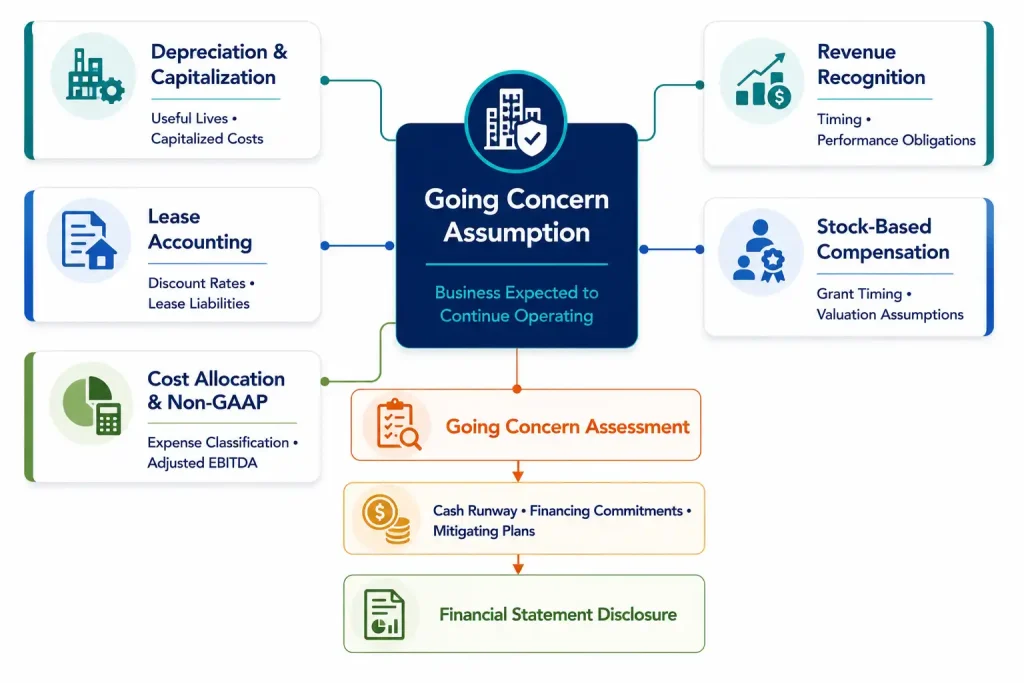
CFOs often treat the going concern concept in accounting as a checkbox buried in the footnotes. An auditor confirms it, a CFO signs it, and both move on without much thought. That treatment misses what the concept actually does. It sits underneath every other policy election a finance team makes. That includes how to depreciate an asset and how to time revenue. It also includes how to discount a lease and how to present adjusted earnings. Each choice assumes, implicitly, that the business will still be operating twelve months from now. Someone will need to live with the consequences. When that assumption comes under strain, the going concern meaning shifts. It moves from an abstract accounting principle into the single most consequential sentence in the entire financial statement package.
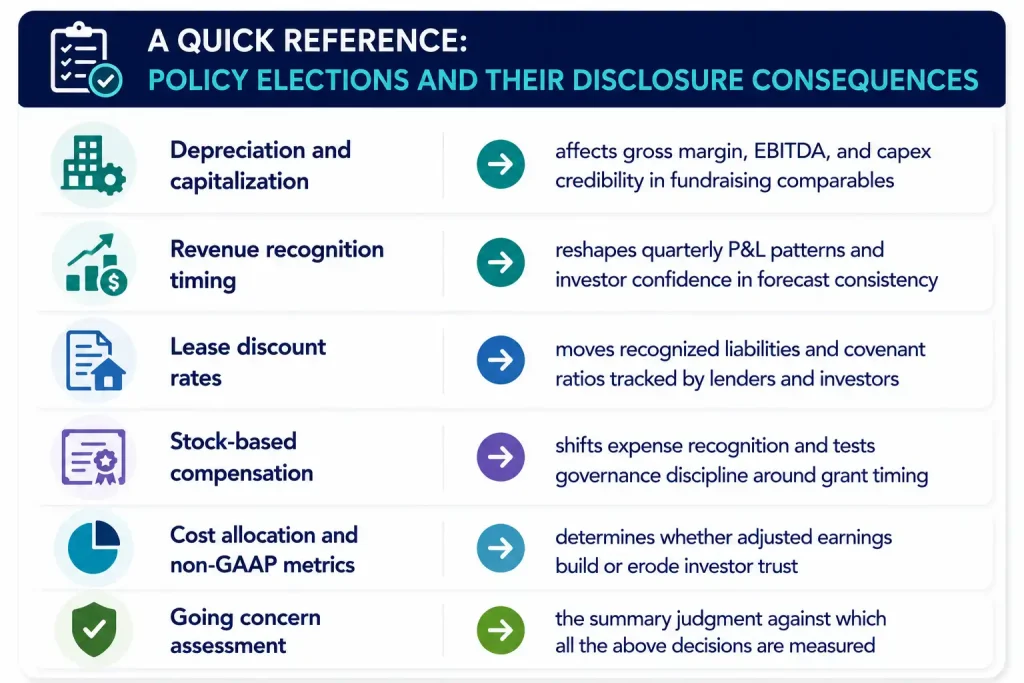
This article walks through the policy elections that carry the most disclosure weight. They include depreciation and capitalization, revenue recognition timing, and lease discount rates. They also include stock-based compensation, cost allocation, non-GAAP presentation, and the going concern assessment itself. None of these decisions happen in a vacuum, and none of them are purely technical. They are judgment calls made under pressure, defended in audit rooms, and remembered by boards long after the quarter closes.
Understanding the Going Concern Concept in Accounting
Under both US GAAP and IFRS, management must evaluate this each reporting period. The question is whether substantial doubt exists about the entity’s ability to continue operating for the next twelve months. ASC 205-40 formalizes this in US GAAP. The auditor’s own going concern opinion under AU-C 570 provides an independent check on management’s conclusion. This distinction matters more than it first appears. Management assesses first, using operating cash flow projections, financing commitments, and covenant headroom. The auditor then evaluates whether that assessment holds up. The resulting disclosure, if any, must give investors and lenders an honest picture of the risk. This exercise teaches a CFO more about the business than almost any other annual ritual. It forces a rigorous answer to a question every other policy election quietly assumes away.
Depreciation and Capitalization: Where Judgment Meets the Balance Sheet
Depreciation rarely gets attention in a business obsessed with growth metrics. Yet the method chosen, straight-line, double declining, or units of production, shapes gross margin and EBITDA. It also shapes the credibility of a capex story in front of a lender or an investor. At a $170M global medical device manufacturer, I served as Operations Controller and Director of Strategic Planning. Standard costing and bill of materials management across three international plants demanded a level of precision. That precision had to withstand line-by-line audit scrutiny in a heavily regulated industry. A depreciation election that looked reasonable alone had to hold up against the inventory valuation. It also had to hold up against the cost of goods sold. It also had to hold up against the covenant tests tied to all three.
The same logic extends to internal-use software capitalization under ASC 350-40. The criteria for capitalizing development costs during the application development stage are reasonably clear, but the boundary between feasibility and implementation is a judgment call. I have built capitalization frameworks with defined thresholds and review cadences precisely because the alternative, an inconsistent policy applied deal by deal, invites the kind of audit friction that erodes trust with the stakeholders a company is trying to reassure.
Revenue Recognition Timing and the Discipline of ASC 606
Few standards have forced as much genuine reflection as ASC 606, particularly around bundled arrangements and implementation fees. Whether those fees represent a distinct performance obligation, recognized upfront, or an embedded cost amortized over the customer relationship, changes the shape of the income statement in ways that ripple through investor expectations for quarters afterward. While serving as the de facto head of finance for a high-growth cybersecurity and identity access management company generating approximately $30M in annual recurring revenue, I built the revenue recognition framework, controls environment, and board-grade reporting that later carried the business through acquisition diligence. Getting that framework right the first time, rather than defending an aggressive interpretation after the fact, is what let the numbers survive a buyer’s scrutiny without a single restatement.
The alternative path teaches its own lesson. I have encountered organizations recognizing revenue at contract signature instead of delivery, justified with little more than institutional habit. That posture is a red flag, not a policy. Unwinding it, restating prior periods, and rebuilding the recognition framework from a defensible foundation is painful in the short term, but it is the only path that survives contact with a serious diligence process or a going concern review during a downturn.
Lease Discount Rates Under ASC 842
Choosing a discount rate for embedded leases looks administrative until it starts moving covenant ratios that a lender or strategic investor tracks closely. Most private companies default to the risk-free rate because it is simpler and less volatile. Building an incremental borrowing rate from a synthetic debt ladder, using credit proxies and treasury input, produces a right-of-use asset and lease liability that reflect economic reality instead of administrative convenience. That distinction becomes decisive the moment a lender starts asking why the balance sheet does not match the story management is telling.
Stock-Based Compensation and the Weight of Assumptions
Grant date determination and fair value estimation under Black-Scholes rely on inputs, volatility, expected life, and risk-free rate, that feel objective but carry real judgment. A modest revision to expected life assumptions can shift expense recognition across every subsequent quarter. When grant timing drifts even slightly past board approval, the honest response is to acknowledge the lapse, re-run the valuation, tighten the approval process, and explain the correction plainly to the audit committee and comp committee rather than construct a narrative around intent.
Cost Allocation, Non-GAAP Presentation, and the Line Investors Watch
Allocating cost between cost of goods sold and operating expense, or deciding what belongs inside an adjusted EBITDA figure, tests a finance leader’s willingness to prioritize durability over elegance. An allocation model that cannot be supported by the underlying systems, however conceptually sound, becomes a liability the moment auditors flag inconsistency quarter over quarter. As Chief Financial Officer of a Euronext Paris-listed public gaming and digital entertainment company reporting under both IFRS and US GAAP across five countries, I learned that non-GAAP metrics are governed less by accounting rules than by investor memory. Once a definition is set, any departure from it demands an explanation that will be remembered. The strongest non-GAAP presentations include full reconciliations, consistent definitions applied period over period, and an honest acknowledgment of where an adjustment is directional rather than precise.
The Going Concern Concept in Accounting: When Assessment Becomes Survival
Nowhere does policy judgment carry more weight than in the going concern assessment itself. As Chief Financial Officer of a mission-driven education and research institution operating under variable philanthropic and earned-revenue conditions, I partnered with development leadership to model funding scenarios that fed directly into the going concern conclusion presented to the audit committee each year. That work is not a formality. It requires an honest, forward-looking evaluation of cash runway, financing commitments, and the mitigating plans management intends to execute if projections fall short. A going concern disclosure, when warranted, is not an admission of failure; it is the accounting system doing precisely what it was designed to do, giving lenders, donors, and boards an accurate picture of risk before it becomes a crisis.
ESG Disclosure as the Next Frontier of Policy Judgment
Environmental, social, and governance reporting is not yet governed by a comprehensive US standard, but the discipline it requires, defining emissions scopes, documenting labor cost allocations, defending governance thresholds, draws on the same muscle built through years of ASC 606, 842, and 718 judgment calls. CFOs who have already learned to document and defend a policy election will find that discipline transfers directly.
Three Key Takeaways
- Every policy election, from depreciation method to lease discount rate, is a small going concern statement in its own right, because each one assumes the business will be around long enough for the choice to matter, and each one should be documented as if a skeptical auditor or acquirer will ask about it years later.
- The going concern concept in accounting rewards CFOs who treat the annual assessment as a genuine forecasting exercise rather than a compliance formality, building cash runway models and mitigating plans well before an auditor or lender forces the conversation.
- Documentation is the difference between a defendable policy and an exposed one; a memo written at the time of the decision, capturing the alternatives considered and the rationale chosen, protects the next CFO, the next board member, and the next investor far more than any explanation offered after the fact.
Disclaimer: This article is intended for informational purposes only and does not constitute legal, tax, or accounting advice. You should consult your own tax advisor or counsel for advice tailored to your specific situation.
Hindol Datta is a four-time CFO and senior finance executive with over 25 years of leadership experience across cybersecurity, SaaS, gaming, logistics, digital marketing, medical devices, consumer products, and nonprofit organizations. He has led more than $120M in fundraising and over $150M in M&A transactions while building the financial and operational systems that let complex businesses scale with confidence. He is the author of seven books in the Systems CFO Series and holds active CPA, CMA, and CIA credentials.
AI-assisted insights, supplemented by 25 years of finance leadership experience.