
Executive Summary
The going concern assumption sits beneath every financial statement a company issues. It quietly permits accountants to defer expenses and amortize costs. It also lets them report assets at operating value rather than liquidation value. Most finance leaders never examine that assumption closely until the quarter it stops holding. At that point, the going concern accounting question moves from a footnote technicality to the central fact of the business. ASC 205-40 places the initial responsibility for that judgment squarely on management, not the auditor. The standard rewards preparation, discipline, and honest forecasting over optimism.
This article walks through the going concern assumption as codified in ASC 205-40. It covers the two-step analysis management must perform and how auditors under PCAOB and AICPA standards test that analysis. It also covers the operational disciplines that matter most: forecasting rigor, disclosure language, and board communication. These are what separate companies who navigate substantial doubt with credibility from those who lose investor confidence in the process.
What the Going Concern Assumption Means for Financial Reporting
Financial reporting rests on the presumption that an entity will continue operating for the foreseeable future. That presumption is the going concern basis of accounting. It allows a balance sheet to reflect equipment at depreciated cost rather than auction value. It also lets a company defer revenue and expense recognition across periods. The alternative would mean settling every account as though the business were closing its doors tomorrow. Under ASC 205-40, management holds the initial and primary duty. It must evaluate whether substantial doubt exists about the entity’s ability to continue as a going concern. That evaluation covers the year after it issues the financial statements. That duty predates and sits alongside whatever the auditor later concludes.
The word substantial carries a defined meaning inside the standard. It triggers a qualitative and quantitative analysis. That analysis applies whenever conditions and events, considered in the aggregate, point to real risk. The risk: the entity will probably fail to meet its obligations as they come due. That window runs twelve months. It runs from the issuance date, not the balance sheet date. Finance teams building their first going concern memo frequently misunderstand that distinction. Management must weigh what happens between year end and issuance. That includes pending debt maturities, expiring credit lines, forecasted negative cash flows, adverse legal judgments, and equity raises that have stalled in diligence.
The Two-Step Test at the Center of Going Concern Accounting
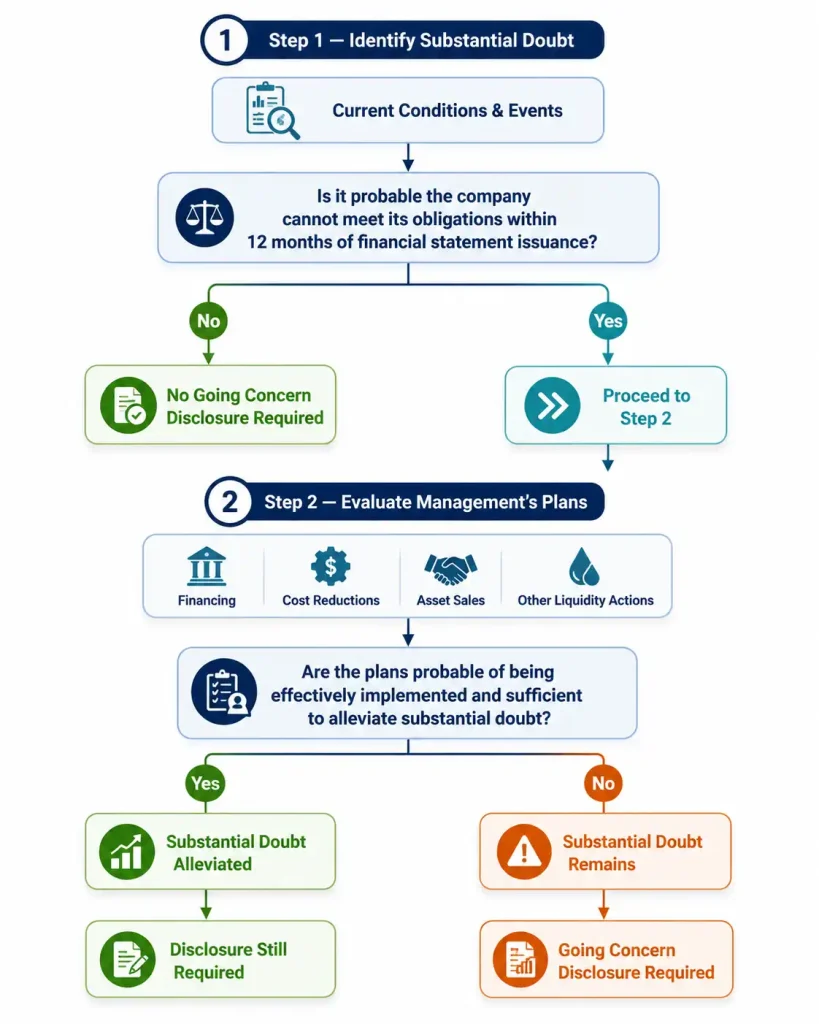
ASC 205-40 structures the analysis in two sequential steps, and the discipline of keeping them sequential, rather than blending them into a single judgment call, is what auditors look for first.
| Step | Question Management Must Answer | Outcome |
| Step 1 | Do current conditions, in the aggregate, indicate substantial doubt about the entity’s ability to continue as a going concern within twelve months of issuance? | If no, no disclosure is required. If yes, proceed to Step 2. |
| Step 2 | Do management’s plans, already underway or formally approved before issuance, alleviate that doubt? | If yes, disclosure is still required, describing the plans and why they are probable of success. If no, disclosure must state that substantial doubt remains unresolved. |
Why the Issuance Date Changes the Analysis
A Series B company showing seven months of runway, with a Series C round projected to close in month eight, sits inside a genuinely difficult judgment zone. A signed term sheet without funding, or a bridge commitment made verbally but never documented, does not satisfy Step 2 on its own. Boards operating a mission-driven institution through a capital raise of this kind, structuring a stack of equity and venture debt across a multi-million dollar raise, learn quickly that the audit committee will ask for the same evidence the standard demands: executed agreements, board approval, and cash timing the team can defend line by line.
How Auditors Evaluate Going Concern Judgments
Auditors, operating under PCAOB and AICPA standards, independently assess going concern risk and test the adequacy of management’s disclosure. They interrogate the assumptions inside the cash flow forecast, review access to capital, and evaluate the status of financing negotiations, sometimes requesting written confirmation directly from prospective investors or lenders. The most contentious conversations with auditors rarely originate in revenue recognition or lease accounting; they originate in the probabilistic center of the going concern assumption, where the process effectively asks management to prove a negative and requires the auditor to apply professional skepticism to every assumption offered.
A driver-based forecasting engine, built from a blank page inside a high-growth cybersecurity and identity access management company, held actuals within five percent of forecast for eight consecutive quarters, and that kind of track record is precisely what converts a going concern conversation from adversarial to procedural. Auditors trust a forecast that has already demonstrated accuracy under pressure far more readily than one presented for the first time during a liquidity crisis.
Building the Cash Flow Forecast That Withstands Scrutiny
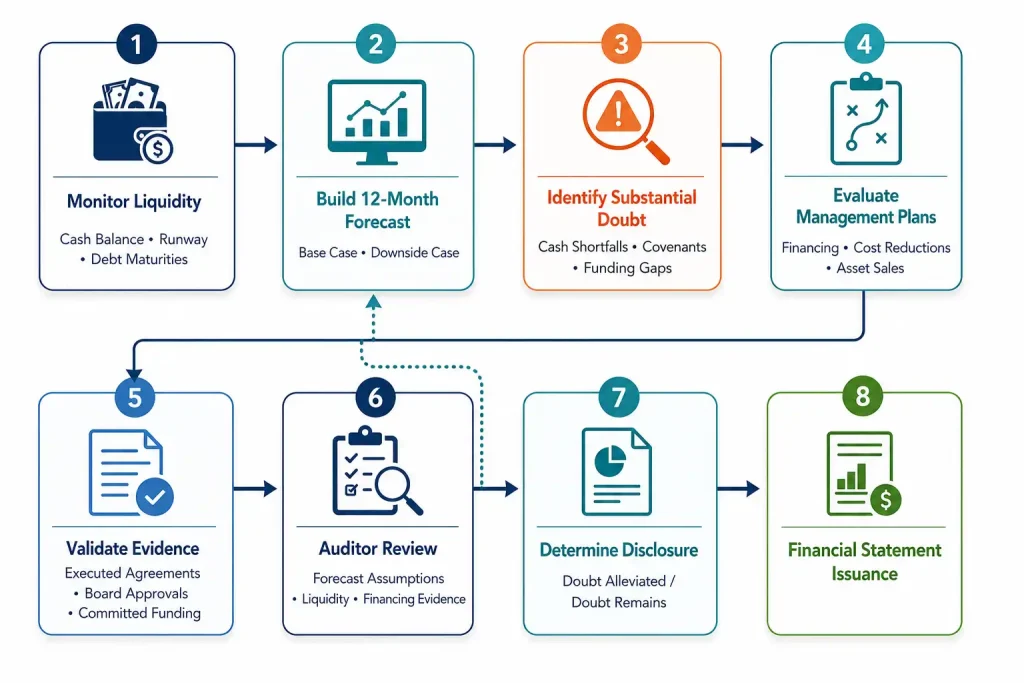
The forecast a CFO brings into a going concern conversation needs the following components, reviewed by the board on a recurring cadence and grounded in operational data rather than aspiration:
- A rolling twelve-month cash flow model with base and downside scenarios
- Explicit assumptions on revenue timing, cost reductions, and funding events
- Covenant compliance tracking tied to actual credit agreements
- A documented gap between committed and probable financing sources
An early-stage digital marketing SaaS company once reduced monthly burn from $800K to $200K during an operational turnaround, a compression achieved through structural cost changes rather than short-term deferrals, which is the distinction auditors look for when they assess whether cost reductions are probable of being effectively implemented under Step 2.
Writing Disclosure Language That Holds Up
Boilerplate disclosure language does not survive audit scrutiny. When management concludes that substantial doubt is alleviated by planned actions, the footnote must describe those actions specifically, explain why they are feasible, and connect them to the underlying risk they are meant to resolve. Executed term sheets, board-approved cost reductions, contracted cash receipts, and completed asset sales qualify; vague intentions and undocumented conversations do not.
When substantial doubt remains unresolved, the disclosure must say so without hedging, a requirement that is often harder for founders to accept than for CFOs to draft, since private-company reputation is frequently tied to funding narratives. Investors, in practice, extend more patience to honest disclosure than to surprises discovered later. A financing round that closes after the balance sheet date can resolve the going concern question only if it closes before the financial statements are issued and covers the forecasted shortfall; anything that lands after issuance is a subsequent event under ASC 855, disclosed separately rather than folded into the going concern assessment itself.
The Downstream Effects of a Going Concern Footnote
A going concern disclosure rarely stays contained to the footnote. It can trigger clauses inside debt agreements, vendor contracts, and equity warrants, and it can complicate insurance renewals or payment term negotiations with suppliers who read the audited financials before extending credit. For companies registering securities with the SEC, a going concern note can slow the review process and invite direct questions from staff examiners. A $127M global consumer products company that secured $12M in growth financing while owning its full banking and lender relationship management understood this dynamic directly, since a lender conversation initiated after a going concern footnote already exists carries a materially different tone than one initiated proactively while the balance sheet is still healthy.
The operational management of this risk demands coordination across treasury, FP&A, legal, and accounting on scenario modeling and disclosure language, with legal counsel reviewing consistency against offering documents and private placement memoranda, and investor relations prepared to communicate liquidity strategy with the same candor the disclosure itself requires.
A Practical Checklist for Managing Substantial Doubt
- Maintain a rolling forecast reviewed by the board no less than quarterly
- Document financing commitments as they are signed, not after the fact
- Build contingency relationships with secondary lenders before they are needed
- Embed runway discussions into standing board materials, not crisis memos
- Review disclosure language against offering documents before issuance
Treating Going Concern as Enterprise Risk, not a Footnote
The organizations that manage this well treat the going concern assumption as part of enterprise risk management rather than an accounting exercise confined to year end. There is no shame in raising capital while the runway remains healthy; the more difficult moment to raise from is the one where the tank is already empty and the going concern language is already drafted. Companies that disclose with clarity and calm tend to secure funding and retain investor support; companies that attempt to obscure the issue tend to trigger the exact panic they were trying to avoid. The difference sits in the transparency of communication, not in the underlying facts.
Three Key Takeaways
- The going concern assumption is a management judgment first and an audit conclusion second, which means the twelve-month forecast, the documented financing pipeline, and the board-level cadence around both need to exist well before an auditor ever asks for them.
- Disclosure quality under ASC 205-40 depends on specificity: executed agreements, board-approved plans, and contracted cash flows satisfy Step 2 of the standard, while verbal commitments and undocumented negotiations do not, regardless of how confident management feels about them.
- A going concern footnote carries consequences well beyond the audit opinion, touching debt covenants, vendor terms, insurance renewals, and SEC review timelines, which is why the strongest defense is proactive liquidity planning rather than a well-written disclosure written under pressure.
Disclaimer: This article is intended for informational purposes only and does not constitute legal, tax, or accounting advice. You should consult your own tax advisor or counsel for advice tailored to your specific situation.
Hindol Datta is a four-time CFO and senior finance executive with over 25 years of leadership experience across cybersecurity, SaaS, gaming, logistics, digital marketing, medical devices, consumer products, and nonprofit organizations. He has led more than $120M in fundraising and over $150M in M&A transactions while building the financial and operational systems that let complex businesses scale with confidence. He is the author of seven books in the Systems CFO Series and holds active CPA, CMA, and CIA credentials.
AI-assisted insights, supplemented by 25 years of finance leadership experience.