
Executive Summary
The GILTI tax regime has governed CFC earnings for United States shareholders since 2017. For finance teams building real operations abroad, it has rarely felt like the narrowly targeted anti-abuse rule its name implies. An engineering center in India can trigger a GILTI tax inclusion with no intangible property in sight. So can a shared services hub in Eastern Europe or a product team in Singapore. The entity only has to earn more than a routine return on its tangible asset base.
That regime is now in transition. Beginning with tax years after December 31, 2025, the One Big Beautiful Bill Act retires the GILTI label. In its place comes Net CFC Tested Income, or NCTI. It also rewrites several of the mechanics finance teams have spent years learning to model. This article walks through how the GILTI tax has worked and what the high-tax exception offers as a planning tool. It also covers what the shift to NCTI changes for companies with foreign subsidiaries.
Understanding the GILTI Tax and Why It Exists
GILTI stands for Global Intangible Low-Taxed Income, a name that suggests a narrow focus on intellectual property. In practice, the GILTI tax functions as a catch-all inclusion regime. It captures the earnings of controlled foreign corporations, or CFCs, above a deemed routine return on tangible assets. Intangibles do not need to be involved at all.
Congress introduced the GILTI tax as part of the 2017 Tax Cuts and Jobs Act. The goal was to modernize the international tax framework and discourage U.S. companies from parking income in low-tax jurisdictions. Rather than waiting for repatriation, the GILTI tax forces U.S. shareholders to recognize their pro-rata share of CFC earnings annually. This applies whether or not the CFC distributes that income. Finance teams that have built genuine operating footprints abroad know this well. That includes those running cybersecurity and identity platforms with delivery centers across multiple countries. For them, that annual inclusion has meant confronting cash tax liability on income the business has not yet touched.
How the Calculation Works
At a high level, a U.S. shareholder includes its pro-rata share of tested income. That figure broadly means CFC gross income minus Subpart F income, effectively connected income, and a handful of narrow exclusions. From that figure, the calculation subtracts:
- Tested losses of other CFCs in the group
- A deemed 10% return on Qualified Business Asset Investment, known as QBAI, a proxy for tangible assets such as plant, property, and equipment
What remains is the GILTI tax base. Its effective rate depends on whether the shareholder is a corporation or an individual. For a domestic C corporation, a 50% deduction under Section 250 applies. That has historically brought the effective GILTI tax rate to 10.5% before credits. Foreign tax credits can offset the liability, but only up to 80% of foreign taxes paid. That credit is also calculated on a pooled basis across all CFCs. Finance teams often call that pooling basket blending. It forces low-taxed and high-taxed entities together. That eliminates the precision a finance team might want when managing exposure entity by entity. Unused credits cannot be carried forward or back.
Individuals and pass-through owners fare worse under the GILTI tax rules. Without a Section 962 election to be treated as a corporation, they receive neither the Section 250 deduction nor the foreign tax credit, and K-1 recipients have been known to face GILTI tax bills with no corresponding cash distribution to cover them.
The GILTI High-Tax Exception as a Planning Tool
The GILTI high-tax exception, or HTE, allows companies to exclude tested income from the GILTI tax base if the effective foreign tax rate on that income exceeds 90% of the U.S. corporate rate, a threshold that has sat at approximately 18.9%. Applied on a tested-unit basis, the exception requires precise mapping of income, taxes, and legal entity structure, reconciling local GAAP to U.S. tax definitions.
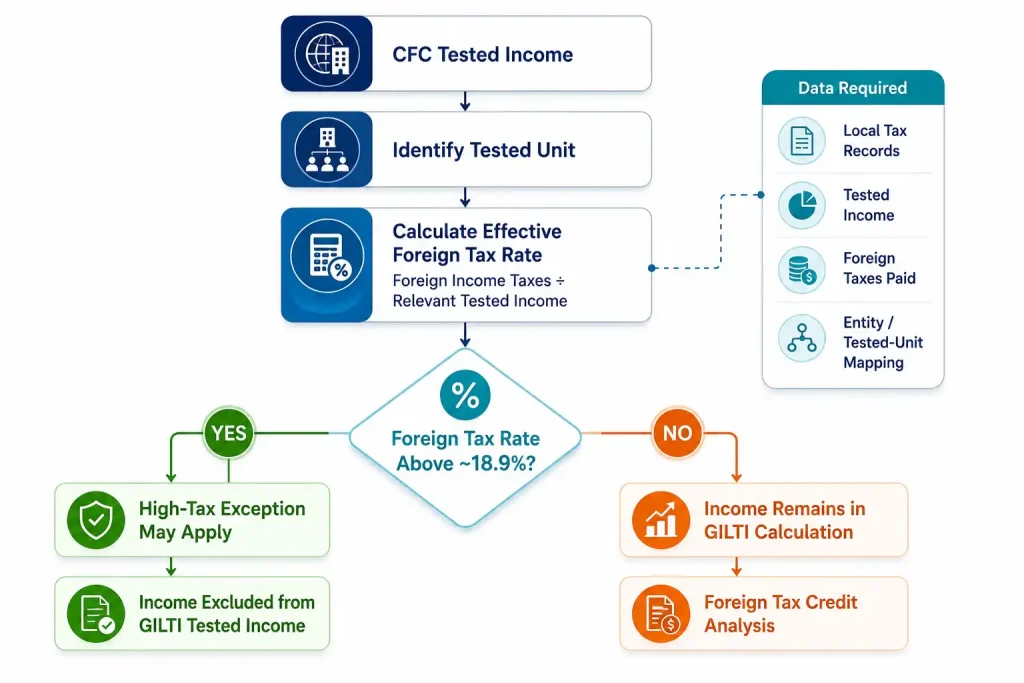
For companies operating in higher-tax jurisdictions such as Germany, France, or India, the HTE has been able to reduce GILTI tax exposure to near zero. A $127M global consumer products company with supply chain operations across Asia and clean audit history each year still had to build the underlying data stack to support an HTE election, a project that can run past 100 hours across a handful of subsidiaries. The payoff is a GILTI tax position that aligns with how the business actually pays tax around the world, which matters as much to a board and its auditors as it does to the cash number itself.
The HTE also forces deeper structural questions: whether IP ownership should sit in a low-tax jurisdiction, whether it should follow R&D activity instead, and whether intercompany licensing or cost-sharing arrangements make sense. These choices touch product strategy and engineering culture as much as they touch the tax return, and GILTI tax planning that ignores that connection tends to create friction with the parts of the business it was meant to protect.
From GILTI Tax to Net CFC Tested Income
The most consequential change to the GILTI tax regime since its creation arrives with the One Big Beautiful Bill Act. For tax years beginning after December 31, 2025, the term GILTI disappears from the statute, replaced by Net CFC Tested Income. The rename accompanies real computational shifts:
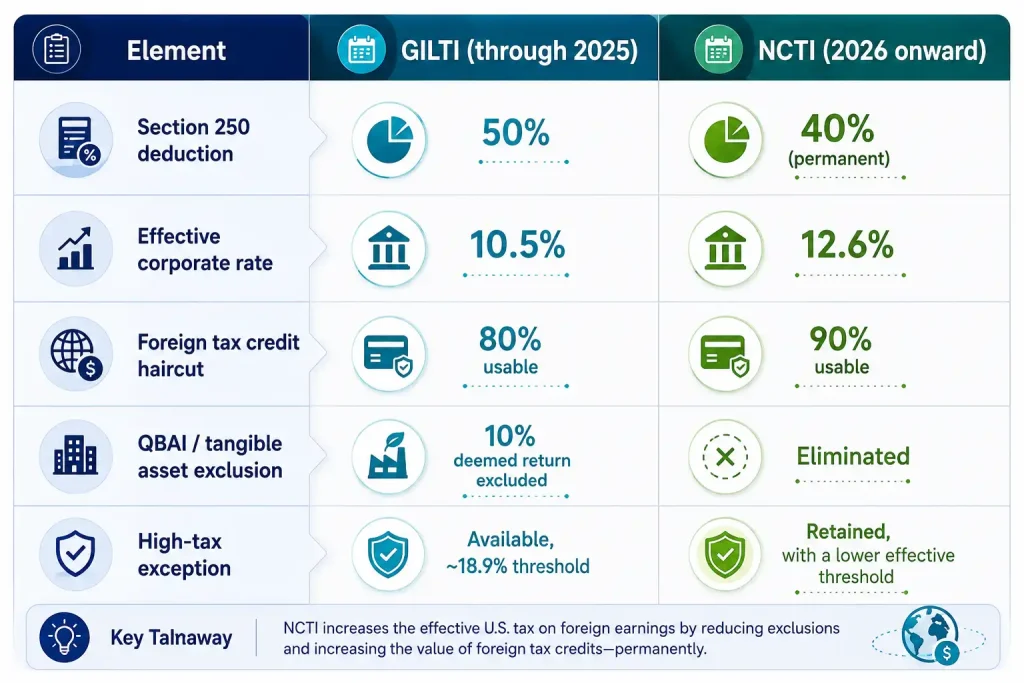
The net effect is mixed rather than uniformly worse. A higher foreign tax credit percentage helps companies with meaningful foreign tax already paid, while the loss of the QBAI exclusion removes a benefit that mattered most to businesses with a heavy tangible asset base, including manufacturing operations and asset-heavy real estate structures. Service businesses with thin fixed asset footprints, including most SaaS and digital marketing companies, will notice the transition less, since the QBAI exclusion rarely shielded much of their income to begin with.
Cash Flow, ASC 740, and the Cost of Getting the Model Wrong
A GILTI tax inclusion is a book-to-tax timing mismatch. The income is taxed in the United States even when the cash stays offshore, and companies with capital controls or limited repatriation capacity end up funding a U.S. tax bill against income they cannot yet move. Forecasting that exposure across multiple years, tracking earnings and profits, and mapping dividend pathways against local legal reserve requirements is unglamorous work, but it separates companies that can move capital efficiently from those that discover a cash trap during a board update.
The accounting side carries its own risk. Most companies expense GILTI as a period cost under ASC 740 rather than build it into deferred tax modeling, given the complexity of the moving parts. That choice deserves revisiting once operations stabilize. An effective tax rate that moves several points because a foreign operating lease was not properly depreciated under U.S. standards is the kind of variance that costs weeks to unwind and explain to an audit committee, a lesson familiar to public companies managing consolidated reporting under both IFRS and U.S. GAAP across several jurisdictions.
Building a Structure That Withstands Scrutiny
None of this GILTI tax complexity shows up on the surface of a profit and loss statement, yet it shapes the narrative that investors, auditors, and acquirers ultimately believe about the business. The transition to NCTI does not remove the need for that narrative. It changes the numbers behind it.
Companies with foreign subsidiaries should treat the next filing cycle as an opportunity to revisit entity structure, HTE elections, and ASC 740 methodology together rather than in isolation, since each of the OBBBA’s changes touches the others. A structure that made sense under the 80% credit haircut and the QBAI exclusion may not be the right structure once both assumptions change.
Three Key Takeaways
- The GILTI tax regime that has governed CFC earnings since 2017 is being replaced by Net CFC Tested Income for tax years beginning after December 31, 2025, and the changes are not cosmetic: a lower Section 250 deduction, a higher foreign tax credit ceiling, and the elimination of the QBAI exclusion combine to raise the effective rate for most corporations to 12.6%.
- The high-tax exception remains one of the most effective planning tools available, but claiming it requires the kind of tested-unit mapping and effective-rate reconciliation that only pays off when the underlying data infrastructure already exists.
- GILTI tax exposure is as much a cash flow and governance problem as a compliance one, and companies that model repatriation, ASC 740 treatment, and entity structure together tend to avoid the kind of variance that damages credibility with boards and auditors.
Disclaimer: This article is intended for informational purposes only and does not constitute legal, tax, or accounting advice. You should consult your own tax advisor or counsel for advice tailored to your specific situation.
Hindol Datta is a four-time CFO and senior finance executive with over 25 years of leadership experience across cybersecurity, SaaS, gaming, logistics, digital marketing, medical devices, consumer products, and nonprofit organizations. He has led more than $120M in fundraising and over $150M in M&A transactions while building the financial and operational systems that let complex businesses scale with confidence. He is the author of seven books in the Systems CFO Series and holds active CPA, CMA, and CIA credentials.
AI-assisted insights, supplemented by 25 years of finance leadership experience.