
Executive Summary
The debate over GAAP vs IFRS is not an academic exercise reserved for technical accounting memos. It is a daily operating reality for finance organizations that report across borders. It applies equally to any team that raises capital internationally or consolidates subsidiaries under more than one framework. Understanding the difference between GAAP and IFRS shapes how revenue is booked and how inventory is valued. It also shapes how leases hit the income statement, and how a board interprets the health of the business.
This article walks through where GAAP and IFRS align and where they diverge. It shows what that divergence means in practice for finance leaders managing multi-entity, cross-border organizations. The goal is not to catalog every technical distinction. It is to give CFOs a working map of where IFRS vs GAAP differences carry real financial and strategic weight.
Two Philosophies Behind GAAP and IFRS
US GAAP is rules-based. It leans on detailed, industry-specific guidance designed to minimize ambiguity. IFRS is principles-based, built to let preparers apply judgment across widely different business environments. Both frameworks aim to represent a company’s economic reality faithfully, but they arrive at that goal through different roads. For CFOs running cross-border operations, the difference between IFRS and GAAP shows up long before it reaches a footnote. It shows up in how a deal is priced and how a covenant is tested. It also shapes how a board reads the numbers in front of it.
Where GAAP vs IFRS Diverge Most in Day-to-Day Reporting
Revenue Recognition and Inventory
Under ASC 606 and IFRS 15, both frameworks now apply a control-based revenue model, recognizing revenue when control of goods or services transfers to the customer. In practice, US GAAP applies that model with heavy implementation guidance. IFRS allows more interpretive room, particularly for long-term construction and service contracts, which can produce earlier or smoother revenue recognition.
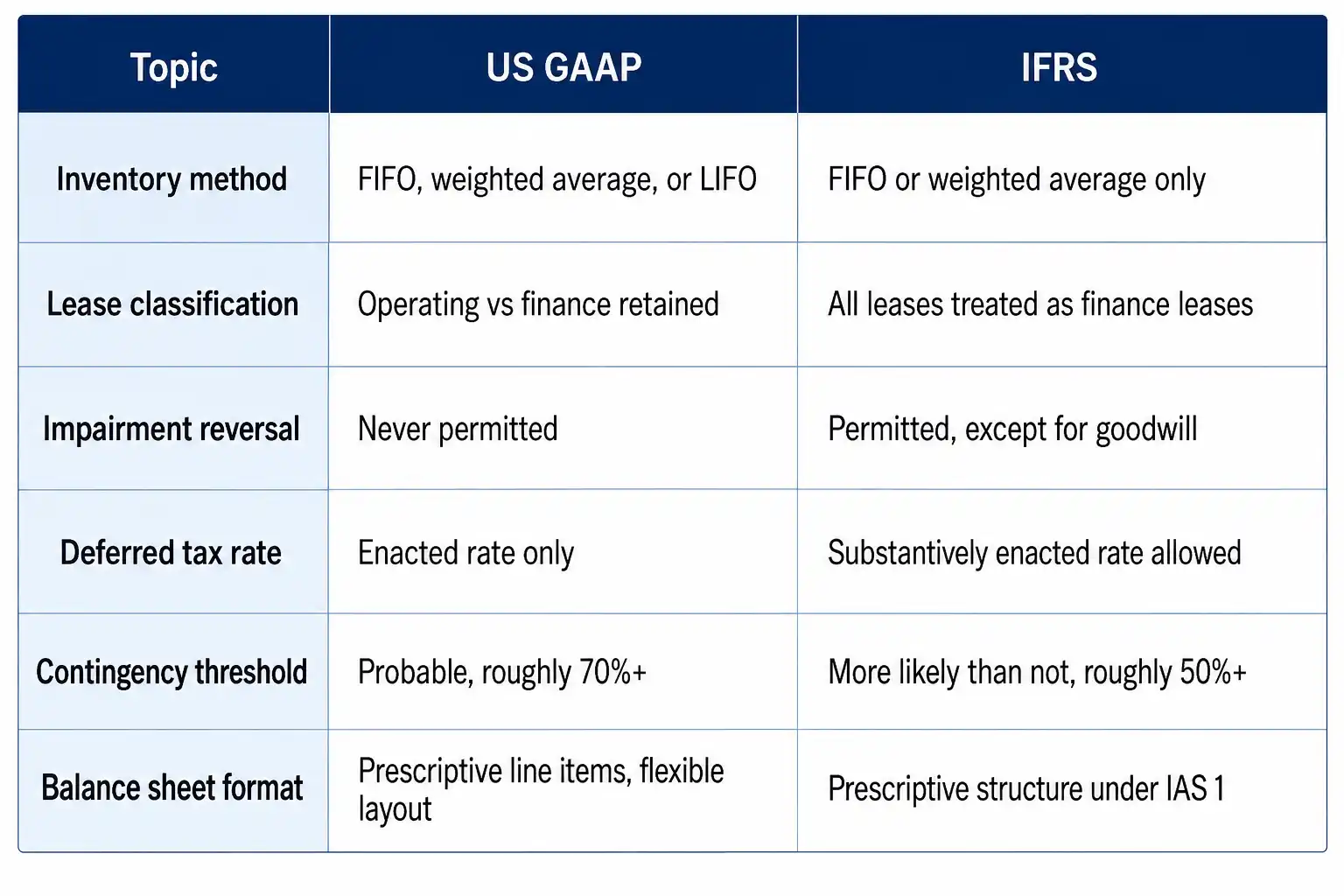
Inventory accounting is one of the most cited GAAP vs IFRS differences. US GAAP permits LIFO, which many US companies use during inflationary periods to reduce taxable income. IFRS prohibits LIFO entirely, requiring FIFO or weighted average cost. Companies reporting under both standards often end up running dual inventory systems, since the choice of method flows directly into cost of goods sold and gross margin.
Consolidation and Control
Both frameworks consolidate entities based on control, but they define control differently. US GAAP uses a bifurcated model: a voting interest test, plus a variable interest entity test for structures where risk and benefit sit outside straightforward ownership. IFRS applies a single model built around power over relevant activities and exposure to variable returns. This difference matters most in joint ventures, franchises, and special-purpose entities, where IFRS can require consolidation through de facto control even without majority ownership, a result US GAAP typically would not reach.
Leases and Goodwill
Lease accounting converged in structure but not in presentation. ASC 842 requires lessees to record right-of-use assets and liabilities while preserving the operating versus finance lease distinction. IFRS 16 removes that distinction entirely, treating all leases like finance leases, which tends to inflate reported EBITDA relative to a comparable US GAAP filer.
Goodwill impairment tells a similar story of shared intent and different mechanics.
Taxes, Contingencies, and Currency: The Judgment Calls That Move Earnings
Deferred taxes are measured using enacted rates under US GAAP, while IFRS permits substantively enacted rates, giving companies more flexibility when a new rate is nearly certain to pass into law. On recognition, US GAAP applies a more-likely-than-not test that frequently produces valuation allowances, while IFRS recognizes deferred tax assets once future taxable profit is probable, a lower bar that can pull recognition earlier in loss-making or turnaround situations.
Contingencies and legal provisions diverge sharply. US GAAP recognizes a liability only when a loss is probable, generally read as a threshold above 70%. IFRS recognizes a provision when an outflow is more likely than not, a threshold above 50%. Two companies facing the same lawsuit, with the same facts, can report a materially different balance sheet depending on which standard applies.
Currency translation follows a similar shared framework with a meaningful exception. Both standards remeasure transactions at the spot rate and run the resulting gains and losses through the income statement. Translation adjustments for consolidating a foreign subsidiary bypass the income statement under both frameworks, unless the subsidiary operates in a hyperinflationary economy, in which case IFRS routes the remeasurement directly through earnings.
Managing Dual-Framework Reporting in Practice
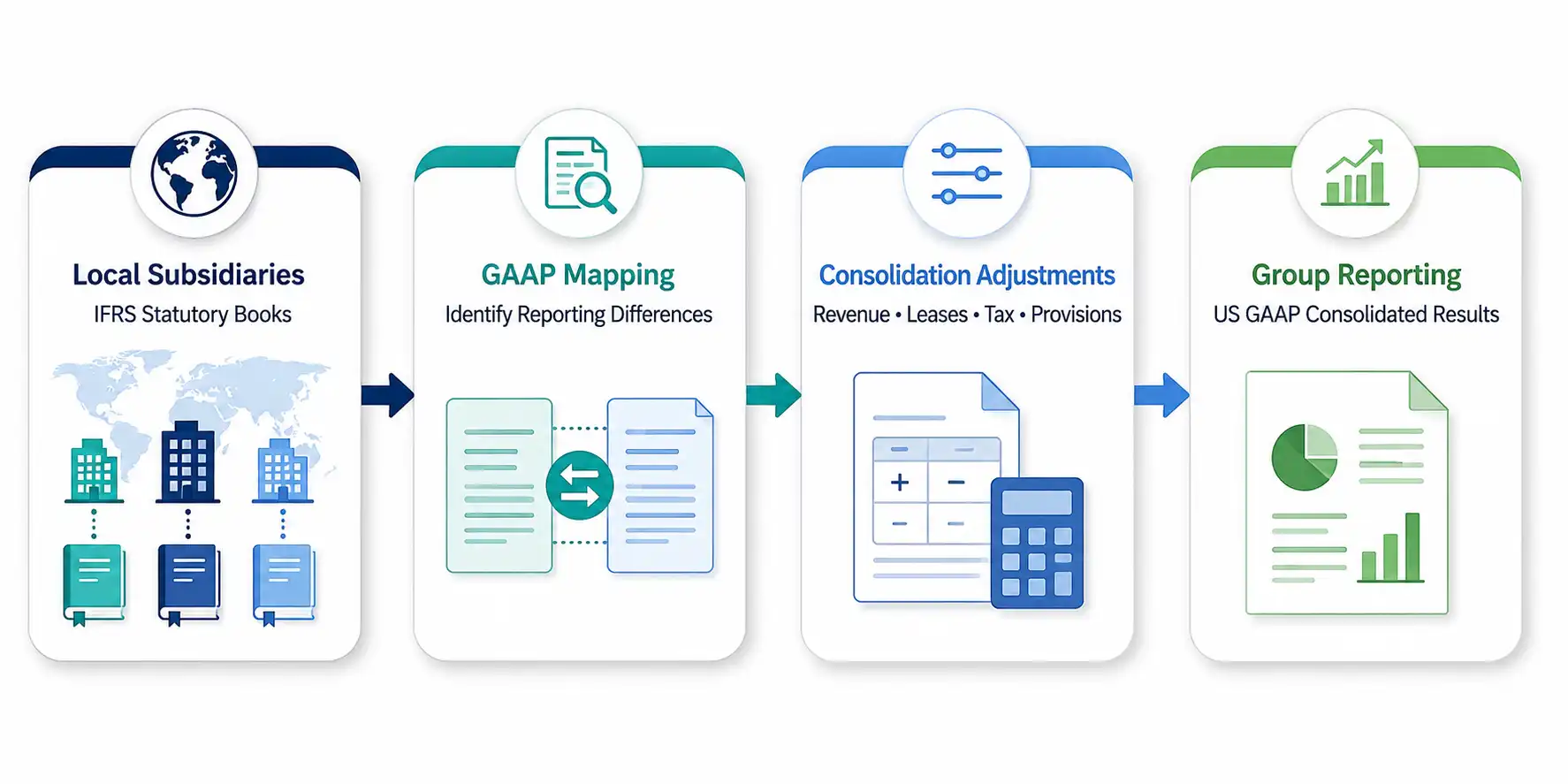
Running consolidated financial reporting across five countries under both IFRS and US GAAP, inside a publicly listed gaming and digital entertainment company, surfaces the difference between GAAP and IFRS in a very concrete way: the same transaction, recorded twice, producing two legitimate but different answers. A single, unified revenue definition across every subsidiary, supported by a common financial systems backbone, is often what makes statutory reporting cycles under both frameworks tractable rather than a quarterly fire drill.
That same discipline shows up wherever a US-based finance function oversees European or Asia-Pacific subsidiaries keeping local statutory books in IFRS while consolidating results into US GAAP for the parent. A cybersecurity and identity access management company operating across the United States, Canada, Mexico, India, and Nepal, or a global consumer products company sourcing from China and Vietnam, both depend on the same underlying discipline: a mapping process that translates IFRS ledger entries into US GAAP through consolidation adjustments, not through wholesale conversion of local books. Getting that mapping wrong does not just create a reconciliation headache. It erodes the confidence of auditors, lenders, and boards in the numbers they are being asked to sign off on.
The practical governance model that tends to hold up under audit scrutiny includes a few consistent elements:
- A centralized accounting policy function that owns how US GAAP is applied across every entity, working alongside regional controllers rather than overriding them.
- Reconciliation schedules that are traceable, documented, and tied to specific standards, not built as one-off spreadsheets recreated each quarter.
- Internal controls, consistent with Sarbanes-Oxley expectations for public filers, that validate the consistency of treatment across both ledgers.
- A close process, ideally supported by ERP systems capable of multi-book configurations, that reduces the volume of manual adjustment at period end.
Three Key Takeaways
- The difference between GAAP and IFRS is rarely about which framework is more correct; it is about where each framework places judgment, and CFOs who understand that placement can anticipate how a transaction will look before the accounting team finishes the memo.
- The areas of greatest financial consequence, including inventory method, lease presentation, contingency recognition, and deferred tax measurement, are also the areas most likely to move reported earnings, leverage ratios, and investor perception, which makes them worth board-level attention rather than footnote-level delegation.
- Reconciling IFRS vs US GAAP at scale is a governance exercise as much as a technical one, and the finance organizations that manage it well tend to centralize policy ownership while keeping statutory compliance local, rather than forcing a single global standard onto every entity.
Disclaimer: This article is intended for informational purposes only and does not constitute legal, tax, or accounting advice. You should consult your own tax advisor or counsel for advice tailored to your specific situation.
Hindol Datta is a four-time CFO and senior finance executive with over 25 years of leadership experience across cybersecurity, SaaS, gaming, logistics, digital marketing, medical devices, consumer products, and nonprofit organizations. He has led more than $120M in fundraising and over $150M in M&A transactions while building the financial and operational systems that let complex businesses scale with confidence. He is the author of seven books in the Systems CFO Series and holds active CPA, CMA, and CIA credentials.
AI-assisted insights, supplemented by 25 years of finance leadership experience.