
Executive Summary
Post-acquisition integration tends to draw attention toward financial systems, headcount decisions, and product roadmaps, while the domain migration, the CMS consolidation, and the SEO migration for custom CMS platforms sit quietly in the background until organic traffic collapses and nobody can explain why. A pipeline built over years of search visibility can unwind within weeks when a redirect map goes missing or a legacy content system is abandoned without a plan, and by the time the finance team notices the drop in inbound leads, the damage has already compounded.
This article works through four places where digital integration commonly breaks: domain migration, CMS consolidation, duplicate content, and analytics continuity. Each section carries a practitioner’s view of what goes wrong, what the recovery costs, and what a defensible playbook looks like before the next transaction closes.
Why Digital Integration Belongs on the CFO’s Agenda
Search visibility is a form of capital in the same way a customer contract or a patent is a form of capital, and treating it as an IT concern rather than a value preservation concern is how acquirers end up paying for traffic they never keep. Domain migration, CMS integration, and SEO continuity are not cosmetic technical exercises. They determine whether the customer acquisition engine that justified part of the purchase price still runs the day after close.
In one high-growth cybersecurity and identity access management company that scaled toward $30M in annual recurring revenue across five country entities, the finance function learned early that anything touching the customer-facing web presence needed the same discipline as the general ledger. A dashboard that shows revenue but ignores the traffic feeding the top of the funnel gives a CFO a partial picture of the business at exactly the moment full visibility matters most.
Domain Migration and the Cost of a Careless Redirect
Branding changes after a deal often force a website domain migration, and the instinct to simplify by pointing every old URL at the parent company’s homepage is understandable and almost always wrong. Search engines do not transfer ranking authority when a page’s destination no longer matches its content, and without careful mapping, years of accumulated link equity evaporate.
A venture-backed digital marketing organization scaled from $9M to $180M in revenue over twenty-four months, and the growth depended in part on organic search performance that had been built page by page over several years. Any acquirer inheriting that kind of asset and redirecting it carelessly would be discarding demand generation infrastructure that took real time and real spend to build, and recovering it afterward typically takes far longer than migrating it correctly the first time.
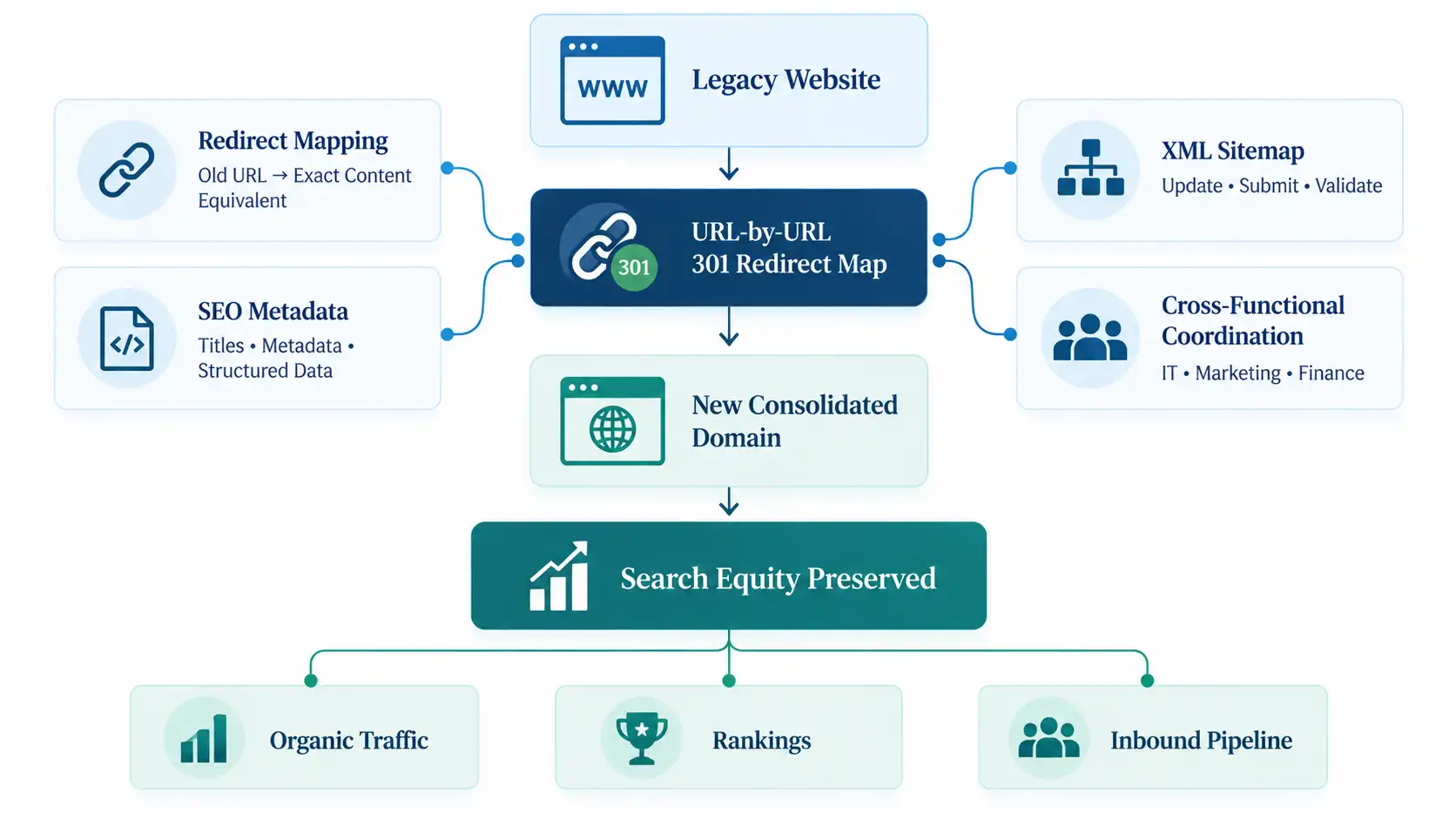
What SEO-Safe Domain Migration Requires
A defensible migration plan generally includes the following elements, executed together rather than sequentially:
- 301 redirects mapped from each old URL to its exact content equivalent, not a blanket redirect to the homepage
- Retention of metadata, titles, and structured data across the migrated pages
- Updated XML sitemaps submitted to search engines within days of go-live, not weeks
- Coordination between IT, marketing, and finance so that no function is discovering the migration after it has already happened
SEO Migration for Custom CMS: Avoiding the Frankenstein Stack
Merging content management systems is where SEO migration for custom CMS platforms becomes genuinely difficult, because a bespoke system built in-house over a decade rarely maps cleanly onto a standardized platform like WordPress. The result, left unmanaged, is a patchwork of legacy plugins, security gaps, and inconsistent user interfaces that slow every subsequent marketing initiative.
An early-stage email marketing and community technology company illustrates the opposite lesson: building the content and reporting infrastructure from scratch, with disciplined architecture from day one, avoided the retrofitting problem entirely. That is rarely the situation an acquirer inherits. More often, the acquired company’s CMS was built for a different scale, and the temptation is to bridge the old and new systems through manual workarounds rather than commit to a real migration.
CMS Migration Best Practices
The following sequence keeps a custom CMS migration from becoming a permanent drag on marketing execution:
- Audit the existing CMS for extensibility, plugin support, and long-term viability within the first two weeks post-close
- Prioritize consolidation into a single content system rather than maintaining parallel platforms
- Archive redundant or outdated assets instead of migrating everything by default
- Test page speed and mobile responsiveness end to end before the new site takes any production traffic
- Sequence the migration around product launches and seasonal campaigns so the technical work does not collide with revenue-critical marketing windows
Treating this migration with the same rigor as an ERP implementation, including discovery, user acceptance testing, and stakeholder sign-off, is what separates a clean transition from a Frankenstein stack that erodes marketing productivity for quarters afterward.
Duplicate Content and the Silent SEO Penalty
Mergers routinely produce duplicate blogs, overlapping FAQ pages, and near-identical product descriptions across subdomains, and search engines respond to that confusion by downranking every version rather than picking a winner. A company that ends up with four identical pricing pages spread across subdomains is not protecting its search equity; it is diluting it, and the algorithmic penalty that follows can take six weeks or longer to unwind.
The same multi-entity cybersecurity organization referenced earlier, operating across five countries with localized web presences, had to be particularly deliberate about canonical structure once its customer-facing content began to overlap across regional sites. SEO diligence in a merger context should include the following steps as a matter of course:
- Identify overlapping or near-duplicate content across all inherited domains and subdomains
- Set canonical URLs so search engines understand which version of a page carries ranking authority
- Apply hreflang tags correctly wherever multilingual or multi-region content exists
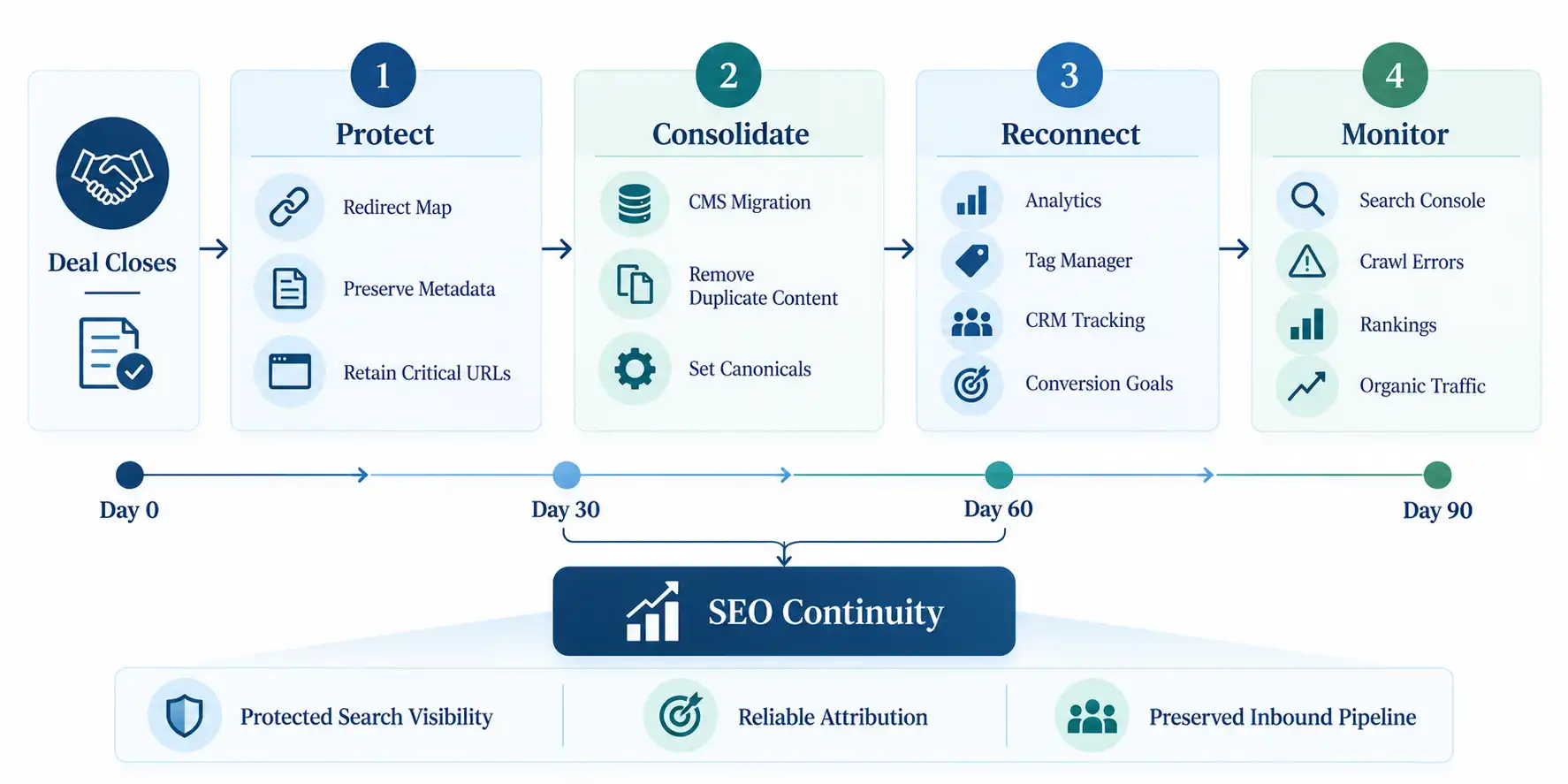
- Monitor Google Search Console closely for ninety days after any content consolidation, watching for crawl errors and ranking volatility
Reconnecting Analytics and Attribution After the Merge
Unified reporting is not optional once two web properties combine, because misaligned conversion tracking and broken attribution models make it impossible to judge whether marketing spend is actually working. A global consumer products company operating across direct-to-consumer, Amazon, and wholesale channels found that even small gaps in tracking consistency across channels could obscure where revenue was actually being generated, and the same risk multiplies during a CMS or domain migration when tracking pixels are easy to lose in the transition.
Restoring analytics integrity after integration generally requires consolidating Google Analytics and Tag Manager properties into a single source of truth, revalidating every goal conversion rather than assuming they carried over correctly, and syncing CRM and CMS tracking identifiers so revenue attribution holds continuously through the transition rather than breaking for the six or eight weeks it typically takes someone to notice.
Building SEO Continuity into the Integration Playbook
None of this is an argument for treating digital infrastructure as more important than the balance sheet; it is an argument for treating it as part of the same balance sheet. A target’s Google footprint, its inbound pipeline, and its content architecture are assets the acquirer is paying for as surely as its customer contracts, and a botched SEO migration for custom CMS platforms quietly writes down the value of that asset before anyone updates a model to reflect it.
Building an SEO continuity requirement into every integration playbook, with a redirect map, a sitemap submission timeline, and a Search Console review built into the first ninety days post-close, converts what is often an afterthought into a standard diligence item alongside revenue retention and employee attrition metrics on the post-close scorecard.
Three Key Takeaways
- Domain migration is a value preservation exercise, not a branding formality, and skipping the redirect mapping in favor of a blanket homepage redirect is one of the fastest ways to erase years of accumulated organic traffic and inbound pipeline.
- A custom CMS inherited through acquisition deserves the same discovery, testing, and stakeholder sign-off given to an ERP migration, because a patchwork integration of legacy and new systems slows marketing execution and multiplies security exposure long after the deal closes.
- Duplicate content and broken analytics attribution are silent penalties that compound over weeks rather than announcing themselves immediately, which is exactly why canonical structure, hreflang tagging, and unified tracking belong on the post-close SEO diligence checklist rather than on a list of things to fix later.
Disclaimer: This article is intended for informational purposes only and does not constitute legal, tax, or accounting advice. You should consult your own tax advisor or counsel for advice tailored to your specific situation.
Hindol Datta is a four-time CFO and senior finance executive with over 25 years of leadership experience across cybersecurity, SaaS, gaming, logistics, digital marketing, medical devices, consumer products, and nonprofit organizations. He has led more than $120M in fundraising and over $150M in M&A transactions while building the financial and operational systems that let complex businesses scale with confidence. He is the author of seven books in the Systems CFO Series and holds active CPA, CMA, and CIA credentials.
AI-assisted insights, supplemented by 25 years of finance leadership experience.