
Executive Summary
In the fractional CFO services market, how an offering is packaged often matters as much as what it actually includes. Most founders do not wake up asking for a seasoned finance executive with Series B experience. They are not thinking about SaaS metrics exposure either. Closing a raise is what they actually ask about. Fixing their reporting and staying out of a cash crunch matter just as much. There is a gap between what a fractional CFO offers and what a founder thinks they need. Service packaging exists to close that gap.
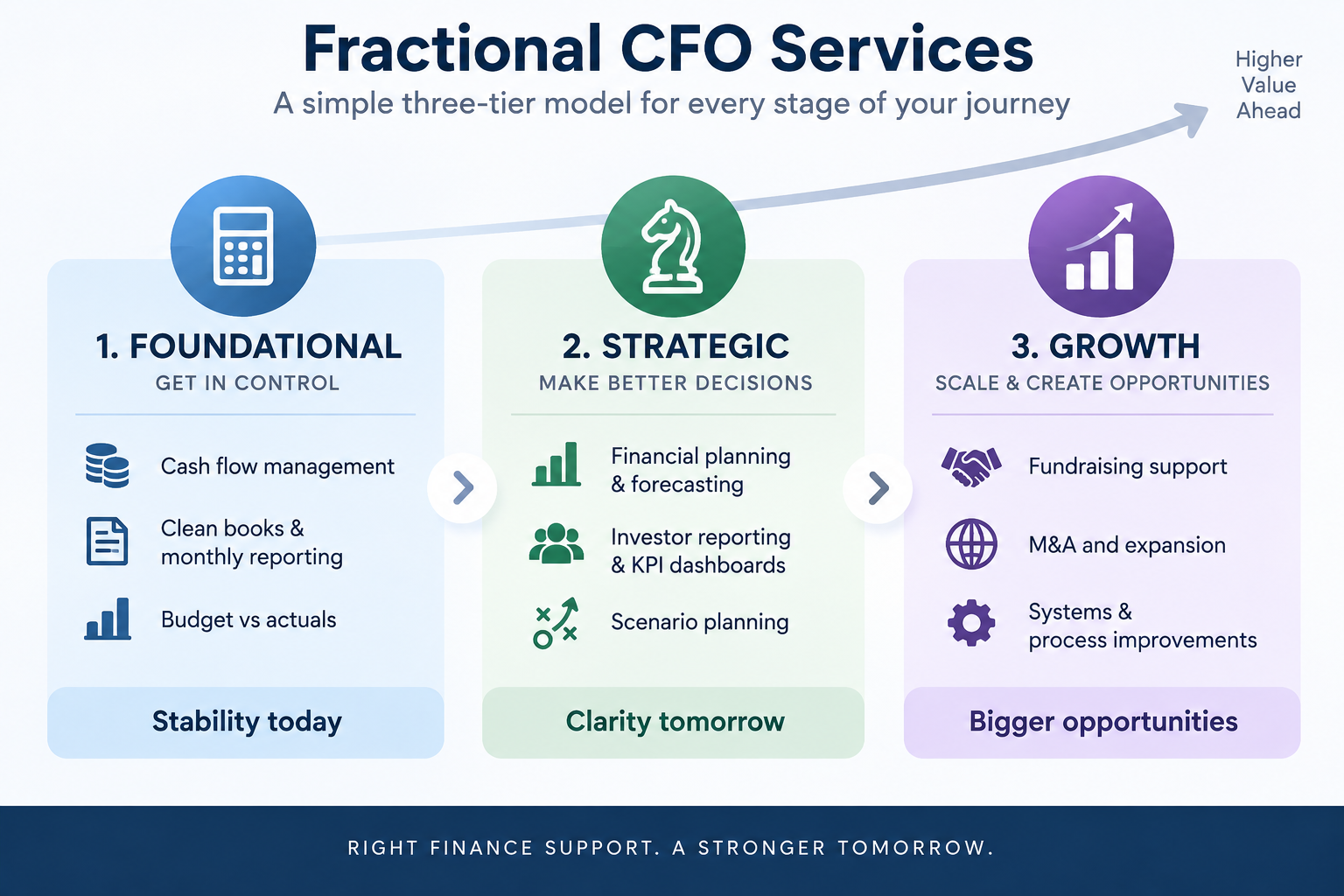
A clear three-tier structure, built around Foundational, Strategic, and Growth services, gives founders a way to see what they need today. It also shows them how they can grow with a CFO over time. This article walks through what belongs in each tier and why the structure reduces friction for both sides. It closes with how to position the model so founders can say yes without hesitation.
Tier One: Foundational Services
Foundational services are the table stakes. They matter for stability and risk management, and they are usually the first thing a founder notices is missing.
Services in this tier include:
- Cash flow management and forecasting
- Accounting cleanup and chart of accounts restructuring
- Payroll setup and management
- Basic financial reporting and a monthly close cadence
- Budget versus actual tracking
Clients arriving at this tier often lack clean books. They have no regular reporting rhythm, and they feel reactive rather than in control. Value here tends to show up fast, usually within two to three weeks.
Typical deliverables:
- 13-week cash forecast
- Monthly reporting pack
- A “state of the books” memo
Tier Two: Strategic Services
This is where the relationship shifts from technician to advisor. The client no longer just needs clean numbers. They need someone who can turn those numbers into decisions.
Services in this tier include:
- Operating model creation covering revenue, headcount, and go-to-market
- Investor reporting and board deck preparation
- KPI development and dashboards
- Scenario planning and runway analysis
- Internal hiring plans and org chart modeling
Clients at this stage are often preparing for a fundraise or scaling headcount quickly. They want clarity and control, not just accuracy.
Typical deliverables:
- Board-ready forecast
- Custom KPI dashboard
- Strategic finance roadmap
Tier Three: Growth Services
At the top tier, the CFO becomes a growth enabler and capital strategist. This is the work that shows up in a fundraise, an acquisition, or a run toward exit.
A fractional CFO engagement supporting an AI governance and assurance platform in its pre-Series A phase illustrates this tier well. Building the operating model, the multi-year scenario analyses, and the capital strategy behind a raise from nothing is squarely Growth-tier work. That holds even when the underlying company is still small.
Services in this tier include:
- Fundraising support, including deck review, pitch preparation, and data room management
- M&A support and financial due diligence
- International expansion modeling
- System implementations, including ERP and FP&A tools
- Cap table scenario modeling and dilution analysis
Clients here are raising capital, acquiring companies, or preparing for exit. They need both horsepower and judgment, often on a tight timeline.
Typical deliverables:
- Fundraise-ready financial model
- M&A support package
- Systems integration plan
Why the Tiered Model Works
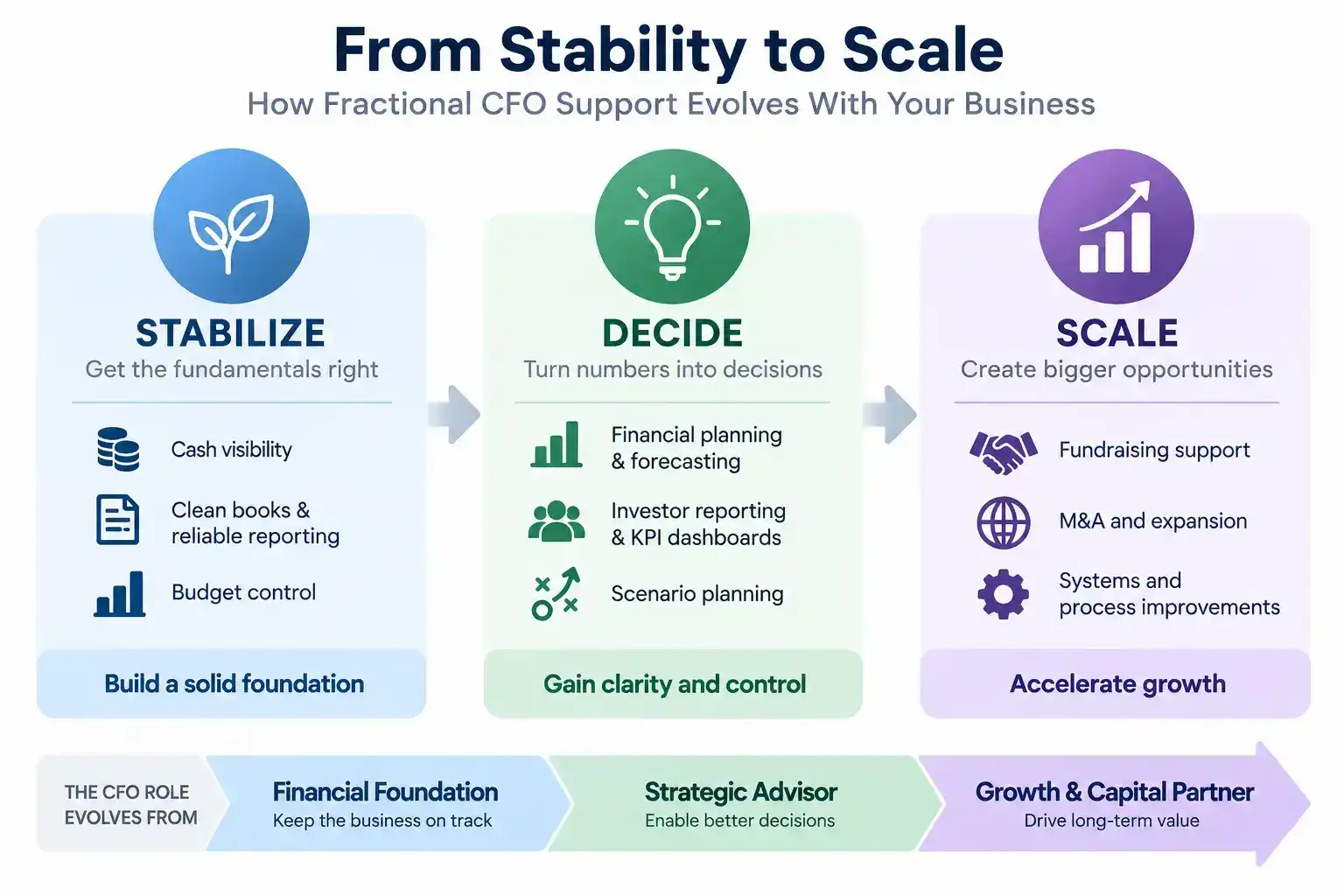
A three-tier structure works for a few concrete reasons. Founders can see what comes next without feeling overwhelmed by a menu of every possible service at once. Pricing becomes clearer too. Retainers and project fees can anchor to a specific tier instead of being negotiated from scratch each time. Most importantly, the model builds in an upsell path. A client who starts at the Foundational tier has a visible route forward. Strategic and Growth work are there once the relationship matures.
Positioning Tips
A few practices make the tiers land with founders rather than confuse them:
- Use the language founders actually use, such as “runway clarity” instead of “liquidity forecasting”
- Bundle deliverables by outcome, not by task
- Share examples or case studies tied to each tier
- Resist the urge to offer too many choices; clarity beats options
Three Key Takeaways
- Founders buy outcomes, not job titles, so packaging should speak to what keeps them up at night rather than to a CFO’s credentials.
- A three-tier structure gives both sides a shared reference point for pricing, scope, and what happens as the relationship grows, which shortens the sales cycle on its own.
- The tiers only work if the language matches how founders actually talk about their problems, since a technically accurate label that does not resonate will not move a prospect to yes.
Disclaimer: This article is for informational purposes only and does not constitute legal, financial, or business advisory advice. Fractional CFOs should tailor service packaging to their own client base and market positioning.
Hindol Datta is a four-time CFO and senior finance executive with over 25 years of leadership experience across cybersecurity, SaaS, gaming, logistics, digital marketing, medical devices, consumer products, and nonprofit organizations. He has led more than $120M in fundraising and over $150M in M&A transactions while building the financial and operational systems that let complex businesses scale with confidence. He is the author of seven books in the Systems CFO Series and holds active CPA, CMA, and CIA credentials.
AI-assisted insights, supplemented by 25 years of finance leadership experience.