
Executive Summary
Fractional CFO services are not purchased the way a company buys software or office supplies. A founder hiring a fractional CFO is buying judgment and discretion. The purchase includes the ability to steady a business when capital, runway, or board pressure tighten all at once. Marketing playbooks built for transactional products rarely translate to a decision like this one. What works instead is credibility marketing, a discipline built on demonstrated expertise rather than declared expertise. The content itself becomes the pitch, often before the first call ever happens.
This article lays out a practical framework for building a marketing engine around fractional CFO services. The goal is inbound interest generated without compromising positioning, tone, or the quality of the client relationship. It draws on patterns observed across cybersecurity, digital marketing, education, and consumer products engagements. These patterns translate into five sequential steps a fractional CFO can apply regardless of industry focus.
Positioning Fractional CFO Services for Credibility
A LinkedIn profile functions less as a resume and more as a storefront window. The distinction matters more than most fractional CFOs initially assume. The headline should speak directly to the value delivered rather than the title held. “Fractional CFO Services | Helping Seed to Series C Startups Scale with Capital Clarity” tells a visitor something specific. “Chief Financial Officer” tells them almost nothing.
The summary beneath the headline carries the weight of proof. It should name the verticals served, the scale of capital raised or managed, and the systems implemented. The language should be the language the client actually uses: burn, runway, cash, board, investor readiness. A fractional CFO who has raised more than $120M across multiple engagements brings substantial credible material to the table. The same holds for one who has led over $150M in M&A transactions. Most marketing copy will never need all of it. The discipline lies in choosing which two or three data points earn a place in the summary. The rest can be left out.
Closing the Positioning Loop
Every strong positioning statement ends with a low-friction call to action. It should be specific enough to act on immediately. An offer to send a copy of an onboarding playbook by direct message is one example. This converts a passive profile visit into an active exchange. It is often the first genuine touchpoint in a relationship that eventually becomes a client engagement.
Three Signature Content Types for Fractional CFO Services
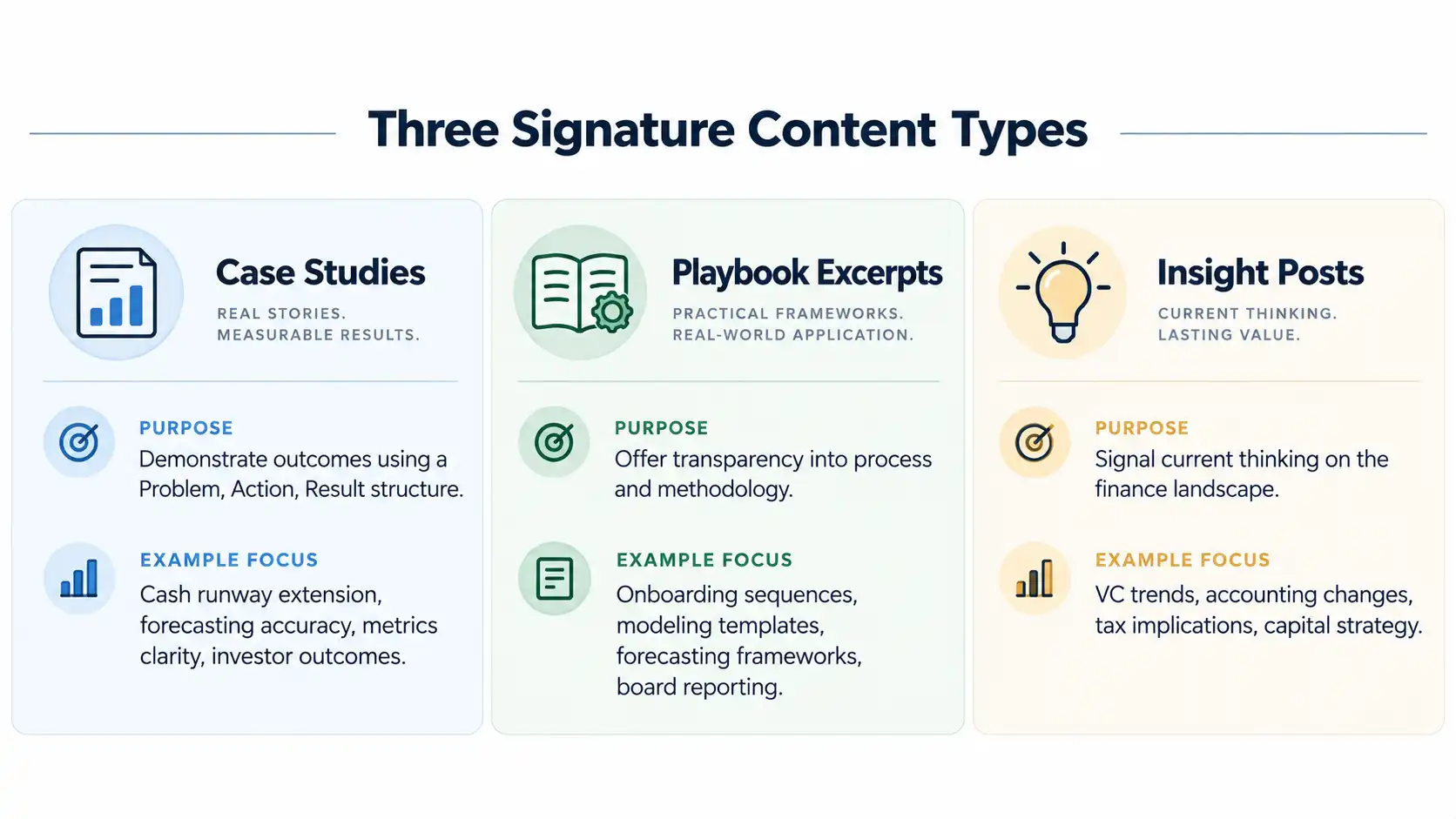
Content built around fractional CFO services tends to fall into three durable categories, each serving a different stage of trust-building.
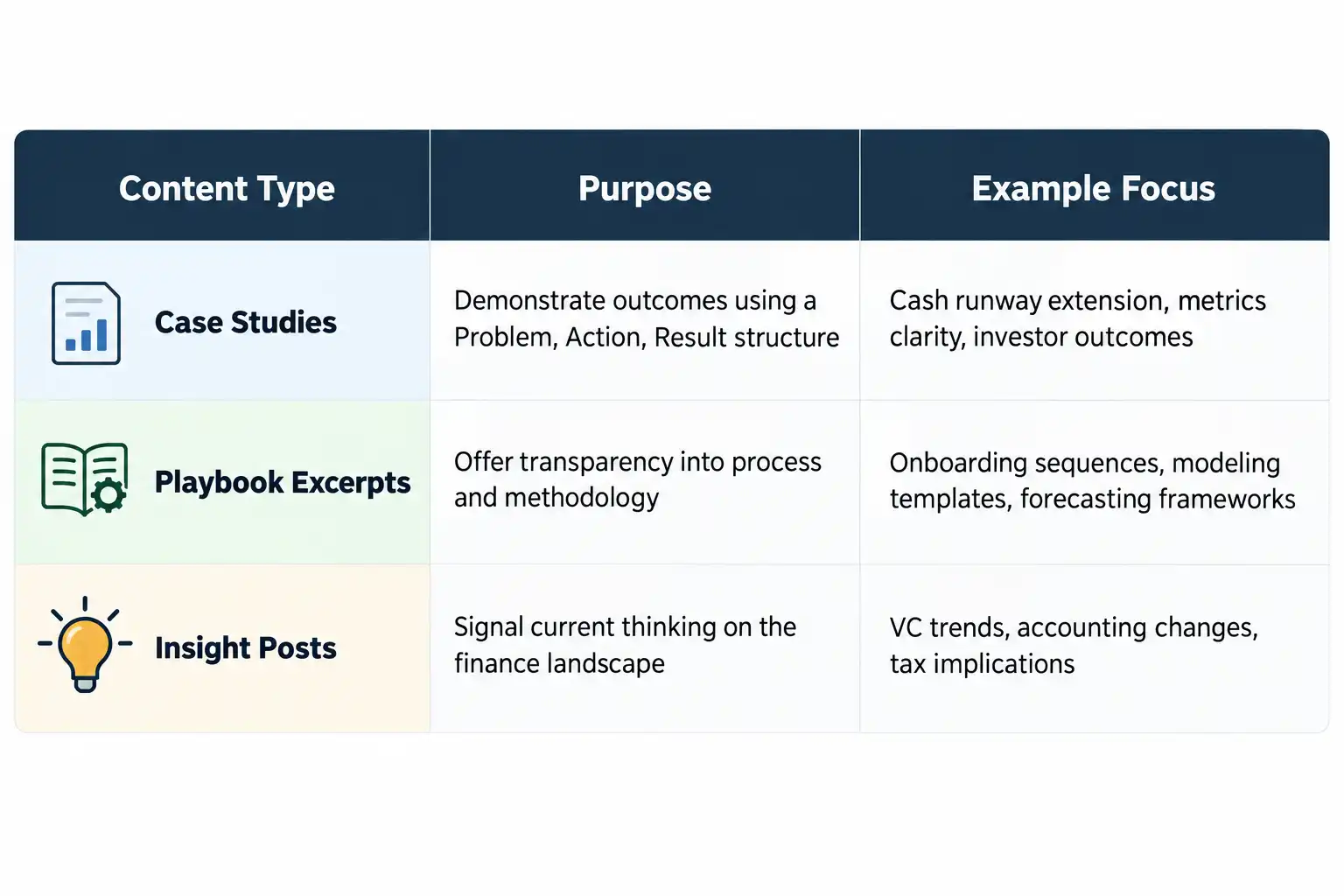
A cybersecurity and identity access management company generating approximately $30M in annual recurring revenue offers a useful illustration of the case study format in practice. The finance function there built a driver-based forecasting engine and capacity model from scratch. Actuals held within five percent of forecast for eight consecutive quarters, a result that reads well as a case study precisely because it is specific, measurable, and free of company-identifying detail. Publishing the shape of that story, without naming the business, does more to build inbound interest than a generic claim of forecasting expertise ever could.
Consistency matters more than volume. One piece per week, rotated across the three categories, tends to outperform a burst of content followed by silence, because prospects follow credibility over time rather than reacting to a single post.
Referrals and Network Activation
Past clients and investors remain the most reliable advocates for fractional CFO services, and the systems around referrals deserve as much design attention as the content calendar. A quarterly update email sent to a curated list of prior clients and friendly investors, summarizing anonymized wins and offering diagnostic calls, keeps a fractional CFO present in conversations that would otherwise happen entirely out of reach. During a $37M capital raise at a mission-driven education institution, board relationships and investor narrative work extended well past the transaction itself, and those relationships continued generating introductions long after the raise closed, which is the pattern a well-designed referral system is built to reproduce.
Useful frameworks shared freely also travel further than most fractional CFOs expect. A maturity model, a metrics scorecard, or a thirteen-week cash forecast template, offered without a paywall, tends to circulate among founders and advisors in a way that gated content never does, and each circulation carries the fractional CFO’s name along with it.
Warm Outreach as the Alternative to Cold Calls
Cold outreach performs poorly for high-trust services, largely because trust cannot be manufactured in a single unsolicited message. Warm calls, initiated through shared connections, event conversations, or reactions to published content, convert at a meaningfully higher rate, and the mechanics behind them are straightforward:
- Track engagement on published posts and follow up individually with commenters
- Speak at niche webinars, founder summits, or industry-specific panels
- Offer brief diagnostic sessions to portfolio companies of investors already in the network
A venture-backed digital marketing organization that scaled from $9M to $180M in revenue over twenty-four months, while raising $36.5M across three funding rounds, built its advisory relationships almost entirely through this warm-call pattern rather than outbound prospecting. The finance leadership there grew from a single person to twelve, and much of that growth traced back to introductions made by investors who had first encountered the work through shared content rather than a sales pitch.
Building an Asset Library
Marketing built around fractional CFO services improves in proportion to the depth of the underlying asset library: templates for forecasting, board decks, and cash flows; frameworks such as maturity models and metrics scorecards; and supporting documents like pricing sheets, onboarding plans, and sample scopes. These assets reduce friction at every stage of the sales process, because a prospect who has already seen a sample board reporting pack or a growth-stage pricing model arrives at the first conversation with fewer open questions and considerably more confidence.
At a $127M global consumer products company operating across direct-to-consumer, Amazon, and wholesale channels, inventory turns more than doubled from three times to seven times through a combination of demand planning and SKU rationalization, a result concrete enough to anchor an entire case study asset on its own. The specificity of that kind of result, presented without naming the business, tends to land with prospects in a way that a general claim of operational expertise cannot match, because it demonstrates rather than asserts.
Three Key Takeaways
- Credibility marketing for fractional CFO services works because it reverses the usual sales sequence: the prospect learns something valuable, builds confidence in the underlying expertise, and only then considers the conversation about an engagement, rather than being asked to trust a claim before seeing any evidence behind it.
- A referral system built on quarterly updates and freely shared frameworks compounds over time in a way that one-off outreach cannot, because each interaction adds to a body of work that continues generating introductions long after the original content was published.
- An asset library of templates, frameworks, and anonymized case studies shortens the sales cycle for fractional CFO services by answering the prospect’s unspoken question, “does this person actually have a process,” before it is ever asked aloud.
Disclaimer: This article is intended for informational purposes only and does not constitute legal, tax, or accounting advice. You should consult your own tax advisor or counsel for advice tailored to your specific situation.
Hindol Datta is a four-time CFO and senior finance executive with over 25 years of leadership experience across cybersecurity, SaaS, gaming, logistics, digital marketing, medical devices, consumer products, and nonprofit organizations. He has led more than $120M in fundraising and over $150M in M&A transactions while building the financial and operational systems that let complex businesses scale with confidence. He is the author of seven books in the Systems CFO Series and holds active CPA, CMA, and CIA credentials.
AI-assisted insights, supplemented by 25 years of finance leadership experience.