
Executive Summary
Vendors often sell FP&A automation as a technology project, complete with cloud platforms, dashboards, and data lakes. Yet the real shift is in how a company understands itself. When planning moves from backward-looking reports to forward-looking insight, finance becomes the place where the business rehearses its decisions before making them.
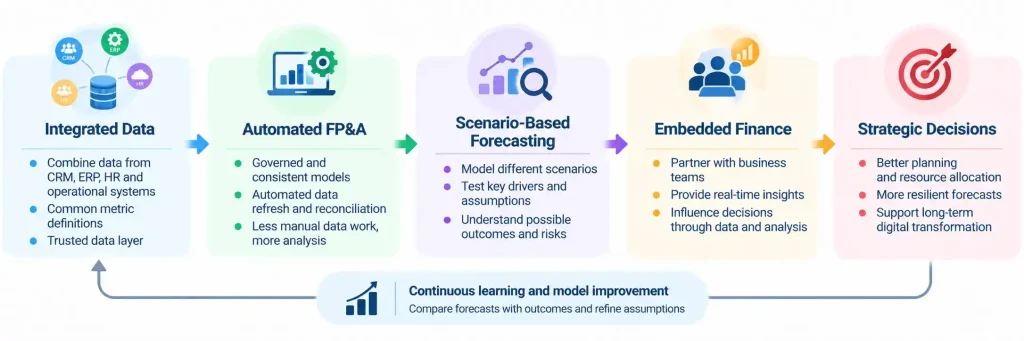
The sections ahead explain how CFOs can use FP&A automation and connected planning to drive digital transformation. They cover the shift in FP&A’s purpose, the data architecture that makes automation useful, and the move to scenario-based and probabilistic models. They also address how embedded finance changes behavior and how the CFO orchestrates the planning rhythm. Together they show transformation as a change in capability, not only in tools.
From Historians to Cartographers
Many finance teams describe FP&A in narrow terms: building forecasts, preparing budgets, and analyzing variances. That description reflects a function focused on recording the past. In volatile markets, a function that projects the past forward can miss what is happening now.
A New Purpose for FP&A
Modern FP&A must interpret as well as report. Instead of reflecting financial results shaped elsewhere, it maps uncertainty and makes hidden forces visible. That requires moving beyond fixed annual budgets toward models that adjust as conditions change.
Probabilistic thinking sits at the center of this shift. A strong analyst might note that unit economics look stable only if churn stays within its historical band. The same analyst would add that a 12% rise in acquisition costs in one segment could break the margin structure. That kind of conditional statement reflects readiness, not false precision.
FP&A also becomes a place where functions reconcile competing assumptions. Moving the debate from the number itself to the assumptions behind it changes the tone of financial discussion. Over time, the business comes to see finance as a partner in managing risk instead of a source of constraints.
The Architecture Behind FP&A Automation
Dashboards attract attention, but they are only as good as the data behind them. Forecasting, modeling, and scenario testing depend on consistent, timely, and well-governed data. Successful FP&A automation therefore starts with foundations, not visuals.
Data Integration, Governance, and Feedback
In many legacy environments, revenue appears one way in the CRM and another in the ERP. Headcount sits in the HR system while related costs hide in general ledger codes. The company effectively lives in several versions of itself, and none reconciles easily.
Consider a company where the word “customer” carries five definitions, from any billable account to any freemium user. Finance may forecast on one definition while sales celebrates wins on another. The first step of transformation in such a case is agreeing on language, not buying software.
Connected planning rests on several architectural pillars that work together:
- Data integration that joins CRM, ERP, HR, and operational systems into one trusted layer
- Common metric definitions applied across functions and time periods
- Model governance with documentation, version control, and clear parameters
- Automation that removes manual data wrangling and refreshes inputs on a set cadence
- Feedback loops that compare forecasts with outcomes and explain the gaps
Legacy Planning Versus Connected Planning
| Dimension | Legacy Planning | Connected Planning |
| Data sources | Separate systems with conflicting figures | Integrated layer with shared definitions |
| Models | Spreadsheets owned by individuals | Governed, versioned, and documented models |
| Cadence | Annual budget and quarterly forecast | Rolling forecasts with frequent updates |
| Analyst time | Mostly spent gathering and reconciling data | Mostly spent on analysis and judgment |
| Learning | Variances explained after the fact | Forecast accuracy reviewed and models refined |
FP&A automation also carries its own risk for decision makers. A dashboard that refreshes hourly on stale assumptions offers speed without validity. Governance must therefore define how teams source, validate, and update data, and how they flag uncertainty.
A cybersecurity and identity SaaS company with entities in five countries shows the value of a sound foundation. Implementing NetSuite across five entities shortened the monthly close from 18 days to 10. A driver-based forecasting engine and capacity model then kept actuals within plus or minus five percent of forecast for 8 consecutive quarters.
Scenario Thinking and Probabilistic Forecasting
Traditional forecasting extends the prior year with known growth rates and adjustments. That approach works when conditions stay stable, but it struggles with sudden shifts. Digital FP&A seeks a resilient forecast instead of a perfect one.
Models That Support Decisions
Every scenario should describe a coherent picture of the world, not just a different growth rate. A weak scenario simply asks what happens if revenue grows 5% instead of 3%. A strong one asks how contribution margin responds if currency headwinds persist and demand softens. Parameterized models let teams test such cases quickly by adjusting linked drivers.
Probabilistic forecasting adds another layer of insight for leaders. Teams work with ranges and likelihoods, such as the chance of breaching a covenant in a given quarter under a specific scenario. This approach also supports optionality planning for capital decisions. For example, a model might show that delaying a capital commitment by one quarter costs $2M in acceleration but protects $20M in downside.
Simple models often prove the most useful in practice. Imagine a model built on three inputs: churn, lead conversion lag, and implementation time. If those drivers explain most of the business, leaders can use the model to time investments, sequence hiring, and negotiate vendor terms. Machines can run regressions and flag outliers, but people still interpret context and shape the narrative.
A Euronext Paris-listed gaming company with subsidiaries in five countries shows why shared foundations matter for modeling. A firmwide rollout of Oracle Financials and MicroStrategy created a single definition of revenue across every subsidiary. Consistent inputs made cross-border scenarios comparable instead of contradictory.
Embedded Finance and Behavioral Change
The clearest sign of transformation appears in conversation. A product leader asks finance how an early launch would affect working capital, or a sales leader asks whether acceleration would hurt burn. At that point, FP&A has moved from supplying information to shaping decisions.
Building Trust Through Rhythm
Embedded finance means each major function has a finance partner who understands its language and constraints. Forecasts are co-developed with line leaders instead of handed down. Picture an FP&A team that produces accurate forecasts no one uses because it sits apart from the business. When analysts begin attending weekly operating reviews as listeners, demand for finance in the room can grow.
Trust between finance and the business depends on three conditions. Finance must arrive prepared with context, not just numbers. It must show humility by inviting others to find where the model breaks. It must also tell clear stories that connect past signals to current risks.
Connected Planning Cadence
| Rhythm | Frequency | Purpose |
| Flash forecast | Weekly | Captures early signals from sales, operations, and cash |
| Rolling forecast update | Monthly | Refreshes assumptions and extends the planning horizon |
| Scenario review | Quarterly | Tests strategic options against changing conditions |
| Forecast accuracy review | Quarterly | Compares predictions with outcomes and improves models |
A professional services firm with five business units illustrates the value of embedded insight. Finance built engagement-level profitability and utilization analytics from scratch. That work showed leaders where the business created margin and where it leaked, giving them a shared basis for decisions.
The CFO as Orchestrator of Connected Planning
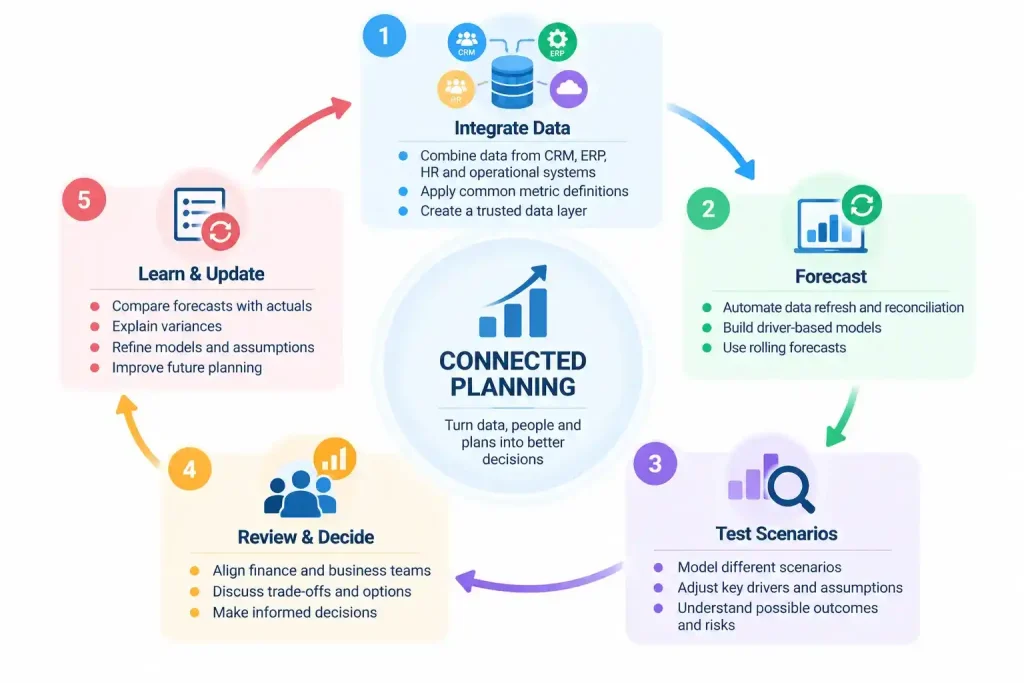
Systems and models are useless if they do not inform action. The CFO holds the pieces together by deciding what the company tracks, how often it reviews it, and why it matters. Connected planning succeeds when the CFO designs the rhythm of attention.
Designing the Planning Rhythm
Many companies still run on annual budgets, quarterly reports, and monthly variance reviews. Those cycles made sense when markets moved slowly. Today, rolling forecasts, real-time flash updates, and continuous scenario testing better match the pace of change.
Orchestration is also a social act, not only a technical one. Picture a strategy offsite where each business unit brings a growth plan that seems reasonable alone but impossible in aggregate. A CFO can lay out each plan’s assumptions and show where they overlap or conflict. Building the model with the group can then turn competing ambitions into an executable strategy.
A pre-Series A AI governance and assurance platform shows how early this mindset can take hold. Finance built an AI-first finance workflow alongside the operating model, scenario analyses, and capital strategy. Designing automation into finance from the start made connected planning part of how the company operated.
FP&A automation, used well, frees analysts from data wrangling so they can focus on judgment. Connected planning then turns that judgment into a shared language across the company. Together, they make finance the intelligence core of digital transformation.
Three Key Takeaways
- FP&A automation creates value only when it rests on integrated data, shared metric definitions, and governed models with feedback loops.
- Connected planning replaces static annual budgets with rolling forecasts, scenario reviews, and probabilistic models that support faster decisions.
- Embedded finance partners and a CFO who orchestrates planning rhythms turn automation into lasting behavioral change.
Disclaimer: This article is intended for informational purposes only and does not constitute legal, tax, or accounting advice. You should consult your own tax advisor or counsel for advice tailored to your specific situation.
Hindol Datta is a four-time CFO and senior finance executive with over 25 years of leadership experience across cybersecurity, SaaS, gaming, logistics, digital marketing, medical devices, consumer products, and nonprofit organizations. He has led more than $120M in fundraising and over $150M in M&A transactions while building the financial and operational systems that let complex businesses scale with confidence. He is the author of seven books in the Systems CFO Series and holds active CPA, CMA, and CIA credentials.
AI-assisted insights, supplemented by 25 years of finance leadership experience.



