
Executive Summary
Treasury desks at multinational conglomerates used to own foreign exchange risk. That boundary has quietly dissolved. A startup can carry forex risk without anyone in finance naming it. A remote engineering team sits in Eastern Europe. The company bills customers in euros. The bank account holds dollars. The exposure is already there. Left unmanaged, foreign exchange risk does not announce itself. It shows up as an unexplained dip in revenue. A margin will not reconcile. A board member asks a question nobody can answer with confidence.
Currency exposure inside a growing company follows a predictable pattern. Once the instruments are understood, forex risk changes shape. It stops being a source of quarterly anxiety. It becomes a source of strategic control. The goal is not to eliminate currency risk. It is to understand it well enough to choose, deliberately, which parts of it are worth carrying.
Why Foreign Exchange Risk Demands Attention Earlier Than Most CFOs Assume
Exchange rates move on interest rate differentials, geopolitical shocks, inflation surprises, and capital flows. None of those forces care how early-stage a company happens to be. When the dollar strengthened by roughly 17 percent against the euro, pound, and yen in 2022, finance teams felt it. The effect landed directly on the numbers. The effect was not abstract. Companies billing in foreign currency watched revenue compress. The customer relationship had not changed. The pricing had not changed. The product usage had not changed. That is the essence of foreign exchange risk. The business performs as planned. The numbers tell a different story anyway.
A high-growth cybersecurity and identity access management company running payroll and delivery teams across the United States, Canada, Mexico, India, and Nepal makes the point concretely. With more than 230 employees spread across five currencies and a customer base billed predominantly in dollars, the exposure was never a single dramatic event. It was a steady accumulation of small mismatches between where revenue landed and where costs were incurred, the kind of exposure that is easy to under-price until a single volatile quarter turns it into a board-level conversation.
The mistake many finance leaders make is assuming that exposure below 10 or 15 percent of revenue does not warrant a formal response. That assumption ignores correlation risk. When currency moves against a company during a quarter when revenue is already under pressure from other causes, the two effects compound rather than offset, and even a modest exposure can breach a covenant or distort a growth metric that investors are watching closely.
The Three Faces of Currency Exposure
Foreign exchange risk is not one thing. It shows up in three distinct forms, and each demands a different response from the finance function.
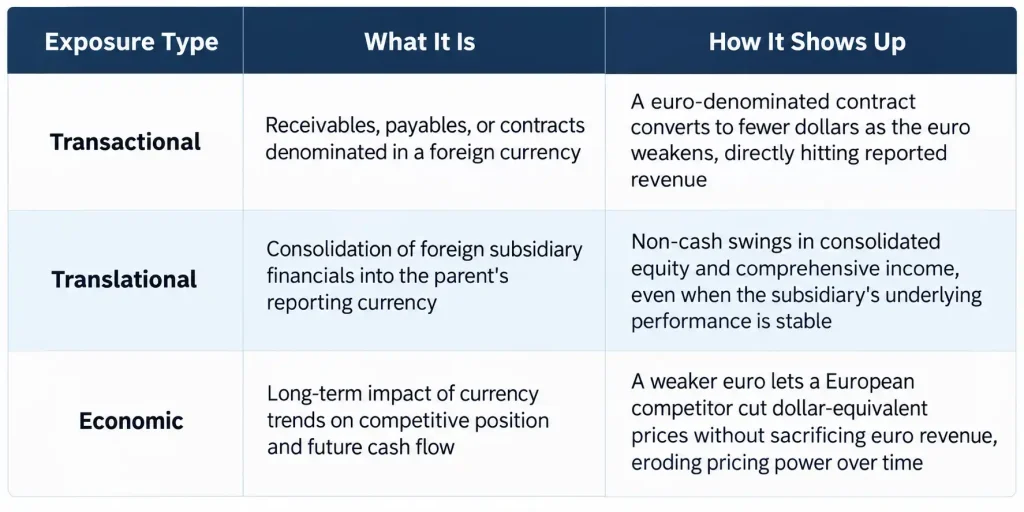
Translational exposure is the one most often underestimated because it does not touch cash directly. A global medical device manufacturer with manufacturing plants in Copenhagen, Cork, and Taiwan, reporting in dollars against a European headquarters currency, illustrates why that underestimation is dangerous. Standard costing and bill-of-materials management across three currencies meant that translation adjustments could move consolidated numbers by amounts large enough to draw audit committee questions, even in quarters where every plant hit its operating targets. Economic exposure, meanwhile, is the hardest to see and the easiest to ignore, since it never appears as a single line item. It erodes competitiveness gradually, through pricing pressure that a quarterly P&L will not isolate until the damage has compounded for several cycles.
Matching the Hedge to the Exposure
No single instrument solves foreign exchange risk. The right choice depends on whether the underlying cash flow is committed or forecasted, whether upside participation matters, and how long the exposure will last.
Forward contracts lock in a fixed exchange rate for a future transaction at no upfront cost. A company expecting a predictable flow of euro revenue can sell those euros forward and remove the guesswork entirely, at the cost of forfeiting any benefit if the currency moves in its favor. The risk with forwards is overhedging: if the underlying revenue does not materialize as forecast, the company is left holding a currency obligation with no matching receivable.
Currency options cost a premium, typically 0.5 percent to 3 percent of notional value, but they preserve upside. A company can buy the right to sell euros at a set rate while still benefiting if the euro strengthens beyond that level, which makes options well suited to usage-based or variable revenue models where the forecast itself carries meaningful uncertainty.
Swaps address longer-dated exposure tied to debt structures. A Euronext Paris-listed gaming and digital entertainment company operating across the United States, France, the United Kingdom, Singapore, and South Korea relied on this kind of instrument repeatedly during cross-border M&A activity exceeding $100M, where currency mismatches between deal financing and target cash flows needed resolution before closing instead of after the fact.
Natural hedging requires no derivatives at all. A $127M global consumer products company sourcing through supply chains in China and Vietnam reduced its transactional exposure simply by aligning procurement currency with revenue currency wherever the supplier relationship allowed it, trading a modest amount of margin flexibility for a smaller derivatives book.
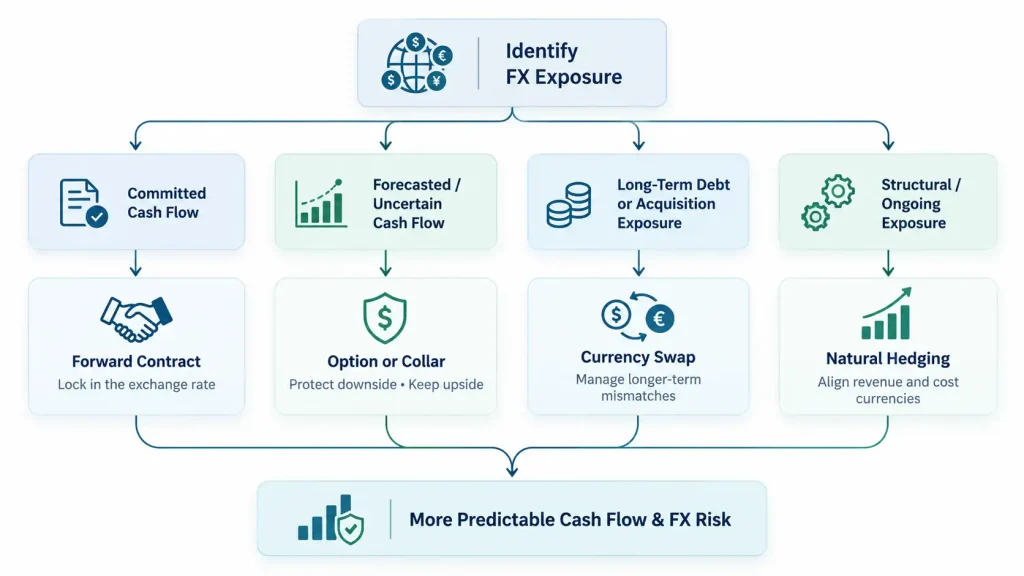
A simple decision framework helps CFOs choose among these:
- Committed cash flow, no need for upside: use a forward contract.
- Forecasted or uncertain cash flow, upside desired: use an option or a collar.
- Long-term exposure tied to debt or an acquisition: use a swap.
- Structural, ongoing exposure: pursue natural hedging alongside financial instruments, not instead of them.
Building a Foreign Exchange Risk Policy the Board Will Trust
Instruments alone do not manage forex risk. Without a governing policy, hedging drifts into ad hoc decisions made under pressure, which is its own form of risk. A formal FX policy, reviewed by the board’s audit or risk committee at least annually, should define five things:
- The objective of hedging: protecting cash flow, reducing earnings volatility, or improving forecast reliability.
- The scope of exposure covered: which currencies, which flows, and whether economic exposure is included.
- The permitted instruments and the approval thresholds for each.
- The target hedge ratio and time horizon by currency or business line.
- The reporting cadence and the individuals accountable for execution and reconciliation.
Segregation of duties matters here more than most finance leaders initially appreciate. No individual should be able to initiate, approve, and reconcile the same trade. That principle held equally true leading a finance and audit committee relationship at a mission-driven education institution that raised $37M in equity and venture debt and at a public company preparing for IPO, where the composition of the risk committee mattered as much as the instruments it authorized. Hedge accounting under ASC 815 raises the stakes further: without contemporaneous documentation of the hedge relationship at inception, fair value swings hit the income statement directly, introducing the earnings volatility the hedge was meant to prevent.
From Risk Mitigation to Strategic Advantage
Framing foreign exchange risk purely as something to avoid understates what a disciplined program actually enables. A company that can fix its Mexican peso cost base for twelve months before opening a Mexico City office is not just managing forex risk; it is converting an uncertain expansion decision into a calculable one. A company that can offer local-currency pricing to a customer in Argentina or Turkey while protecting its own dollar-denominated margin gains a competitive edge that pure dollar pricing cannot match.
Institutional investors read this discipline as a signal. A company earning 40 percent of revenue outside the United States with no articulated FX policy presents a risk-adjusted return profile that a diligence team will discount. The same company with a documented policy, clear hedge ratios, and a track record of effectiveness testing presents as one that understands its own business well enough to plan around it, which is precisely the signal boards and investors are looking for heading into a raise, an acquisition, or an IPO process.
Three Key Takeaways
- Foreign exchange risk is present the moment a company touches more than one currency, regardless of stage, and the exposure hides in plain sight until a volatile quarter forces the question onto the board agenda.
- The right hedging instrument depends on whether the underlying cash flow is committed or forecasted, and matching forwards, options, swaps, and natural hedging to the correct exposure matters more than choosing the most sophisticated tool available.
- A documented FX policy with clear governance and segregation of duties does more than reduce earnings volatility; it signals operational maturity to investors and turns currency management into a source of strategic optionality rather than a defensive afterthought.
Disclaimer: This article is intended for informational purposes only and does not constitute legal, tax, or accounting advice. You should consult your own tax advisor or counsel for advice tailored to your specific situation.
Hindol Datta is a four-time CFO and senior finance executive with over 25 years of leadership experience across cybersecurity, SaaS, gaming, logistics, digital marketing, medical devices, consumer products, and nonprofit organizations. He has led more than $120M in fundraising and over $150M in M&A transactions while building the financial and operational systems that let complex businesses scale with confidence. He is the author of seven books in the Systems CFO Series and holds active CPA, CMA, and CIA credentials.
AI-assisted insights, supplemented by 25 years of finance leadership experience.