
Executive Summary
Financial data quality management decides whether a forecast earns belief or invites doubt. Once a board member asks where a number came from, trust in the whole model starts to wobble. The logic may be sound, but questionable inputs undermine every scenario, projection, and decision built on top of them.
The sections ahead explain how CFOs can strengthen financial data management for forecasting. They cover what data quality means in practice, the forces that quietly erode it, and the governance structures that protect it. They also address the culture and daily habits that sustain quality and the CFO’s role in making it a strategic asset. Together they show data quality as a discipline of credibility, not a cleanup project.
What Financial Data Quality Management Means in Practice
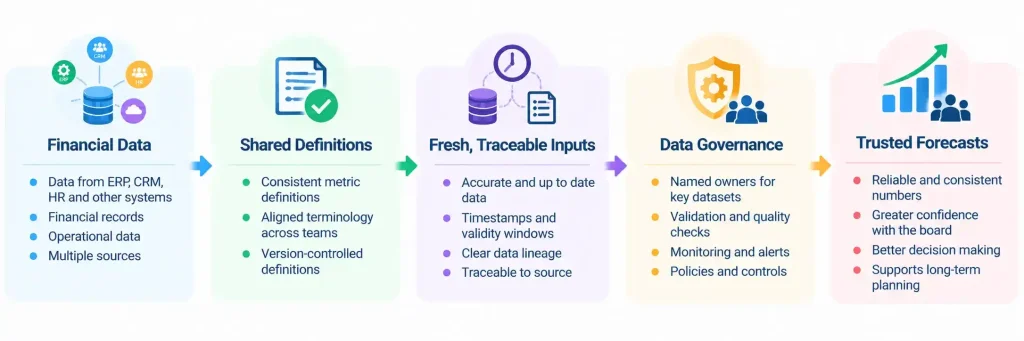
High-quality financial data is data fit for decision making. Accuracy alone is not enough, because a number can be mathematically correct and still mislead if it is stale, misclassified, or misunderstood. A revenue figure that excludes a product line or includes unrecognized deferred contracts may be precise but operationally wrong.
Meaning, Timing, and Lineage
Strong financial data quality management rests on three foundations:
- Semantic alignment, so every team defines terms such as booked revenue, committed deals, and recognized headcount cost the same way
- Temporal awareness, so users know whether each input reflects yesterday, last week, or last month
- Clear lineage, so users can trace every number to its source, its transformations, and the people who touched it
Consider a SaaS company whose revenue line looks oddly resilient despite churn pressure elsewhere. The data feed is live and reconciles, yet a CRM change has begun recording freemium upgrades as ARR before customers sign contracts. The forecast is not wrong in arithmetic; it is wrong in meaning. Rebuilding trust with the team and the board can take weeks.
A Euronext Paris-listed gaming company with subsidiaries in five countries shows the value of semantic alignment. A firmwide rollout of Oracle Financials and MicroStrategy created a single, unified definition of revenue across every subsidiary. That shared definition gave leaders consistent numbers to forecast against.
How Financial Data Quality Erodes
No financial dataset stays clean on its own for long. Quality decays quietly through small changes that teams tolerate and rationalize. Over time, the model stops reflecting the business and starts reflecting workarounds.
Five Sources of Degradation
Most data quality problems in forecasting trace back to a handful of recurring causes.
Data Degradation Vectors and Defenses
| Degradation Vector | How It Appears | Defense |
| Structural drift | A source system changes fields or hierarchies while downstream models still use the old structure | Lineage tracking and impact reviews before system changes |
| Ownership ambiguity | No single person owns a dataset end to end | A named owner for every forecasting-critical dataset |
| Semantic ambiguity | Teams or regions define the same term differently | Documented, version-controlled definitions |
| Temporal decay | Old inputs are treated as current | Freshness tags and validity windows on key metrics |
| Behavioral erosion | Teams hard-code overrides instead of fixing sources | A culture that treats anomalies as questions to investigate |
Structural drift is especially dangerous because it rarely breaks a model outright. If an ERP consolidates 30 cost centers into 18 and a model still references the old codes, it keeps running but misallocates overhead. Months may pass before someone asks why one region’s margin looks implausibly stable.
Defending against degradation starts with accepting that drift will happen. Monitoring should check consistency as well as availability. For example, it can alert owners when revenue in the general ledger and the CRM diverge beyond a set threshold. Every metric should also carry a timestamp and a validity window, so stale assumptions trigger warnings.
A cybersecurity and identity SaaS company with entities in the United States, Canada, Mexico, India, and Nepal shows the payoff of strong foundations. Implementing NetSuite across five entities shortened the monthly close from 18 days to 10. A driver-based forecasting engine and capacity model then kept actuals within plus or minus five percent of forecast for 8 consecutive quarters.
Governance for Financial Data Management
Governance in this context is not a binder of policies. It is the set of roles, definitions, and routines that keep meaning stable as the business changes. Every data point reflects decisions about what to collect, when to extract it, and how to classify it.
Structures That Sustain Quality
Effective financial data management relies on a few core governance components.
Core Components of Data Governance in Finance
| Component | What It Does | Who Typically Owns It |
| Data dictionary | Defines each metric, including inclusions, exclusions, and currency treatment | FP&A with input from each function |
| Data owners | Certify timeliness, consistency, and lineage for specific datasets | A named individual for each dataset |
| Data council | Resolves conflicts between sources and evolves definitions | Cross-functional group from FP&A, IT, and operations |
| Change management | Previews and assesses source system changes before they go live | IT and finance jointly |
| Usage feedback loop | Lets downstream users report anomalies and suggest fixes | Forecast users and data owners |
A data dictionary is a living document, not a static list. A definition of customer ARR might exclude usage-based components or convert multi-currency contracts at a fixed rate. Debated across functions and version-controlled, such definitions let teams compare models and align decisions.
Change management deserves special attention from finance leaders. A schema change in the CRM or ERP may look like a technical update to IT. For forecasting teams, however, it can change how the business sees itself. Imagine a manufacturer whose planned and actual material costs keep diverging. The cause might be procurement switching supplier pricing from quarterly uploads to real-time feeds without telling finance. A simple rule requiring procurement to flag methodology changes can resolve the gap.
A $170M medical device manufacturer with operations in Copenhagen, Cork, and Taiwan illustrates why cost data needs this discipline. Work as operations controller there involved standard costing and bill-of-materials management across multiple sites. Consistent cost structures across locations made product-level economics comparable.
Governance done well speeds finance and operating teams up. It reduces rework, cuts exception handling, and ends arguments about what a number means.
Culture and the Daily Practice of Data Quality
Behind every clean dataset sits a network of habits and incentives. Analysts work under constant time pressure, which tempts them to accept stale data or override a calculation that looks off. Each shortcut seems reasonable, yet together they compound risk.
Habits That Protect Integrity
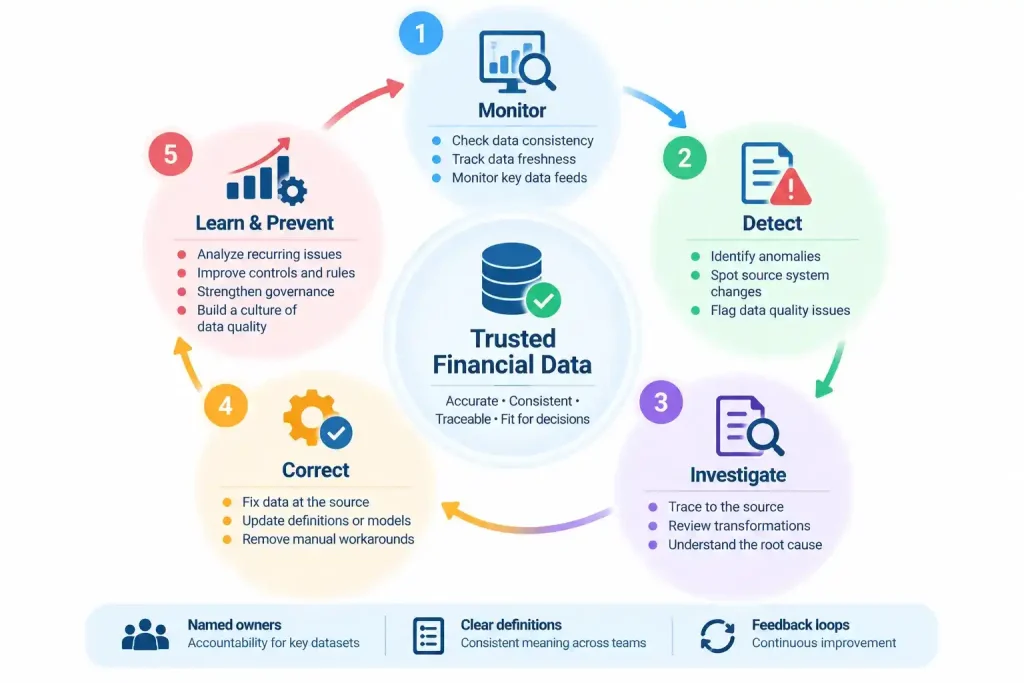
A culture of data quality rewards rigor as well as speed. Teams should feel safe surfacing anomalies instead of hiding them, and leaders should welcome questions about data integrity instead of reacting defensively. When the CFO treats data quality as a shared responsibility and celebrates corrections, the right behaviors spread.
Data literacy matters as much as tool skills. Analysts need to understand definitions, recognize anomalies, and follow lineage. Regular reconciliation sessions and cross-functional reviews then become forums for learning instead of blame.
Transparency completes the picture for everyone who uses the forecast. Strong forecasts arrive with notes on stale inputs, known limitations, and unusual trends. This honesty builds trust, because users know finance represents the data accurately even when it is imperfect.
A marketplace SaaS company with operations in the United States and Poland shows how reliable data supports external credibility. Consolidated cross-border reporting and cohort and unit economics models anchored investor diligence during a $20M Series B. Investors could rely on the numbers because the reporting framework held up under scrutiny.
The CFO’s Role in Financial Data Quality Management
In the end, data quality is a leadership responsibility. The CFO sits where strategy, operations, and finance meet. That position makes the role well suited to elevate data quality from a back-office concern to a strategic asset. Without trusted data, plans weaken and capital goes to the wrong places.
Stewardship at Scale
The CFO’s agenda for data quality typically spans vision, structure, alignment, capability, and communication. Leaders must explain why quality matters to the whole enterprise and sponsor clear ownership, active data councils, and visible monitoring. They must also align definitions across sales, marketing, operations, and technology, and invest in training that builds data literacy.
Communication with the board matters most of all. Forecasts should come with clear statements of assumptions, limitations, and uncertainties. That openness lets a CFO present a forecast and also explain why the company believes it.
Financial data quality management, practiced this way, becomes a multiplier of insight. It protects against false precision and gives leaders the confidence to act decisively.
Three Key Takeaways
- Financial data quality management depends on shared definitions, clear timing, and traceable lineage, not accuracy alone.
- Data degrades through structural drift, unclear ownership, semantic confusion, stale inputs, and tolerated workarounds, so monitoring and named owners are essential.
- Strong financial data management combines governance structures, a culture of transparency, and CFO leadership that treats data quality as a strategic asset.
Disclaimer: This article is intended for informational purposes only and does not constitute legal, tax, or accounting advice. You should consult your own tax advisor or counsel for advice tailored to your specific situation.
Hindol Datta is a four-time CFO and senior finance executive with over 25 years of leadership experience across cybersecurity, SaaS, gaming, logistics, digital marketing, medical devices, consumer products, and nonprofit organizations. He has led more than $120M in fundraising and over $150M in M&A transactions while building the financial and operational systems that let complex businesses scale with confidence. He is the author of seven books in the Systems CFO Series and holds active CPA, CMA, and CIA credentials.
AI-assisted insights, supplemented by 25 years of finance leadership experience.



