
Executive Summary
Financial consolidation often starts as a single ledger and quietly turns into a constellation. New entities appear. Currencies multiply. One tab tracks accruals while another still runs on cash basis. In a hypergrowth company, this is not a quarterly inconvenience. It becomes an existential test of whether finance can still tell one coherent story.
This article sets out how a financial consolidation process should evolve as a company scales. It covers why consolidation breaks down under growth. It covers how to design a process built for the next threshold, rather than the current one. It also covers how to accelerate the close without losing governance. And it covers how to turn consolidation into a genuine source of strategic insight.
Why Financial Consolidation Breaks Down at Scale
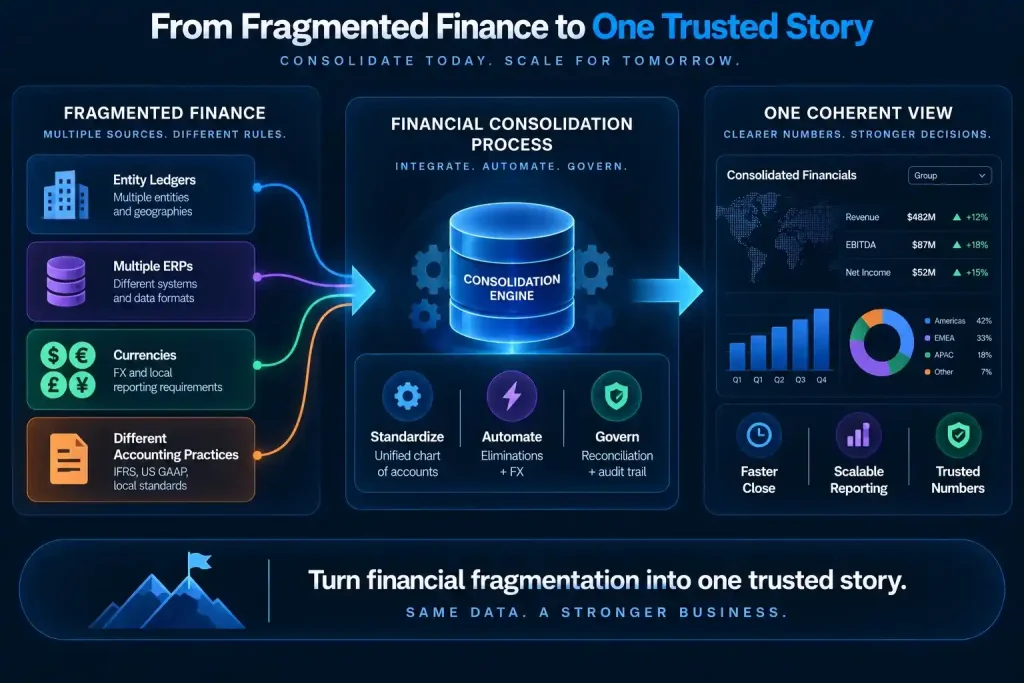
A typical month-end close in a fast-growing company hides real complexity. Intercompany transactions cross multiple tax regimes. Several ERP systems, often acquired piecemeal, each hold their own chart of accounts. Currency revaluation and deferred revenue recognition each add another layer of interpretation. Meanwhile the board still expects clarity, and investors still expect speed.
Fragmentation, not laziness, causes most of the delay. Accruals get handled differently in one office than another. A shared service center may follow templates the domestic controller has never seen. The fix is standardization. It means a common chart of accounts and a shared close checklist. It also means a cadence of reconciliation that starts before the month ends.
Building a Financial Consolidation Process That Scales With Growth
Scalability works better as a mindset than as a feature. What holds together at ten entities can fracture at fifty. A financial consolidation process built as a set of swappable modules survives that transition. A single rigid system rarely does.
A modular process assumes new entities, business lines, and geographies will keep arriving on no fixed schedule. It plans for that variety instead of resisting it.
- Standardized data ingestion, so a new entity can plug into the process without a full rebuild
- Entity-level ledgers that feed a single, unified chart of accounts
- Rules engines that manage intercompany eliminations through logic, not manual reconciliation
Case: Designing for the Next Threshold, Not the Current One
A Euronext Paris-listed gaming and digital entertainment company, operating across five countries, rebuilt its financial consolidation process around exactly this principle. It rolled out one consolidated finance system built on a single, unified revenue and cost definition across every entity. That structure compressed statutory reporting cycles under both IFRS and US GAAP ahead of an IPO-readiness process. It kept holding up through more than $100M in cross-border acquisitions that followed. The process had been built for a future the company had not yet reached. That is why it did not buckle once that future arrived.
Accelerating the Close Without Losing Governance
Hypergrowth companies cannot tolerate a slow close, but speed without governance just trades one risk for another. The real goal is speed with integrity, not speed instead of it.
A rolling close helps more than a rushed one. Reconciliation happens continuously through the month, rather than piling up in a frantic final week. Automation supports this shift, but only for the right tasks. Account reconciliations, intercompany eliminations, and FX translation adjustments are domains of logic. A well-trained system removes fatigue-driven error there, rather than introducing new risk.
Governance still needs its own deliberate design.
- Every journal entry carries a clear rationale, not just a number
- Every adjustment links back to the assumption that produced it
- Every close checklist leaves behind a traceable audit trail
A high-growth cybersecurity and identity access management company built this discipline directly into its forecasting. Its driver-based forecasting engine paired a matching capacity model with a disciplined reporting cadence. Together, they held actuals within five percent of forecast for eight consecutive quarters. That accuracy did not come from working faster. It came from a process transparent enough that every number could be traced back to its source.
Turning the Financial Consolidation Process Into a Strategic Insight Engine
Consolidation has spent decades as backstage work: necessary, accurate when done well, and rarely strategic. In a hypergrowth company, that framing runs out of runway fast. A closed book has to feed forward into scenario analysis, not just tie out the past.
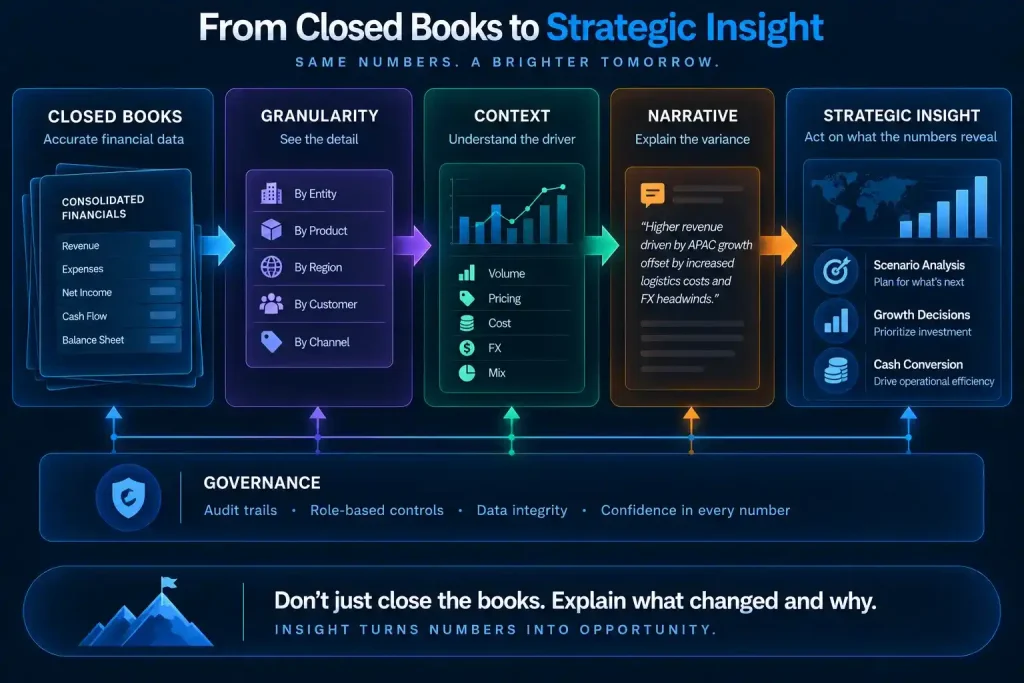
Four elements turn a compliance exercise into real insight.
- Granularity, so a consolidated ledger preserves line-item detail instead of aggregating it away
- Context, so a variance links to the assumption, forecast, or driver behind it
- Narrative, so the close ends with an explanation, not just a balanced set of entries
- Governance, so audit trails and role-based controls keep the resulting insight trustworthy
Case: Making Variance Explainable, Not Just Reportable
A $127M global consumer products company, with a supply chain spanning two continents, once buried its inventory carrying cost inside a generic cost-of-goods line. Once isolated and tracked by SKU and by channel, inventory turns moved from three times to seven times. It came from a consolidation process granular enough to make the underlying driver visible in the first place. That visibility changed how leadership thought about growth and cash conversion together.
Three Key Takeaways
- A financial consolidation process breaks down under fragmentation, not effort. Standardizing the chart of accounts and the close checklist fixes more than adding headcount or working longer hours.
- Scalability means designing for the next threshold, not the current one. A modular process, built around swappable components, absorbs new entities and geographies without requiring a full rebuild each time.
- Consolidation becomes a strategic asset only when it adds granularity, context, and narrative to the numbers. A process that only ties out the ledger stays backstage. One that explains the variance moves into the room where decisions get made.
Disclaimer: This article is intended for informational purposes only and does not constitute legal, tax, or accounting advice. You should consult your own tax advisor or counsel for advice tailored to your specific situation.
Hindol Datta is a four-time CFO and senior finance executive with over 25 years of leadership experience across cybersecurity, SaaS, gaming, logistics, digital marketing, medical devices, consumer products, and nonprofit organizations. He has led more than $120M in fundraising and over $150M in M&A transactions while building the financial and operational systems that let complex businesses scale with confidence. He is the author of seven books in the Systems CFO Series and holds active CPA, CMA, and CIA credentials.
AI-assisted insights, supplemented by 25 years of finance leadership experience.