Executive Summary
Financial consolidation automation has become one of the most consequential investments a finance organization can make, yet many leaders still treat it as a software project rather than a change in how the finance function operates. Across the organizations where finance leaders have built these systems, the real payoff is not faster spreadsheets. It is the return of time to judgment, analysis, and strategic conversation with the business.
This article traces that journey through four stages, beginning with the structural foundation that automation requires and moving through the trust and transparency needed for adoption. It then examines how freed capacity should be redeployed into new roles before closing with the governance that keeps the system healthy over time. Each section draws on practitioner experience across industries, so the argument rests on what actually happens in close cycles, board meetings, and audits.
Architecting the Foundation for Financial Consolidation Automation
All transformation begins with structure. It is tempting to treat financial consolidation software as an IT deployment, yet that framing mistakes the frame for the canvas. Automation succeeds only when the underlying architecture is sound, and that architecture starts with clarity about identity: what gets consolidated, why it matters, and who must trust the result. Until those questions have answers, even the best platform will only reproduce confusion at scale.
The CFO serves as the steward of that clarity. She does not need to understand every configuration setting, but she does understand the cost of ambiguity. Finance leaders have watched a close produce seventeen versions of the truth in the weeks after period end, heard operations challenge the numbers, and sat through board meetings that open with the phrase “it depends on how you look at it.” These are not technical failures. They are symptoms of foundational misalignment.
Defining Taxonomy Before Tooling
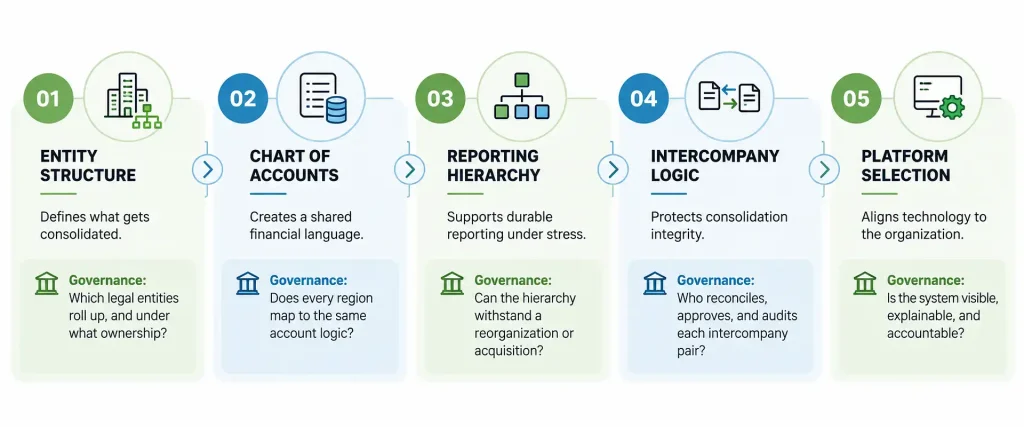
Building that foundation begins with taxonomy rather than tools. Legal entities require precise definitions. The chart of accounts must function as a shared language across regions rather than a set of suggestions. Reporting hierarchies need to hold up under stress, not just look elegant on a diagram. Intercompany transactions, the quiet saboteurs of consolidation integrity, must be mapped, reconciled, and placed under governance before any automation is attempted.
This work moves slowly and offers no immediate celebration. In a high-growth cybersecurity and identity access management company operating across 5 country entities, the finance team spent months aligning entity structures and intercompany logic before touching system configuration. That patience later showed up as a monthly close that shrank from 18 days to 10.
Choosing a Platform Aligned to the Organization
The choice of platform is a strategic decision, not a procurement exercise. The CFO should select the most aligned option rather than the most advanced one. The system must scale and adapt, serve audit, tax, operations, and forecasting, and remain visible, explainable, and accountable. Bridging the present and the possible matters more than any feature checklist.
Integration follows the same logic. When data flows cleanly across subsidiaries, when eliminations post without manual rework, and when variances are flagged by logic rather than by memory, a new standard takes hold. Speed of this kind is not speed for its own sake. It builds confidence and frees the people who once spent their evenings repairing numbers.
Building Trust in Automated Consolidation Processes
There is a strange discomfort that often follows early success. Numbers arrive on time, mappings align, and eliminations reconcile without friction. Yet in some corners of the organization, hesitation lingers. The results are no longer hand-touched, and the process no longer feels familiar. The efficiency that was promised can feel, to some people, like distance. Where spreadsheets and long hours once signaled visible effort, silence now fills the space.
That silence unsettles people who equated manual work with control. Automation does not simply alter processes. It alters relationships between people and their data, between effort and ownership, and between time and trust. The CFO must guide this transition with sensitivity rather than command.
Making Automation Transparent
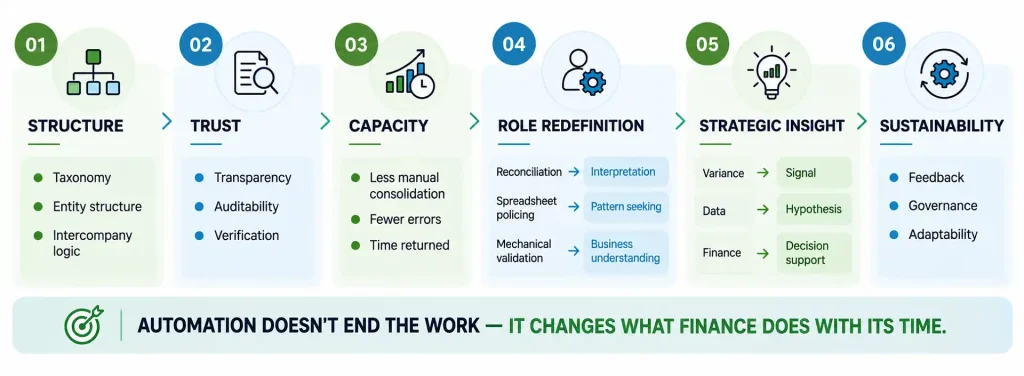
Transparency comes first. Automation cannot operate as a black box. Its logic must remain visible, its rules documented, and its flow auditable. Every journal entry posted by the system should be traceable, and every elimination should carry a note of provenance. Trust does not attach itself to systems, but to clarity, and clarity is what makes the system worth believing.
When controllers and analysts can see how an automated consolidation handles outliers, adjusts for currency, and manages exceptions, they begin to relax into it. Their release from old habits comes from comprehension rather than resignation. In a Euronext Paris-listed gaming company operating across five countries, the shift became visible once the finance team could trace every consolidated figure back to its source entity. The system did not erase their role. It elevated that role.
Allowing Verification Without Fear
Early stages bring double-checking. Reviewers inspect automated outputs, and someone inevitably runs a parallel spreadsheet just to be sure. This is not resistance. It is learning. The CFO should allow this, and even encourage it, as a bridge from habit to confidence. Over time the need fades, but the allowance has to stay in place while the confidence forms.
Redefining Ownership Around Judgment
The most delicate work involves ownership. For years, many people have equated manual control with responsibility. They felt accountable because they physically moved the data. When that movement disappears, their perceived value can seem to disappear with it. The CFO must intervene by helping the team understand that ownership resides in judgment rather than mechanics. The machine consolidates, the human interprets, the machine closes, and the human decides.
This cultural shift does not happen at once. It unfolds through conversation, through acknowledgment of the anxiety beneath resistance, and through recognition that celebrates insight rather than effort alone. Leadership that values precision without perfectionism, and progress without nostalgia, gives the shift room to take hold. When trust is established, the team stops racing to finish. The close becomes quieter and more deliberate, and energy once spent wrestling with systems moves toward questions of signal, deviation, and emerging trends.
Reclaiming Capacity and Redefining Finance Roles
Time returned does not always know where to go. When manual consolidation lifts, late nights of copy-pasting and error-chasing give way to quiet accuracy, and the finance function settles into a stillness it may not have felt in years. Relief alone, however, does not define what transformation should become. The deeper question remains: now that the work finishes faster, what should the team do with the time it gained?
Leaving that question unanswered lets the new capacity dissipate into lighter workloads. A CFO who views automation as a beginning rather than an endpoint treats this moment as an opening. Efficiency without elevation is a hollow victory. The real opportunity lies in reshaping what finance does, shifting energy from input to insight, from assembly to analysis, and from support to strategy.
Role Redefinition and Reskilling
Redefinition starts with the people doing the work. Analysts who once spent weeks preparing reconciliations move into interpretation. Controllers who policed spreadsheets become pattern seekers. Even entry-level staff, long confined to mechanical validation, learn to see the business through the numbers rather than the numbers alone. In a venture-backed digital marketing organization that grew its finance team from one person to twelve, this reskilling became the difference between a team that reported results and a team that shaped decisions. The CFO leads this reskilling as a journey rather than a mandate, opening doors of possibility before changing the titles on those doors.
Reframing Value Beyond Effort
Long hours and visible struggle have often been mistaken for commitment. Many finance teams carry a quiet pride in the heroics of a difficult close. The CFO must gently unwind that mythology by showing that value lives in clarity rather than labor. The most strategic minds are not those who survive the fire drill but those who prevent it altogether.
Creating Forums for Strategic Thinking
New forums support this shift. Weekly synthesis sessions treat variance as signal rather than error. Cross-functional discussions bring hypotheses, not just answers. Reviews expect insight rather than treating it as optional. These rituals send a consistent message that finance no longer keeps the past but studies the present and stewards the future.
Not everyone finds this shift easy. Some team members will struggle to let go of the safety of mechanical tasks, and a nostalgia for tangible effort will persist. The CFO meets that nostalgia with grace, walking the team through the discomfort and showing them that what they are becoming is not less real but more essential.
As roles evolve, perception evolves too. The finance function, once seen as a mirror held to the past, becomes a lens focused on what lies ahead. Questions change. Which trends are emerging in product line margins? What does customer churn reveal about pricing elasticity? And which signals in the data might shape next quarter’s priorities? These are strategic questions, and they show that the team has not merely automated its work. It has ascended.
Sustaining Financial Consolidation Software and Leading Through Evolution
All systems, however elegant at birth, drift toward entropy over time. Integrations fray, business units expand and diverge, and exceptions creep in through the back door, so the clean automation once celebrated begins to flicker under the weight of ungoverned change. The CFO who led the automation must understand this drift as a truth rather than a failure, because the work of automation is never truly finished. It must be sustained, and sustaining it is strategic as well as technical.
Installing Feedback and Governance Rhythms
The first act of maturity is installing feedback, not as complaint but as vigilance. The finance organization becomes both the beneficiary and the caretaker of the automation. That means embedding periodic reviews of the system’s logic, controls, and mappings into the operating rhythm. These reviews are not mere diagnostics. They express respect for the system, recognizing that automation, like every form of abstraction, is only as durable as the thinking that supports it.
In a mission-driven education and research institution, the finance and audit committees expected monthly and annual reporting that tied back to the same logic every period. Consistency of that kind made the periodic reviews meaningful, because each figure was measured against a standard the board already trusted.
Building Adaptability into Design
The business will not stand still. Mergers occur, entities shift, and accounting rules evolve. The system must accommodate change without demanding reinvention. This is the quiet advantage of thoughtful automation. It bends without breaking, welcomes new subsidiaries as configurations rather than crises, and integrates new data sources as expansion rather than exception. That flexibility does not happen by accident. It comes from intentional design.
Sustaining Belief in the System
Beyond governance and adaptability, what sustains the system is belief. Belief that automation amplifies insight rather than abdicating control, that numbers arriving faster can be trusted more deeply, and that freed capacity is a responsibility rather than a luxury must be renewed constantly. That renewal matters most when a variance appears unexplained, when a close runs suspiciously fast, or when someone wonders aloud whether the human touch still matters.
The CFO answers those moments with transparency rather than defensiveness. She shows the audit trail, reviews the rules, and brings clarity to the process and steadiness to the dialogue. In doing so, she sustains the system and reinforces a culture in which finance earns respect for how wisely it thinks rather than how hard it works. Precision becomes a given rather than a grind, and speed becomes readiness rather than recklessness.
That culture radiates outward. Business leaders begin to see finance as the partner that surfaces early truths rather than the department that delivers late numbers. Investors see consistency, boards see reliability, and the team itself takes pride in outcomes rather than hours. Sustaining automation is therefore a leadership act, not a maintenance task. It is the CFO’s ongoing choice to protect what has been built, refine what is still maturing, and extend the benefits beyond the boundary of the department.
Three Key Takeaways
- Financial consolidation automation succeeds only when taxonomy, entity structure, and intercompany logic are settled before the platform goes live, because a fast system built on ambiguity simply replicates confusion at scale.
- Trust in automated outputs grows from transparency, documented logic, and room for verification rather than from claims of efficiency, so the CFO should keep the audit trail visible and treat parallel checks as a natural part of learning.
- The capacity that automation returns must be deliberately redirected toward interpretation, forecasting, and strategy, and the same discipline that maintains the system through feedback and adaptability keeps those gains durable over time.
Disclaimer: This article is intended for informational purposes only and does not constitute legal, tax, or accounting advice. You should consult your own tax advisor or counsel for advice tailored to your specific situation.
Hindol Datta is a four-time CFO and senior finance executive with over 25 years of leadership experience across cybersecurity, SaaS, gaming, logistics, digital marketing, medical devices, consumer products, and nonprofit organizations. He has led more than $120M in fundraising and over $150M in M&A transactions while building the financial and operational systems that let complex businesses scale with confidence. He is the author of seven books in the Systems CFO Series and holds active CPA, CMA, and CIA credentials.
AI-assisted insights, supplemented by 25 years of finance leadership experience.