
Executive Summary
Financial close automation is not about closing the books faster for its own sake. It is about producing numbers that are accurate, controlled, and ready for decisions the moment the close ends. This article explains why financial close automation has become a strategic imperative. It also covers which parts of the close to automate first, how automation strengthens controls, and how a faster close turns into faster strategy.
A close built on manual reconciliation and spreadsheet handoffs creates risk as well as fatigue. Readers will find a practical roadmap covering journal entries, reconciliations, intercompany eliminations, controls, and the shift from reporting history to guiding decisions.
Why Financial Close Automation Is a Strategic Imperative
Stakeholders no longer accept delayed performance insight in a fast-moving market. Business leaders, regulators, and investors expect data that is timely, trustworthy, and actionable. The length of the close cycle has become a proxy for organizational agility. Companies that close quickly and accurately are more confident in their data. They are also more credible in external communication.
From Manual Bottlenecks to Continuous Flow
Typical bottlenecks in a manual close include delayed journal entries and version control problems across spreadsheets. Inconsistent intercompany reconciliations and post-close adjustments also erode confidence. These are risks to reporting accuracy, and not only inefficiencies. Missed filings or earnings surprises driven by avoidable errors damage reputation and valuation.
Financial close automation reduces manual dependencies and minimizes the risk of human error. Data entry becomes data flow, and close activities shift from periodic bursts to continuous processes. Validation checks become embedded rather than retrospective within financial close automation. The close begins to resemble a living system.
The goal of financial close automation is not simply to close faster. A poorly automated close can move quickly and still produce the wrong answer. The real goal is a system where transactions flow into ledgers automatically. Reconciliations flag anomalies in real time, and controls are embedded into the process rather than applied as patches.
At a cybersecurity and identity access management company with $30M in ARR and entities across five countries, an end-to-end NetSuite implementation compressed the monthly close from 18 days to 10. A driver-based forecasting engine built on the same clean data held actuals within plus or minus 5% of forecast for 8 consecutive quarters. At a public gaming and digital entertainment company operating in five countries, a unified ERP and business intelligence platform created one definition of revenue across every subsidiary. Statutory reporting cycles shortened under both IFRS and US GAAP.
Leadership, Not Just Tools
Financial close automation does not displace finance professionals. It shifts their role from data chaser to insight architect. This frees time for variance analysis and forward-looking commentary. The CFO must lead this shift as an architect of process, not only a buyer of software. The transformation cannot be delegated solely to IT.
Automation initiatives also surface the need for broader data governance. No automation can overcome flawed source systems or inconsistent master data.
Targeting the Right Components of Financial Close Automation
Not every part of the close is equally ready for automation. High-volume, repetitive activities governed by defined logic are strong candidates. Judgment calls should stay in human hands instead of moving to software.
High-Value Automation Targets
| Close component | What automation does | Typical benefit |
| Journal entries | Template-driven rules, embedded validation, scheduled postings | More reliable ledgers from day one |
| Account reconciliation | Matches transactions, flags exceptions, routes unresolved items | Effort reduced by up to 80% in mature setups |
| Intercompany eliminations | Real-time elimination logic, automatic rounding adjustments | Fewer delays across legal entities |
| Task management | Real-time dashboards by role, dependency, and due date | Fewer status meetings, better accountability |
| Cross-system validation | RPA bots compare CRM, ERP, and procurement data | Anomalies caught before they reach reports |
Journal entries such as payroll accruals and depreciation often follow standard patterns. They still get built in spreadsheets and uploaded with varying formats. Template-driven automation removes that inconsistency at the source. Account reconciliation is one of the most manual and painful steps in the close. Reconciliation engines create a full audit trail while ensuring no account is missed.
In global enterprises with many legal entities, intercompany eliminations introduce delays. Different local ERPs, currency translations, and unaligned calendars create friction. Automated elimination logic, paired with centralized intercompany netting, also improves treasury efficiency. Robotic process automation is especially valuable where APIs are unavailable. Bots can perform screen-based checks that would otherwise consume entire days.
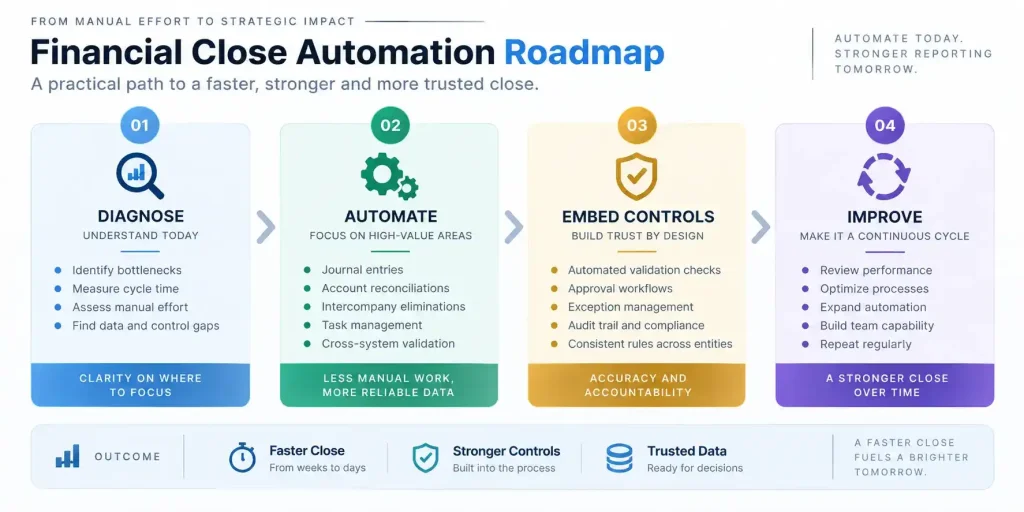
Building a Sequenced Roadmap
- Diagnose first: measure cycle time by component, identify bottlenecks, and quantify manual effort before choosing what to automate.
- Rank by value: a two-week automation of intercompany eliminations may return more than a six-month ERP customization.
- Manage change deliberately: communicate the reason behind each change, train teams, and celebrate early wins to build adoption.
- Review quarterly: financial close automation is a continuous improvement journey, and new opportunities emerge as tools evolve.
At a mission-driven education institution, disciplined monthly and annual reporting gave leadership clear visibility. Audit committee engagement reinforced the same discipline that a sequenced automation roadmap provides in a larger enterprise.
Strengthening Controls and Data Integrity through Financial Close Automation
Speed is the most visible benefit of financial close automation, but its most lasting value is trust. Financial misstatements can trigger shareholder lawsuits and regulatory scrutiny. Books must close accurately, with documented controls and data that reconciles from transaction to financial statement.
Embedding Discipline into Every Entry
Manual journal entries without robust approval workflows are systemic vulnerabilities and not simple inconveniences. Late reconciliations that mask misclassifications carry the same risk. Automated workflows require preparers to select from predefined templates and mandate justification. Entries then route through role-based approval before posting. System rules flag duplicate postings and unusual amounts, and every entry is logged, time-stamped, and permission-tracked.
Automated reconciliations remove the discretionary element from high-volume account matching. Instead of waiting until quarter-end, tools match transactions daily or weekly. They enforce aging and escalation rules for unresolved items. Segregation of duties also strengthens automatically, since role-based access prevents a preparer from later reconciling the same account they posted. This reduces the compliance burden during SOX and other audits.
Data Integrity and Audit Readiness
Automated close tools validate data across ledgers, subledgers, and reporting layers using predefined rules. Fixed asset additions are reconciled against capital expenditure entries. Revenue in a CRM is compared against invoicing data in the ERP, with discrepancies flagged before reporting. This reduces post-close adjustments and the risk of restatements over time.
Automated audit documentation replaces scattered binders of emails, screenshots, and sign-offs. Every close task carries preparer and approver details, and every journal has its backup. Auditors can receive read-only access to test controls independently, which reduces both audit fees and audit fatigue. Dashboards tracking reconciliation completion and error rates surface exceptions in workflow rather than burying them in reports.
From Faster Closes to Smarter Decisions
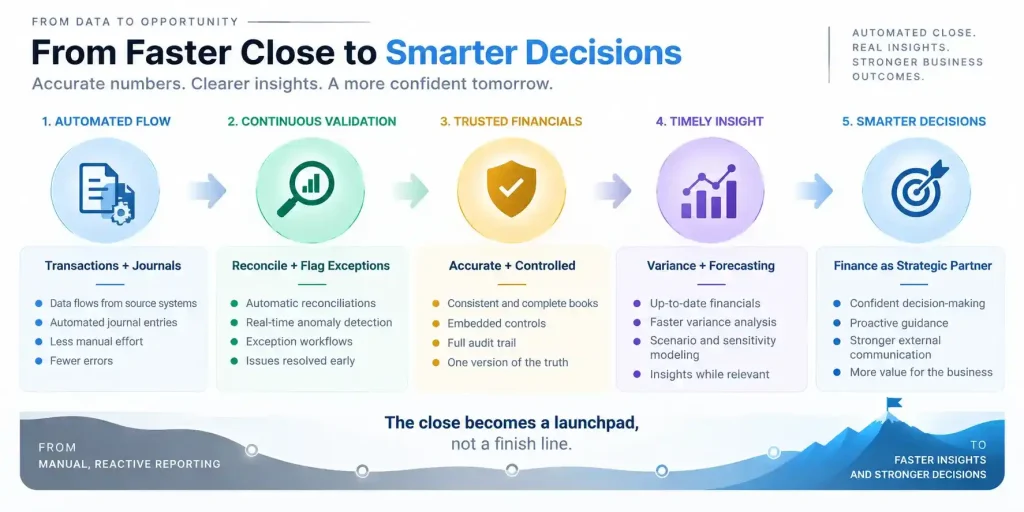
The real measure of financial close automation is not how quickly books are sealed. It is how effectively insights are extracted afterward. Automation is a doorway and not a destination. The organizations that capture its full value use it to move finance from record-keeper to strategist.
Timing and Depth of Insight
Traditional close environments make decision-makers wait days or weeks for validated reports. This delay compresses time for interpretation and causes misalignment with fast-moving decisions. When journal entries post near real time, insight reaches decision-makers while it is still relevant. A regional sales leader can adjust discounting when margin compression shows up in real-time reporting. A COO can reallocate capacity when absorption variances surface within hours.
Financial close automation also deepens the quality of insight. With data clean and structured, finance analysts run variance diagnostics and sensitivity models with more speed. The close becomes a launchpad for forward-looking analysis rather than a finish line. Rolling forecasts become more credible when key drivers such as revenue by channel update continuously instead of locking into quarterly cadences.
Business Partnership and Talent
When the close burden lifts, finance professionals engage business units as counselors instead of compliance enforcers. Sales leaders begin to see finance as a partner who helps win. Operations leaders welcome timely, tailored input from finance as well. Boards and investors also gain a finance function that can explain variance drivers with confidence, because the story is rooted in real-time data.
The cultural effect of financial close automation matters just as much. A finance team freed from manual grind develops data storytelling, business acumen, and digital literacy. This helps the function attract and retain professionals who want to shape strategy rather than chase checklists.
Three Key Takeaways
- Treat financial close automation as a strategic imperative that improves data trust and decision speed, not only a way to close faster.
- Sequence financial close automation by diagnosing bottlenecks first, then targeting journal entries, reconciliations, intercompany eliminations, and task management by value.
- Use the time and confidence that financial close automation creates to strengthen controls, deepen forecasting, and turn finance into a strategic partner.
Disclaimer: This article is intended for informational purposes only and does not constitute legal, tax, or accounting advice. You should consult your own tax advisor or counsel for advice tailored to your specific situation.
Hindol Datta is a four-time CFO and senior finance executive with over 25 years of leadership experience across cybersecurity, SaaS, gaming, logistics, digital marketing, medical devices, consumer products, and nonprofit organizations. He has led more than $120M in fundraising and over $150M in M&A transactions while building the financial and operational systems that let complex businesses scale with confidence. He is the author of seven books in the Systems CFO Series and holds active CPA, CMA, and CIA credentials.
AI-assisted insights, supplemented by 25 years of finance leadership experience.